
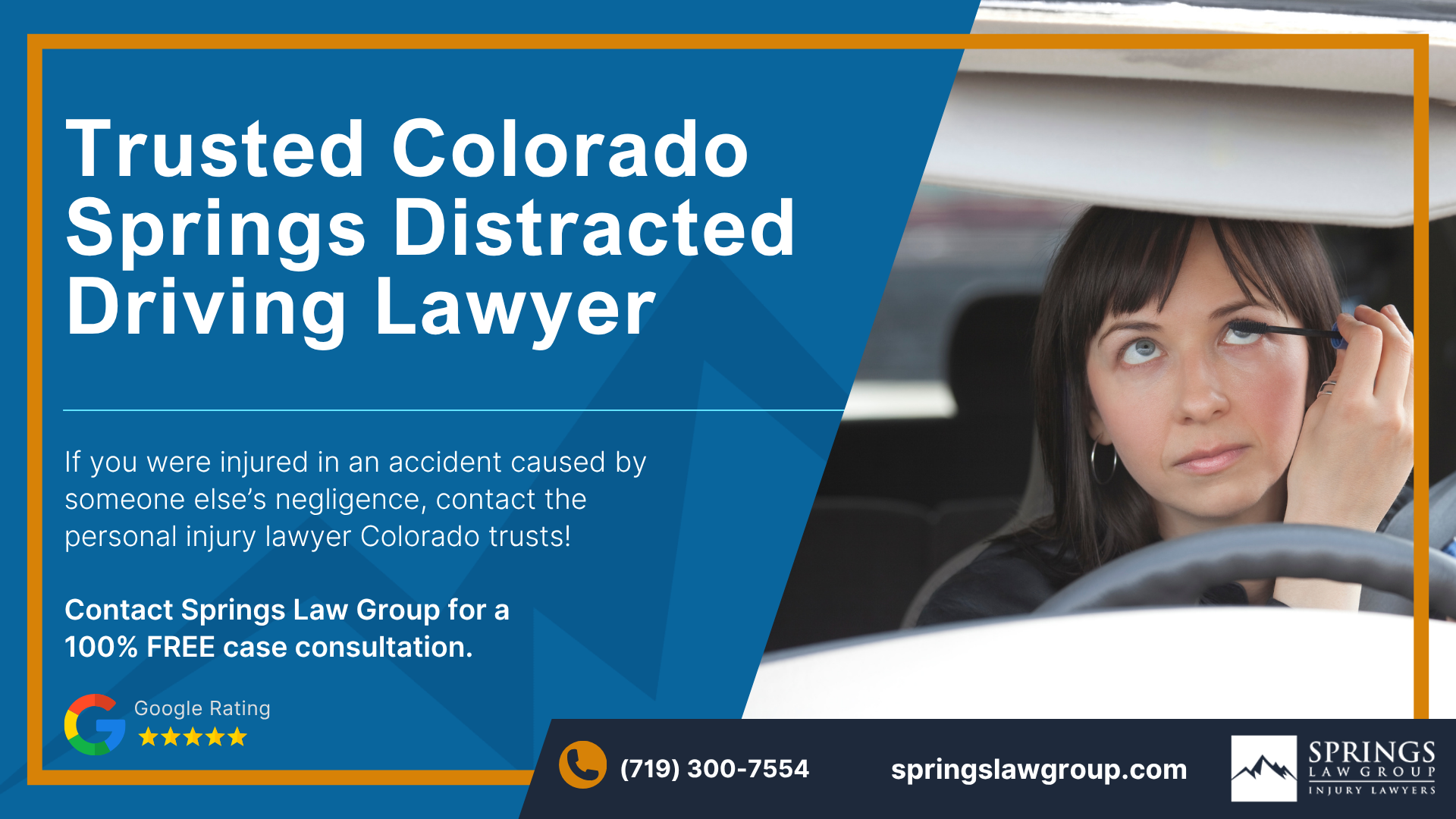
Colorado Springs Distracted Driving Lawyer

Were You or A Loved One Injured in an Accident?
Get Free Answers In as Little as 3 Minutes
right-image
700

Injured in a Distracted Driving Accident? Contact Springs Law Group

A Colorado Springs distracted driving lawyer can help prove what happened, protect key evidence, and push back when insurers try to minimize a crash caused by inattention behind the wheel.

Distracted driving cases often hinge on details that disappear quickly, including phone activity, witness observations, and video footage from nearby cameras.

Insurance companies frequently dispute distraction and shift blame to reduce what they pay, even when the facts point to preventable conduct by the driver who caused the wreck.

This page explains how distracted driving claims work in Colorado, what evidence matters most, and how Springs Law Group can help pursue compensation after a serious collision.

How Distracted Driving Causes Serious Crashes; Colorado Laws on Distracted Driving; Comparative Fault in Distracted Driving Crashes; Common Injuries in Distracted Driving Crashes; How a Distracted Driving Claim Works (Step by Step); Evidence in a Distracted Driving Accident Case; Damages in Distracted Driving Claims; Contact an Attorney for Help Recovering Damages After a Car Wreck in Colorado Springs

A Colorado Springs Distracted Driving Accident Attorney Can Help You Seek Compensation and Justice

Distracted drivers cause car accidents in seconds, often without braking or reacting until impact. A cell phone is one of the most common triggers, because texting and driving forces a driver’s attention off the road and into a screen when the margin for error is already small.

Distracted driving accidents happen in many other ways too, including navigation use, eating, reaching for items, or turning to talk to passengers, all of which divert focus at the worst moment.

For accident victims, the injuries can be immediate and severe, because distracted crashes often involve high speeds, rear-end impacts, or missed right-of-way decisions.

Negligent drivers rarely admit distraction, and insurers often treat that denial as a reason to fight liability or lower the value of a claim.

A strong personal injury claim depends on proving how the distraction occurred and connecting it to the collision through objective evidence and credible timelines.

When that proof is handled correctly, accident victims may be able to recover compensation for medical treatment, lost income, pain, and long-term limitations.

The goal is to build a case that is grounded in facts, not assumptions, so the responsible driver and insurer cannot rewrite what happened.

If you or a loved one were injured in a distracted driving accident in Colorado Springs, Springs Law Group may be able to help you in seeking compensation and justice.

Contact us today for a free consultation.

Use the chat feature on this page to find out if you qualify for a distracted driving accident claim.

Table of Contents

How Distracted Driving Causes Serious Crashes

Distracted driving occurs when a driver’s attention shifts away from the task of operating a motor vehicle, even briefly, and that moment is often enough to cause a high-impact crash.

The CDC breaks distraction into three categories, visual distractions, manual distractions, and cognitive distractions, and many behaviors overlap all three at once.

Texting and driving is a clear example because it pulls a driver’s eyes off the road, hands off the steering wheel, and mind off traffic conditions at the same time.

NHTSA reports that in 2023, 3,275 people were killed and an estimated 324,819 people were injured in crashes involving distracted drivers, a distracted driving statistic that reflects how often “minor” inattention leads to serious injuries.

That same NHTSA research notes distraction-affected crashes accounted for an estimated 13% of injury crashes and 13% of all police-reported crashes in 2023.

Drivers generally underestimate how dangerous a glance can be, but NHTSA warns that sending or reading a text can take your eyes off the road for about five seconds, long enough to travel the length of a football field at highway speed.

Accidents caused by distraction often happen without meaningful braking or evasive steering because the driver’s attention is not on the roadway when hazards develop.

When distracted driving occurs in traffic, it increases the risk of rear-end collisions, missed red lights, failure-to-yield crashes, and roadway departures that produce the worst outcomes.        How Distracted Driving Causes Serious Crashes
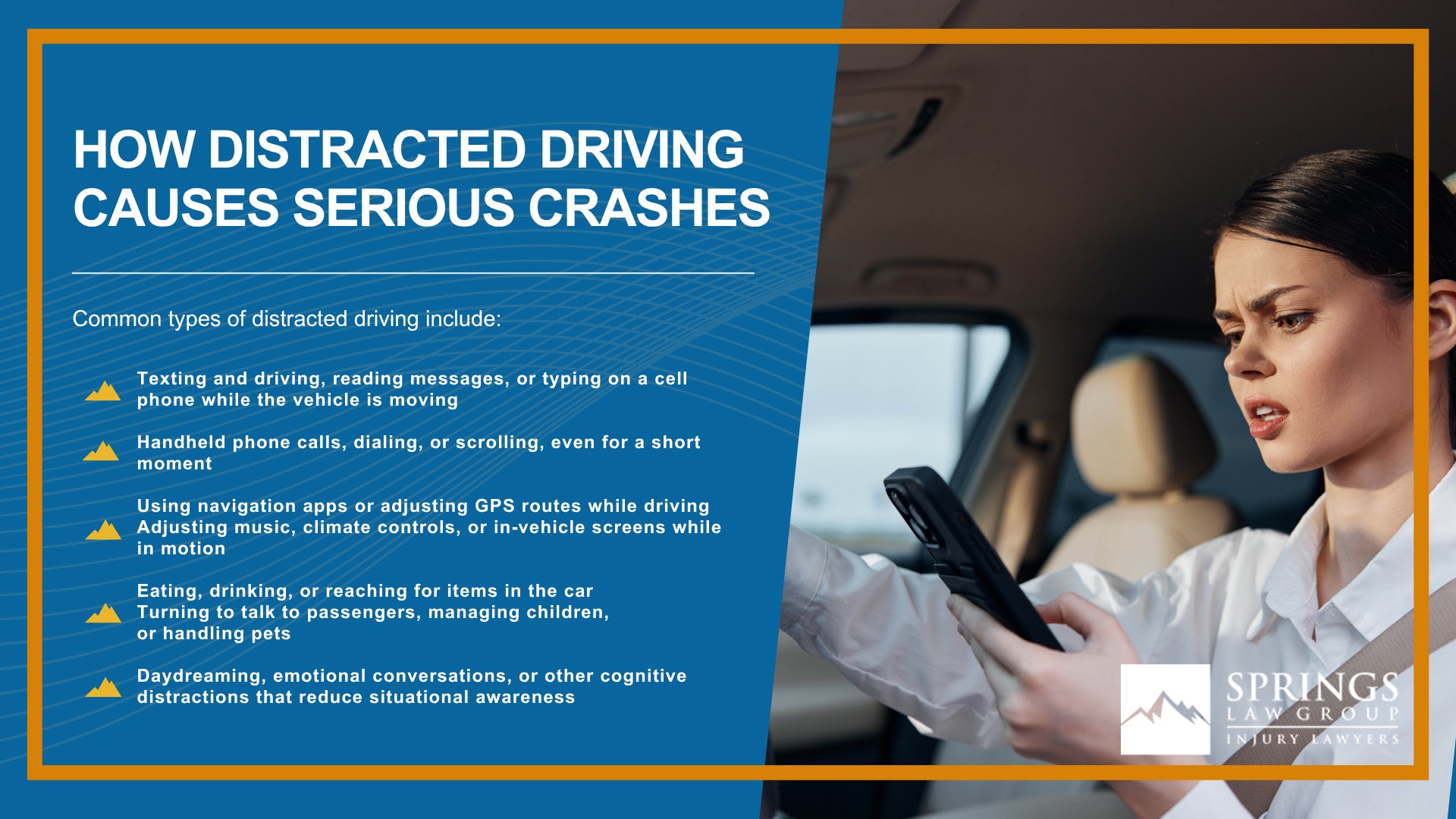
Common types of distracted driving include:

  • Texting and driving, reading messages, or typing on a cell phone while the vehicle is moving
  • Handheld phone calls, dialing, or scrolling, even for a short moment
  • Using navigation apps or adjusting GPS routes while driving
  • Adjusting music, climate controls, or in-vehicle screens while in motion
  • Eating, drinking, or reaching for items in the car
  • Turning to talk to passengers, managing children, or handling pets
  • Daydreaming, emotional conversations, or other cognitive distractions that reduce situational awareness

Colorado Laws on Distracted Driving

Colorado has specific distracted-driving laws that apply to car crashes caused by texting, handheld device use, and other forms of mobile device interaction behind the wheel.

The core statute is C.R.S. § 42-4-239, which addresses the use of a mobile electronic device while driving and sets penalties and exceptions.

Colorado also expanded its restrictions through SB24-065, creating the statewide hands-free framework that took effect January 1, 2025.

In a civil injury case, these rules matter because a violation can support the argument that the driver breached a duty of reasonable care, which helps establish negligence.
How Distracted Driving Causes Serious Crashes; Colorado Laws on Distracted Driving

Colorado distracted-driving laws and rules include:

  • C.R.S. § 42-4-239: Restricts use of a mobile electronic device while driving and defines key terms, penalties, and exceptions.
  • Texting and manual data entry ban: Prohibits text messaging and similar manual data entry or transmission while operating a motor vehicle.
  • Colorado Hands-Free Law effective Jan. 1, 2025 (SB24-065): Prohibits using a mobile electronic device while driving unless the driver uses a hands-free accessory, such as Bluetooth or a mounted device.
  • Emergency exceptions: Provides exceptions for emergencies and contacting public safety entities under defined circumstances.

Comparative Fault in Distracted Driving Crashes

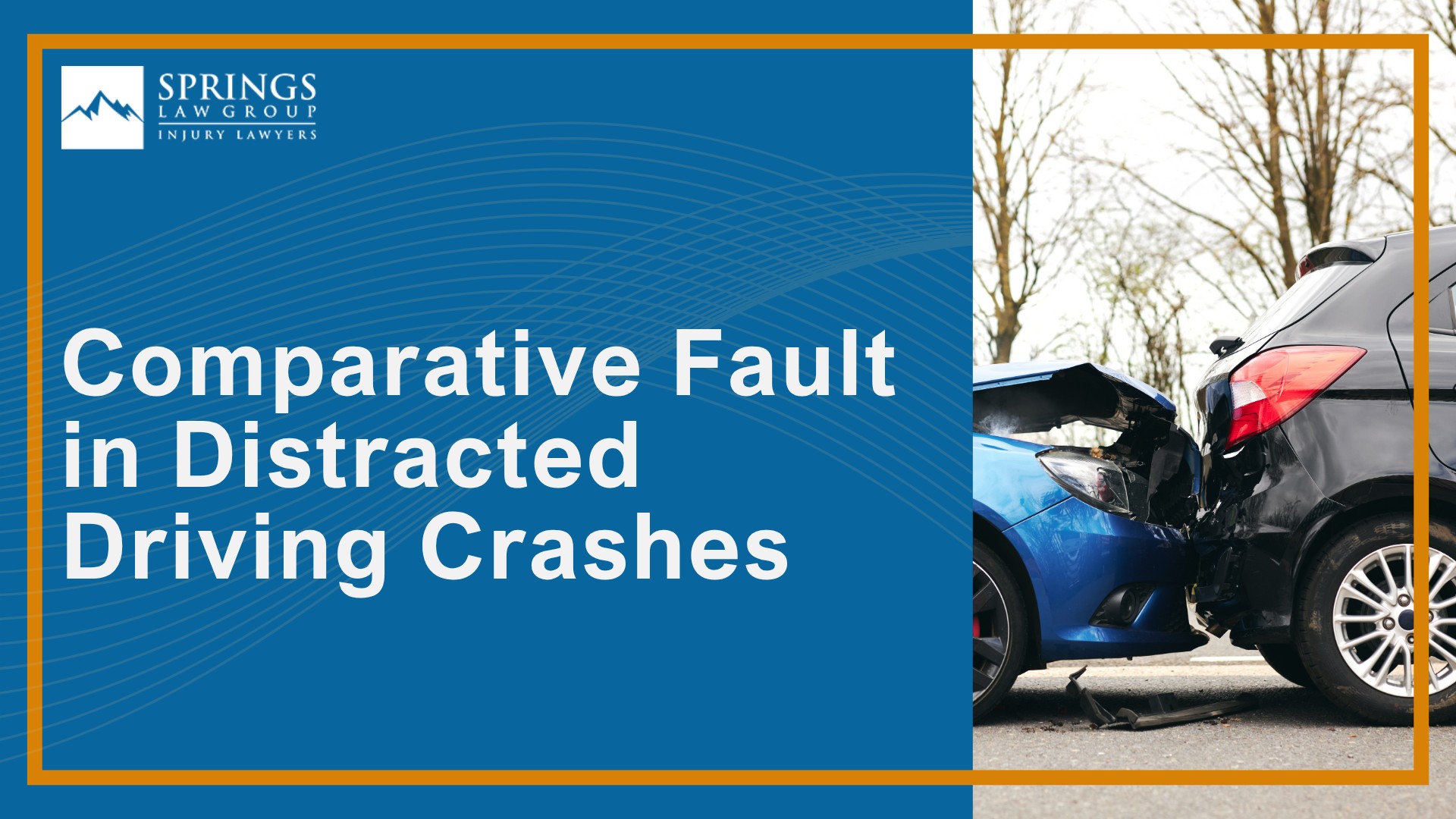
Comparative fault matters in any accident involving a distracted driver because insurers rarely accept full responsibility without pushing blame back onto the injured person.

Even when distraction seems obvious, the other side may argue the injured driver was speeding, following too closely, or failed to react in time, then use those claims to reduce financial compensation.

Colorado’s modified comparative negligence rule makes those arguments meaningful because percentage allocations can reduce an award or bar recovery at the cutoff.
How Distracted Driving Causes Serious Crashes; Colorado Laws on Distracted Driving; Comparative Fault in Distracted Driving Crashes

A car accident lawyer addresses this by rebuilding the timeline with objective proof, including vehicle damage patterns, scene evidence, witness accounts, and any available video.

When distraction is disputed, the focus shifts to what the distracted driver did not do, such as braking, yielding, or maintaining lane position, and whether the evidence supports that failure.

The goal is to keep the fault analysis tied to provable facts so the case value reflects the conduct that actually caused the crash.

Common Injuries in Distracted Driving Crashes

Distracted driving crashes often happen without a meaningful attempt to brake or steer away because the driver does not recognize the hazard until impact.

Rear-end collisions are common, especially in stop-and-go traffic, because a distracted driver fails to notice slowing vehicles ahead.

Intersection crashes are also frequent when a driver misses a red light, stop sign, or a vehicle with the right of way while looking down at a phone or screen.

Lane-departure and sideswipe collisions can occur when a driver drifts across lines, clips another vehicle, or leaves the roadway entirely.

Head-on impacts can result when a driver crosses the center line, and these collisions often produce catastrophic injuries because of the combined force.

Distracted driving can also lead to multi-vehicle pileups when a driver triggers a chain reaction and multiple impacts occur in seconds.

These crash patterns tend to cause high-energy trauma, which increases the risk of traumatic brain injuries, spinal cord injuries, and broken bones.
How Distracted Driving Causes Serious Crashes; Colorado Laws on Distracted Driving; Comparative Fault in Distracted Driving Crashes; Common Injuries in Distracted Driving Crashes

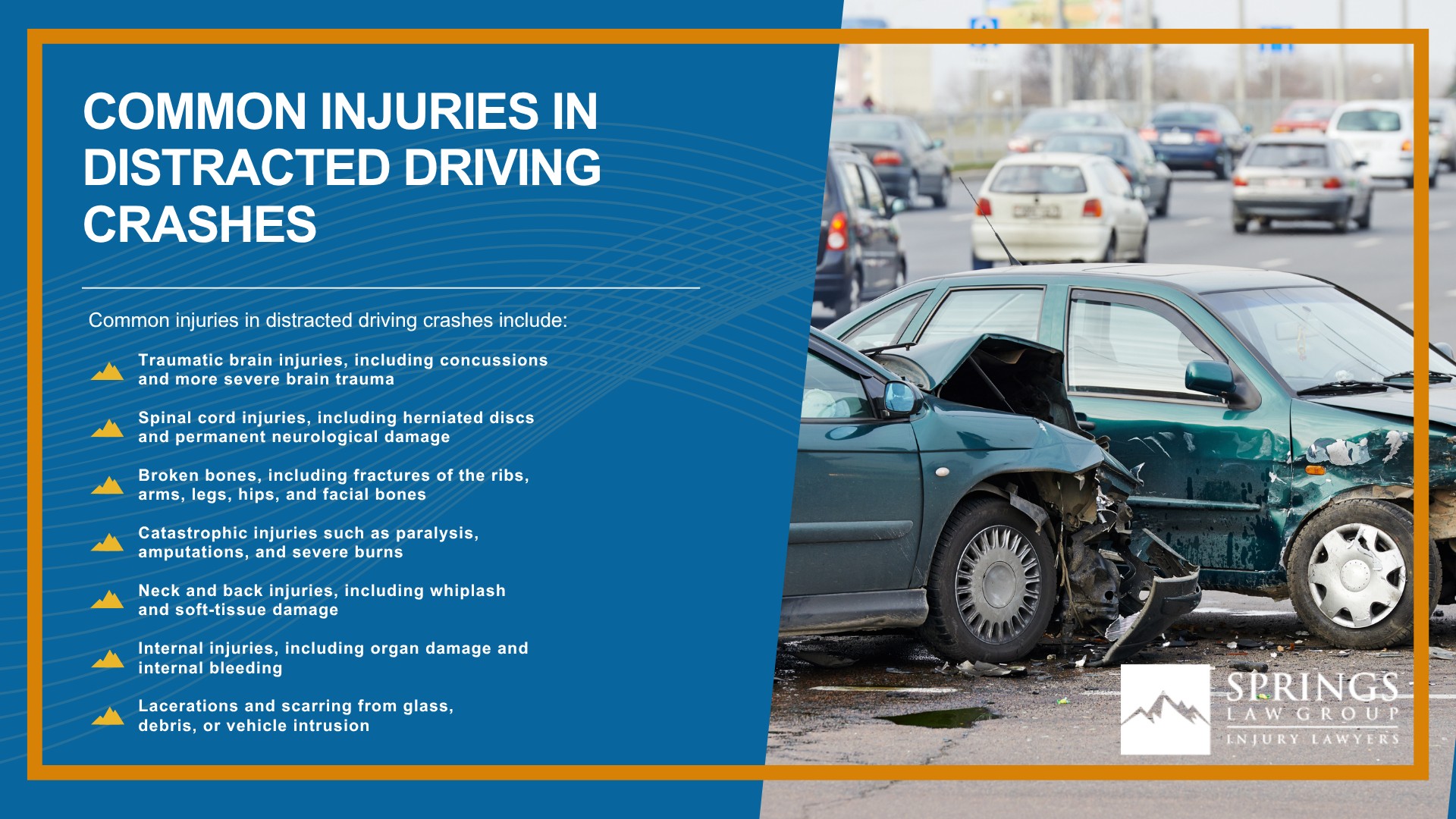
Common injuries in distracted driving crashes include:

  • Traumatic brain injuries, including concussions and more severe brain trauma
  • Spinal cord injuries, including herniated discs and permanent neurological damage
  • Broken bones, including fractures of the ribs, arms, legs, hips, and facial bones
  • Catastrophic injuries such as paralysis, amputations, and severe burns
  • Neck and back injuries, including whiplash and soft-tissue damage
  • Internal injuries, including organ damage and internal bleeding
  • Lacerations and scarring from glass, debris, or vehicle intrusion

How a Distracted Driving Claim Works (Step by Step)

A distracted driving claim is built to show that the crash happened because the driver chose an extremely dangerous distraction instead of watching the road.

Distracted driving attorneys start by preserving evidence from the crash scene and identifying what proof may exist beyond the police report.

Proving negligence often depends on showing what the driver was doing in the moments before impact and how that conduct caused the collision.

That can include investigating the driver’s cell phone use, locating video footage, and locking in witness accounts before memories fade.

The claim then moves into a structured demand and negotiation phase with the other driver’s insurance company, which often disputes distraction or tries to shift partial fault.

When a fair resolution is not offered, personal injury law provides a path to file suit and push the case forward so the at-fault driver can be held accountable.
How Distracted Driving Causes Serious Crashes; Colorado Laws on Distracted Driving; Comparative Fault in Distracted Driving Crashes; Common Injuries in Distracted Driving Crashes; How a Distracted Driving Claim Works (Step by Step)

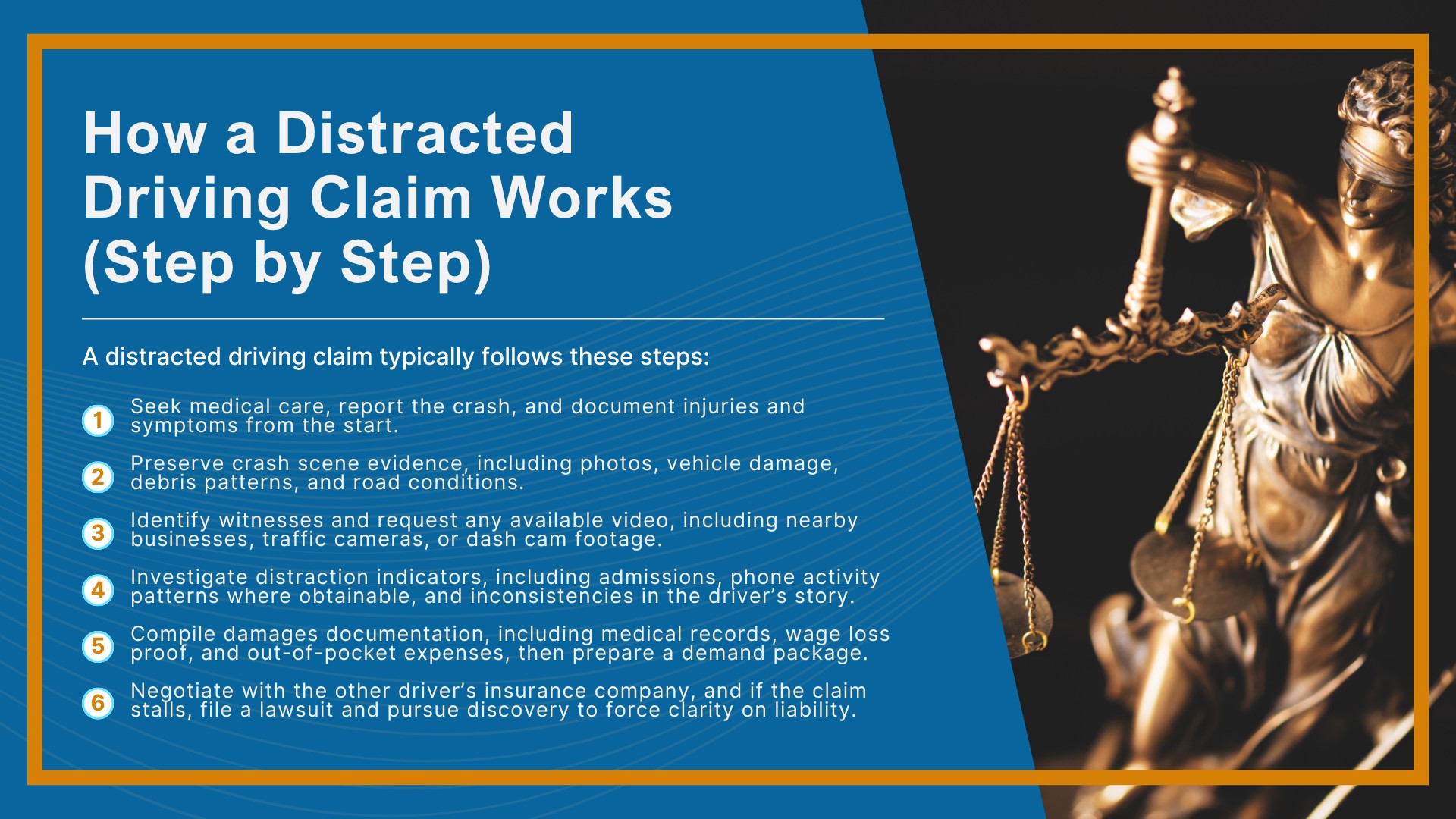
A distracted driving claim typically follows these steps:

  1. Seek medical care, report the crash, and document injuries and symptoms from the start.
  2. Preserve crash scene evidence, including photos, vehicle damage, debris patterns, and road conditions.
  3. Identify witnesses and request any available video, including nearby businesses, traffic cameras, or dash cam footage.
  4. Investigate distraction indicators, including admissions, phone activity patterns where obtainable, and inconsistencies in the driver’s story.
  5. Compile damages documentation, including medical records, wage loss proof, and out-of-pocket expenses, then prepare a demand package.
  6. Negotiate with the other driver’s insurance company, and if the claim stalls, file a lawsuit and pursue discovery to force clarity on liability.

A strong claim stays focused on causation, what the distracted driver failed to see, and what a reasonably attentive driver would have done in the same situation.

Insurers often frame distraction as unprovable, so early evidence preservation and a clean timeline matter.

When litigation becomes necessary, formal discovery can expose facts that were not available during the claim phase.

The goal is to present a complete, evidence-driven case that supports full damages and a settlement position that reflects the true impact of the crash.

Evidence in a Distracted Driving Accident Case

Proving driver distraction often comes down to building a record that shows what the driver was doing in the moments before impact, not just what they claim after the fact.

Accident reports can provide a starting point, but they rarely capture the full picture of what caused the crash.

The strongest cases pull objective proof that ties driver distraction to the collision, whether the at-fault driver was an adult driver commuting to work or a teen driver still developing safe habits behind the wheel.

That evidence is what allows a claim to move from suspicion to holding negligent drivers accountable.
How Distracted Driving Causes Serious Crashes; Colorado Laws on Distracted Driving; Comparative Fault in Distracted Driving Crashes; Common Injuries in Distracted Driving Crashes; How a Distracted Driving Claim Works (Step by Step); Evidence in a Distracted Driving Accident Case

Evidence in a distracted driving accident case often includes:

  • Accident reports, including diagram narratives, citations, and witness references
  • Traffic camera footage, dash cam video, doorbell cameras, and surveillance from nearby businesses
  • Cell phone records and usage data, when obtainable through the legal process, to evaluate activity around the time of the crash
  • Witness statements describing phone use, eyes down, drifting lanes, delayed braking, or other distraction cues
  • Vehicle damage patterns and crash reconstruction findings that match inattention, such as no braking or late evasive action
  • Admissions by the driver, social media activity, or messages that suggest distraction before or during the drive

Damages in Distracted Driving Claims

Damages are the monetary amounts a person seeks to recover for losses caused by a distracted driving crash, based on proof and how the injury affects daily life.

Medical expenses like hospital bills, follow-up care, and physical therapy often form the baseline, but the claim should also account for income loss and the personal impact of the injury.

A law firm helps assess and calculate damages by organizing records, verifying costs, projecting future needs when supported by medical opinion, and presenting a clear narrative that connects each loss to the crash.

That work supports fair compensation and allows the claim to reflect both financial losses and the real disruption the injury caused.
How Distracted Driving Causes Serious Crashes; Colorado Laws on Distracted Driving; Comparative Fault in Distracted Driving Crashes; Common Injuries in Distracted Driving Crashes; How a Distracted Driving Claim Works (Step by Step); Evidence in a Distracted Driving Accident Case; Damages in Distracted Driving Claims

Damages in distracted driving claims often include:

  • Medical bills and hospital bills for emergency care, imaging, surgery, and specialist treatment
  • Ongoing medical expenses, including physical therapy, prescriptions, and follow-up appointments
  • Lost wages from missed work, reduced hours, or inability to return to the same job
  • Reduced earning capacity when injuries limit long-term work ability
  • Pain and suffering tied to physical discomfort, limitations, and the recovery timeline
  • Emotional distress, including anxiety, sleep disruption, and fear of driving after the crash
  • Out-of-pocket expenses related to treatment and recovery, such as transportation and home assistance
  • Property damage and loss-of-use costs, including repair or replacement of the vehicle and rental expenses

Springs Law Group: Hire a Distracted Driving Accident Lawyer

Distracted driving crashes often leave injured people facing medical bills, lost income, and an insurance process that feels stacked against them.

Springs Law Group focuses on building evidence-driven cases that hold distracted drivers responsible and present damages in a way the legal system recognizes and respects.

That approach allows the firm to challenge blame-shifting tactics and push claims forward based on facts, not assumptions.
How Distracted Driving Causes Serious Crashes; Colorado Laws on Distracted Driving; Comparative Fault in Distracted Driving Crashes; Common Injuries in Distracted Driving Crashes; How a Distracted Driving Claim Works (Step by Step); Evidence in a Distracted Driving Accident Case; Damages in Distracted Driving Claims; Contact an Attorney for Help Recovering Damages After a Car Wreck in Colorado Springs

If you were injured by a distracted driver and want clear guidance on your options, contact Springs Law Group to schedule a free legal consultation and discuss the next steps available under Colorado law.


Frequently Asked Questions

Written By:
Picture of Christopher Nicolaysen
Christopher Nicolaysen

Member of the Colorado Bar Association since 2014. Attorney, Christopher M. Nicolaysen focuses primarily on helping those injured in Colorado car accidents, other auto accidents, and Colorado personal injury incidents.

This article has been written and reviewed for legal accuracy and clarity by the team of writers and attorneys at Springs Law Group and is as accurate as possible. This content should not be taken as legal advice from an attorney. If you would like to learn more about our owner and experienced Colorado personal injury lawyer, Christopher Nicolaysen, you can do so here.

Springs Law Group does everything possible to make sure the information in this article is up to date and accurate. If you need specific legal advice about your case, contact us. This article should not be taken as advice from an attorney.

Do You
Have A Case?
No out of pocket costs.
We only collect a fee AFTER you win your case and receive full compensation.
Contact our team today to discuss your case for free & Get answers in as little as 3 minutes.
Would you like our help?
right-image
700
About Springs Law Group
The lawyers at Springs Law Group have experience handling diverse personal injury cases with empathy and understanding.
We recognize the delicate nature of these claims and tailor strategies to meet your unique requirements, focusing on smart — not emotional — strategies.
Our team is committed to building long-lasting, trust-based client relationships.
We believe this approach helps ensure that choosing us means partnering with a firm that genuinely values you as a person — not just another client.
Recent Posts
Do You
Have A Case?
No out of pocket costs.
We only collect a fee AFTER you win your case and receive full compensation.
Contact our team today to discuss your case for free & Get answers in as little as 3 minutes.
Would you like our help?
right-image
700

Personal Injury Lawyers in Colorado Springs, Colorado

Local Colorado Springs Resources

Education
Emergency Services
Courthouses
Department of Motor Vehicles
Community & History

Leave Us A Review

We use reviews to help show more people like you why we do what we do!

Personal injury victims represented by a lawyer recover up to 3x more.

Our Process

1
Investigation
Gather evidence. Get police reports. Obtain insurance policies.
2
Treatment
You focus on healing. We help guide you through the process.
3
Medical Records
Get the records we need to make sure you have a strong case.
4
Demand Prep
Prepare and send our demands to the insurance company.
5
Negotiation
Negotiate with the insurance company for max compensation.
6
Settlement
Reach a settlement offer you agree with or we file a lawsuit.
7
Litigation
If we have to go to court, our trial lawyers get ready to win.

Videos

Our Team

Personal Injury Lawyers in Colorado Springs, CO