
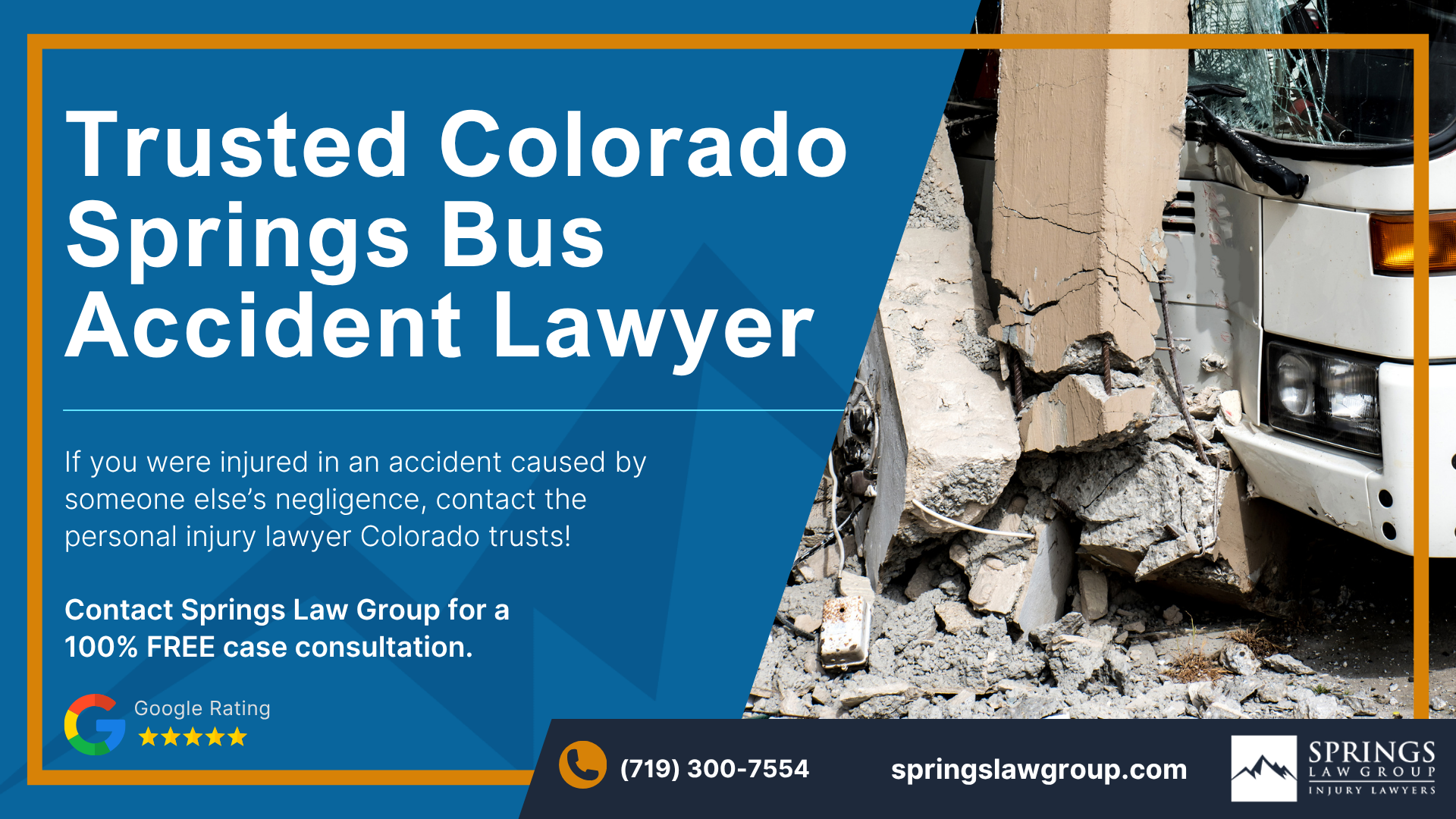
A bus accident claim in Colorado Springs can involve more than a collision between two vehicles.
These cases may involve city buses, school buses, charter or tour buses, shuttle services, paratransit vehicles, private transportation companies, government entities, contractors, and other vehicles involved in the accident.
Bus accident victims can include passengers, pedestrians, bicyclists, drivers, and occupants of other vehicles.
The legal process can depend on who owned and operated the bus, whether the driver was working at the time, whether a public entity or private company was involved, and what evidence establishes who was at fault.
A Colorado Springs bus accident lawyer can investigate those issues, identify potentially responsible parties, and evaluate the compensation that may be available when negligence causes injuries.
Mountain Metropolitan Transit, commonly called Mountain Metro, provides fixed-route public transportation in Colorado Springs and surrounding areas.
Because Mountain Metro is part of the City of Colorado Springs transit system, an accident involving one of its buses can raise legal issues that differ from a claim involving a privately operated vehicle.
A Mountain Metro accident may involve a collision with another vehicle, a pedestrian or bicyclist crash, unsafe braking or turning, or injured passengers inside the bus.
A claim involving a Mountain Metro bus may require review of:
When a public entity may be responsible, the Colorado Governmental Immunity Act can affect whether and how the claim may proceed.
Colorado law recognizes certain waivers of governmental immunity, including qualifying injuries resulting from the operation of a public entity’s motor vehicle, but the injured person must still establish negligence, causation, and damages.
Mountain Metro Mobility is Colorado Springs’ ADA complementary paratransit service for eligible riders whose disabilities prevent them from using fixed-route transit some or all of the time.
The service transports passengers who may rely on wheelchairs, other mobility devices, vehicle securement systems, or assistance during boarding and exiting.
Paratransit injury claims can involve more than collisions with other vehicles.
Injured passengers may suffer harm during boarding, unloading, wheelchair securement, sudden braking, unsafe transfers, or other transportation-related incidents.
Mountain Metro Mobility claims may involve:
Depending on the circumstances, responsibility may involve a public entity, driver, contractor, another motorist, or another party whose conduct contributed to the injury.
Springs Law Group can investigate who operated the vehicle, what duties applied, and which parties may be legally responsible.
Bus passengers can suffer serious injuries even when the bus is not involved in a major collision.
Sudden braking, unsafe acceleration, sharp turns, falls inside the vehicle, unsafe boarding or exiting conditions, and collisions with other vehicles can all result in a passenger injury claim when negligence contributed to the incident.
Colorado law can impose a heightened duty of care on common carriers toward their passengers.
Courts have described this duty as requiring the highest degree of care consistent with the practical operation of the transportation service.
Whether that standard applies can depend on the type of transportation provider and the circumstances of the injury.
A bus passenger injury claim may involve:
A passenger does not necessarily have to prove that the bus collided with another vehicle to have a claim.
The relevant questions can include whether the driver or operator acted negligently, whether the transportation provider failed to meet an applicable duty of care, and whether that conduct caused the passenger’s injuries.
Springs Law Group can investigate onboard video, driver and transit records, witness statements, maintenance information, medical records, and other evidence to determine how the injury occurred and which parties may be legally responsible.
Pedestrians and cyclists are especially vulnerable when a bus is involved in a collision because of the vehicle’s size, weight, turning radius, and blind spots.
These crashes may occur in crosswalks, near bus stops, during right or left turns, in bike lanes, or when a bus changes lanes or fails to yield.
Liability can depend on whether the bus driver was distracted, speeding, operating in a blind spot, making an unsafe turn, or otherwise failing to exercise reasonable care.
Road design, visibility, traffic signals, and the conduct of other drivers can also affect the analysis.
Pedestrian and cyclist bus accidents can cause broken bones, traumatic brain injuries, spinal injuries, internal injuries, and other serious harm.
Springs Law Group can review the accident scene, police report, witness statements, available video, and traffic conditions to determine how the collision occurred and which parties may be legally responsible.
A bus accident may also involve a driver or passenger in another vehicle.
A bus can cause a car accident by rear-ending traffic, changing lanes unsafely, running a red light, failing to yield, or turning across another vehicle’s path.
Because buses are large vehicles, even a lower-speed crash can cause significant vehicle damage and personal injury.
A person in another car may suffer whiplash, back injuries, broken bones, head injuries, or other bus accident injuries.
When a bus or transit vehicle causes a crash, the claim may involve the bus driver, the entity that owns the bus, a maintenance contractor, another negligent driver, or more than one insurance company.
School buses, charter buses, tour buses, and shuttle buses raise their own legal issues.
A school bus accident may involve public school districts, private transportation contractors, students, parents, and government notice rules.
A charter bus or tour bus accident may involve a private bus company, commercial insurance, driver logs, maintenance records, and company safety policies.
These claims may involve:
If a loved one was hurt on a school bus, tour bus, charter bus, or shuttle, Springs Law Group can investigate the incident and determine which parties may be legally responsible.
Bus accidents can result from negligent driving, mechanical problems, inadequate maintenance, unsafe operating practices, hazardous road conditions, or the conduct of other motorists.
Determining the cause is important because it can help identify which driver, company, government entity, contractor, or other party may be legally responsible.
Common contributing factors may include:
A bus accident attorney can investigate driver records, onboard video, maintenance and inspection records, witness statements, crash reports, and other evidence to determine how the accident occurred and which parties may be responsible.
Bus accidents can cause injuries ranging from relatively minor soft tissue trauma to permanent and life-changing conditions.
Passengers may be thrown from their seats, fall while standing, strike interior surfaces, or suffer direct impact during a collision, while pedestrians, cyclists, and occupants of other vehicles may face particularly severe injuries because of the size and weight of a bus.
Common bus accident injuries may include:
Injury victims may require emergency treatment, surgery, rehabilitation, physical therapy, future medical care, and long-term treatment.
Medical professionals may also need to evaluate whether an injury is expected to cause permanent limitations or require continuing care.
Springs Law Group’s legal team can gather medical records, treatment plans, expert opinions, and other evidence to document the full effect of the injuries when pursuing compensation.
Liability for a Colorado Springs bus accident depends on how the accident occurred, who operated and controlled the bus, and whether another person or company contributed to the injuries.
More than one party may be legally responsible when several acts of negligence combine to cause the accident.
Potentially liable parties may include:
Liability is not established merely because a person or business owned the bus, employed someone involved in the accident, or was connected to the location where the injury occurred.
The evidence must establish a legal basis for holding that party responsible and connect the negligent conduct to the injuries and damages.
Claims involving public buses can follow different rules than claims against private drivers or transportation companies.
If Mountain Metropolitan Transit, a public school district, or another government entity may be responsible, the Colorado Governmental Immunity Act can affect whether and how the claim may proceed.
Colorado law recognizes certain exceptions to governmental immunity, including qualifying injuries arising from the operation of a public motor vehicle by a public employee acting within the scope of employment.
That waiver does not automatically establish negligence, so the injured person must still prove fault, causation, and damages.
Public bus claims may also require compliance with special notice requirements before a lawsuit can move forward.
Identifying the correct public entity, driver, contractor, or other responsible party can therefore be an important early step in the case.
The Colorado Governmental Immunity Act may affect bus accident claims involving government agencies or public employees.
Government immunity can limit when and how a public entity may be sued, but Colorado law includes certain waivers, including for injuries involving the operation of a public motor vehicle in some circumstances.
A bus accident claim involving a government entity may require analysis of:
Because these cases can be technical, injured individuals should speak with a bus accident lawyer as soon as possible after the incident.
When a bus accident claim involves a Colorado public entity or public employee, the Colorado Governmental Immunity Act generally requires written notice within 182 days after the injured person discovers the injury.
This notice requirement can apply well before the deadline for filing the personal injury lawsuit itself.
The notice must provide required information about the claimant, the circumstances of the injury, the public employees involved when known, the nature and extent of the injury, and the damages being claimed.
Identifying the correct government entity and providing notice to the proper recipient are important because failure to comply with the CGIA can prevent the claim from proceeding.
In 2026, the Colorado Supreme Court reaffirmed in Mostellar v. City of Colorado Springs that the 182-day period generally runs from discovery of the injury rather than from the later discovery of which public entity may be responsible.
Anyone injured in an accident involving a public bus, school bus, or other government-operated vehicle should therefore have the notice requirements evaluated promptly.
Evidence can help establish how a bus accident occurred, who may be legally responsible, and how the injuries affected the person involved.
Because onboard video, transit records, electronic data, and other evidence may be overwritten or lost, important records should be identified and preserved as early as possible.
Depending on the type of bus and accident, useful evidence may include:
Claims involving public transportation may also require records showing which government entity, contractor, or agency owned and operated the bus.
Springs Law Group can investigate the accident, preserve available evidence, and identify the parties whose conduct may have contributed to the crash.
If you suffered injuries in a bus accident, your health and safety should come first.
Some injuries may not be immediately apparent, so obtaining appropriate medical care and documenting what happened can be important both for your recovery and any later legal claim.
After a Colorado Springs bus accident, consider taking these steps:
Compensation in a bus accident case depends on the injuries, evidence, liability, insurance coverage, and long-term impact on the injured person’s life.
The goal is to pursue compensation that reflects the harm caused by someone else’s negligence.
Compensation may include:
Springs Law Group works to pursue fair compensation and the full compensation available under Colorado law.
While no attorney can promise maximum compensation or guarantee a result, the firm can build the strongest claim the evidence supports.
The deadline for a Colorado bus accident claim depends on how the injury occurred, the type of legal claim, and whether a private company or government entity is involved.
Colorado generally provides a three-year statute of limitations for bodily injury and property damage claims arising from the use or operation of a motor vehicle.
That deadline may apply to many bus crashes involving collisions, negligent driving, or other injuries arising from the operation of the bus.
Not every bus-related injury necessarily falls under the three-year motor vehicle rule.
Claims involving unsafe property conditions, boarding areas, defective products, or other forms of negligence may be subject to different deadlines, and Colorado generally provides a two-year limitations period for many other negligence and wrongful death claims.
Claims involving a public bus, public school district, or other government entity may also be subject to the Colorado Governmental Immunity Act.
When the CGIA applies, written notice generally must be provided within 182 days after discovery of the injury, which can be much earlier than the deadline for filing the lawsuit itself.
In 2026, the Colorado Supreme Court reaffirmed that the 182-day CGIA notice period generally begins when the injury is discovered rather than when the injured person later determines which public entity may be responsible.
Because several deadlines can potentially apply to the same incident, Springs Law Group can review how the accident occurred, identify the bus operator and potentially responsible parties, and determine which notice and filing requirements may apply.
A bus accident can leave an injured person facing medical treatment, lost income, future care needs, and questions about which driver, company, contractor, or government entity may be responsible.
Claims involving public buses, school buses, charter buses, paratransit vehicles, and private transportation companies can also involve different insurance, liability, and filing requirements.
Springs Law Group can investigate how the accident occurred, preserve important evidence, identify potentially responsible parties, and determine whether Colorado government notice rules or other special procedures may apply.
Our attorneys can also document medical expenses, lost wages, future treatment needs, pain and suffering, and other damages supported by the evidence.
Springs Law Group handles qualifying personal injury cases on a contingency fee basis, subject to the written fee agreement.

If you or a loved one was injured in a Colorado Springs bus accident, contact Springs Law Group for a free consultation or use the chat feature on this page.
Our attorneys can review the circumstances of the accident and explain the legal options that may be available.