
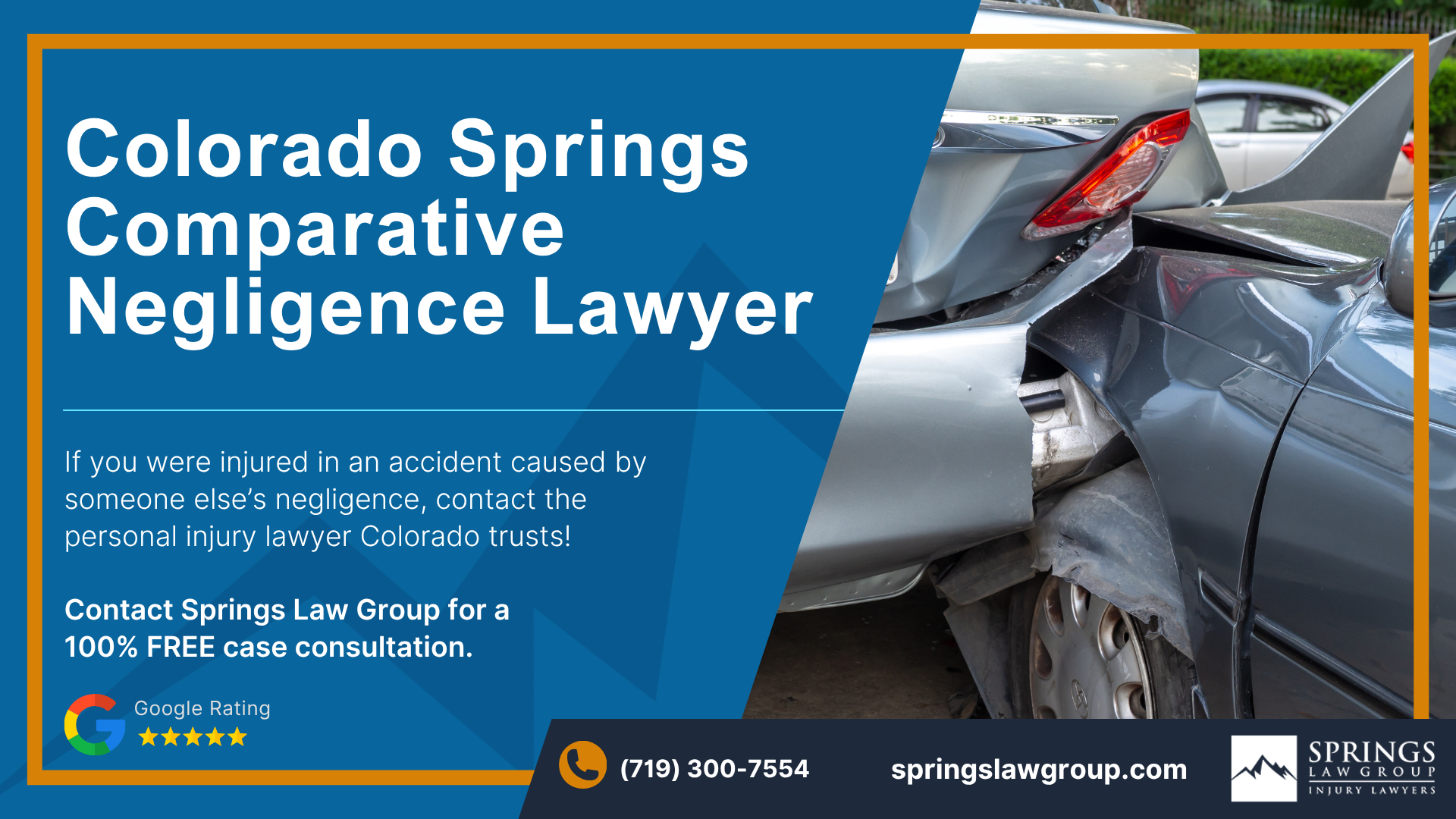
Comparative negligence refers to a legal principle that divides responsibility between the involved parties based on how much each contributed to the incident.
Colorado is a modified comparative negligence state, not a pure comparative negligence state, which means different rules apply once the plaintiff’s percentage of fault reaches a certain threshold.
Under C.R.S. § 13-21-111, an injured person may seek compensation even if they share some blame, but only so long as their negligence “was not as great as” the negligence of the person or people they are suing.
In practical terms, Colorado’s comparative negligence laws mean you can still recover damages in many personal injury cases if you are less than 50% at fault, and your award is reduced by your share of fault (for example, a 20% at-fault finding reduces a $100,000 verdict to $80,000).
If the plaintiff’s fault is equal to or greater than the combined fault of the defendant or defendants, however, Colorado law bars any recovery, which is why this is sometimes called the “50% bar” rule.
By contrast, in states that follow pure comparative negligence, an injured party can technically recover even if they are 90% or 99% at fault, with their recovery reduced by that percentage.
Colorado’s approach is meant to strike a middle ground: it allows an injured party to seek compensation when someone else was more at fault, while preventing recovery when the plaintiff’s own negligence is at least as great as that of the defendant.
In most personal injury claims, this turns into a fight over numbers, because shifting the plaintiff’s percentage of fault from 49% to 50% flips the outcome from reduced recovery to no recovery at all.
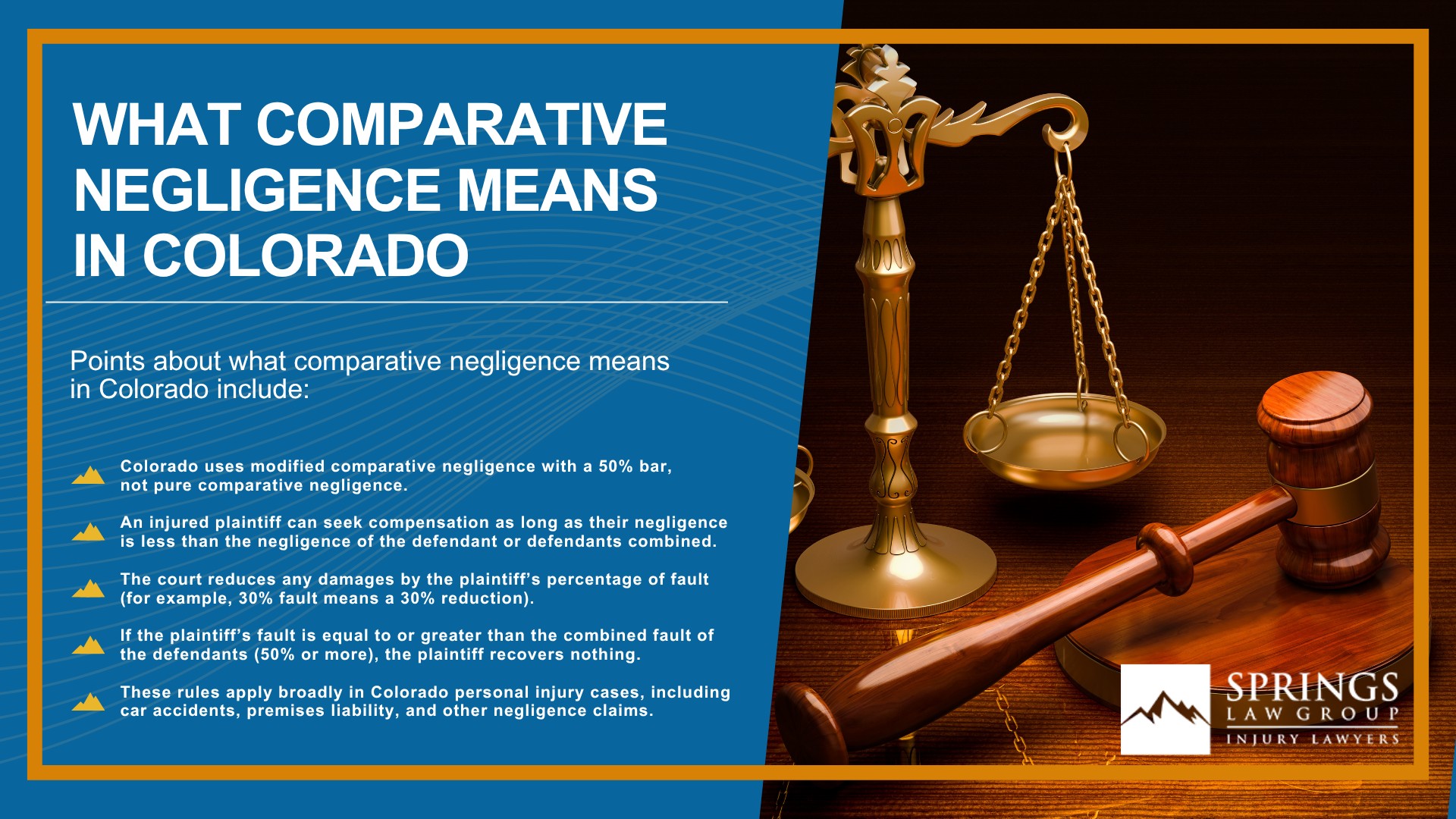
Points about what comparative negligence means in Colorado include:
Because of this framework, comparative negligence laws in Colorado make the percentage of fault a central issue in many claims.
Even if you were partially responsible, you may still be able to recover damages as long as your share of fault stays below the legal cutoff.
The more accurately the evidence reflects what really happened, the easier it is to determine a fair allocation of fault under Colorado’s modified comparative negligence system.
Insurance companies often treat comparative fault as a tool to reduce what they pay, not just a neutral rule for determining fault.
The other driver’s insurance company may emphasize small mistakes you made, such as speed, position, or distraction, to argue that you were partially at fault and lower your financial recovery.
In the legal system, even a modest fault percentage can significantly reduce the plaintiff’s damages, so pushing your share of responsibility higher is in the insurer’s interest.
Adjusters may ask leading questions, request broad statements, or focus on minor inconsistencies to build a narrative that shifts blame onto you.
The burden of proof lies with the plaintiff in a personal injury case, which makes evidence crucial for disputing fault and countering these tactics.
Without strong documentation, the insurer’s version of events can gain traction, even when it does not match what actually happened.
Clear evidence and careful communication are often the only way to prevent comparative fault arguments from unfairly shrinking or eliminating your claim.
Evidence changes the fault percentage when it provides a clearer, more objective picture of how the crash actually happened.
Police reports can influence early negotiations, especially when the officer notes contributing factors, visibility, or whether someone was driving too fast for the speed limit or road conditions.
Witness statements may support or contradict the at-fault party’s version, which can move the percentage of fault up or down when their accounts are consistent and specific.
Scene photos and video can show lane positions, traffic controls, skid marks, and damage patterns that support one narrative over another.
Vehicle damage and crush patterns often help reconstruct angles of impact and relative speeds, which is where expert analysis can become important in contested cases.
Digital records such as dash cam footage, traffic camera video, and phone or telematics data can also undercut claims that “nothing could have been done” to avoid the collision.
Medical records and timelines help connect the mechanism of injury to the crash dynamics, showing that the event was substantial, not minor.
Together, this evidence forms the foundation of a thorough investigation that challenges unsupported fault arguments.
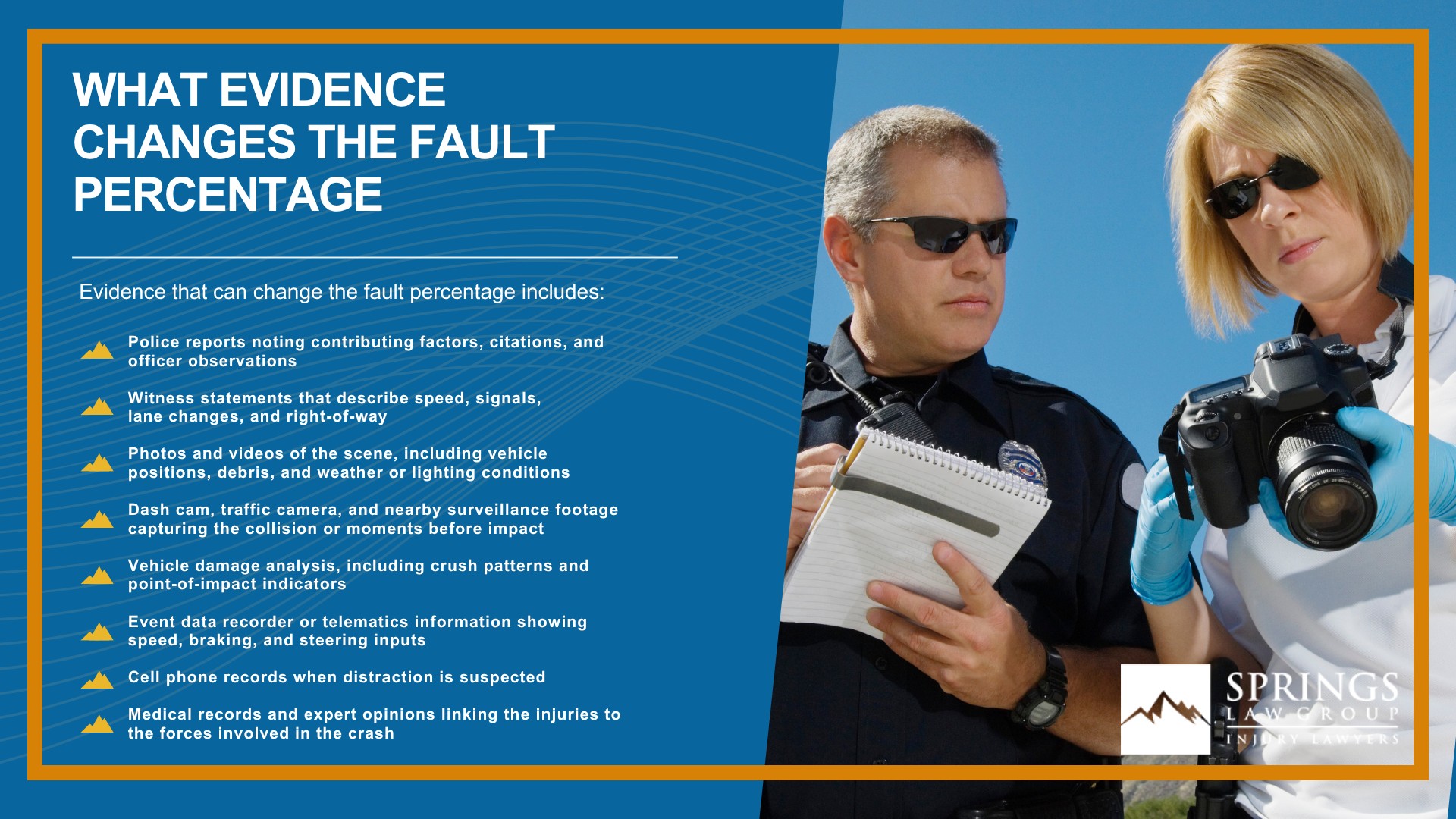
Evidence that can change the fault percentage includes:
When this kind of evidence is collected and organized, it becomes harder for an insurer to inflate your share of responsibility without proof.
Strong documentation can demonstrate that the at-fault party had time to react, was speeding, or ignored signals or traffic conditions.
In closer cases, expert analysis of physical and digital evidence can shift the narrative from speculation to measurable facts.
That shift often directly affects how much fault is assigned to each driver and, ultimately, how much compensation remains available under Colorado’s comparative negligence rules.
Comparative negligence most often comes up in crashes where fault is not obvious at first glance.
After an accident, it is common for drivers to feel confused about what happened and unsure whether they did something wrong.
In many of these cases, multiple parties made decisions that contributed to the collision, and insurers focus on those details to divide blame.
Intersections, lane changes, merging, and bad weather are all situations where more than one party may have a plausible argument about what the other should have done differently.
Pedestrian and bicycle crashes can also involve comparative negligence when the driver and the person on foot or on a bike each had duties to watch for traffic.
Rear-end collisions that seem straightforward may become more complicated if a sudden stop, distraction, or other factors are alleged.
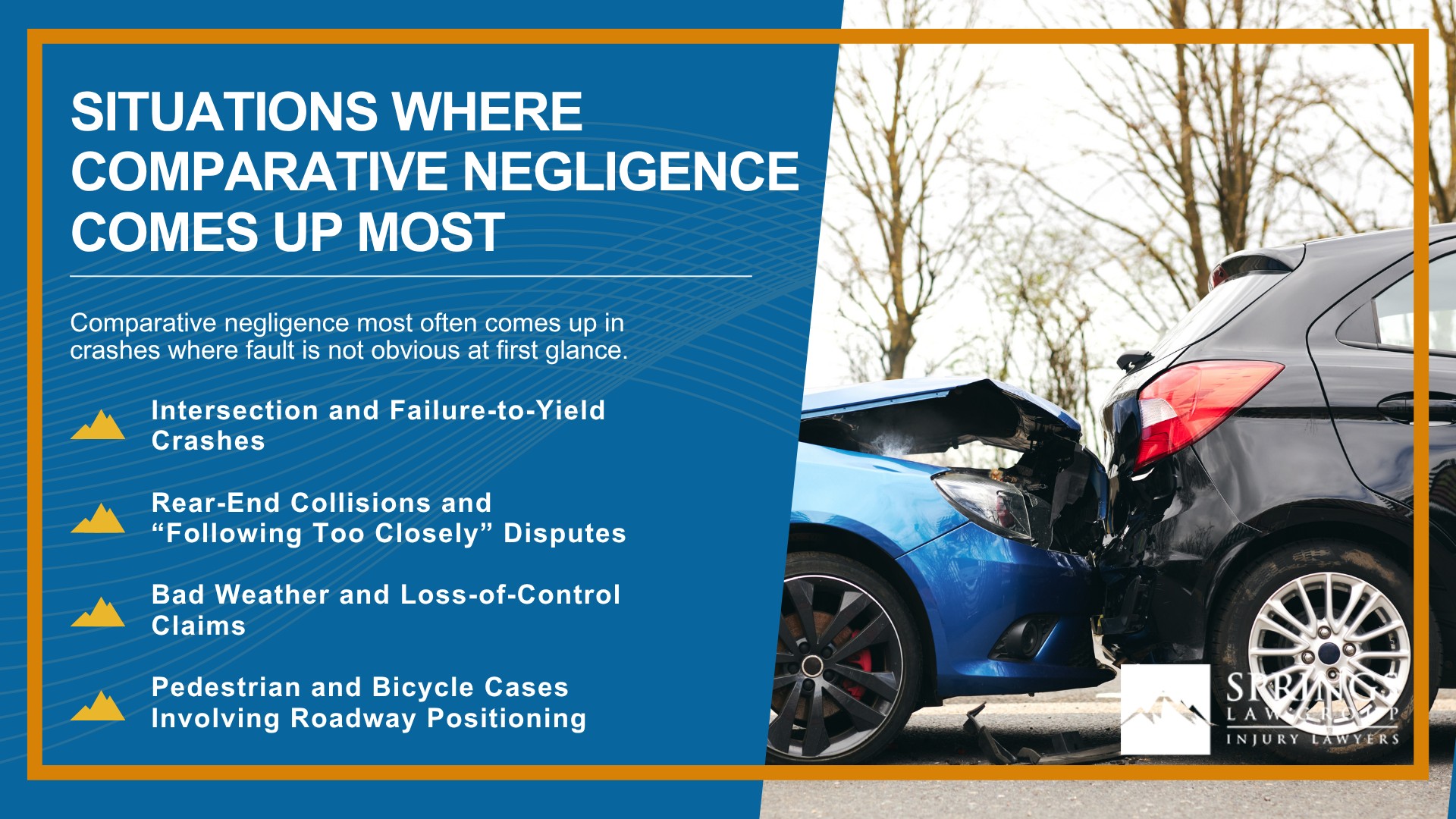
Intersection and failure-to-yield crashes are some of the most common settings for comparative negligence disputes because each driver may claim the other had the right-of-way.
Confusion over signals, turn arrows, stop signs, and gaps in traffic can give insurers room to unfairly shift blame onto the injured person.
Small details such as lane position, speed, and signal timing often matter more than drivers realize in the moment.
Clear evidence can help show which driver had the duty to yield and who entered the intersection unsafely.
Common intersection and failure-to-yield scenarios include:
Rear-end collisions are often treated as straightforward, but fault can still be disputed when drivers argue about sudden stops and following distance.
In many cases, the trailing driver is presumed responsible for following too closely or failing to pay attention to traffic ahead.
Insurers sometimes argue that the front driver contributed to the crash by braking abruptly, changing lanes without signaling, or stopping in an unusual place.
Comparative negligence disputes in these cases often turn on details like traffic flow, signal timing, and whether the stop was foreseeable.
Photos of vehicle positions, impact points, skid marks, and traffic controls can help show whether the rear driver had enough space and time to react.
Witness statements and any available video often play a key role in confirming which version of events fits what actually happened.
Bad weather and loss-of-control claims are a common setting for comparative negligence because drivers often blame the storm instead of their own decisions.
Insurers may argue that sliding on ice, snow, or standing water was “unavoidable,” then point to speed, following distance, or lane changes to push more fault onto the injured driver.
Disputes often arise when one driver says everyone was going slowly and cautious, while the other driver claims the roads were too slick to stop in time.
In these cases, evidence about how other vehicles were moving, how far traffic had already slowed, and what the pavement looked like becomes important.
Photos, weather data, and officer observations can help show whether the driver who lost control failed to slow down, left too little space, or braked aggressively on a slick surface.
When those facts are documented clearly, it becomes easier to separate true loss-of-control events from preventable crashes caused by poor choices in bad weather.
Pedestrian and bicycle cases often involve disputes about roadway positioning, because drivers and insurers may argue that the person on foot or on a bike was “in the wrong place.”
Fault arguments may focus on whether the pedestrian was in a crosswalk, crossing against a signal, or walking along the roadway in low visibility.
For cyclists, comparative negligence questions frequently center on the use of bike lanes, shoulders, and traffic lanes, as well as lane changes and turns.
Drivers may try to shift blame by claiming the pedestrian or cyclist was too far into the lane, too close to traffic, or not where a driver expected them to be.
Clear evidence of signals, lane markings, lighting, and where the person was positioned in the moments before impact is often critical in pushing back against these arguments.
Even if you are found partly at fault in a Colorado car accident case, you may still be able to recover money for your losses as long as your share of fault stays below the legal cutoff.
Your compensation is typically reduced by your percentage of fault, so a clear understanding of your total damages becomes important.
Damages can include both financial losses and the human impact of pain, limitations, and disruption to daily life.
Legal help can make a difference because insurance companies often push for a higher fault percentage specifically to pay less than the claim is worth.
A lawyer focused on your best interests will work to document your losses thoroughly and argue for a fault allocation that supports fair compensation.
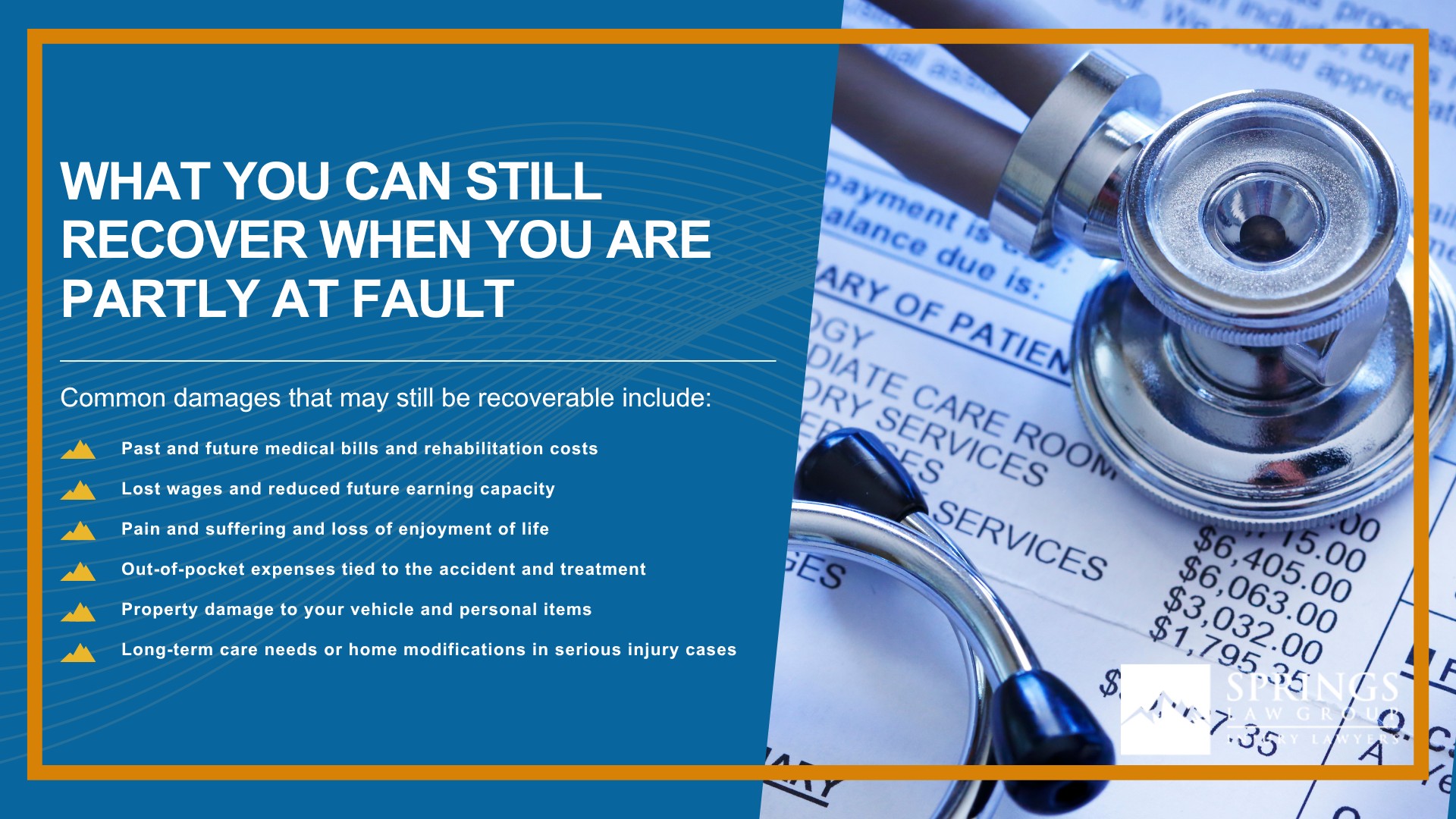
Common damages that may still be recoverable include:
Even after a fault reduction, these categories can add up to a significant recovery when they are properly documented and supported by evidence.
Without that documentation, insurers have more room to minimize or deny key parts of the claim.
Legal help can also protect you from accepting a settlement that reflects only a portion of your total damages.
The goal in a comparative negligence case is not perfection, but to reach the best possible outcome within the rules by building a strong record of both fault and harm.
Springs Law Group helps clients in comparative fault cases by focusing on evidence that shows the other party’s higher degree of negligence.
Insurance companies often try to minimize their payouts by shifting blame onto the injured person, so the firm’s first job is to push back with facts, not assumptions.
A comparative negligence lawyer at Springs Law Group gathers scene photos, witness statements, police reports, and digital records to show how the crash really happened.
When fault is disputed, proving a lower fault percentage often requires substantial evidence, including access to accident reconstructionists and expert witnesses.
An experienced personal injury attorney from the firm can coordinate that work and organize it into a clear narrative for negotiations or trial.
Lawyers in comparative negligence cases also negotiate directly with insurance adjusters, pursuing settlements that reflect the true scope of injuries and losses, and they are prepared to litigate if the insurer will not move.
Hiring a personal injury lawyer sends a strong message to the insurance company that you are serious about protecting your rights and pursuing maximum compensation allowed under Colorado law.
Springs Law Group handles these cases on a contingency fee basis, so clients do not pay attorney’s fees unless there is a financial recovery.
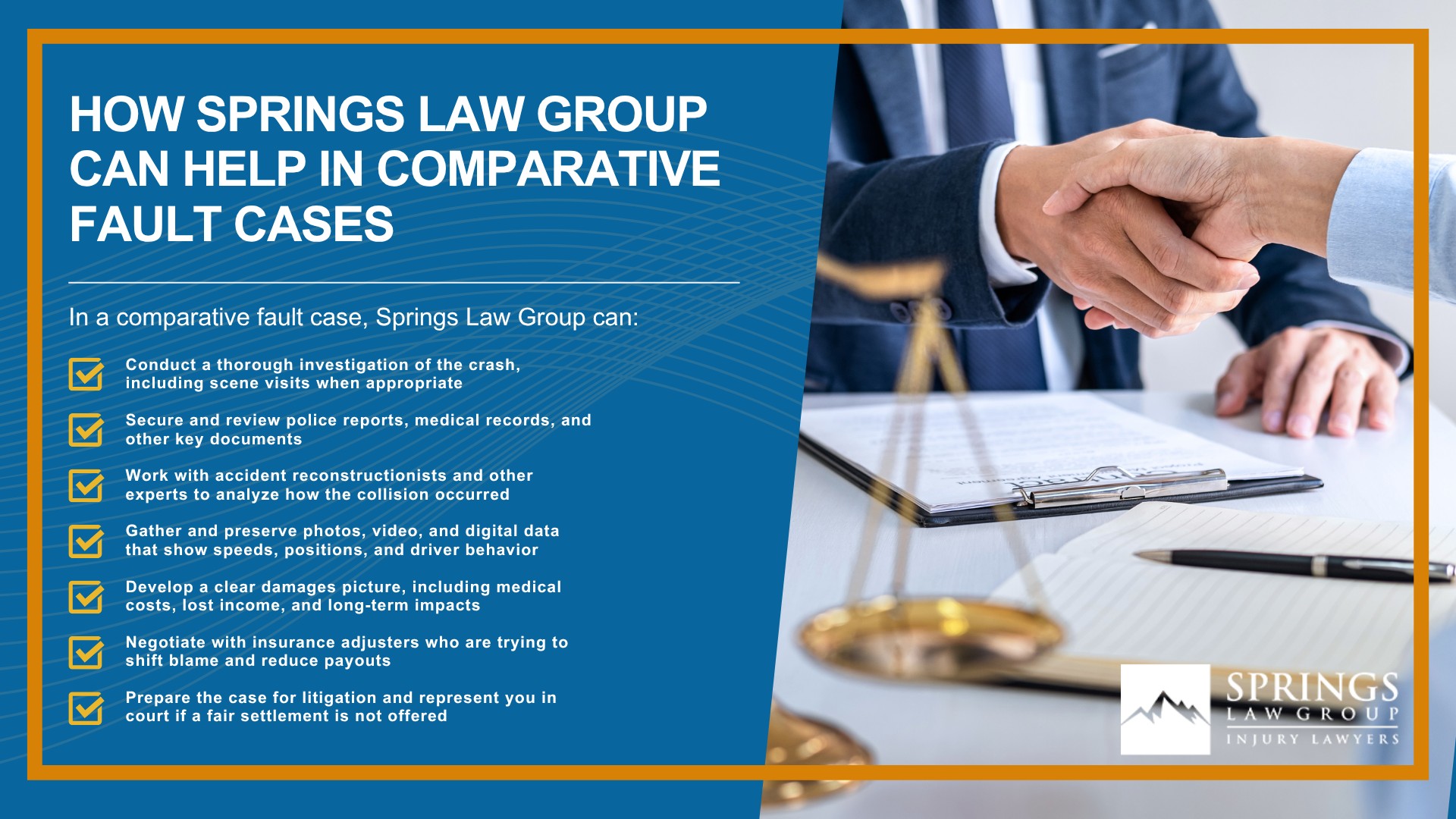
In a comparative fault case, Springs Law Group can:
The longer you wait to contact a personal injury attorney, the more your legal rights are at risk as evidence disappears and insurance company narratives harden.
By getting Springs Law Group involved early, you give yourself a better chance to control the fault story, protect your claim, and pursue the compensation you deserve.
Comparative negligence cases are rarely straightforward, especially when insurers are working to push as much fault onto you as possible.
The outcome often depends on how quickly the facts are documented, how clearly your damages are presented, and whether someone is standing between you and the insurance company’s efforts to limit its exposure.
You do not have to manage that alone while trying to recover from your injuries.

Contact Springs Law Group to speak with an experienced attorney about your Colorado car accident case.
Our law firm can review the facts, explain how Colorado’s modified comparative negligence rules apply, and outline a strategy to protect your claim.
Consultations are focused on your rights, your options, and what it will take to pursue fair compensation in your situation.