
Colorado Springs Head-On Collision Lawyer

Were You or A Loved One Injured in an Accident?
Get Free Answers In as Little as 3 Minutes
right-image
700

Injured in a Head-On Collision? Contact Springs Law Group Today

A head-on collision is one of the most violent types of traffic accidents because the force of impact is concentrated at the front of both vehicles.

These crashes often occur when a driver crosses the centerline, enters oncoming traffic, drives the wrong way, or attempts an unsafe passing maneuver.

The resulting injuries can be catastrophic, requiring emergency medical care, surgery, rehabilitation, and long-term treatment.

Springs Law Group represents individuals in Colorado Springs who have suffered serious injuries in head-on crashes and need help pursuing compensation from the driver or party responsible for the collision.

Colorado Springs Head-On Collision Lawyer

Do You Need a Lawyer After a Head-On Collision in Colorado Springs?

Head-on collisions often produce some of the most severe injuries seen in motor vehicle accidents because both vehicles may be moving toward one another at the moment of impact.

The forces involved in striking a vehicle head-on can cause traumatic brain injuries, spinal cord injuries, internal organ damage, multiple fractures, and other life-altering conditions that require extensive medical care.

Many victims face lengthy recoveries, lost income, physical limitations, and uncertainty about their future long after the crash itself is over.

Although fault is often clearer in a head-on collision than in other types of accidents, important questions may still arise regarding how the crash occurred, who crossed into oncoming traffic, whether multiple parties share responsibility, and what insurance coverage is available.

Building a successful claim requires evidence showing both how the collision happened and how the injuries have affected the victim’s life.

Police reports, witness statements, accident reconstruction, vehicle damage, electronic vehicle data, medical records, and expert opinions may all play a role in establishing liability and damages.

A head-on collision lawyer can investigate the crash, identify responsible parties, evaluate available insurance coverage, and pursue compensation for medical expenses, lost wages, future treatment, pain and suffering, and other losses.

Springs Law Group represents Colorado Springs accident victims and works to build claims that reflect the full physical, financial, and personal impact of a serious head-on crash.

If you or a loved one suffered injuries in a head-on collision because of someone else’s negligence, Springs Law Group can help you pursue compensation for medical bills, lost wages, pain and suffering, future medical treatment, property damage, and other losses tied to your recovery.

When the evidence supports your claim, negligent drivers, vehicle owners, employers, companies, government entities, or other responsible parties may be held liable for the harm they caused.

Contact Springs Law Group today for a free consultation.

You can also use the chat feature on this page to get in touch with our experienced Colorado Springs head-on collision lawyers.

Table of Contents

What Is a Head-On Collision?

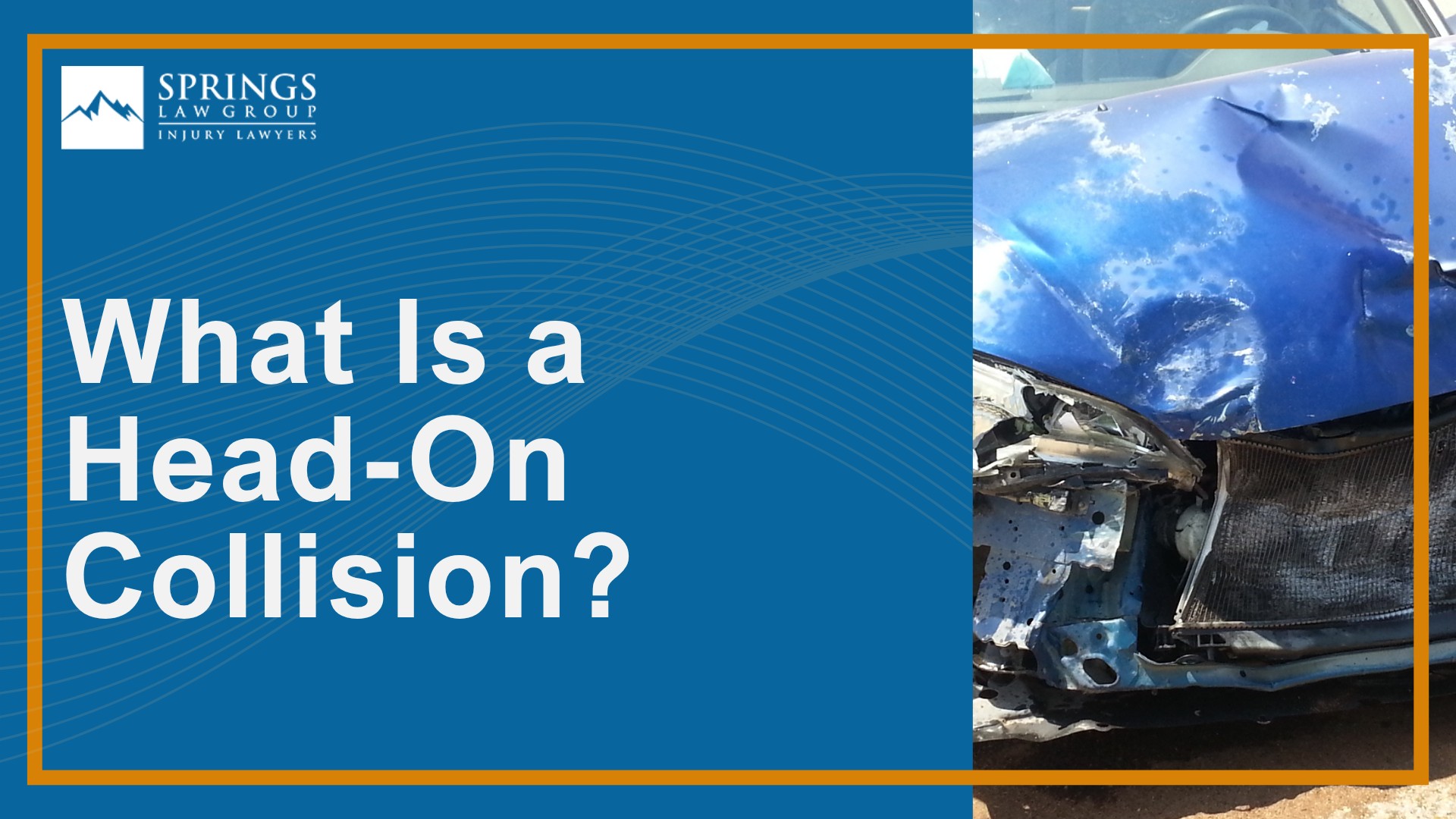
A head-on collision is a motor vehicle crash in which the front ends of two vehicles traveling in opposite directions strike one another.

These collisions typically occur when a driver crosses the centerline, enters an opposing lane of travel, drives the wrong way, attempts an unsafe passing maneuver, or loses directional control of the vehicle.

From a crash-dynamics perspective, head-on impacts are among the most severe collision types because the kinetic energy generated by both vehicles is concentrated at the point of impact.

The resulting deceleration forces are transferred directly to the occupants, creating a high risk of traumatic brain injuries, spinal injuries, internal organ damage, orthopedic trauma, and other catastrophic injuries.

Head-on collisions can occur on highways, rural roads, two-lane roadways, intersections, entrance ramps, and other traffic environments where opposing traffic flows are separated by only a centerline, median, or traffic control device.
Although modern vehicles contain airbags, crumple zones, seatbelt systems, and other safety technologies designed to absorb crash forces, these protections cannot eliminate the significant injury risks associated with a frontal impact involving opposing traffic.

The severity of a head-on collision often depends on factors such as vehicle speed, vehicle size, angle of impact, roadway conditions, occupant position, and whether secondary collisions occur after the initial crash.

Because these collisions frequently involve substantial injuries, extensive property damage, and disputed liability issues, determining exactly how and why the crash occurred is often a critical part of any resulting personal injury claim.

Why Head-On Collisions Are Often So Serious

Head on crashes are often serious because the impact is concentrated at the front of both vehicles.

When opposite directions collide, the crash forces can affect the head, neck, chest, abdomen, legs, spine, and internal organs.

Many head on collision accidents cause catastrophic injuries because the people involved may have little time to react.

A head on accident may also involve high speeds, wrong way driving, distracted driving, fatigued drivers, improper passing, or a driver who crosses into oncoming traffic.
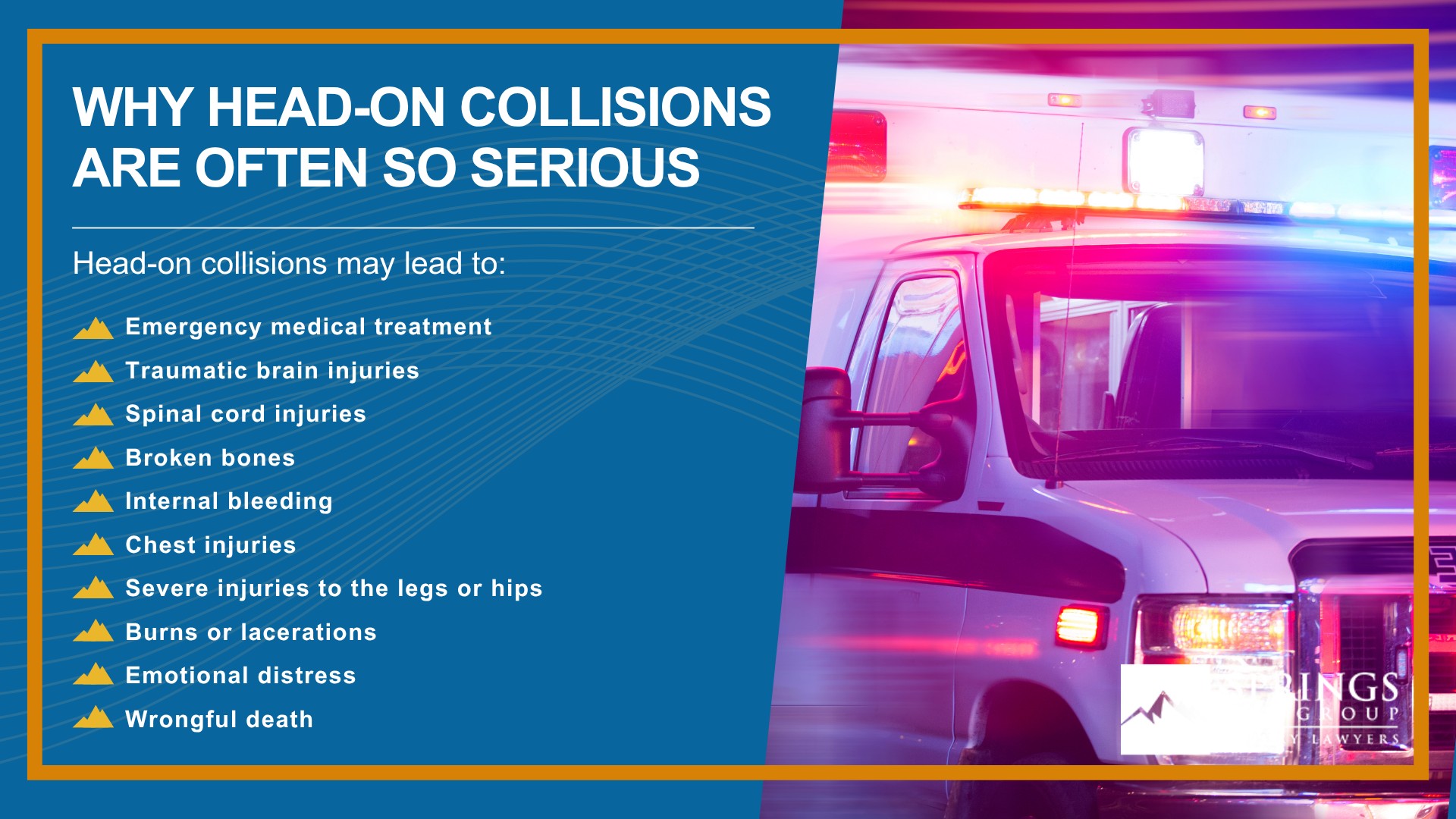
Head-on collisions may lead to:

  • Emergency medical treatment
  • Traumatic brain injuries
  • Spinal cord injuries
  • Broken bones
  • Internal bleeding
  • Chest injuries
  • Severe injuries to the legs or hips
  • Burns or lacerations
  • Emotional distress
  • Wrongful death

The seriousness of these crashes can make the legal process more complex than other personal injury cases.

A head on collision attorney can help investigate the crash, identify at fault parties, and pursue compensation for the full impact of the injuries.

Common Causes of Head-On Collisions in Colorado Springs

Head on accidents occur when a driver fails to stay in the proper lane, enters traffic moving the wrong way, or loses control of the vehicle.

In Colorado Springs, these crashes may happen on highways, two-lane roads, intersections, rural roads, and busy local streets.
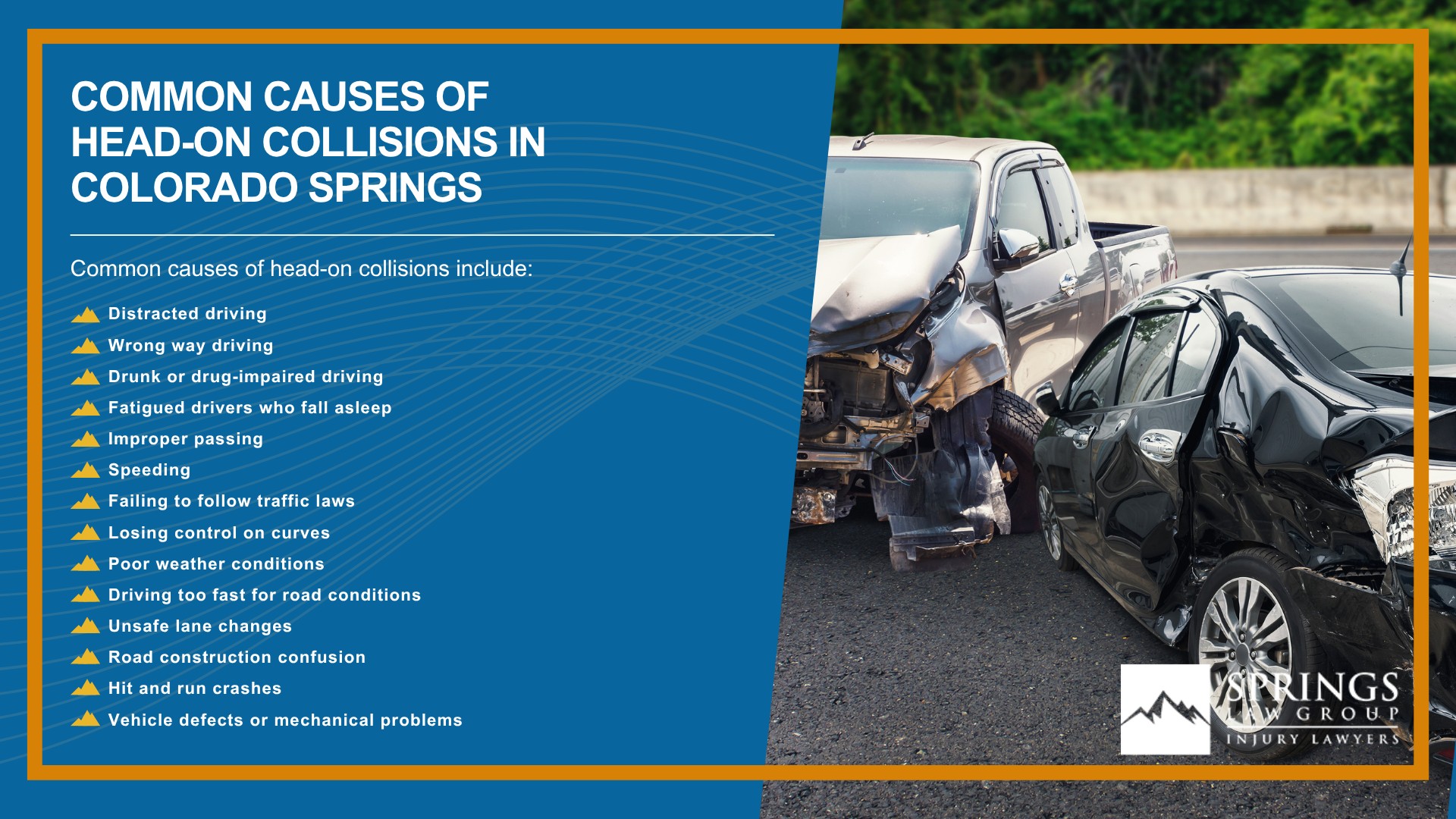
Common causes of head-on collisions include:

  • Distracted driving
  • Wrong way driving
  • Drunk or drug-impaired driving
  • Fatigued drivers who fall asleep
  • Improper passing
  • Speeding
  • Failing to follow traffic laws
  • Losing control on curves
  • Poor weather conditions
  • Driving too fast for road conditions
  • Unsafe lane changes
  • Road construction confusion
  • Hit and run crashes
  • Vehicle defects or mechanical problems

Most head on crashes involve preventable conduct.

A distracted driver may drift across the centerline.

A fatigued driver may fall asleep and enter oncoming traffic.

A driver may attempt to pass another vehicle on a two-lane road without enough time or visibility.

Springs Law Group investigates what caused the crash and whether the other driver, a company, a government entity, or another responsible party may be liable.

Head-On Collisions on I-25, Highway 24, and Colorado Springs Roads

Head-on collisions can happen anywhere, but certain roads carry higher risks because of speed, traffic volume, curves, intersections, ramps, and changing road conditions.

In Colorado Springs, serious head on crashes may occur on I-25, Highway 24, Powers Boulevard, Academy Boulevard, Woodmen Road, Platte Avenue, rural roads, and two-lane routes throughout El Paso County.

A crash involving oncoming traffic may happen when a driver enters a highway ramp the wrong way, crosses the median, drifts into the opposite lane, or tries to pass without enough space.

On smaller roads, head-on collisions may occur when two vehicles meet around a curve, when a driver crosses the centerline, or when weather causes a vehicle to lose control.

Springs Law Group reviews where the accident occurred, how the vehicles were traveling, whether traffic laws were violated, and whether road design, lighting, weather, or signage contributed to the crash.

Common Injuries Caused by Head-On Collisions

Head-on collisions can cause severe injuries because the force of impact may be extreme.

Accident victims may need emergency medical treatment, surgery, hospitalization, physical therapy, and long-term care.
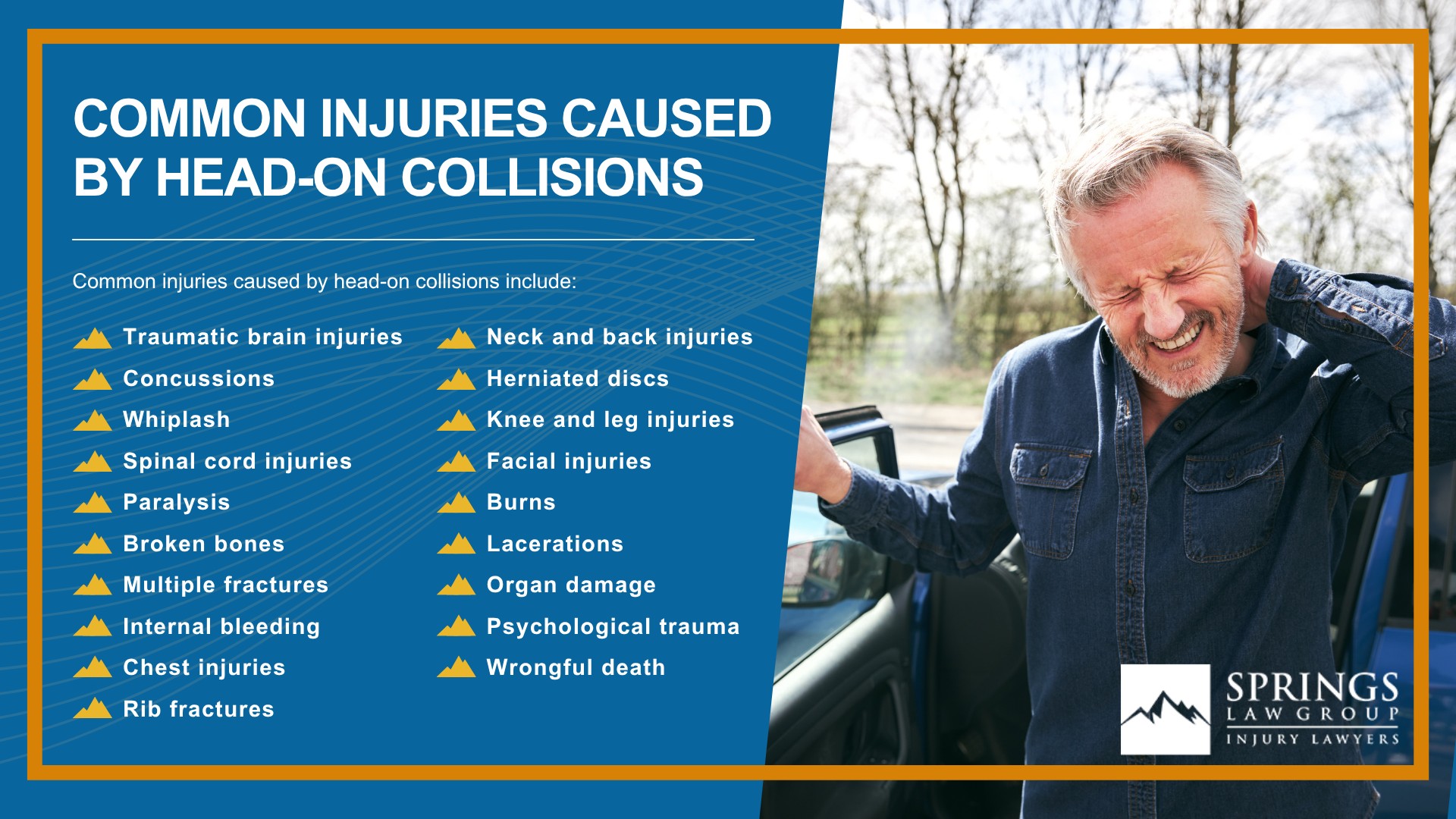
Common injuries caused by head-on collisions include:

  • Traumatic brain injuries
  • Concussions
  • Whiplash
  • Spinal cord injuries
  • Paralysis
  • Broken bones
  • Multiple fractures
  • Internal bleeding
  • Chest injuries
  • Rib fractures
  • Neck and back injuries
  • Herniated discs
  • Knee and leg injuries
  • Facial injuries
  • Burns
  • Lacerations
  • Organ damage
  • Psychological trauma
  • Wrongful death

Some injuries are visible at the scene.

Others may become clear after medical testing, imaging, or follow-up appointments.

Because head on collision injuries can be severe, medical attention should be the first priority after the crash.

Medical records help show the injury, the treatment plan, and the connection between the car crash and the harm suffered.

Who Can Be Held Liable for a Head-On Collision?

Determining liability in a head on collision case depends on the facts.

In many cases, the at fault driver is responsible because they crossed into oncoming traffic, drove the wrong way, violated traffic laws, or made an unsafe decision.
Potentially liable parties may include:

  • The at fault driver
  • A distracted driver
  • A drunk or drug-impaired driver
  • A fatigued driver
  • A driver who attempted improper passing
  • A vehicle owner
  • An employer if the driver was working
  • A trucking company
  • A rideshare or delivery company
  • A vehicle manufacturer
  • A repair shop
  • A government entity responsible for unsafe road design or missing signage
  • Another party whose negligence contributed to the crash

In some cases, more than one party may share responsibility.

The other driver may have crossed the centerline, but a company may also be involved if the driver was working at the time.

A government entity may be involved if confusing road design, missing signs, or unsafe roadway conditions contributed to a wrong way crash.

Springs Law Group reviews all possible at fault parties so the claim is not limited before the facts are fully understood.

How Springs Law Group Investigates Head-On Collision Claims

A head on collision claim requires a thorough investigation because fault, speed, lane position, and vehicle movement may be disputed.

Springs Law Group investigates how the crash occurred, who caused it, what insurance coverage applies, and how the injuries affect the client’s life.
Our investigation may include:

  • Reviewing the accident report
  • Reviewing police reports
  • Evaluating the accident scene
  • Gathering photos and video
  • Reviewing vehicle damage
  • Identifying witnesses
  • Collecting medical records
  • Reviewing emergency medical treatment records
  • Evaluating traffic laws and citations
  • Reviewing dash camera or surveillance footage
  • Looking for roadway evidence
  • Working with accident reconstruction experts when needed
  • Identifying the at fault driver’s insurer
  • Reviewing available insurance coverage
  • Calculating medical expenses, lost wages, and associated costs

Accident reconstruction experts may be useful in complex cases involving disputed lane position, high speeds, hit and run crashes, or multiple vehicles.

Springs Law Group builds the claim with evidence so the insurance company understands what happened and why the injured person deserves fair compensation.

Evidence That Can Help Prove Fault After a Head-On Collision

Strong evidence can make a major difference in a head on collision case.

The insurance company may dispute liability, blame the injured person, or argue that another driver caused the crash.
Helpful evidence may include:

  • Police reports
  • The accident report
  • Photos of the accident scene
  • Photos of vehicle damage
  • Skid marks and debris patterns
  • Roadway measurements
  • Witness statements
  • Traffic camera footage
  • Dash camera footage
  • Cell phone records when distracted driving is suspected
  • Toxicology results when impairment is suspected
  • Vehicle black box data
  • Medical records
  • Emergency medical records
  • Repair estimates
  • Expert reports
  • Insurance documents

Evidence can show whether the other driver crossed into oncoming traffic, was driving wrong way, failed to obey traffic laws, or lost control of the vehicle.

It can also help prove the severity of the injuries and the amount of compensation needed.

A personal injury lawyer can gather and preserve evidence before vehicles are repaired, road conditions change, or witnesses become difficult to locate.

What Compensation Can You Recover After a Head-On Collision?

If another driver caused your head on accident, you may be able to recover compensation through a personal injury claim or personal injury lawsuit.

The value of the claim depends on the severity of the injuries, available insurance, fault, medical needs, and how the crash affects your life.
Compensation may include:

  • Medical bills
  • Future medical expenses
  • Emergency medical treatment
  • Surgery costs
  • Rehabilitation
  • Physical therapy
  • Lost wages
  • Reduced earning capacity
  • Property damage
  • Vehicle replacement or repair
  • Out-of-pocket expenses
  • Pain and suffering
  • Emotional distress
  • Loss of enjoyment of life
  • Wrongful death damages when a loved one dies

A fair settlement should account for the full harm caused by the crash, not just the first medical bill or the initial property damage estimate.

Springs Law Group works to pursue fair compensation and, when supported by the evidence, pursue maximum compensation available under Colorado law.

Medical Bills and Future Treatment After a Head-On Crash

Medical bills after a head-on crash can add up quickly.

A person injured in a head on collision may need ambulance transport, emergency room care, diagnostic imaging, surgery, hospitalization, medication, physical therapy, specialist visits, and future medical treatment.

Future treatment may be needed when the crash causes:

  • Traumatic brain injuries
  • Spinal cord injuries
  • Broken bones
  • Internal bleeding
  • Neck or back injuries
  • Severe soft tissue injuries
  • Chronic pain
  • Permanent disability
  • Psychological trauma

The cost of care may continue for months or years after the car accident.

These associated costs should be considered before accepting a settlement from the insurance company.

Springs Law Group reviews medical records, treatment plans, and future care needs to help pursue compensation that reflects the full medical impact of the crash.

Lost Wages and Reduced Earning Capacity After a Head-On Collision

A serious head-on collision can keep an injured person out of work for weeks, months, or longer.

Some accident victims cannot return to the same job because of pain, mobility limits, traumatic brain injuries, emotional distress, or permanent restrictions.

Lost wage damages may include:

  • Time missed from work
  • Lost wages
  • Lost bonuses or commissions
  • Lost benefits
  • Reduced earning capacity
  • Missed business income
  • Job retraining
  • Career changes
  • Reduced retirement contributions

The impact depends on the injury, the person’s job duties, medical restrictions, age, training, and long-term prognosis.

A head on collision lawyer can gather employment records, tax records, medical restrictions, and expert opinions to document work-related losses.

How Insurance Companies Handle Head-On Collision Claims

Insurance companies often treat head-on collision claims as high-exposure cases because the injuries, medical expenses, and future damages can be substantial.

Even when one driver appears to have crossed into oncoming traffic, the insurer may still investigate whether comparative fault, road conditions, weather, mechanical failure, or a sudden medical emergency contributed to the crash.

Common insurance company tactics include:

  • Alleging comparative negligence
  • Arguing the crash was unavoidable
  • Blaming weather or road conditions
  • Claiming a sudden medical emergency caused the collision
  • Disputing why the driver crossed the centerline
  • Challenging future medical treatment
  • Minimizing the severity of injuries
  • Questioning lost income and earning capacity
  • Requesting broad medical records
  • Making an early settlement offer before the prognosis is clear

Insurers may also dispute the extent of the injuries, especially when the claim involves traumatic brain injuries, spinal injuries, orthopedic trauma, internal injuries, or long-term medical needs.

Police reports, accident reconstruction, vehicle data, medical records, expert opinions, and witness testimony can help establish how the crash occurred and the full impact it has had on the injured person’s life.

What to Do After a Head-On Collision in Colorado Springs

After a head-on collision, safety and medical care come first.

These crashes can cause severe injuries even when symptoms are not immediately obvious.
After a head-on crash, you should:

  • Call 911
  • Request emergency medical treatment
  • Move to safety if possible
  • Report the crash to police
  • Get medical attention
  • Follow medical advice
  • Take photos of the scene if you can do so safely
  • Photograph vehicle damage
  • Get witness contact information
  • Exchange insurance information
  • Avoid admitting fault
  • Save the accident report
  • Keep medical records and bills
  • Track lost wages
  • Avoid discussing the crash on social media
  • Speak with a lawyer before accepting a settlement

If you were injured in a head on collision, you should not assume the insurance company will calculate the full value of your claim.

Legal representation can help protect your rights and preserve the evidence needed to seek compensation.

How Colorado Law Affects Head-On Collision Claims

Colorado law affects head-on collision claims in several ways.

To recover compensation, the injured person generally must prove that another driver or responsible party caused the crash and that the crash caused their injuries.

Colorado also follows modified comparative negligence.

This means compensation may be reduced if the injured person is found partly at fault.

If the injured person’s share of fault is too high, recovery may be barred.
Head-on collision claims may involve:

  • Traffic laws
  • Negligent driving
  • Wrong way driving
  • Distracted driving
  • Improper passing
  • Fatigued driving
  • Hit and run issues
  • Insurance coverage disputes
  • Multiple at fault parties
  • Personal injury claims
  • Wrongful death claims
  • Comparative fault arguments

Because liability can be disputed, evidence matters.

Springs Law Group can explain how Colorado law applies to your claim and what legal options may be available.

How Long Do You Have to File a Head-On Collision Claim in Colorado?

In many Colorado motor vehicle accident cases, the deadline to file a lawsuit is generally three years from the date of the crash.

Some claims may have shorter deadlines, especially if a government entity may be involved or if the case includes special notice requirements.

You should not wait until the deadline is close.

Evidence can disappear, vehicles may be repaired, roadway conditions may change, and witnesses may become harder to find.
Important timing issues may include:

  • Getting medical treatment
  • Requesting police reports
  • Preserving vehicle damage evidence
  • Gathering witness statements
  • Reviewing insurance coverage
  • Filing an insurance claim
  • Evaluating policy limits
  • Consulting an experienced attorney
  • Filing a personal injury lawsuit if settlement is not possible

A Colorado Springs head on collision lawyer can review the facts and explain the deadline that may apply to your case.

Why Choose Springs Law Group for Your Head-On Collision Case?

Springs Law Group represents injured people in Colorado Springs and El Paso County after serious car accidents, head on crashes, and other personal injury cases.

Our law firm understands how a severe crash can affect medical care, work, family life, transportation, and financial stability.
Clients choose Springs Law Group because we provide:

  • Free consultation
  • Local Colorado Springs legal experience
  • A legal team that handles serious injury claims
  • Help dealing with the insurance company
  • Thorough investigation of head on collision accidents
  • Support gathering medical records and evidence
  • Guidance through the legal process
  • Legal representation focused on fair compensation
  • Experience handling complex car accident claims

Every case is different.

Springs Law Group does not promise a specific result.

We do work to identify the at fault driver, document the injuries, calculate damages, and pursue compensation supported by the facts.

If the party’s insurance company refuses to offer a fair settlement, our attorneys can discuss whether legal action may be appropriate.

Springs Law Group: Contact a Colorado Springs Head-On Collision Lawyer Today

Head-on collisions often leave victims facing some of the most serious consequences associated with motor vehicle accidents.

A single crash can result in traumatic brain injuries, spinal cord damage, multiple fractures, permanent disabilities, extensive medical treatment, and months or years of recovery.

At the same time, important questions may arise regarding fault, insurance coverage, future medical needs, and the full financial impact of the injuries.

Preserving evidence and understanding your legal rights early in the process can make a significant difference in the outcome of a claim.

Springs Law Group represents individuals and families in Colorado Springs who have been harmed in head-on collisions caused by another person’s negligence.

Our law firm investigates how the crash occurred, identifies potentially liable parties, evaluates available insurance coverage, and pursues compensation for medical expenses, lost income, future treatment costs, pain and suffering, property damage, and other losses supported by the evidence.
If you or a loved one was injured in a head-on collision, Springs Law Group can review your case and explain the legal options available to you.

Contact Springs Law Group today for a free consultation with a Colorado Springs head-on collision lawyer.

You can also use the chat feature on this page to discuss your accident and learn whether you may have a claim for compensation.


Frequently Asked Questions

  • What should I do after a head on car accident in Colorado Springs?

    After a head on car accident, your first priority should be safety and medical care.

    Call 911, request emergency medical treatment, report the crash to police, exchange insurance information, and take photos of the scene and vehicle damage if you can do so safely.

    You should also keep medical records, save the accident report, avoid admitting fault, and speak with a lawyer before accepting a settlement from the insurance company.

  • Who is usually at fault in a head on car accident?

    Fault depends on the facts of the crash.

    In many cases, the driver who crossed the centerline, entered oncoming traffic, drove the wrong way, made an improper pass, or lost control of the vehicle may be responsible.

    Springs Law Group can review the police report, witness statements, vehicle damage, traffic laws, and accident evidence to determine who may be liable.

  • Why are head-on collisions so dangerous?

    Head-on collisions are dangerous because two vehicles traveling in opposite directions may collide with extreme force.

    A head on car accident can cause traumatic brain injuries, spinal cord injuries, broken bones, internal bleeding, chest injuries, emotional distress, and wrongful death.

    Even when a person survives the crash, they may need emergency care, surgery, physical therapy, future treatment, and time away from work.

  • Can I recover compensation after a head on car accident?

    You may be able to recover compensation if another driver or responsible party caused the crash.

    Compensation may include medical bills, future medical expenses, lost wages, reduced earning capacity, property damage, pain and suffering, and emotional distress.

    Springs Law Group can evaluate your claim, identify the at fault driver, review available insurance coverage, and help you pursue fair compensation under Colorado law.

  • How long do I have to file a head-on collision claim in Colorado?

    In many Colorado motor vehicle accident cases, the deadline to file a lawsuit is generally three years from the date of the crash.

    Some claims may involve shorter deadlines, especially if a government entity or special notice requirement is involved.

    A Colorado Springs head-on collision lawyer can review the facts of your head on car accident and explain the deadline that may apply to your case.

  • What causes most head-on collisions?

    Most head-on collisions occur when a driver enters a lane of opposing traffic.

    Common causes include distracted driving, impaired driving, fatigue, unsafe passing maneuvers, speeding, wrong-way driving, and drifting across the centerline.

    Some crashes occur when a driver falls asleep at the wheel or loses control because of weather, road conditions, or a medical emergency.

    Head-on collisions can also result from vehicle defects, roadway design issues, or missing traffic controls in certain situations.

    Determining the cause of the crash is often one of the most important parts of a head-on collision investigation.

  • Are head-on collisions usually fatal?

    Not all head-on collisions are fatal, but they are among the deadliest types of motor vehicle accidents.

    Because both vehicles may be traveling toward one another at the time of impact, the forces involved can be significantly greater than in many other crashes.

    Victims often suffer traumatic brain injuries, spinal cord injuries, internal organ damage, multiple fractures, and other catastrophic injuries.

    Modern safety features such as airbags, seatbelts, and crumple zones have improved survivability, but serious injuries remain common.

    The severity of a head-on collision often depends on factors such as vehicle speed, vehicle size, angle of impact, and whether secondary collisions occur.

  • Can I recover compensation if the other driver died in a head-on accident?

    Yes.

    The death of the at-fault driver does not automatically prevent an injured person from pursuing compensation.

    In many cases, a claim may still be made against the deceased driver’s automobile insurance policy, and additional insurance coverage may be available depending on the circumstances of the crash.

    If the available insurance is insufficient, a claim may sometimes be pursued against the deceased driver’s estate or other responsible parties when supported by the facts.

    These cases can involve additional legal and procedural requirements, but the right to seek compensation for injuries, medical expenses, lost income, and other damages may still exist.

    An attorney can evaluate the available insurance coverage and explain the legal options based on the specific circumstances of the collision.

Written By:
Christopher Nicolaysen

Member of the Colorado Bar Association since 2014. Attorney, Christopher M. Nicolaysen focuses primarily on helping those injured in Colorado car accidents, other auto accidents, and Colorado personal injury incidents.

This article has been written and reviewed for legal accuracy and clarity by the team of writers and attorneys at Springs Law Group and is as accurate as possible. This content should not be taken as legal advice from an attorney. If you would like to learn more about our owner and experienced Colorado personal injury lawyer, Christopher Nicolaysen, you can do so here.

Springs Law Group does everything possible to make sure the information in this article is up to date and accurate. If you need specific legal advice about your case, contact us. This article should not be taken as advice from an attorney.

Do You
Have A Case?
No out of pocket costs.
We only collect a fee AFTER you win your case and receive full compensation.
Contact our team today to discuss your case for free & Get answers in as little as 3 minutes.
Would you like our help?
right-image
700
About Springs Law Group
The lawyers at Springs Law Group have experience handling diverse personal injury cases with empathy and understanding.
We recognize the delicate nature of these claims and tailor strategies to meet your unique requirements, focusing on smart — not emotional — strategies.
Our team is committed to building long-lasting, trust-based client relationships.
We believe this approach helps ensure that choosing us means partnering with a firm that genuinely values you as a person — not just another client.
Recent Posts
Do You
Have A Case?
No out of pocket costs.
We only collect a fee AFTER you win your case and receive full compensation.
Contact our team today to discuss your case for free & Get answers in as little as 3 minutes.
Would you like our help?
right-image
700

The #1 Personal Injury Lawyers in Colorado Springs, Colorado

Local Colorado Springs Resources

Education
Emergency Services
Courthouses
Department of Motor Vehicles
Community & History

Leave Us A Review

We use reviews to help show more people like you why we do what we do!

Top-Rated Personal Injury Firm Serving Colorado Springs & Beyond

Personal injury victims represented by a lawyer recover up to 3x more.

Our Process

Play Video
1
Investigation
Gather evidence. Get police reports. Obtain insurance policies.
2
Treatment
You focus on healing. We help guide you through the process.
3
Medical Records
Get the records we need to make sure you have a strong case.
4
Demand Prep
Prepare and send our demands to the insurance company.
5
Negotiation
Negotiate with the insurance company for max compensation.
6
Settlement
Reach a settlement offer you agree with or we file a lawsuit.
7
Litigation
If we have to go to court, our trial lawyers get ready to win.

Videos

Our Team

The #1 Personal Injury Lawyers in Colorado Springs, CO