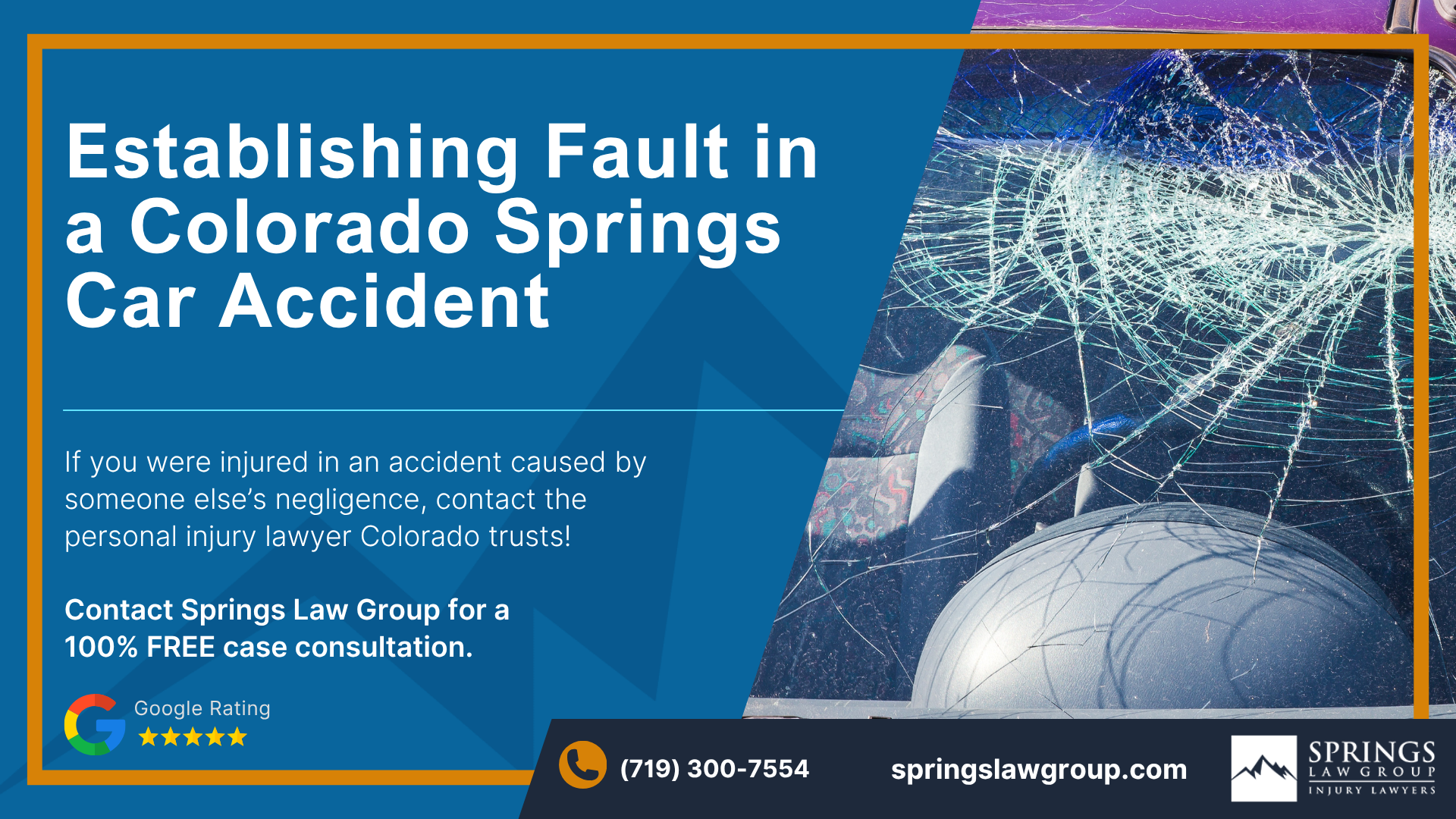
Establishing fault in a Colorado Springs car accident involves determining whose negligence caused or contributed to the collision.
Colorado follows an at-fault insurance system, allowing injured people to pursue compensation from parties legally responsible for their injuries and losses.
Police reports, witness statements, vehicle damage, video footage, and electronic records may help establish liability when drivers disagree about what happened.
Under Colorado’s modified comparative negligence rule, an injured person’s share of fault may reduce or prevent a financial recovery.
If fault is disputed after your accident, our Colorado Springs car accident lawyers can investigate the collision and challenge unsupported allegations of negligence.
Contact Springs Law Group for a free consultation, or use the chat feature on this page to discuss your car accident claim.
Fault is determined by evaluating each driver’s conduct and whether that conduct caused or contributed to the collision.
Insurance companies determine fault for claim-handling purposes by investigating the collision, reviewing applicable state laws, and assessing the evidence supporting claims for bodily injuries and property damage.
Key factors include each driver’s actions, the right of way, road conditions, and whether the other party could reasonably have avoided the collision.
A personal injury claim generally requires proof of negligence rather than simply showing that an accident occurred.
The elements of a negligence claim generally include:
The circumstances of the accident determine whether these elements can be established.
For example, evidence that a driver exceeded the speed limit may support a negligence claim, but the evidence must also connect that conduct to the harm suffered.
A violation of an applicable traffic law may support a finding of negligence when the violation causes the type of harm the law was intended to prevent.
Colorado traffic laws that may be relevant to a fault determination include:
A driver may be negligent even without violating a specific traffic statute or receiving a citation.
Drivers must exercise reasonable care under the circumstances, including adjusting their behavior when visibility is limited or roads are icy.
Disagreements over right of way, traffic signals, vehicle speed, and lane changes can complicate liability determinations.
On roads such as I-25, Powers Boulevard, Academy Boulevard, and Woodmen Road, fault disputes may involve merging traffic, busy intersections, or sudden changes in traffic speed.
Under Colorado’s left-turn statute, drivers turning left must yield to oncoming traffic within the intersection or close enough to present an immediate hazard.
However, the turning driver is not necessarily the only person responsible for a collision.
An approaching motorist who runs a red light or travels at an unsafe speed may also contribute to the crash.
When both drivers claim they had a green light, investigators may need to compare witness accounts, available video footage, and traffic signal information.
The following driver is often responsible for a rear-end accident because motorists must leave sufficient distance to respond safely to slowing or stopped traffic.
Colorado recognizes a rebuttable presumption of negligence in certain rear-end collisions, but the circumstances of the impact determine whether that presumption applies.
An unsafe lane change, unexpected reversing, or defective brake lights may affect the allocation of fault.
Fault in a lane-change accident may depend on which vehicle crossed a lane marking and whether the driver could complete the maneuver safely.
Speeding can complicate the determination, particularly when one driver changes lanes unsafely and another is traveling too fast to react to the hazard.
A driver can also be negligent for traveling at an unsafe speed for existing conditions even when driving below the posted speed limit.
A motorist who fails to notice a traffic signal, stopped vehicle, or pedestrian may have been distracted before the collision.
In distracted driving accident cases, available phone records, witness accounts, and evidence of delayed braking may help establish whether driver inattention contributed to the crash.
A failure to brake does not independently prove that a driver was using a phone.
Colorado prohibits driving under the influence of alcohol or drugs under C.R.S. § 42-4-1301.
An impaired driver may be assigned a substantial percentage of fault if evidence shows that impairment contributed to the crash.
Police observations, chemical test results, witness accounts, and vehicle movements may help determine fault in these cases.
A DUI arrest or conviction does not automatically establish that the impaired driver bears all responsibility for the collision.
When drivers give conflicting accounts, investigators compare their statements with independent evidence to determine which explanation is supported by the facts.
Evidence that may help establish fault includes:
Witness testimony may be incomplete because a person saw only part of the collision or had an obstructed view of a traffic signal.
Similarly, photographs of a vehicle’s final position may not show where the vehicle was at impact.
Collecting and preserving car accident evidence promptly can help investigators evaluate conflicting statements before important records become unavailable.
Accident reconstruction experts use engineering principles and available crash evidence to evaluate how a collision occurred.
An accident reconstruction analysis may help determine:
Reconstruction may be particularly useful when the drivers dispute the sequence of events or the physical evidence contradicts one driver’s account.
Not every car accident requires expert testimony, and the reliability of a reconstruction depends on the available evidence and methods used.
A police report can provide important evidence of the circumstances of an accident, but it does not conclusively establish civil liability.
Police officers may identify suspected traffic violations, record witness statements, and document roadway conditions at the accident scene without having personally witnessed the collision.
An officer’s initial assessment may also be based on information available before investigators obtain video footage or electronic records.
Receiving a traffic citation does not automatically make a driver financially responsible for every loss arising from an accident.
For example, a citation for speeding may be relevant to a collision, but the injured person must still establish a connection between the violation and the resulting harm.
The absence of a ticket does not prevent an injured person from proving that another driver acted negligently.
Shared fault can arise when separate acts of negligence by more than one person or business contribute to the same collision.
Depending on the circumstances, potentially liable parties may include:
Under C.R.S. § 13-21-111.5, each defendant is generally liable for the portion of damages attributable to their own fault, subject to statutory exceptions.
The fault of properly designated nonparties may also be considered in certain cases.
In a multiple-vehicle accident, investigators must determine which driver caused each impact and whether subsequent collisions resulted from the initial crash or separate negligent actions.
For example, a driver who rear-ends a stopped vehicle may push it into the car ahead without the middle driver doing anything negligent.
In other circumstances, a second driver may independently fail to stop and contribute to additional injuries or damage.
Vehicle damage patterns, electronic records, witness statements, and reconstruction findings may help establish the sequence of impacts and each driver’s responsibility.
Colorado follows a modified comparative negligence rule under C.R.S. § 13-21-111.
Unlike traditional contributory negligence systems that can bar recovery when an injured person bears any legally relevant fault, Colorado allows recovery in certain cases involving partial fault.
In a typical two-driver negligence case, an injured person who is less than 50% at fault may recover reduced compensation.
An injured person who is 50% or more at fault cannot recover damages from the other driver in that case.
For example, if an injured driver’s proven damages total $100,000:
These examples illustrate the effect of comparative negligence alone and do not account for insurance coverage, statutory limitations, or other factors affecting the amount recovered.
When multiple defendants are responsible, Colorado courts generally compare the injured person’s negligence with the combined negligence of the defendants, as established in Mountain Mobile Mix, Inc. v. Gifford.
The involvement of designated nonparties or other liability issues may require additional analysis.
An insurance adjuster may acknowledge that the other driver violated a traffic law but assign partial fault to you based on an allegation that your actions also contributed to the collision.
For instance, an insurer may allege that you were speeding when another motorist turned across your lane.
An insurer’s proposed percentage of fault is not a binding determination of negligence.
Our attorneys can review the evidence supporting the allegation and challenge an unsupported assessment that could reduce your compensation or prevent recovery.
Your own insurer and the other party’s insurer may assign fault differently based on the evidence available to each company.
These assessments affect how insurers handle claims but do not conclusively establish civil liability.
Many disputed claims resolve through settlement negotiations without a formal determination of fault by a court.
If a personal injury lawsuit proceeds to trial, the judge or jury determines the relevant facts and allocates fault as appropriate under Colorado law.
Understanding how fault works in Colorado can help you identify which insurance policies may cover your losses.
Colorado’s at-fault insurance system generally allows an injured person to seek compensation for medical expenses, lost wages, and vehicle repairs through the negligent party’s insurer, subject to policy limits and applicable law.
Unlike many no-fault states, Colorado does not require drivers to carry personal injury protection (PIP) coverage as part of a no-fault insurance system.
According to the Colorado Division of Motor Vehicles, Colorado’s minimum auto liability insurance requirements are:
These minimum policy limits do not establish the maximum damages a negligent driver may legally owe.
Depending on the applicable insurance policies, injured people may also have access to medical payments, collision, or uninsured and underinsured motorist coverage through their own insurance provider.
An insurer’s assessment of liability may influence its settlement offer, but it does not establish the final legal responsibility of the drivers involved.
Insurance rates may increase after an at-fault accident, depending on the insurer’s rating practices and applicable Colorado insurance rules.
Under C.R.S. § 10-4-628, insurers generally cannot increase premiums because of accidents for which the insured was not at fault, although general rate increases may still apply.
If the insurance company disputes your claim or alleges that you contributed to a collision, Springs Law Group can investigate the circumstances and evaluate whether those allegations are supported by evidence.
Our Colorado Springs personal injury lawyers review police reports, compare driver and witness statements, and work with qualified experts when additional investigation is necessary.
We negotiate with insurance companies and pursue fair compensation for injuries and financial losses caused by negligent drivers and other responsible parties.
Our law firm handles qualifying personal injury cases on a contingency fee basis, meaning you do not pay attorney fees unless we recover compensation on your behalf.
Contact Springs Law Group for a free case evaluation, or use the chat feature on this page to discuss your disputed car accident claim.
Yes, a traffic violation by another motorist does not eliminate the possibility that your conduct also contributed to the collision.
Colorado’s comparative negligence rule allows responsibility to be allocated according to the evidence of each party’s negligence.
Ask the insurance company to explain its liability determination and identify the evidence supporting it.
Notify your own insurer promptly, file any applicable claim, and comply with your policy’s reporting and cooperation requirements.
Do not admit fault or speculate about the cause of the crash when speaking to insurance representatives, but provide accurate information about what you personally observed.
Preserve photographs of the accident scene, witness contact details, and available recordings.
Strong evidence may help challenge the other party’s insurer when it attempts to assign fault without adequate support.
A car accident attorney can review the insurer’s position and explain whether further negotiations or legal action may be appropriate.
Yes, additional witness statements, video recordings, or accident reconstruction findings may contradict an insurer’s original assessment.
For example, dashcam footage showing that a driver ran a red light may help resolve a dispute that initially depended on conflicting driver statements.
Potentially, an injured passenger may have claims against both drivers if their negligence contributed to the passenger’s injuries.
Available compensation depends on the evidence, applicable insurance coverage, and any legally relevant fault attributable to the passenger.
Under C.R.S. § 13-80-101(1)(n), Colorado generally allows three years from the date a motor vehicle injury claim accrues to commence a lawsuit.
Different deadlines and additional notice requirements may apply, particularly when a government entity is involved.
Ongoing negotiations over fault do not automatically extend the filing deadline.

Member of the Colorado Bar Association since 2014. Attorney, Christopher M. Nicolaysen focuses primarily on helping those injured in Colorado car accidents, other auto accidents, and Colorado personal injury incidents.
This article has been written and reviewed for legal accuracy and clarity by the team of writers and attorneys at Springs Law Group and is as accurate as possible. This content should not be taken as legal advice from an attorney. If you would like to learn more about our owner and experienced Colorado personal injury lawyer, Christopher Nicolaysen, you can do so here.
Springs Law Group does everything possible to make sure the information in this article is up to date and accurate. If you need specific legal advice about your case, contact us. This article should not be taken as advice from an attorney.
We use reviews to help show more people like you why we do what we do!

I was uneasy about reaching out to a law firm after being in an accident that left me injured and my vehicle totaled. I don’t care for the idea of suing for what was very clearly an accident. However, after learning more about the overall process of working with a professional team to navigate the murky waters of the insurance world, I was pleasantly surprised to find that the experience wasn’t as gross as I’d originally felt about it.

Springs Law is very friendly and professional. I always felt that they were on my side and cared about my injury and what I was going through. I highly recommend them.

Springs Law Group is an amazing group to work with! I got into a rough accident, and they never ceased to let me know they were there working hard to help me in my hour of need. It was always very easy to reach out to someone if I had any questions, and they were always happy to answer any questions I had.
I never have a problem with getting a response when I need them – which is not the case with most other firms. They really truly care about each client. As a plus, they always have positive attitudes, which matters tremendously when you are in a stressful legal situation.
Big thanks to Mr. Jake Kimbell and his team for their assistance with my case. He helped me through an incredibly challenging part of my life, and most importantly helped navigate through the convoluted legal channels of my case. I cannot thank him and his team enough for their support.

The entire team at Springs Law group has been nothing but amazing. Jake and the rest of the staff were great to work with and extremely professional. They were very attentive and answered any questions and concerns I had. I was always able to contact them and they were very responsive and communicated with me.

Springs Law Group is an amazing group to work with! I got into a rough accident, and they never ceased to let me know they were there working hard to help me in my hour of need. It was always very easy to reach out to someone if I had any questions, and they were always happy to answer any questions I had.