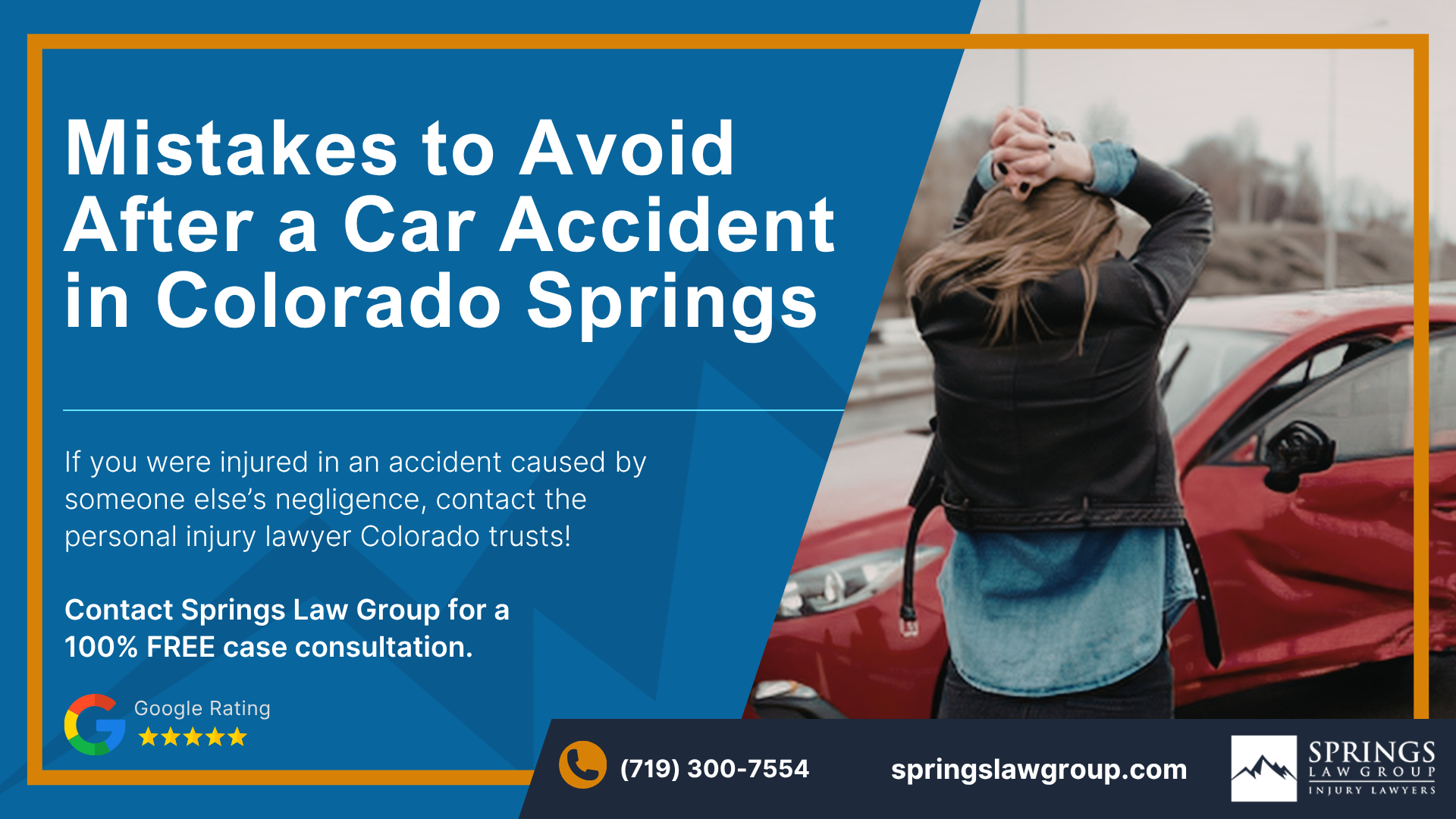
Common mistakes people make after a car accident in Colorado Springs include admitting fault before the crash has been investigated, delaying medical treatment, losing evidence, and accepting a settlement before the extent of your injuries is known.
Insurance companies may use recorded statements, medical records, and social media activity to dispute liability or question the severity of your injuries.
Signing a settlement release or missing a filing deadline can have lasting consequences for your ability to recover compensation.
If you have already made a mistake, additional evidence or a truthful explanation of the circumstances may help address the problem.
If you were injured in a collision, our Colorado Springs car accident lawyers can evaluate your claim, address insurance disputes, and help protect your legal rights.
Contact Springs Law Group for a free consultation, or use the chat feature on this page to discuss your accident with our legal team.
Under C.R.S. § 42-4-1606, Colorado drivers involved in crashes resulting in injury, death, or property damage generally must immediately notify the appropriate law enforcement agency.
Even a minor accident can result in a reporting obligation, and failing to report it as required can complicate the insurance claims process.
A police report may document the identities of the drivers, witness accounts, vehicle damage, traffic citations, and the responding officer’s observations.
Police officers are not required to investigate or prepare a report for every minor collision, although the statute provides exceptions to that rule when a participant requests an investigation or a participant cannot show proof of insurance.
Auto accidents on private property may also be subject to reporting requirements, depending on the circumstances.
You should also notify your own insurance company promptly and comply with the notice and cooperation requirements of your policy.
Delayed reporting can lead to disputes about insurance coverage or make it more difficult to verify what happened.
A car crash can be a traumatic experience, particularly when other vehicles or passengers are involved or someone has suffered serious injuries.
Try to stay calm, check on other passengers, and move to a safe location if possible.
You may not know whether the other driver was paying attention before impact or which circumstances contributed to the collision.
An apology or a statement accepting responsibility may be cited by an insurance adjuster when evaluating your claim, even if the statement does not establish legal liability.
Provide truthful information to responding officers and exchange information with the other parties involved in the crash.
Distinguish what you personally observed from what you assume happened.
Avoid guessing about vehicle speeds, distances, or another driver’s actions when you do not know the answer.
Establishing fault in a car accident may require reviewing traffic laws, witness statements, vehicle damage, and other evidence that was not available at the crash scene.
These details can help determine fault without relying solely on statements made immediately after the collision.
Some people assume they escaped injury because they do not experience symptoms immediately after a car accident.
The body’s fight-or-flight response to a collision, which involves the release of adrenaline, may temporarily reduce awareness of pain.
According to the Centers for Disease Control and Prevention (CDC), symptoms of a concussion or mild traumatic brain injury may take hours or days to appear.
Common injuries such as whiplash, herniated discs, and other soft tissue injuries may also produce symptoms that become more noticeable after the collision.
Internal injuries may not be obvious at the accident scene, making appropriate medical evaluation important even when there are no visible wounds.
Seek prompt medical care after an accident and obtain emergency medical attention if you develop symptoms such as worsening headaches, repeated vomiting, weakness, or loss of consciousness.
Delaying treatment may leave an injury untreated and allow an insurance company to question whether the collision caused your symptoms.
Gaps in medical treatment may make it more difficult to document your recovery, the severity of your injuries, and the need for additional care.
Follow your medical provider’s treatment recommendations, attend follow-up appointments, and report changes in your symptoms accurately.
If transportation difficulties, financial concerns, or insurance problems prevent you from attending an appointment, discuss those barriers with your provider.
Missing an appointment does not automatically invalidate a personal injury claim, but accurate medical documentation can help explain interruptions in care.
Important evidence may disappear within days of a collision as vehicles are repaired, surveillance footage is overwritten, and witnesses become harder to locate.
A police report is useful, but it may not provide enough information to resolve every dispute over liability.
Collect information at the accident scene when it is safe to do so, without interfering with emergency responders or putting yourself at risk.
Evidence to collect and preserve after a car accident may include:
If a nearby business or residence has a security camera that may have recorded the crash, identify its location so that the footage can be requested before it is erased.
Before disposing of or repairing a vehicle involved in a serious collision, consider whether additional photographs, inspections, or preservation measures are necessary.
An attorney can help preserve relevant electronic vehicle data or arrange an inspection when the circumstances warrant further investigation.
The other driver’s insurance adjuster may request a recorded statement shortly after the accident.
Adjusters may seek to minimize payouts by disputing fault, questioning medical treatment, or challenging the amount of compensation requested, particularly when claimants lack legal representation.
Questions may concern how the collision happened, your medical history, the extent of your injuries, or your activities since the crash.
An incomplete answer about your symptoms or a speculative statement about fault may later be compared with medical records, witness statements, and other evidence.
You generally are not required to provide a recorded statement to the other driver’s liability insurance company simply because it requests one.
Your own insurance policy, however, may require you to cooperate with an investigation, provide information, or participate in a statement or examination.
Consider seeking professional guidance from legal counsel before giving a recorded statement so that you understand your obligations and the purpose of the request.
Keep copies of written correspondence and notes of important conversations with insurance representatives.
An insurance company may ask you to sign a medical authorization allowing it to obtain healthcare records.
Medical history can be relevant to a claim, particularly when there is a dispute about whether a collision aggravated a preexisting condition.
However, a broadly worded authorization may permit access to records extending well beyond the injuries involved in the accident.
Review which records the insurer is requesting, the time period covered, and whether the authorization is reasonably limited to the issues involved.
An attorney can explain your disclosure obligations and help you respond to requests without concealing relevant information.
Insurance companies and defense attorneys may review social media activity to investigate how an accident occurred or challenge the injuries reported in a personal injury claim.
Posting about the accident on social media can create a permanent record of statements made before you know the full extent of your injuries.
Even posts unrelated to the collision may become relevant if they appear inconsistent with your account of your recovery.
Social media activity that may create problems during a car accident claim includes:
A photograph of someone hiking or attending a social event does not establish that the person has fully recovered or experienced no pain during the activity.
However, an insurance company may use that photograph to question reported physical limitations.
Social media evidence may also support your claim when relevant posts by another driver suggest distraction, impairment, or other negligent conduct before the crash.
The timing and context of those posts must be evaluated alongside other evidence.
Do not delete or alter potentially relevant posts, photographs, or messages to prevent them from being used in a car accident claim.
In Terra Management Group, LLC v. Keaten, 2025 CO 40, the Colorado Supreme Court held that the duty to preserve relevant evidence arises when a party knows or should know that litigation is underway or reasonably foreseeable.
Destroying evidence in violation of that duty can have legal consequences, including court-imposed sanctions.
Potentially relevant posts and messages should be left unchanged while you obtain advice about your preservation obligations.
Avoid posting about the accident, injuries, or settlement negotiations while your claim remains unresolved.
Changing privacy settings does not guarantee that existing posts will remain inaccessible, and an attorney can advise you on managing your accounts while complying with preservation obligations.
Medical bills and vehicle repair estimates may represent only a portion of the financial losses resulting from a car accident.
If your injuries prevent you from working, require additional care, or interfere with everyday activities, those consequences should be documented.
Records that may help support a request for compensation include:
Keep these records as expenses arise rather than attempting to reconstruct them months later during settlement negotiations.
Insurance companies may make quick settlement offers to resolve claims before the full extent of an accident victim’s losses is known.
A quick settlement may address emergency medical bills and initial vehicle repair costs while underestimating concealed vehicle damage, future treatment, reduced earning capacity, or lasting physical pain.
Although an early offer may provide welcome financial relief, you should understand the extent of your injuries and anticipated medical expenses before agreeing to a final bodily injury settlement.
You can generally reject an initial offer or negotiate for additional compensation supported by the evidence.
When settling a car accident case, consider both the proposed payment and the claims you will be giving up.
An enforceable settlement release generally prevents you from pursuing further compensation from the released parties for the claims covered by the agreement.
If your injuries worsen or additional medical expenses arise, you may be unable to recover those costs through the resolved claim.
Property damage and bodily injury claims can be settled separately, but the wording of a release determines which claims are resolved.
Before accepting payment for vehicle repairs, review the agreement to determine whether it also releases claims for physical injuries.
Our attorneys can review a proposed settlement and identify provisions that may affect unresolved claims or additional sources of insurance coverage.
Under C.R.S. § 13-80-101(1)(n), Colorado generally allows three years from the date a motor vehicle injury claim accrues to commence a lawsuit.
Certain claims have different deadlines or additional notice requirements.
For example, claims against government entities may require written notice within 182 days after discovery of the injury under C.R.S. § 24-10-109.
Ongoing insurance negotiations do not automatically extend the statute of limitations.
Missing an applicable deadline may prevent you from pursuing an otherwise valid claim.
Seek legal advice early if you are uncertain about the filing deadline or the identity of the responsible parties.
Making even a costly mistake after a collision does not necessarily prevent you from recovering compensation.
Additional medical records may explain delayed symptoms, and witness accounts or video footage may resolve inconsistencies in an earlier statement.
If evidence is missing, other documentation may help establish what happened.
Do not attempt to correct a previous mistake by changing your account inaccurately, deleting relevant records, or withholding information from your attorney.
Preserve the available evidence and explain the circumstances truthfully.
Although common missteps such as missing a medical appointment may be addressed with additional documentation, more damaging mistakes, such as signing an enforceable settlement release or missing a filing deadline, can be difficult to overcome.
An attorney can evaluate how the mistake affects your claim and determine which legal options remain available.
At Springs Law Group, we represent individuals injured in car accidents throughout Colorado Springs and the surrounding communities.
Our Colorado Springs personal injury lawyers can investigate your accident, preserve available evidence, review insurance requests, and address disputes concerning fault or medical treatment.
We negotiate with insurance companies to pursue fair compensation for your injuries and financial losses, and we can explain the consequences of accepting a settlement before you sign an agreement.
Our law firm handles qualifying personal injury cases on a contingency fee basis, meaning you do not pay attorney fees unless we recover compensation on your behalf.
Contact Springs Law Group for a free case evaluation, or use the chat feature on this page to discuss your car accident claim.
Seek prompt medical attention even if you feel fine, as symptoms of concussions, back injuries, and soft tissue damage may not appear immediately.
Prompt medical care helps establish a documented link between the collision and your injuries.
Document all communication with insurance companies for your records, including emails, letters, settlement offers, and notes from phone conversations.
You are generally not required to give a recorded statement to the other driver’s insurance company, although your own insurance policy may include cooperation requirements.
Consult a car accident attorney before providing recorded statements or signing insurance documents that could affect your right to recover compensation.
Yes, an apology does not automatically establish that you caused the accident or prevent you from pursuing a personal injury claim.
The circumstances of the collision, applicable traffic laws, and available evidence must be considered when determining liability.
Not necessarily, but an insurance company may question whether your injuries resulted from the crash or whether additional treatment was necessary.
Medical records and an accurate explanation of the reasons for the gap may help address those concerns.
Yes, even private posts can be screenshotted by friends or followers and shared publicly.
Relevant content may also be obtained through lawful discovery procedures during litigation.
Privacy settings do not make relevant information immune from disclosure, so preserve potentially relevant content and consult your attorney before changing or deleting it.
You may still be able to support your claim using police reports, witness statements, vehicle damage photographs, surveillance recordings, or other available evidence.
Gathering that information promptly may reduce the risk of further evidence loss.
Consider contacting a personal injury attorney as soon as reasonably possible, particularly if you suffered serious injuries, liability is disputed, or an insurance company requests a recorded statement or settlement release.
Early legal guidance can help you understand your obligations, preserve evidence, and make informed decisions about your claim.

Member of the Colorado Bar Association since 2014. Attorney, Christopher M. Nicolaysen focuses primarily on helping those injured in Colorado car accidents, other auto accidents, and Colorado personal injury incidents.
This article has been written and reviewed for legal accuracy and clarity by the team of writers and attorneys at Springs Law Group and is as accurate as possible. This content should not be taken as legal advice from an attorney. If you would like to learn more about our owner and experienced Colorado personal injury lawyer, Christopher Nicolaysen, you can do so here.
Springs Law Group does everything possible to make sure the information in this article is up to date and accurate. If you need specific legal advice about your case, contact us. This article should not be taken as advice from an attorney.
We use reviews to help show more people like you why we do what we do!

I was uneasy about reaching out to a law firm after being in an accident that left me injured and my vehicle totaled. I don’t care for the idea of suing for what was very clearly an accident. However, after learning more about the overall process of working with a professional team to navigate the murky waters of the insurance world, I was pleasantly surprised to find that the experience wasn’t as gross as I’d originally felt about it.

Springs Law is very friendly and professional. I always felt that they were on my side and cared about my injury and what I was going through. I highly recommend them.

Springs Law Group is an amazing group to work with! I got into a rough accident, and they never ceased to let me know they were there working hard to help me in my hour of need. It was always very easy to reach out to someone if I had any questions, and they were always happy to answer any questions I had.
I never have a problem with getting a response when I need them – which is not the case with most other firms. They really truly care about each client. As a plus, they always have positive attitudes, which matters tremendously when you are in a stressful legal situation.

Big thanks to Mr. Jake Kimbell and his team for their assistance with my case. He helped me through an incredibly challenging part of my life, and most importantly helped navigate through the convoluted legal channels of my case. I cannot thank him and his team enough for their support.

The entire team at Springs Law group has been nothing but amazing. Jake and the rest of the staff were great to work with and extremely professional. They were very attentive and answered any questions and concerns I had. I was always able to contact them and they were very responsive and communicated with me.

Springs Law Group is an amazing group to work with! I got into a rough accident, and they never ceased to let me know they were there working hard to help me in my hour of need. It was always very easy to reach out to someone if I had any questions, and they were always happy to answer any questions I had.