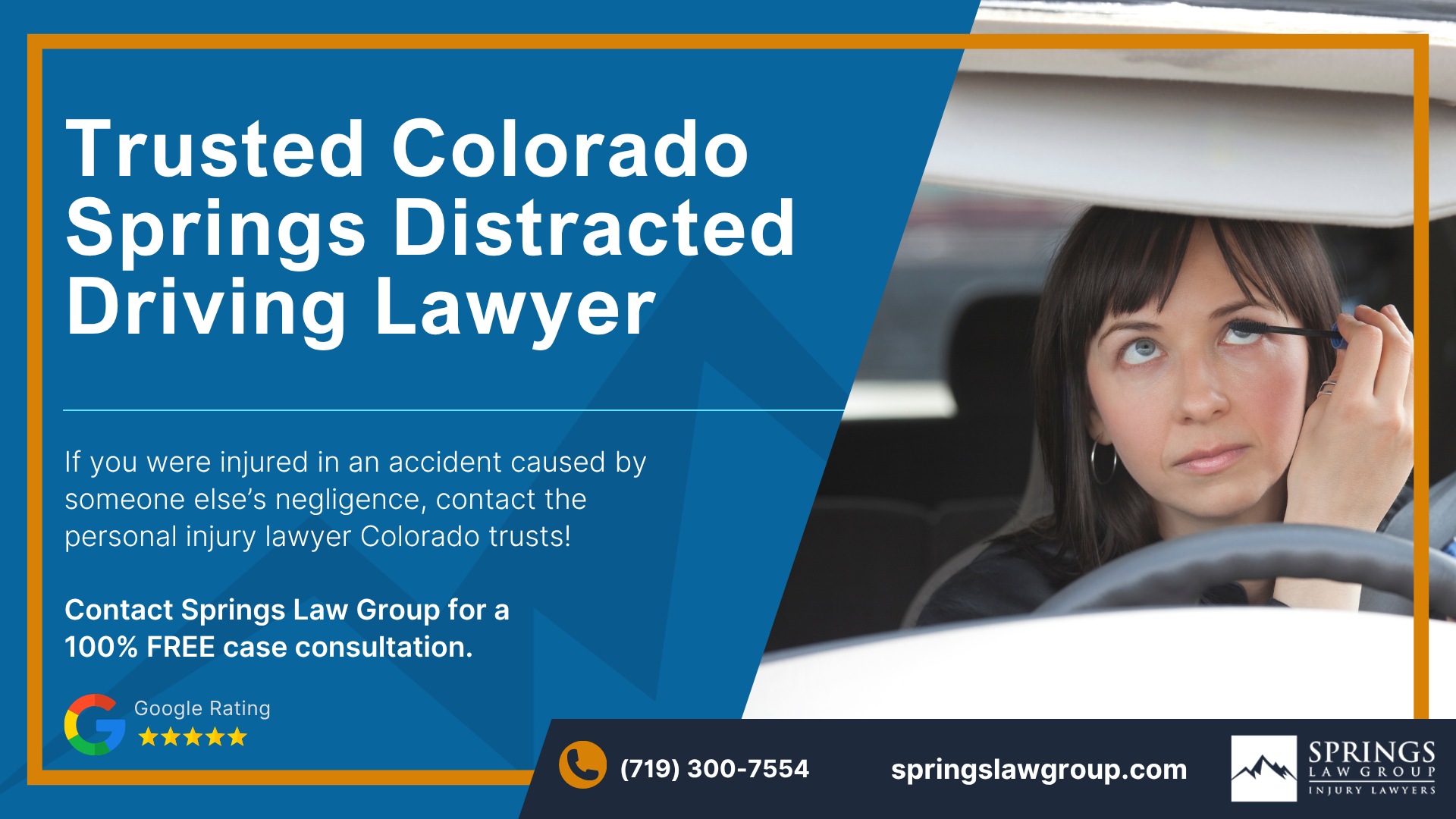
Distracted driving accidents occur when motorists divert their attention from the road to use a mobile phone, adjust navigation, interact with passengers, or engage in other activities behind the wheel.
Colorado’s hands-free driving law restricts the use of mobile electronic devices while driving, but motorists may also be negligent when other distractions interfere with safe driving.
Cell phone records, witness statements, camera footage, and vehicle data may help establish whether driver distraction contributed to a collision.
If a distracted driver caused your accident, you may be entitled to compensation for medical bills, lost income, pain and suffering, and other losses resulting from the other driver’s negligence.
If you or a loved one suffered injuries in a distracted driving accident, our Colorado Springs distracted driving lawyers can investigate the collision and pursue compensation from the responsible parties.
Contact Springs Law Group for a free consultation, or use the chat feature on this page to connect with our Colorado Springs car accident lawyers.
Distracted driving is one of several causes of car accidents in Colorado Springs and can involve any activity that diverts a driver’s attention from the task of operating a vehicle safely.
Distracted driving statistics from the National Highway Traffic Safety Administration (NHTSA) show that 3,208 people died and an estimated 315,167 were injured in motor vehicle accidents involving distracted drivers in 2024.
According to NHTSA campaign data, 8% of all fatal crashes nationwide that year involved a distracted driver.
The Colorado Department of Transportation (CDOT) reports that 71% of Colorado drivers admitted to using their phones while driving in 2025.
The Centers for Disease Control and Prevention (CDC) identifies three types of driver distraction:
A single activity can involve all three types of distraction, limiting a driver’s ability to recognize hazards and react in time.
Texting while driving combines visual, manual, and cognitive distractions because the driver may be looking at a screen, handling a device, and concentrating on a message instead of the road.
According to NHTSA, reading or sending a text message can divert a driver’s eyes from traffic for approximately five seconds.
At 55 mph, a vehicle can travel roughly the length of a football field during that time.
Checking social media, reading emails, and watching videos can create similar risks.
Even a hands-free phone call may distract a driver who becomes too focused on the conversation to notice changing traffic conditions.
Cell phone use is not the only form of distracted driving that can contribute to a car accident.
Other potentially dangerous distractions include:
Passenger interactions and phone use are also concerns for teen drivers.
A study by the AAA Foundation for Traffic Safety found potentially distracting behaviors in approximately 59% of the 2,229 teen driver crashes studied between 2007 and 2015.
An activity does not have to violate Colorado’s cell phone restrictions to constitute negligence if it interferes with safe driving and contributes to a crash.
Colorado’s updated hands-free law took effect on January 1, 2025, expanding previous restrictions on texting while driving.
Under C.R.S. § 42-4-239, drivers generally cannot hold or manually use a mobile electronic device while operating a motor vehicle, subject to statutory exceptions.
Colorado’s hands-free driving law includes the following restrictions and exceptions:
The state restriction also exempts qualifying commercial driver’s license holders operating commercial vehicles, although federal motor carrier regulations separately restrict handheld phone use by commercial drivers.
A first violation of Colorado’s hands-free law carries a $75 fine and two license points.
A second offense within 24 months carries a $150 fine and three points, while a third or subsequent offense within that period carries a $250 fine and four points.
Qualifying offenders may obtain a dismissal by providing proof of purchasing a hands-free accessory and meeting the statutory requirements for a one-time dismissal.
Traffic convictions and accumulated license points can also affect driving privileges and may result in higher auto insurance premiums.
Distracted drivers may face additional penalties for careless driving or reckless behavior that meets the legal requirements for a reckless driving offense.
Colorado’s hands-free law still applies when a motorist is temporarily stopped at a red light or waiting in traffic.
A vehicle stopped in ordinary traffic is not considered lawfully parked for purposes of the exception.
Drivers who look down at their phones while waiting at an intersection may overlook pedestrians, changing traffic signals, or vehicles beginning to move ahead of them.
A distracted driver may miss brake lights, fail to notice a vehicle entering an intersection, or drift across lane markings before realizing that a collision is imminent.
On I-25, motorists who look away from traffic may fail to recognize sudden slowdowns near highway exits or construction zones.
At intersections along Powers Boulevard, Academy Boulevard, and Woodmen Road, inattention can lead to missed traffic signals or unsafe turns.
Distracted driving can contribute to several types of collisions, including:
The absence of timely braking or evasive action can turn a moment of inattention into a devastating crash, particularly on highways where vehicles are traveling at higher speeds.
In distracted driving cases, establishing what the at-fault driver was doing immediately before impact can be difficult, particularly when they deny using a phone.
Unlike drunk driving cases, which may involve blood alcohol concentration test results, distracted driving accident claims often require evidence of a specific activity or lapse in attention.
Police officers may document suspected distraction in an accident report, but they do not necessarily have access to the electronic records or witness accounts needed to establish what happened.
Evidence may include:
Preserving evidence early can be important because camera footage may be overwritten, electronic records may become unavailable, and damaged vehicles may be repaired or destroyed.
Cell phone records may identify calls or messages that occurred around the time of a collision.
However, a record showing that a message was delivered does not necessarily establish that the driver read it or interacted with the device before impact.
Additional device activity records or forensic analysis may help determine whether a motorist was actively using a phone when the accident occurred.
A distracted driving accident attorney may seek relevant electronic evidence through preservation requests, formal discovery, subpoenas, or other lawful procedures as appropriate.
Obtaining these records can be an important part of the legal process when the circumstances of an auto accident are disputed.
Witnesses may recall seeing a motorist looking at a screen or turning away from traffic immediately before a collision.
Video recordings and vehicle event data can also help identify whether a driver failed to brake, maintain their lane, or react to a visible hazard.
Delayed braking alone does not prove that a driver was using a cell phone.
Accident reconstruction experts may compare vehicle movements, available reaction time, roadway conditions, and electronic records to assess whether driver inattention contributed to the crash.
Under Colorado personal injury law, an injured person must establish that the other driver failed to exercise reasonable care and that this failure caused the accident and resulting injuries.
An admission of distraction is not necessary if other evidence supports the claim.
A traffic citation may support a personal injury claim, but it does not automatically establish civil liability.
Colorado’s mobile device law requires an officer issuing a citation under the statute to observe prohibited device use associated with careless or imprudent driving.
An injured person may still have grounds for a personal injury claim when the other driver was not issued a distracted driving ticket.
Our distracted driving attorneys can review the available evidence to help establish fault in a car accident, regardless of whether the investigating officer cited the other driver.
Colorado follows a modified comparative negligence system under C.R.S. § 13-21-111.
An injured person’s compensation may be reduced according to their percentage of fault, and recovery may be barred if their negligence is equal to or greater than that of the party against whom recovery is sought.
An insurance adjuster may acknowledge that the other driver was distracted but argue that you were speeding or failed to yield before the collision.
Such allegations do not establish shared fault without supporting evidence.
Distracted motorists may strike other vehicles, pedestrians, or cyclists without slowing down, resulting in serious or catastrophic injuries.
High-speed collisions can have devastating consequences even when a driver or passenger is wearing a seat belt.
Injuries resulting from distracted driving crashes may include:
Seek prompt medical attention after a collision, particularly if you experience severe pain, confusion, dizziness, numbness, or weakness.
Medical records help establish whether the accident caused your injuries, what medical treatment is necessary, and whether you sustained a permanent injury.
People injured by negligent drivers may be entitled to recover economic and noneconomic damages supported by the evidence and applicable Colorado law.
Compensation in a distracted driving accident claim may include:
In fatal distracted driving crashes, eligible surviving family members may have grounds to pursue a wrongful death lawsuit under Colorado law.
The value of a claim depends on the injuries suffered, available insurance coverage, evidence of liability, and the financial and personal consequences of the collision.
At Springs Law Group, we represent drivers, passengers, and other road users injured by negligent motorists throughout Colorado Springs and the surrounding communities.
Our Colorado Springs personal injury lawyers can investigate whether the other driver was distracted, pursue available electronic evidence, and document the full extent of your injuries and losses.
Our distracted driving accident lawyers negotiate with insurance companies to pursue full and fair compensation and are prepared to file a lawsuit when a qualifying claim cannot be resolved through settlement.
Our law firm handles qualifying personal injury cases on a contingency fee basis, meaning you do not pay attorney fees unless we recover compensation on your behalf.
Contact Springs Law Group for a free case evaluation, or use the chat feature on this page to discuss your distracted driving accident with our legal team.
Yes, a driver may be liable if a hands-free conversation or other permitted activity distracted them from traffic and contributed to a collision.
Compliance with Colorado’s mobile device restrictions does not eliminate a driver’s duty to operate their vehicle with reasonable care.
You may still have a valid personal injury claim even if the other driver denies using a phone.
Cell phone records, witness accounts, surveillance footage, and vehicle data may help determine whether the driver’s actions are consistent with their explanation of the crash.
After a serious accident, call 911, seek medical attention, and exchange contact and insurance information with the other driver when it is safe to do so.
If you observed the driver looking at a phone or engaging in another distracting activity, describe what you actually saw to the responding officer and record the details while they are fresh in your memory.
Collect witness contact information and preserve photographs or available recordings without attempting to access another driver’s phone yourself.
A personal injury attorney can help preserve additional evidence and advise you before you give a recorded statement to the other driver’s insurer.
Under C.R.S. § 13-80-101, Colorado generally allows three years to file a lawsuit for bodily injury arising from the use or operation of a motor vehicle.
Exceptions and separate deadlines may apply, including notice requirements for claims against public entities and different rules for wrongful death claims.
Insurance negotiations do not automatically extend the applicable filing deadline.
Consider seeking legal representation early if you suffered injuries and suspect the other driver was distracted.
A personal injury lawyer with experience handling car accident cases can assess the available evidence, identify potentially liable parties, and explain your options before you accept an insurance settlement.
Many Colorado car accident lawyers handle distracted driving cases on a contingency fee basis.
Springs Law Group offers free initial consultations and handles qualifying personal injury claims under this arrangement.
Our attorney fees are contingent on a recovery, and the written fee agreement explains how fees and case expenses are handled.

Member of the Colorado Bar Association since 2014. Attorney, Christopher M. Nicolaysen focuses primarily on helping those injured in Colorado car accidents, other auto accidents, and Colorado personal injury incidents.
This article has been written and reviewed for legal accuracy and clarity by the team of writers and attorneys at Springs Law Group and is as accurate as possible. This content should not be taken as legal advice from an attorney. If you would like to learn more about our owner and experienced Colorado personal injury lawyer, Christopher Nicolaysen, you can do so here.
Springs Law Group does everything possible to make sure the information in this article is up to date and accurate. If you need specific legal advice about your case, contact us. This article should not be taken as advice from an attorney.
We use reviews to help show more people like you why we do what we do!

I was uneasy about reaching out to a law firm after being in an accident that left me injured and my vehicle totaled. I don’t care for the idea of suing for what was very clearly an accident. However, after learning more about the overall process of working with a professional team to navigate the murky waters of the insurance world, I was pleasantly surprised to find that the experience wasn’t as gross as I’d originally felt about it.

Springs Law is very friendly and professional. I always felt that they were on my side and cared about my injury and what I was going through. I highly recommend them.

Springs Law Group is an amazing group to work with! I got into a rough accident, and they never ceased to let me know they were there working hard to help me in my hour of need. It was always very easy to reach out to someone if I had any questions, and they were always happy to answer any questions I had.
I never have a problem with getting a response when I need them – which is not the case with most other firms. They really truly care about each client. As a plus, they always have positive attitudes, which matters tremendously when you are in a stressful legal situation.

Big thanks to Mr. Jake Kimbell and his team for their assistance with my case. He helped me through an incredibly challenging part of my life, and most importantly helped navigate through the convoluted legal channels of my case. I cannot thank him and his team enough for their support.

The entire team at Springs Law group has been nothing but amazing. Jake and the rest of the staff were great to work with and extremely professional. They were very attentive and answered any questions and concerns I had. I was always able to contact them and they were very responsive and communicated with me.

Springs Law Group is an amazing group to work with! I got into a rough accident, and they never ceased to let me know they were there working hard to help me in my hour of need. It was always very easy to reach out to someone if I had any questions, and they were always happy to answer any questions I had.