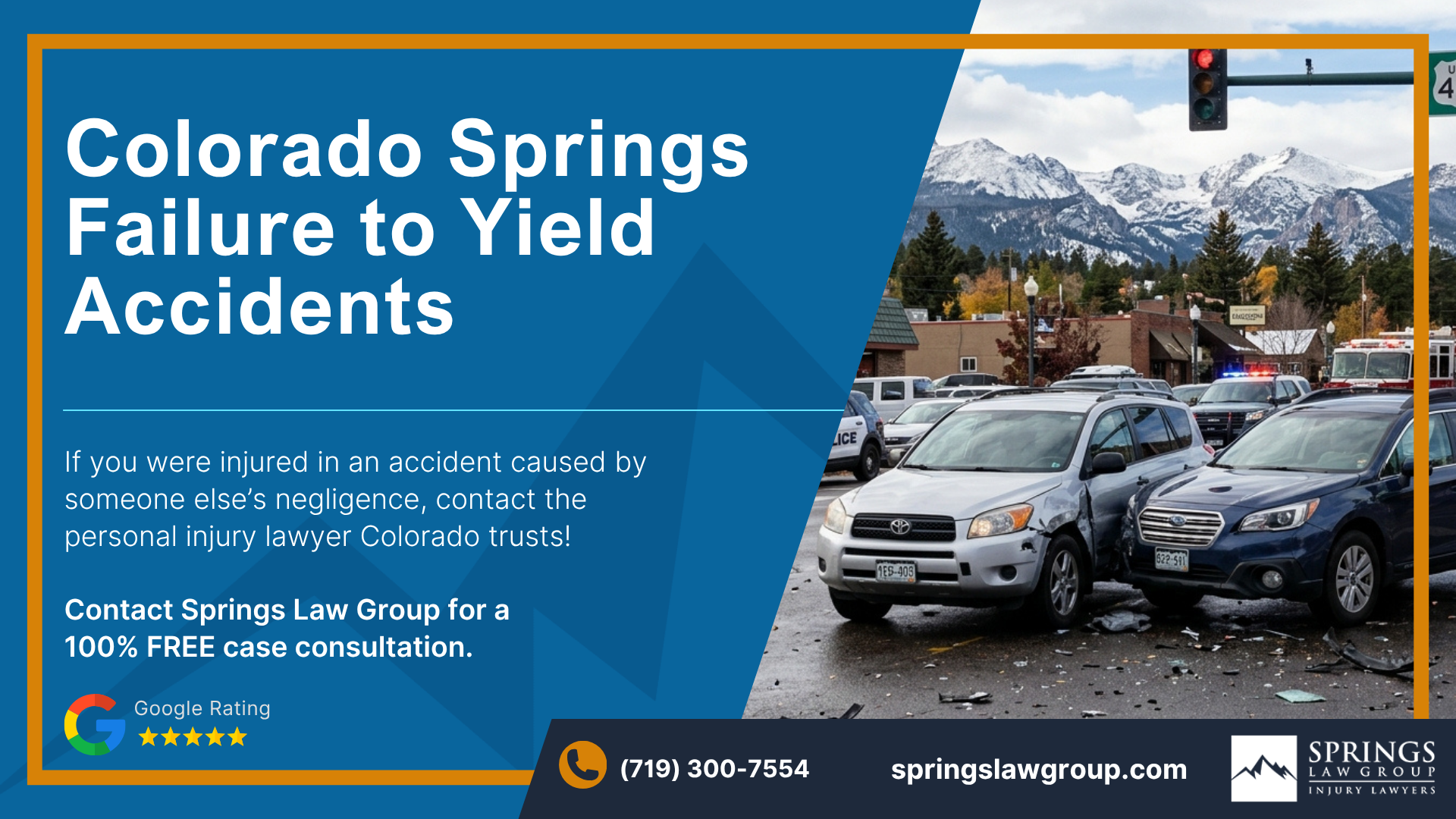
Failure to yield accidents occur when a driver does not give another motorist, pedestrian, or bicyclist the right of way required under Colorado traffic laws.
These collisions can happen at intersections, stop signs, traffic signals, and locations where drivers turn across oncoming traffic or enter a roadway.
Determining fault may require establishing which right-of-way rule applied, whether either driver violated a traffic law, and how their actions contributed to the collision.
People injured in failure to yield accidents may be entitled to compensation for medical expenses, lost wages, pain and suffering, and other accident-related losses.
If you were injured because another driver failed to yield, our Colorado Springs car accident lawyers can investigate the collision and pursue compensation from the responsible parties.
Contact Springs Law Group for a free consultation, or use the chat feature on this page to discuss your accident with our legal team.
Failure to yield is one of the common causes of car accidents in Colorado Springs and occurs when a driver proceeds without giving another road user the required priority.
The duty to yield depends on the traffic controls, direction of travel, and circumstances surrounding the intended maneuver.
Colorado’s right-of-way laws include the following requirements:
A driver’s failure to follow one of these requirements may establish liability if it causes a car accident and resulting injuries.
Busy intersections and multilane roads along Powers Boulevard, Academy Boulevard, Woodmen Road, and Austin Bluffs Parkway can present challenges when drivers misjudge gaps in traffic or overlook other road users.
Failure to yield can result in several types of car accidents, including side-impact collisions, head-on crashes, and accidents involving pedestrians or bicyclists.
Drivers may fail to yield because they are distracted, impatient, or attempting to turn before approaching traffic has cleared.
According to NHTSA data compiled by the Insurance Information Institute, failure to yield was reported for 4,656 drivers and motorcycle operators involved in fatal crashes in 2024, or 8.4% of those drivers.
It ranked third among the specifically identified driving behaviors in that year’s data.
An uncontrolled intersection has no stop signs, yield signs, or traffic signals directing which vehicle should proceed.
Under C.R.S. § 42-4-701, when vehicles approach or enter an intersection from different roads at approximately the same time, the driver on the left generally must yield to the driver on the right.
The rule is subject to exceptions, including those governing through highways.
In a disputed collision, the timing of each vehicle’s arrival and any other applicable traffic rules may affect fault.
Colorado law requires motorists approaching a stop sign to stop at the designated location and yield to vehicles within the intersection or approaching closely enough to create an immediate hazard.
A driver of a vehicle entering a stop-controlled intersection must still yield when required, even after coming to a complete stop.
A driver approaching a yield sign must reduce their speed to a reasonable level, stop if necessary for safety, and yield as required before entering the intersection.
Common violations at stop signs and yield signs include:
Under C.R.S. § 42-4-703, a collision after a driver passes a yield sign without stopping may constitute prima facie evidence of a failure to yield under the circumstances specified in the statute.
This can support a finding of a right-of-way violation without conclusively establishing civil liability.
A driver turning left at an intersection or into a driveway, alley, or private road must yield to oncoming vehicles within the intersection or close enough to present an immediate hazard under C.R.S. § 42-4-702.
These accidents often happen when motorists attempt an unprotected left turn and misjudge the speed or distance of approaching traffic.
For example, a driver turning across several lanes of Academy Boulevard may enter the path of a vehicle traveling straight through the intersection.
The resulting side-impact or T-bone car crash can cause severe injuries, particularly to occupants seated near the point of impact.
The turning driver may be primarily responsible, but an approaching motorist who was speeding or disregarding a traffic signal may also share fault.
A green traffic light does not eliminate every obligation to yield.
Drivers approaching controlled intersections must observe the following signal requirements:
Drivers who turn right on red without checking cross traffic or attempt a left turn before oncoming vehicles have passed may cause a failure to yield accident.
Under C.R.S. § 42-4-704, drivers entering or crossing a roadway from a driveway, parking lot, or other location that is not another roadway must yield to approaching vehicles.
A motorist leaving a commercial parking lot may cause a collision by pulling into traffic before there is sufficient space to enter safely.
Additional duties apply when entering or leaving property across a sidewalk under C.R.S. § 42-4-710.
Drivers entering from a side street may be subject to different rules depending on the traffic controls and configuration of the intersection.
Under C.R.S. § 42-4-705, drivers must yield to an approaching authorized emergency vehicle using qualifying warning signals.
Motorists must move toward the right edge of the roadway, clear of intersections, and stop until emergency vehicles such as ambulances, police cars, or fire trucks have passed, unless a police officer directs otherwise.
Under Colorado Springs City Code § 10.23.112, drivers must also yield to properly identified vehicles in an escorted funeral procession, subject to the ordinance’s exceptions and directions from officers.
Drivers turning at intersections or entering roadways must look for pedestrians and bicyclists as well as approaching motor vehicles.
Under C.R.S. § 42-4-802, drivers must yield to pedestrians in qualifying crosswalk situations when the statutory conditions are met.
A driver making a right turn on a green light must still yield to pedestrians lawfully crossing in an adjacent crosswalk.
Colorado generally grants bicyclists the rights and duties applicable to motor vehicle drivers under C.R.S. § 42-4-1412, subject to specific exceptions.
The Colorado bicycle safety-stop law also allows qualifying cyclists to treat certain stop signs as yield signs and red lights as stop signs when the statutory conditions are satisfied.
Determining fault requires considering the location of each road user, applicable traffic signals, and whether the parties had a reasonable opportunity to avoid the collision.
The driver who failed to yield may be legally responsible when their negligence caused the accident and resulting injuries.
However, the right-of-way violation does not automatically establish that the driver bears all responsibility for the collision.
For example, a driver who turns left across oncoming traffic may violate Colorado law, while the approaching driver may also contribute to the collision by traveling at an unsafe speed.
Establishing fault in a Colorado Springs car accident requires evaluating the conduct of each party and how their actions contributed to the crash.
Drivers may disagree about which vehicle had a green light, arrived first at an intersection, or had sufficient time to complete a turn.
An investigation into conflicting right-of-way claims may consider:
Evidence of distracted driving may also be relevant when a motorist failed to observe approaching traffic or a pedestrian before entering an intersection.
Colorado follows a modified comparative negligence rule under C.R.S. § 13-21-111.
In a typical two-driver case, an injured person who is less than 50% at fault may recover compensation reduced by their percentage of negligence.
If their proven damages total $100,000 and they are found 20% responsible, those damages are generally reduced to $80,000 before other applicable limitations.
An injured person who is 50% or more responsible generally cannot recover damages from the other driver in that case.
Cases involving several defendants or designated nonparties may require additional analysis.
An insurance adjuster may allege that you share responsibility for a traffic accident, but that assessment is not a binding determination of fault.
The evidence needed to establish a right-of-way violation depends on the type of intersection, applicable traffic controls, and disputed actions of the drivers involved.
Evidence may include:
Traffic signal timing plans may help clarify permitted movements, but they do not necessarily establish which signal was displayed at the precise moment of a collision.
In disputed traffic accident cases, accident reconstruction experts may use electronic vehicle data and physical evidence to assess whether an approaching vehicle presented an immediate hazard when another driver began turning.
Collecting and preserving car accident evidence promptly can help prevent the loss of recordings and other records needed to resolve disputed liability.
Under Colorado law, failure to yield in violation of C.R.S. §§ 42-4-701 through 42-4-704 is classified as a class A traffic infraction.
A police officer may issue a traffic citation for an alleged right-of-way violation, while a personal injury claim concerns civil responsibility for injuries and losses resulting from the collision.
Under C.R.S. § 42-4-1713, records of convictions for violations of Colorado’s traffic code are generally inadmissible in civil actions.
The underlying conduct may nevertheless support a negligence claim, including negligence per se in appropriate circumstances.
The injured person must still establish that the violation caused their injuries or other compensable losses.
The absence of a traffic ticket does not prevent someone from pursuing a claim supported by other evidence.
Failure to yield collisions frequently involve vehicles striking one another from the side or at an angle, potentially causing serious injuries to drivers and passengers.
Whiplash is a common injury associated with car accidents and may occur when a failure to yield collision causes the head and neck to move abruptly.
Other physical injuries may include broken bones, head injuries such as concussions, spinal cord injuries, and internal organ damage.
Economic damages compensate for financial losses such as medical bills, lost income, and property damage, while noneconomic damages may compensate for the personal consequences of an injury.
Recoverable damages in a qualifying personal injury claim may include:
If a collision results in fatal injuries, eligible surviving family members may have grounds to pursue a wrongful death lawsuit.
The compensation available depends on the injuries suffered, evidence of liability, applicable insurance coverage, and Colorado law.
When settling a car accident case, consider whether the proposed payment accounts for ongoing medical needs and other reasonably anticipated losses.
If you or a loved one suffered injuries because another driver failed to yield, our experienced attorneys at Springs Law Group can help you understand your legal rights.
Our legal team can gather evidence of the right-of-way violation, obtain available traffic and vehicle records, and challenge unsupported allegations that you contributed to the accident.
We negotiate with insurance companies to pursue fair compensation for your injuries and financial losses and explain your legal options if further legal action becomes necessary.
Our law firm handles qualifying personal injury cases on a contingency fee basis, meaning you do not pay attorney fees unless we recover compensation on your behalf.
Contact Springs Law Group for a free case evaluation, or use the chat feature on this page to discuss your failure to yield accident with our attorneys.
Drivers must stop and yield to traffic already in the intersection or approaching closely enough to present an immediate hazard.
At a four-way stop, the first vehicle to arrive and come to a complete stop generally proceeds first when it is safe to do so.
When drivers arrive at approximately the same time from different roads, the driver on the left generally yields to the driver on the right.
Drivers turning left must also observe applicable duties to yield to oncoming traffic.
Yes, having the right of way does not relieve a driver of the duty to exercise reasonable care.
Speeding, distraction, or another negligent action may affect the allocation of fault if it contributed to the collision.
Yes, witness statements, police reports, photographs, vehicle damage, and available electronic vehicle data may help establish a right-of-way violation without a video recording.
An accident reconstruction expert may also help evaluate the sequence of events when the available evidence warrants further investigation.
A failure to yield violation may result in fines, applicable court costs, and points against your driver’s license.
Accumulating too many points can result in suspension of your driving privileges.
A failure to yield violation may also increase automobile insurance premiums, depending on the insurer and applicable insurance laws.
These consequences are separate from liability for injuries caused by the collision.
You are not required to hire an attorney, but legal help may be useful if the insurance company disputes fault or offers less compensation than your documented losses support.
A car accident lawyer can explain the legal process, evaluate settlement offers, and discuss whether filing a lawsuit is appropriate.
Most civil cases are resolved without a trial, often through settlement, although some end through court rulings instead.
Under C.R.S. § 13-80-101(1)(n), Colorado generally allows three years from the date a motor vehicle injury claim accrues to commence a lawsuit.
Exceptions and separate notice requirements may apply, including when a public entity is involved.
Ongoing negotiations with insurance companies do not automatically extend the applicable filing deadline.

Member of the Colorado Bar Association since 2014. Attorney, Christopher M. Nicolaysen focuses primarily on helping those injured in Colorado car accidents, other auto accidents, and Colorado personal injury incidents.
This article has been written and reviewed for legal accuracy and clarity by the team of writers and attorneys at Springs Law Group and is as accurate as possible. This content should not be taken as legal advice from an attorney. If you would like to learn more about our owner and experienced Colorado personal injury lawyer, Christopher Nicolaysen, you can do so here.
Springs Law Group does everything possible to make sure the information in this article is up to date and accurate. If you need specific legal advice about your case, contact us. This article should not be taken as advice from an attorney.
We use reviews to help show more people like you why we do what we do!

I was uneasy about reaching out to a law firm after being in an accident that left me injured and my vehicle totaled. I don’t care for the idea of suing for what was very clearly an accident. However, after learning more about the overall process of working with a professional team to navigate the murky waters of the insurance world, I was pleasantly surprised to find that the experience wasn’t as gross as I’d originally felt about it.

Springs Law is very friendly and professional. I always felt that they were on my side and cared about my injury and what I was going through. I highly recommend them.

Springs Law Group is an amazing group to work with! I got into a rough accident, and they never ceased to let me know they were there working hard to help me in my hour of need. It was always very easy to reach out to someone if I had any questions, and they were always happy to answer any questions I had.
I never have a problem with getting a response when I need them – which is not the case with most other firms. They really truly care about each client. As a plus, they always have positive attitudes, which matters tremendously when you are in a stressful legal situation.
Big thanks to Mr. Jake Kimbell and his team for their assistance with my case. He helped me through an incredibly challenging part of my life, and most importantly helped navigate through the convoluted legal channels of my case. I cannot thank him and his team enough for their support.

The entire team at Springs Law group has been nothing but amazing. Jake and the rest of the staff were great to work with and extremely professional. They were very attentive and answered any questions and concerns I had. I was always able to contact them and they were very responsive and communicated with me.

Springs Law Group is an amazing group to work with! I got into a rough accident, and they never ceased to let me know they were there working hard to help me in my hour of need. It was always very easy to reach out to someone if I had any questions, and they were always happy to answer any questions I had.