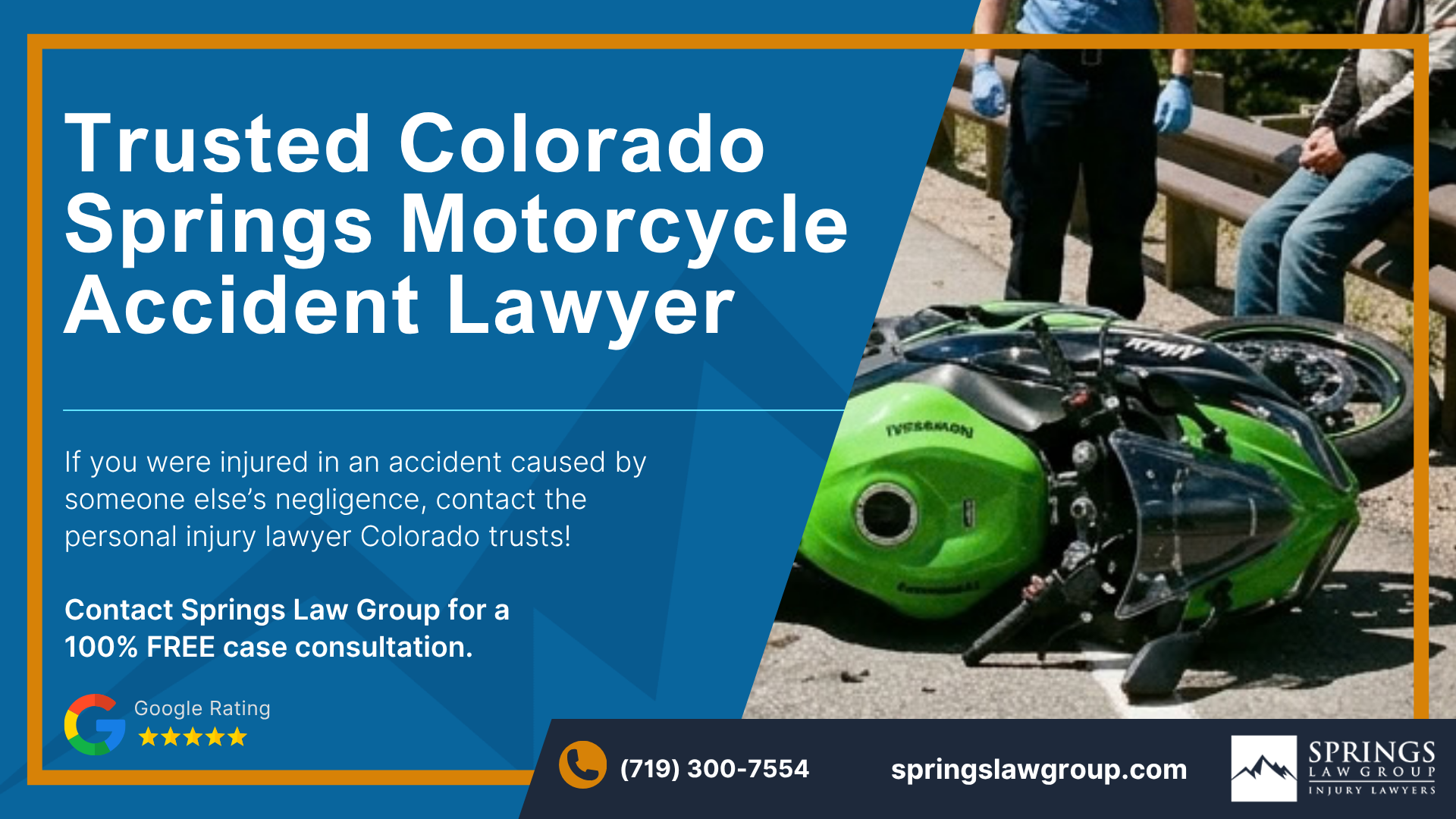
A motorcycle accident can leave injured riders facing serious injuries, emergency treatment, lost wages, motorcycle repairs, and questions about who was responsible for the crash.
Unlike passenger car occupants, motorcyclists have little protection from direct impact with another vehicle or the roadway, making severe injuries possible even when the other vehicle has limited damage.
A driver who turns left across a motorcycle’s path, changes lanes without looking, or follows too closely may cause injuries that require months of treatment or result in permanent limitations.
Motorcycle accident victims must establish more than the fact that a collision occurred: their claims must connect an at-fault party’s negligence to the injuries and losses being claimed.
Springs Law Group represents injured motorcyclists in Colorado Springs and the surrounding El Paso County area.
Our Colorado Springs personal injury lawyers offer free consultations to discuss disputed fault, insurance coverage, motorcycle injuries, and the legal options available after a serious crash.
If you suffered injuries because of a negligent driver, contact Springs Law Group or use the chat feature to discuss your potential case with our legal team.
Motorcycle accident cases can involve disputes that are less common in ordinary car accident claims, including whether a driver saw the rider, how the motorcycle was positioned in a lane, and whether the rider was lawfully filtering through stopped traffic.
Springs Law Group’s founder, Christopher Nicolaysen, identifies motorcycle accident representation as part of his practice, and the firm represents clients with serious motor vehicle injuries throughout Colorado.
The law firm has two published Colorado Springs office locations:
A local motorcycle accident lawyer can evaluate roadway conditions and traffic controls on routes such as I-25, Highway 24, and Powers Boulevard without assuming a location itself establishes negligence.
Motorcycle accident clients comparing firms may want to ask about relevant experience, Colorado motorcycle safety rules, and how the legal team addresses technical disputes.
An experienced motorcycle accident attorney may recognize when accident reconstruction experts could help establish vehicle movements, braking distances, or visibility before a crash.
Whether expert testimony is necessary depends on the available evidence and the issues in dispute.
Springs Law Group offers free consultations and represents qualifying personal injury clients on a contingency fee basis, with attorney fees governed by the written agreement rather than an upfront hourly charge.
The firm’s published case-handling approach includes reviewing evidence, presenting claims to insurers, and preparing for litigation when appropriate.
Many motorcycle accidents arise amid disputes over another driver’s maneuver, the rider’s actions, a defective component, or an unsafe roadway condition.
Determining fault requires examining the movements of the vehicles involved, visibility, speed, right-of-way, and other circumstances that contributed to the collision.
Some claims also require examining mechanical failures, roadway conditions, or the conduct of parties who were not directly involved in the crash.
Common circumstances that may require investigation include:
According to the Colorado Department of Transportation (CDOT), Colorado recorded 165 motorcycle fatalities in 2024, the highest annual total reported through that year.
Motorcyclists accounted for approximately 24% of all Colorado traffic fatalities that year, despite motorcycles representing a much smaller share of registered vehicles.
CDOT reported that 73 of the 165 motorcyclists killed in 2024 (44%) were not wearing helmets and that impairment was involved in 20% of motorcycle fatalities that year.
These statewide figures do not establish the cause of an individual crash or negligence by an unhelmeted adult rider.
According to CDOT’s preliminary 2025 data, Colorado recorded 147 motorcycle fatalities in 2025, an 11% decrease from the previous year.
A driver who looks toward an intersection but misjudges a motorcycle’s speed or distance may turn across its path.
When a collision happens during a lane change, damage patterns, witness statements, roadway markings, and available video may help establish which vehicle moved and whether the maneuver could be made safely.
A motorist’s statement that the motorcycle was difficult to see does not, by itself, prove that either person was negligent.
Truck drivers must account for large blind spots and the additional space needed to turn or merge without entering a motorcyclist’s path.
Some crashes require evaluating the responsibilities of a trucking company, repair contractor, or vehicle owner in addition to the driver’s actions.
See our Colorado Springs truck accident lawyer page for more information about commercial-vehicle liability.
Where a pothole, roadway condition, or defective motorcycle part contributed to a crash, determining responsibility depends on the legal duties involved and evidence of the defect and its role in the injury.
Motorcycle-specific traffic laws may be relevant when determining whether an injured rider or another driver contributed to a collision.
They do not automatically decide liability, because the rule must apply to the situation and any violation must have a legally sufficient connection to the crash.
Colorado’s motorcycle lane-filtering law, enacted in 2024, permits qualifying riders on two-wheeled motorcycles to pass vehicles stopped in traffic under limited conditions.
Lawful lane filtering requires, among other conditions:
Lane splitting between lines of moving vehicles remains prohibited.
A collision that occurs while a rider is filtering does not automatically mean the rider was at fault, and the circumstances must be reviewed against the actual requirements in force on the accident date.
Under Senate Bill 24-079, the lane-filtering authorization is scheduled to expire on September 1, 2027, unless the law is changed.
Under C.R.S. Section 42-4-1502, Colorado requires motorcycle riders and passengers under age 18 to wear compliant protective helmets, but generally does not require adult riders to wear them.
C.R.S. Section 42-4-232 also requires appropriate eye protection for motorcycle operators and passengers, with specified exceptions for helmets that incorporate suitable eye protection.
An adult rider’s decision not to wear a helmet is not, by itself, negligence under Colorado law.
In Dare v. Sobule, the Colorado Supreme Court held that evidence of a rider’s failure to wear a protective helmet is inadmissible to establish comparative negligence or mitigate damages.
A negligence claim usually requires proof that a person or business owed a duty of care, breached that duty, and caused legally recoverable injuries or losses.
The responsible party depends on the facts, and more than one defendant may be involved.
Potentially liable parties may include:
A vehicle owner’s name on a registration, or a business’s connection to a shipment, does not alone establish legal responsibility.
The most useful evidence depends on whether the dispute concerns right-of-way, speed, lane position, visibility, roadway conditions, or a mechanical failure.
Relevant evidence may include:
A police report can be informative, but an officer’s initial fault assessment does not conclusively decide civil liability.
Physical evidence at the accident scene should be documented before damaged equipment is repaired or discarded, and relevant recordings may be overwritten as time passes.
When needed, accident reconstruction experts may evaluate impact locations, braking, and vehicle movements.
Our guide to evidence after an accident explains additional types of records that may support a personal injury claim.
Insurance adjusters may question a rider’s speed, lane position, right-of-way, or compliance with motorcycle traffic rules.
Motorcycle crash victims may encounter unsupported assumptions about reckless riding, but a claim of insurer bias also requires evidence.
Those allegations should be evaluated against witness accounts, photographs, available recordings, and the applicable law rather than assumed to be correct.
Colorado’s modified comparative negligence law generally reduces damages by the injured person’s proven percentage of fault when recovery is permitted.
In an ordinary two-party negligence case, a claimant found 50% or more at fault cannot recover from the other party.
For example, $100,000 in proven damages would generally be reduced to $80,000 when the injured rider is found 20% responsible.
Cases involving multiple defendants or properly designated nonparties require additional fault-allocation analysis.
Our Colorado Springs comparative negligence guide explains these rules in more detail.
A rider may strike another vehicle, the pavement, or a roadside object during a motorcycle crash, leading to injuries that differ in severity and treatment needs.
Potential injuries include:
Some injuries require surgery, rehabilitation, physical therapy, or treatment that continues long after the accident.
Severe internal bleeding can be life-threatening, while spinal cord injuries and other catastrophic trauma may result in permanent disability.
The seriousness of a motorcycle accident claim depends on the documented injuries and their effects rather than assumptions about the crash.
Emergency medical care takes priority over collecting evidence, especially after a high-speed collision or a suspected head, neck, or spinal injury.
Seek immediate medical attention for severe bleeding, loss of consciousness, breathing difficulty, or possible internal bleeding, and obtain an appropriate evaluation for later symptoms.
If you are physically able and it is safe to act, these steps may help protect your health and the available record:
People unable to collect information because of their injuries may still have a viable claim, although other sources of evidence may be needed.
An injured motorcyclist may seek damages for losses legally attributable to another party’s negligence, subject to applicable law, insurance coverage, and the available proof.
Recoverable damages may include:
The amount available may depend on disputed fault, policy limits, injury severity, the extent of medical treatment, and applicable statutory restrictions.
A fair motorcycle accident settlement should account for supported future care, lost wages, pain and suffering, and lasting impairment rather than relying on repair costs alone.
If the crash caused a death, eligible family members may be able to bring separate Colorado Springs wrongful death claims under Colorado law.
For additional information, see our article on car accident damages and common injuries.
Colorado motorcycles must meet motor vehicle insurance requirements, including liability coverage of at least $25,000 for bodily injury or death per person, $50,000 per accident, and $15,000 for property damage, according to the Colorado General Assembly.
These minimum limits do not cap proven damages, and an at-fault driver’s insurance may be insufficient for severe injuries.
Motorcycle claims may involve a third-party claim against the other driver’s insurance company and benefits under an applicable uninsured or underinsured motorist policy.
The driver’s insurance company may offer a motorcycle accident settlement before the full medical prognosis is known or request a recorded statement that could be used to evaluate disputed facts.
Insurance adjusters may question medical treatment, injury severity, and pain and suffering, so compare any offer with documented losses, policy coverage, and deadlines before deciding whether it is a fair settlement.
An experienced motorcycle accident lawyer may help evaluate a proposed settlement and pursue fair compensation, but legal representation does not guarantee a larger award.
Our Colorado Springs insurance claim lawyer page explains insurance disputes in greater detail.
Under C.R.S. Section 13-80-101(1)(n), many lawsuits involving injuries arising from the use or operation of a motor vehicle must be filed within three years after the claim accrues.
For many motorcycle collisions, this period is measured from the crash, but exceptions and different accrual rules may apply.
Wrongful death actions generally have a separate two-year deadline under C.R.S. Section 13-80-102, subject to statutory exceptions.
Certain claims involving defective products may have different limitation periods.
For claims subject to the Colorado Governmental Immunity Act, C.R.S. Section 24-10-109 can require written notice within 182 days after discovery of the injury.
Negotiating with an insurer does not ordinarily pause the lawsuit deadline, and relevant video or physical evidence may disappear much sooner.
A serious motorcycle collision can involve disputed liability, expensive treatment, missed income, and long-term physical limitations.
The appropriate legal response depends on the cause of the crash, the evidence available, the parties responsible, and the applicable deadlines.
Springs Law Group offers free consultations for injured riders in Colorado Springs and the surrounding area.
Contact Springs Law Group for a free consultation, or use the website chat to discuss your motorcycle accident claim and the legal options available under Colorado law.
No standard amount applies to every motorcycle accident claim because liability, injury severity, insurance limits, and future losses differ.
Damages may include documented medical expenses, lost wages, reduced earning capacity, pain and suffering, and other legally recoverable losses.
No attorney can promise a particular settlement or maximum compensation.
A consultation may be useful when injuries require significant treatment, fault is disputed, or insurers question the claimed losses.
Before choosing a motorcycle accident attorney, ask about motorcycle-specific experience, comparable personal injury cases, and the evidence needed to establish responsibility.
A consultation does not require you to hire the firm or accept a proposed settlement.
Potentially, yes.
Colorado generally does not require motorcycle riders age 18 or older to wear helmets, and under Dare v. Sobule, failure to wear a helmet is not admissible to establish the injured rider’s negligence or reduce damages.
Other facts about the collision, injuries, and applicable traffic rules may still affect the claim.
Possibly.
Colorado permits lane filtering only when the applicable requirements are met, including stopped traffic, safe passing conditions, and a motorcycle speed of no more than 15 mph.
Whether either driver was negligent depends on the actual movements of the vehicles and the law in effect on the accident date.
A claim against an uninsured driver may still be possible, although collecting a judgment can present practical difficulties.
Uninsured motorist coverage under an applicable motorcycle or other qualifying policy may provide another potential source of benefits, subject to its terms and Colorado law.
Coverage limits, policy exclusions, and any required notice or reporting can affect the available recovery.
Yes, when the facts support a legal claim against a negligent rider, another driver, or another responsible party.
An injured passenger is not automatically negligent merely because they were riding on the motorcycle.
Available insurance policies and the circumstances of the collision can affect recovery.
A police report may help document the collision, but its absence does not automatically eliminate an injury claim.
Witness accounts, photographs, motorcycle damage, medical records, and other evidence may help establish what happened.
Motorists must still comply with applicable accident-reporting laws.
Not necessarily.
Some claims settle through insurance negotiations without a lawsuit, and litigation does not necessarily lead to a trial.
Filing may be necessary when fault or damages remain disputed, important evidence requires formal discovery, or a legal deadline is approaching.
Springs Law Group offers free consultations and uses contingency fee arrangements for qualifying personal injury matters.
Under this arrangement, an attorney’s fee generally depends on compensation recovered rather than an upfront hourly charge.
The written agreement should specify the fee percentage, treatment of case expenses, and any other financial obligations.

Member of the Colorado Bar Association since 2014. Attorney, Christopher M. Nicolaysen focuses primarily on helping those injured in Colorado car accidents, other auto accidents, and Colorado personal injury incidents.
This article has been written and reviewed for legal accuracy and clarity by the team of writers and attorneys at Springs Law Group and is as accurate as possible. This content should not be taken as legal advice from an attorney. If you would like to learn more about our owner and experienced Colorado personal injury lawyer, Christopher Nicolaysen, you can do so here.
Springs Law Group does everything possible to make sure the information in this article is up to date and accurate. If you need specific legal advice about your case, contact us. This article should not be taken as advice from an attorney.
We use reviews to help show more people like you why we do what we do!

I was uneasy about reaching out to a law firm after being in an accident that left me injured and my vehicle totaled. I don’t care for the idea of suing for what was very clearly an accident. However, after learning more about the overall process of working with a professional team to navigate the murky waters of the insurance world, I was pleasantly surprised to find that the experience wasn’t as gross as I’d originally felt about it.

Springs Law is very friendly and professional. I always felt that they were on my side and cared about my injury and what I was going through. I highly recommend them.

Springs Law Group is an amazing group to work with! I got into a rough accident, and they never ceased to let me know they were there working hard to help me in my hour of need. It was always very easy to reach out to someone if I had any questions, and they were always happy to answer any questions I had.
I never have a problem with getting a response when I need them – which is not the case with most other firms. They really truly care about each client. As a plus, they always have positive attitudes, which matters tremendously when you are in a stressful legal situation.
Big thanks to Mr. Jake Kimbell and his team for their assistance with my case. He helped me through an incredibly challenging part of my life, and most importantly helped navigate through the convoluted legal channels of my case. I cannot thank him and his team enough for their support.

The entire team at Springs Law group has been nothing but amazing. Jake and the rest of the staff were great to work with and extremely professional. They were very attentive and answered any questions and concerns I had. I was always able to contact them and they were very responsive and communicated with me.
Springs Law Group is an amazing group to work with! I got into a rough accident, and they never ceased to let me know they were there working hard to help me in my hour of need. It was always very easy to reach out to someone if I had any questions, and they were always happy to answer any questions I had.