
The #1 Colorado Springs Premises Liability Lawyer

Were You or A Loved One Injured in an Accident?
Get Free Answers In as Little as 3 Minutes
right-image
600
Written By:
Christopher Nicolaysen

Member of the Colorado Bar Association since 2014. Attorney, Christopher M. Nicolaysen focuses primarily on helping those injured in Colorado car accidents, other auto accidents, and Colorado personal injury incidents.

This article has been written and reviewed for legal accuracy and clarity by the team of writers and attorneys at Springs Law Group and is as accurate as possible. This content should not be taken as legal advice from an attorney. If you would like to learn more about our owner and experienced Colorado personal injury lawyer, Christopher Nicolaysen, you can do so here.

Springs Law Group does everything possible to make sure the information in this article is up to date and accurate. If you need specific legal advice about your case, contact us. This article should not be taken as advice from an attorney.

Our Law Firm Investigates Colorado Springs Premises Liability Cases

A Colorado Springs premises liability lawyer from Springs Law Group represents individuals who are injured due to dangerous or poorly maintained property conditions.

Property owners and businesses have a legal duty to keep their premises reasonably safe, and when they fail to do so, visitors can suffer serious injuries that disrupt daily life and long-term health.

Premises liability cases often involve slip and falls, unsafe walkways, negligent security, or other hazards that could have been prevented with proper care.

Springs Law Group helps injured clients hold negligent property owners accountable and pursue compensation for medical expenses, lost income, and the lasting impact of their injuries.

Colorado Springs Premises Liability Lawyer

Injured on Someone Else’s Property? Contact Springs Law Group Today

Under Colorado premises liability laws, property owners have a duty to exercise reasonable care to keep their premises safe for visitors.

When a property owner failed to address a known danger or allowed a hazardous condition to exist, serious injuries can occur. These incidents are often the result of property owner’s negligence, not unavoidable accidents.

Premises liability claims can arise from slip and falls, unsafe stairways, poor lighting, negligent security, or other dangerous conditions that place visitors at risk.

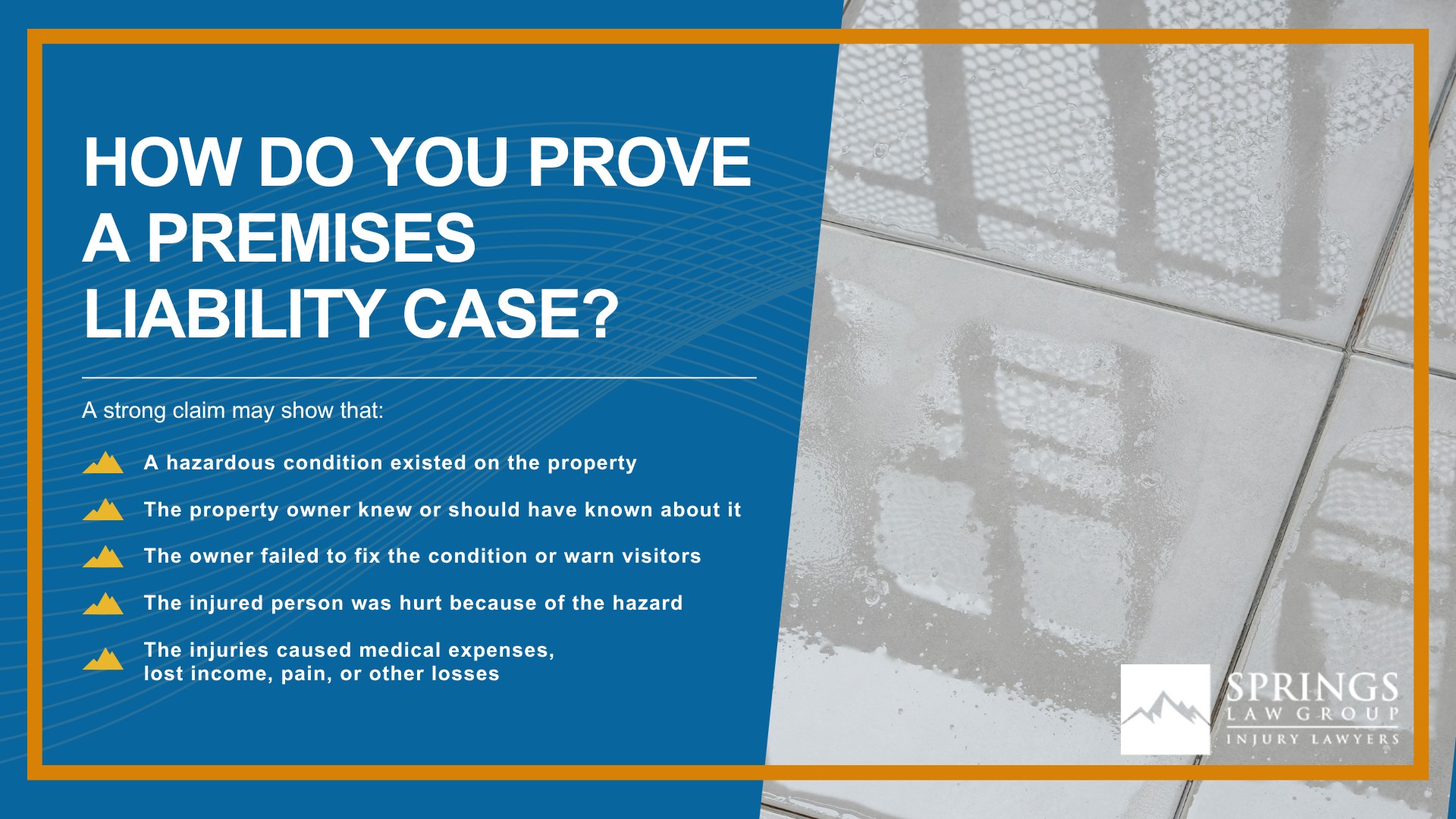
Proving liability requires showing that the property owner knew or should have known about the hazard and did not take appropriate steps to correct it.

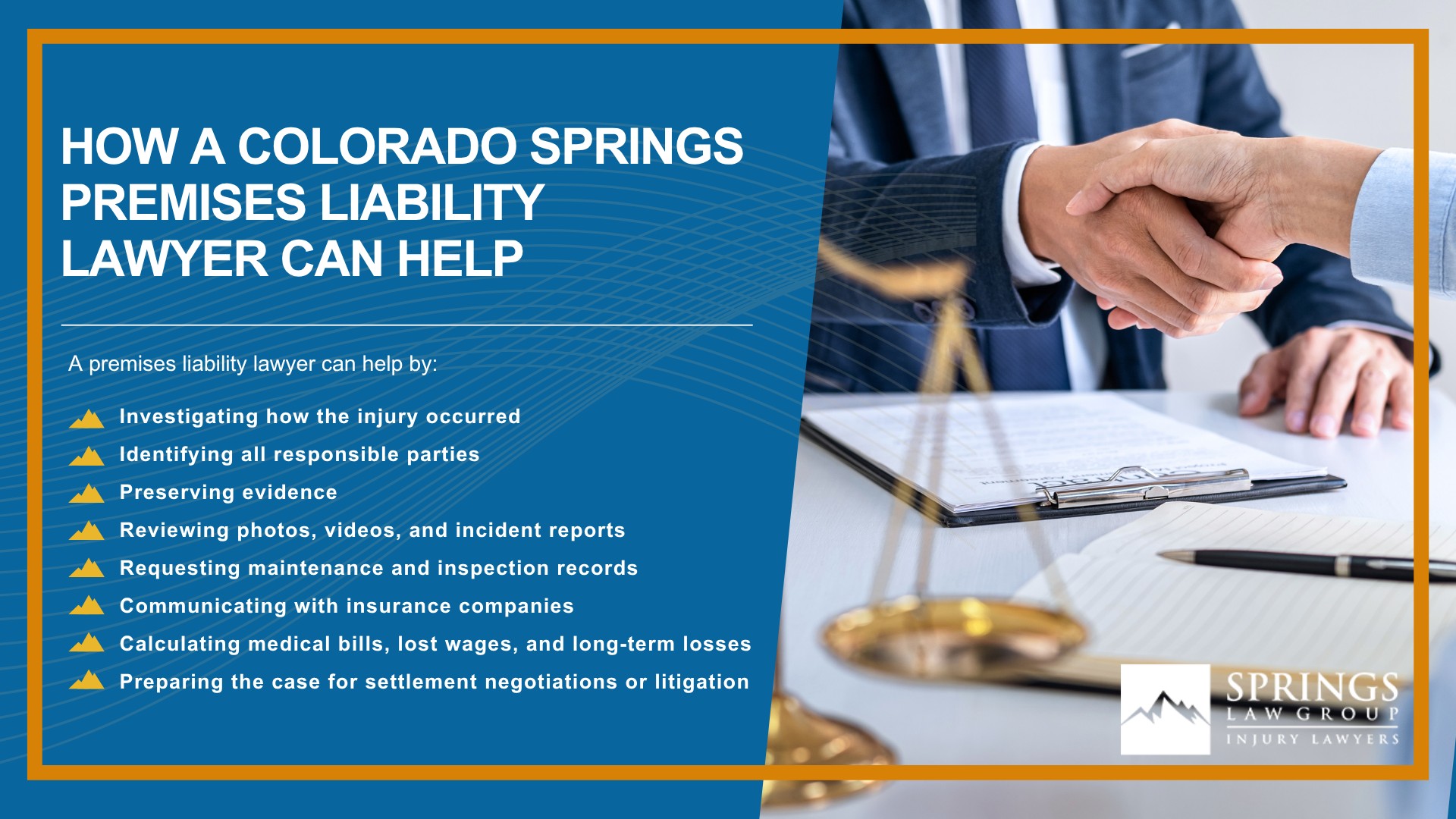
Premises liability attorneys investigate the circumstances of the accident, preserve critical evidence, and build a strong personal injury claim on behalf of the injured party.

If you were hurt because a negligent property owner failed to act responsibly, Springs Law Group can help you seek compensation for medical bills, lost wages, and other damages.

When the facts support liability, property owners and businesses can be held liable for the harm their negligence caused.

Contact us today for a free consultation.

You can also use the chat feature on this page to get in touch with our experienced premises liability attorneys today.

Table of Contents

What is Premises Liability in Colorado?

In Colorado, premises liability refers to the legal responsibility that a property owner or occupier has when someone is injured on another person’s property due to unsafe property conditions.

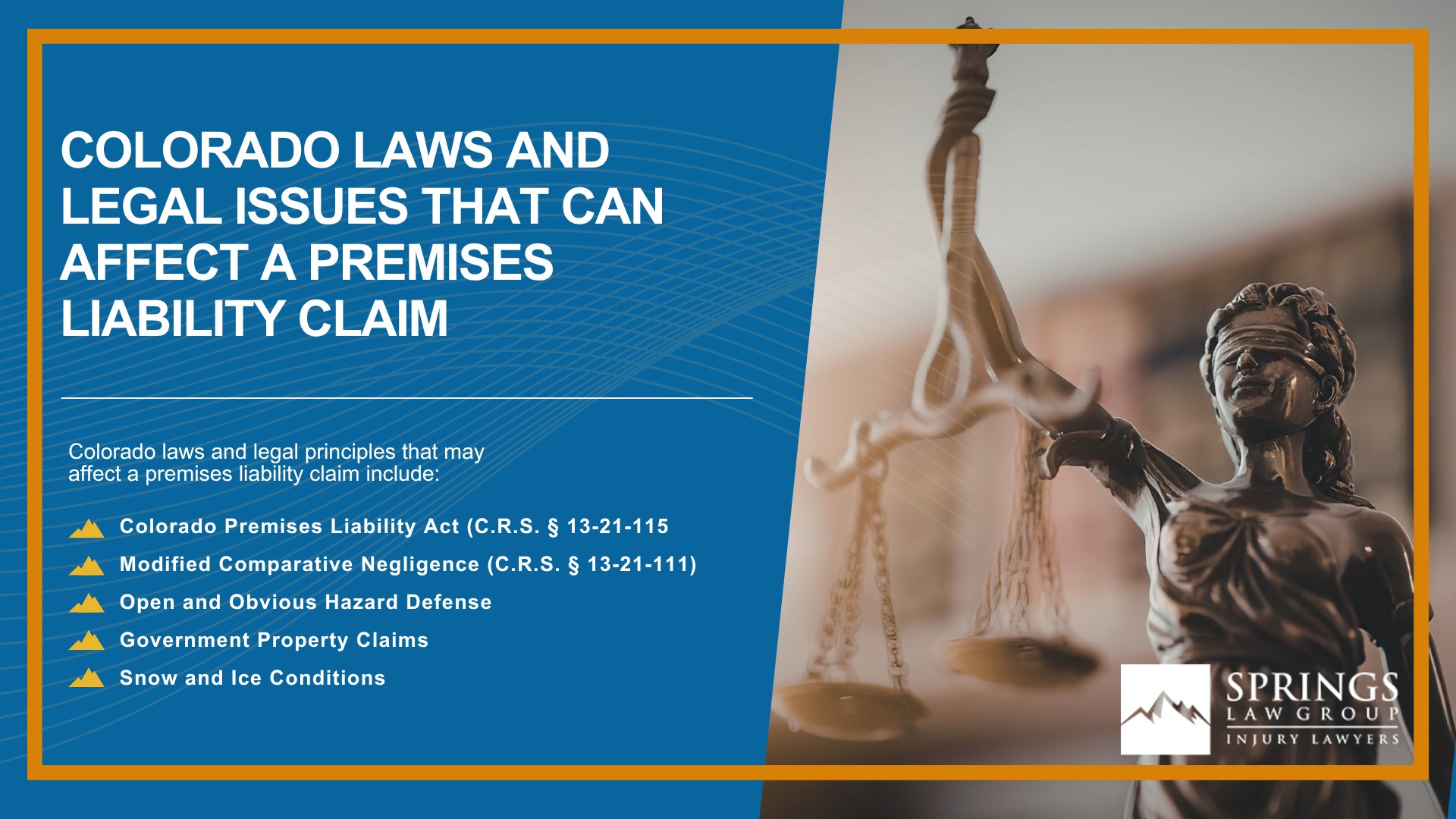
The governing statute is the Colorado Premises Liability Act, found at C.R.S. § 13-21-115, which establishes how and when landowners may be held liable for injuries that occur on their property.

Under this law, a property owner or someone like a landlord, property manager, or other person legally responsible for the condition of the land must exercise reasonable care to ensure that the premises are safe and free from hazards that could foreseeably harm others.

To succeed in a premises liability action, injury victims must show that the property owner was negligent in maintaining the property or failed to warn about dangerous conditions that he or she knew about or reasonably should have known about.

That means proving the owner breached their duty by allowing a dangerous condition to remain, and that this breach was a direct cause of the injury.

For example, if a store failed to clean up a spill or repair broken stairs, and someone slipped and fell as a result, that owner may be held responsible if the hazard was foreseeable and unaddressed.

Colorado’s statute also recognizes different duties depending on legal status (invitee, licensee, trespasser), but a common thread is whether the hazard posed a risk of foreseeable harm that could have been prevented through reasonable action or warning.

If a property owner’s failure to act led to a preventable injury, the injured person may be able to recover compensation for medical bills, lost wages, pain and suffering, and other damages.

A thorough investigation in each case helps determine whether the conditions that caused the harm were obvious or whether the owner had actual notice of the danger.

The Duty of Care: Who Must Keep Property Safe

In a premises liability case, responsibility does not fall only on the person who owns the land.

It extends to anyone who controls, manages, or maintains the property.

Colorado law focuses on who had the authority and ability to correct an unsafe condition, not just whose name appears on a deed.

When a dangerous condition exists and causes injury, the party with control over the property may be held legally responsible for the harm that follows.

Identifying the correct responsible party is a critical early step in any premises liability claim.

In many cases, multiple parties may share responsibility, depending on how the property is owned and operated.

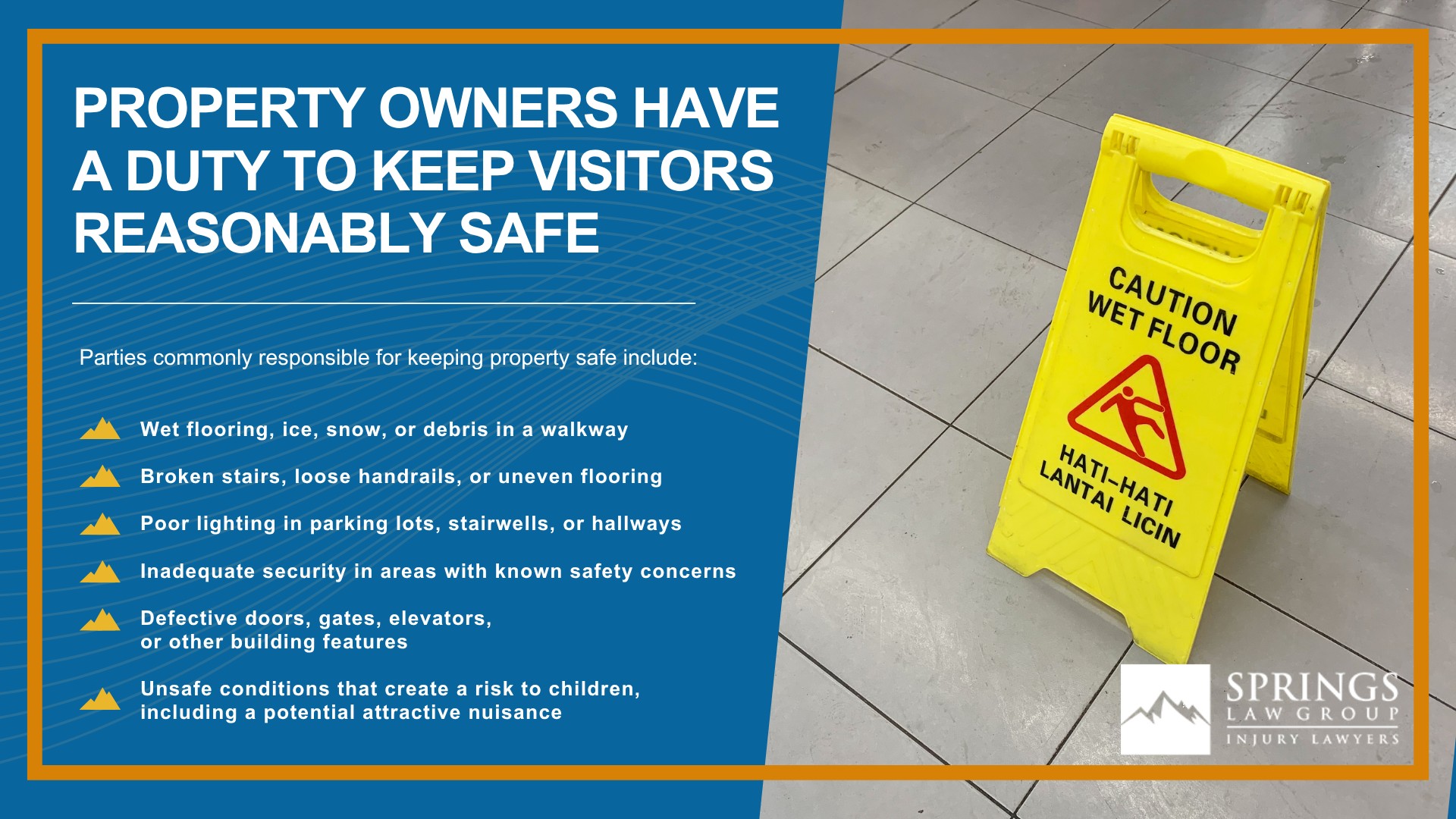
Parties commonly responsible for keeping property safe include:

  • Business owner: A business owner has a duty to maintain safe conditions for customers, vendors, and other invitees, including addressing spills, broken fixtures, and known hazards in a timely manner.
  • Store owner: Retail and grocery store owners are responsible for monitoring their premises, correcting hazards, and warning visitors of dangers that are not immediately obvious.
  • Private owners: Homeowners and landlords may be liable when guests or tenants are injured due to dangerous conditions they knew about or should have addressed.
  • Government entities: Cities, counties, and other public agencies can be responsible for injuries caused by unsafe sidewalks, public buildings, or poorly maintained public spaces, subject to specific notice and procedural rules.
  • Insurance company (indirect role): While an insurance company does not create the hazard, it often becomes the entity defending the claim and paying compensation when a property owner is found liable, making early evidence preservation essential.

How a Premises Liability Claim Works in Colorado

Under Colorado personal injury law, premises liability claims are governed primarily by the Colorado Premises Liability Act, which defines when a landowner or occupier may be held responsible for injuries on their property.

The law focuses on whether the property owner failed to act as a reasonable person would under similar circumstances to prevent foreseeable harm.

Liability often turns on whether the owner had actual knowledge of a dangerous condition or should have discovered it through reasonable inspection and maintenance.

Colorado courts also recognize special rules for children, including the attractive nuisance doctrine, which can impose liability when a hazardous condition is likely to attract children who cannot appreciate the risk.

The injured person must show that the dangerous condition existed, that it posed a foreseeable risk, and that the owner failed to take reasonable steps to fix it or provide an adequate warning.

Property owners frequently defend these cases by arguing the hazard was open and obvious or that they lacked notice of the condition.

Because these cases are fact-intensive and statute-driven, careful documentation and legal analysis are highly important from the start.

The general process for a Colorado premises liability claim includes:

  1. Investigation of the property condition, including photos, maintenance records, and witness statements to establish how the hazard developed.
  2. Determining notice, focusing on whether the owner had actual knowledge or should have known about the dangerous condition.
  3. Evaluating duty and breach, applying the reasonable person standard under Colorado law.
  4. Documenting injuries and damages, including medical records, wage loss, and long-term effects.
  5. Filing the claim or lawsuit, followed by negotiations with insurers or litigation if liability or damages are disputed.

Establishing Negligence in a Premises Liability Case

Establishing negligence is the foundation of any premises liability claim in Colorado.

To succeed, the injured person must show that the property owner failed to act reasonably and that this failure directly caused their own injury.

Courts look at whether the hazard was foreseeable, how long it existed, and whether the owner took appropriate steps to fix it or warn visitors.

Proving negligence requires evidence that the dangerous condition was more than a momentary or unavoidable issue.

Once these elements are shown, liability is determined based on how the owner’s conduct compares to the standard of reasonable care.

Negligence may be established in situations such as:

  • Failing to repair a known hazard after receiving complaints or maintenance reports
  • Allowing spills, ice, or debris to remain on walkways for an unreasonable period
  • Ignoring building code violations or safety regulations
  • Failing to provide adequate lighting, signage, or warnings for dangerous areas
  • Neglecting routine inspections that would have identified the hazard before an injury occurred

Comparative Negligence Laws and How They a Impact Premises Liability Lawsuit

In Colorado, when an injury occurs on another person’s property, a premises liability claim is generally governed by negligence principles and the comparative negligence rules set out in Colorado Revised Statutes § 13-21-111.

Under Colorado’s modified comparative negligence framework, a plaintiff’s damages are reduced in proportion to their own fault if they share responsibility for what happened.

This means that even if an injured person contributed to their injury, such as by not watching where they were walking, they may still recover compensation so long as their share of fault is less than the defendant’s.

Specifically, Colorado law allows an injured person to recover damages only if their negligence is less than that of the property owner or other defendants.

If a jury finds that the injured person’s fault is 50% or more, then they are barred from recovering any compensation at all.

In cases where the injured party is found partly at fault but less than 50% responsible, the total award will be reduced by that percentage; for example, a 20% fault allocation would reduce a $100,000 award to $80,000.

Because premises liability claims often hinge on exactly how a hazard arose, how long it existed, and what conduct led to the injury, comparative fault can be an important factor in deciding how much a property owner must pay.

The defense may attempt to argue that the injured person failed to exercise reasonable care for their own safety, which can significantly diminish the recovery if proven.

Proper legal strategy and evidence presentation can make a massive difference in how fault is allocated and how much compensation an injured victim ultimately receives under Colorado’s comparative negligence system.

Insurance Coverage in Premises Liability Claims

Insurance plays a central role in how injured people are compensated in Colorado premises liability cases.

When an injury occurs due to unsafe property conditions on another’s land, the property owner’s liability insurer is typically the first source of recovery, because most owners carry liability insurance to protect against claims arising from accidents on their property.

This type of insurance is often part of a commercial general liability policy for businesses or part of a homeowner’s liability coverage for private residences.

The purpose of such policies is to cover bodily injury and property damage that results from hazards the owner failed to correct or warn about, such as wet floors, uneven walkways, or poor lighting.

Colorado’s Premises Liability Act defines when injuries on property may lead to liability, and that framework typically triggers an insurer’s obligation to investigate and respond to claims.

Under personal injury law, injured individuals can make a claim directly against the owner’s insurer for damages tied to their accident, including medical bills, lost wages, and pain and suffering.

Insurance companies representing property owners often have teams dedicated to handling these claims, and they may attempt to minimize payouts by disputing fault or the severity of injuries.

Evidence such as maintenance records, inspection logs, incident reports, and photos of the hazard itself can be critical in convincing an insurer to acknowledge coverage and pay appropriate benefits.

In some circumstances, multiple insurance policies may apply.

For example, if a tenant’s business caused the hazardous condition in a leased space, both the tenant’s and property owner’s liability policies may be involved.

Similarly, if a government or public entity owns the land, sovereign immunity and unique notice rules can affect how coverage applies but generally do not negate a public entity’s obligation to carry liability protection.

Because arguing a coverage position against a liability insurer can be complicated and insurers are trained to protect their bottom line, working with an experienced attorney can improve your chances of securing the full compensation you deserve.

An attorney can handle communications with insurers, counter low settlement offers, and ensure that every applicable insurance source is pursued effectively so you are not left to cover your own losses.

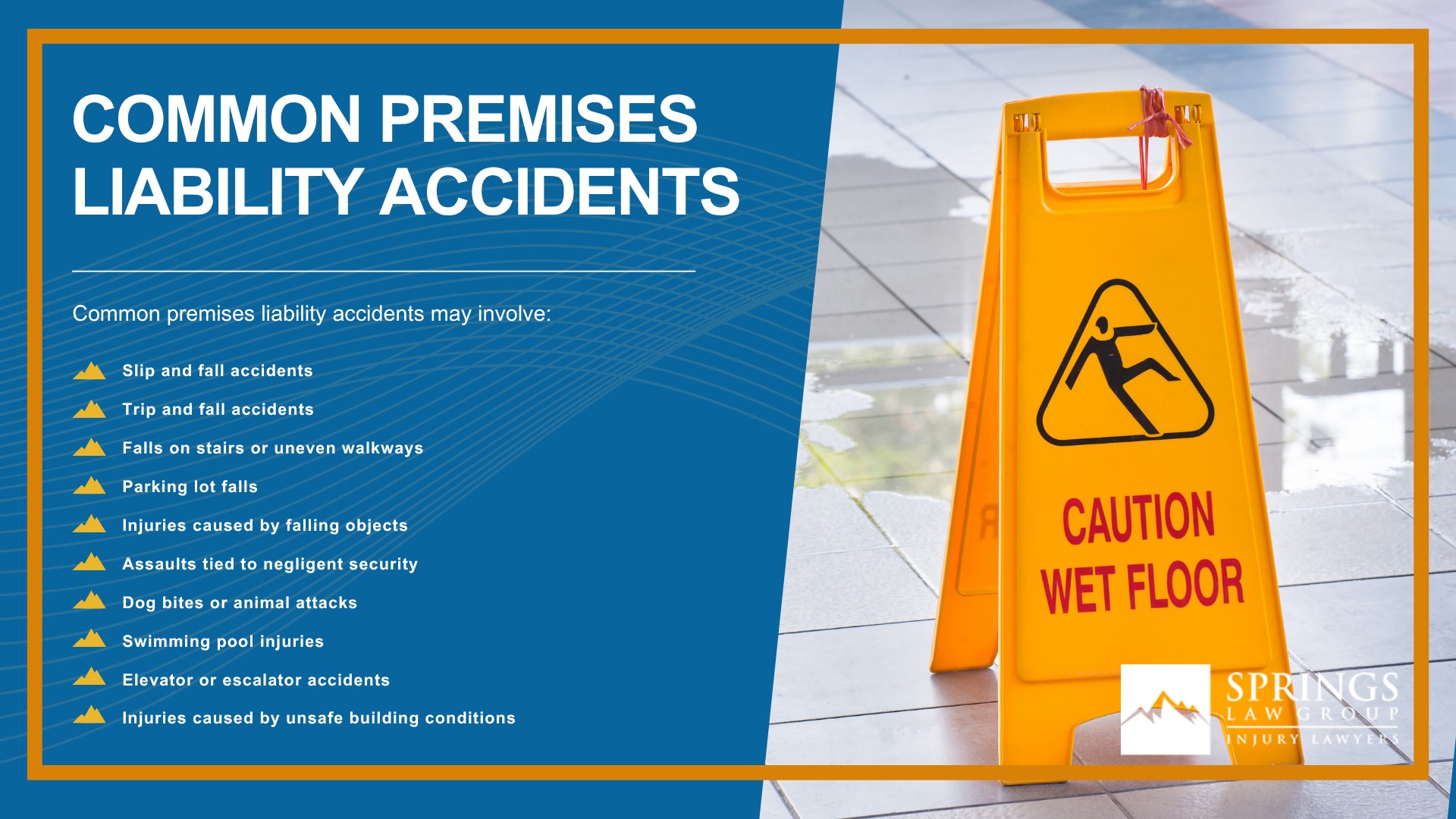
Common Types of Premises Liability Accidents

Premises liability accidents occur when a person is injured because a property was not maintained in a reasonably safe condition.

These incidents are not limited to a single type of hazard and often arise in everyday settings such as stores, apartment complexes, workplaces, and public spaces.

Many injuries happen suddenly, without warning, due to conditions the property owner knew about or should have addressed.

Identifying whether an injury falls within common premises liability cases requires looking at how the hazard developed, how long it existed, and whether the risk was foreseeable.

In many situations, victims do not immediately realize that their injury may be tied to a property owner’s legal obligations.

Understanding how these accidents occur is an important first step in determining whether a valid premises liability claim exists under Colorado law.

Slip and Fall Accidents

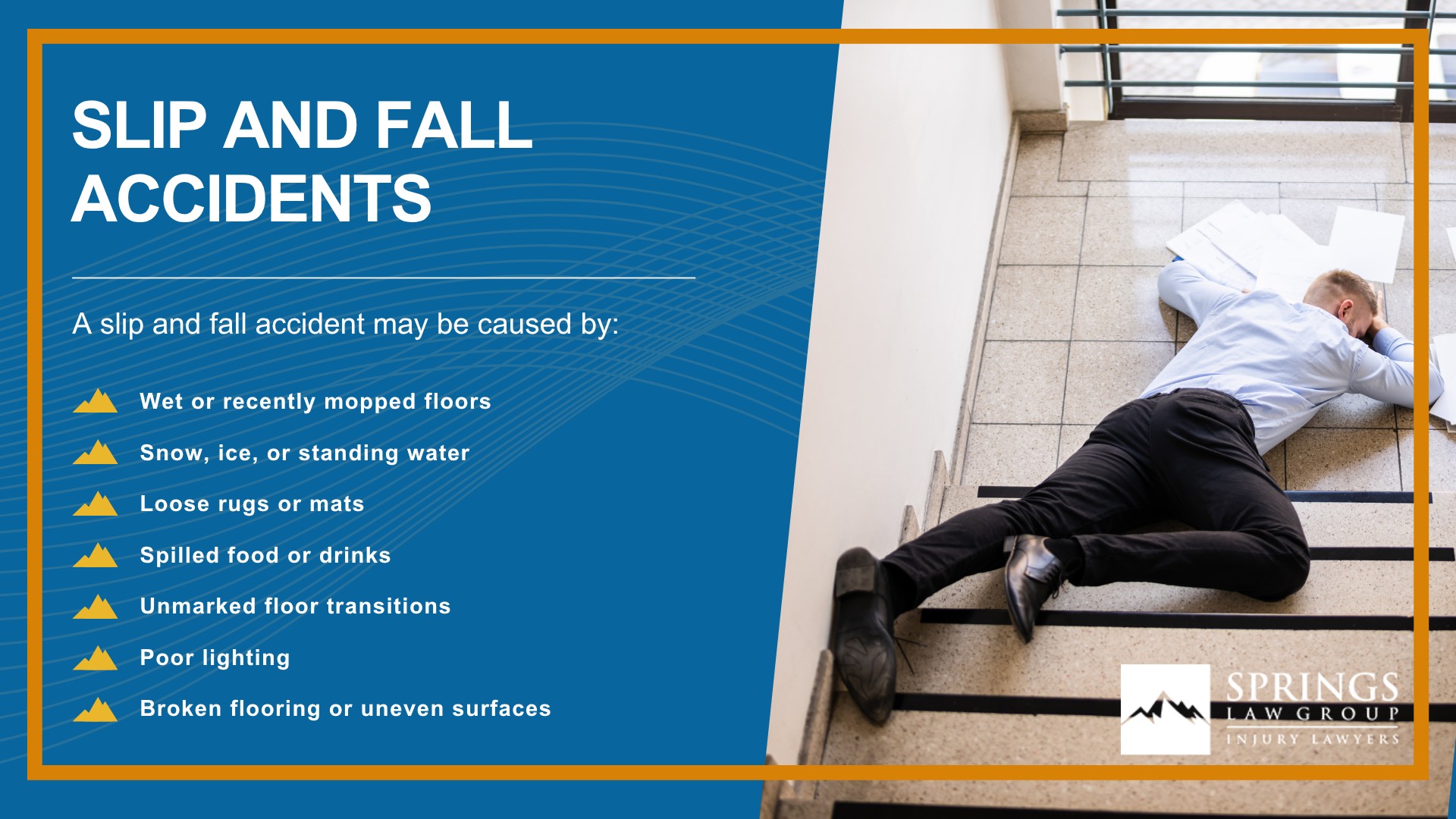
Slip and fall accidents are among the most frequently reported premises liability claims and often occur when walking surfaces are improperly maintained.

These accidents commonly result from temporary hazards that property owners fail to address or warn about in a timely manner.

Even a brief lapse in maintenance or supervision can lead to serious injuries.

Common slip and fall hazards include:

  • Wet or recently mopped floors without warning signs
  • Snow, ice, or slush tracked into entryways
  • Spilled liquids or food in grocery stores and restaurants
  • Grease or oil on parking lots or garage surfaces
  • Leaking roofs or plumbing that create slick walkways

Trip and Fall Injuries

Trip and fall injuries occur when a person’s foot strikes an object or uneven surface, causing them to lose balance and fall.

These accidents often involve permanent or semi-permanent hazards that develop over time and are not corrected by the property owner.

Poor visibility and inadequate maintenance frequently contribute to these injuries.

Common trip and fall hazards include:

  • Uneven sidewalks or cracked pavement
  • Loose carpeting or unsecured rugs
  • Broken or missing stair treads
  • Cords, debris, or merchandise left in walkways
  • Changes in floor height without proper markings

Negligent Security Cases

Negligent security cases arise when a property owner fails to take reasonable steps to protect visitors from foreseeable criminal activity.

These claims often involve inadequate security measures in areas where prior incidents or known risks should have prompted action.

When basic safety precautions are ignored, patrons, tenants, and guests may suffer serious harm.

Common negligent security issues include:

  • Lack of security personnel in high-risk areas
  • Broken or missing locks on doors and gates
  • Poor lighting in parking lots, stairwells, or common areas
  • Failure to install or maintain surveillance cameras
  • Ignoring prior reports of criminal activity on or near the property

Dog Bites and Other Dangerous Animals

Colorado law treats dog bites and other animal-related injuries as a special category within premises liability because interactions with animals can cause serious physical harm.

Under Colorado Revised Statutes § 13-21-124, a dog owner can be held strictly liable for economic damages if their dog bites someone who is lawfully on public or private property and the injury qualifies as serious bodily injury or death, meaning there is a substantial risk of death, significant permanent disfigurement, or major loss of use of any body part or organ.

Strict liability means the victim does not need to show that the owner was negligent in how they handled the animal; the owner may be held responsible simply because the bite occurred under the statutory conditions.

However, if the injury does not rise to the strict liability threshold, victims can still pursue compensation through a traditional negligence claim by showing the animal’s owner failed to exercise reasonable care in controlling the animal and that the failure caused the injury.

Animal attacks involving other species, such as livestock, exotic pets, or aggressive animals kept by property owners, may also give rise to liability if the animal’s presence or behavior created a foreseeable risk and the owner did not take reasonable steps to prevent harm.

In these cases, liability often hinges on whether the owner or property manager knew or should have known of the animal’s dangerous tendencies and failed to act accordingly.

Swimming Pool Accidents and Amusement Park Injuries

Swimming pools and amusement parks present unique premises liability risks because they involve inherently dangerous activities that require heightened safety measures.

In Colorado, property owners and operators have a duty to take reasonable steps to protect guests from foreseeable harm, especially where water attractions, rides, or high-traffic recreational areas are involved.

Failures in supervision, maintenance, or safety design can quickly turn recreational settings into sites of serious injury.

When operators cut corners or ignore safety standards, injured visitors may have grounds for a premises liability claim.

Common swimming pool and amusement park–related premises liability incidents include:

  • Drownings or near-drownings due to lack of lifeguards or inadequate supervision
  • Slips and falls on wet pool decks or locker room surfaces
  • Broken pool gates, missing barriers, or unsecured access points
  • Mechanical failures or improper maintenance of rides and attractions
  • Inadequate safety restraints or malfunctioning ride equipment
  • Failure to warn guests of height, health, or safety restrictions
  • Overcrowding that leads to collisions, falls, or trampling injuries

Because these environments are designed for public use and often involve children, courts closely examine whether operators followed industry safety standards and local regulations.

When preventable injuries occur, property owners, operators, or managing entities may be held responsible for the resulting harm.

Do You Qualify for a Premises Liability Lawsuit?

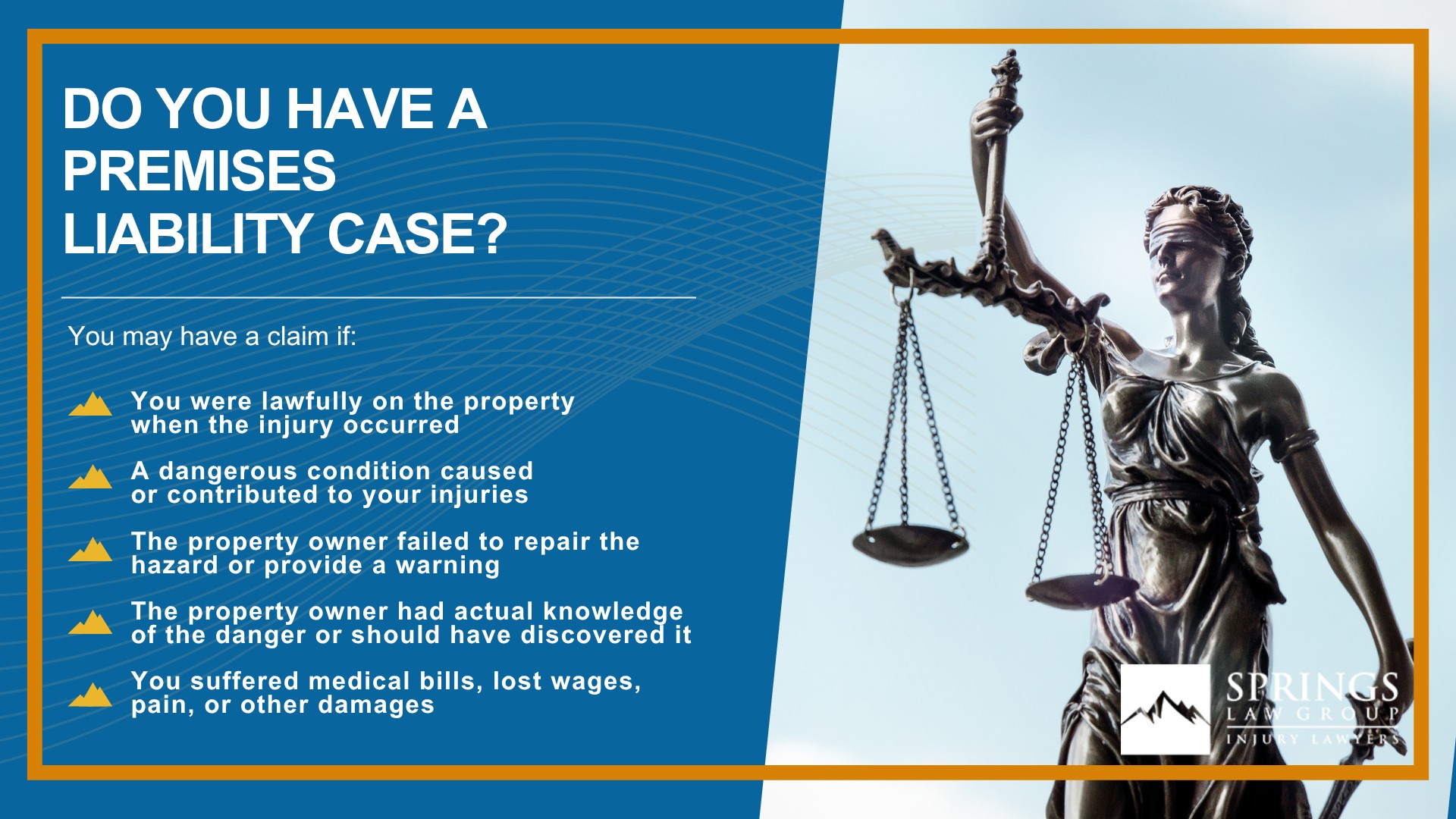
You may qualify for a premises liability lawsuit if you were injured due to unsafe conditions on property owned, leased, or controlled by someone else.

Eligibility generally depends on whether the property owner failed to maintain reasonably safe conditions or warn visitors of known hazards.

Premises liability injuries can occur in stores, apartment complexes, workplaces, hotels, or public spaces, and they often involve hazards that could have been corrected with proper care.

To pursue a claim, the injury must be connected to a specific dangerous condition and supported by evidence such as photographs, witness statements, or incident reports.

Medical documentation linking the injury to the accident is also critical in establishing a valid case.

Even if the property owner disputes responsibility, Colorado law allows injured parties to pursue compensation when negligence can be proven.

At Springs Law Group, premises liability cases are handled on a contingency fee basis, meaning clients pay no legal fees unless compensation is recovered.

A consultation can help determine whether your injury meets the legal requirements for moving forward.

Common Evidence in a Premises Liability Claim

Strong evidence is essential in any premises liability case because property owners and insurers often dispute how an injury occurred.

Evidence helps establish the existence of a dangerous condition, how long it was present, and whether the owner failed to address it.

Timely documentation is especially important, as hazards may be repaired or removed shortly after an incident.

Medical records also play a critical role by linking the injury directly to the unsafe condition.

Together, this evidence forms the foundation for proving negligence and damages.

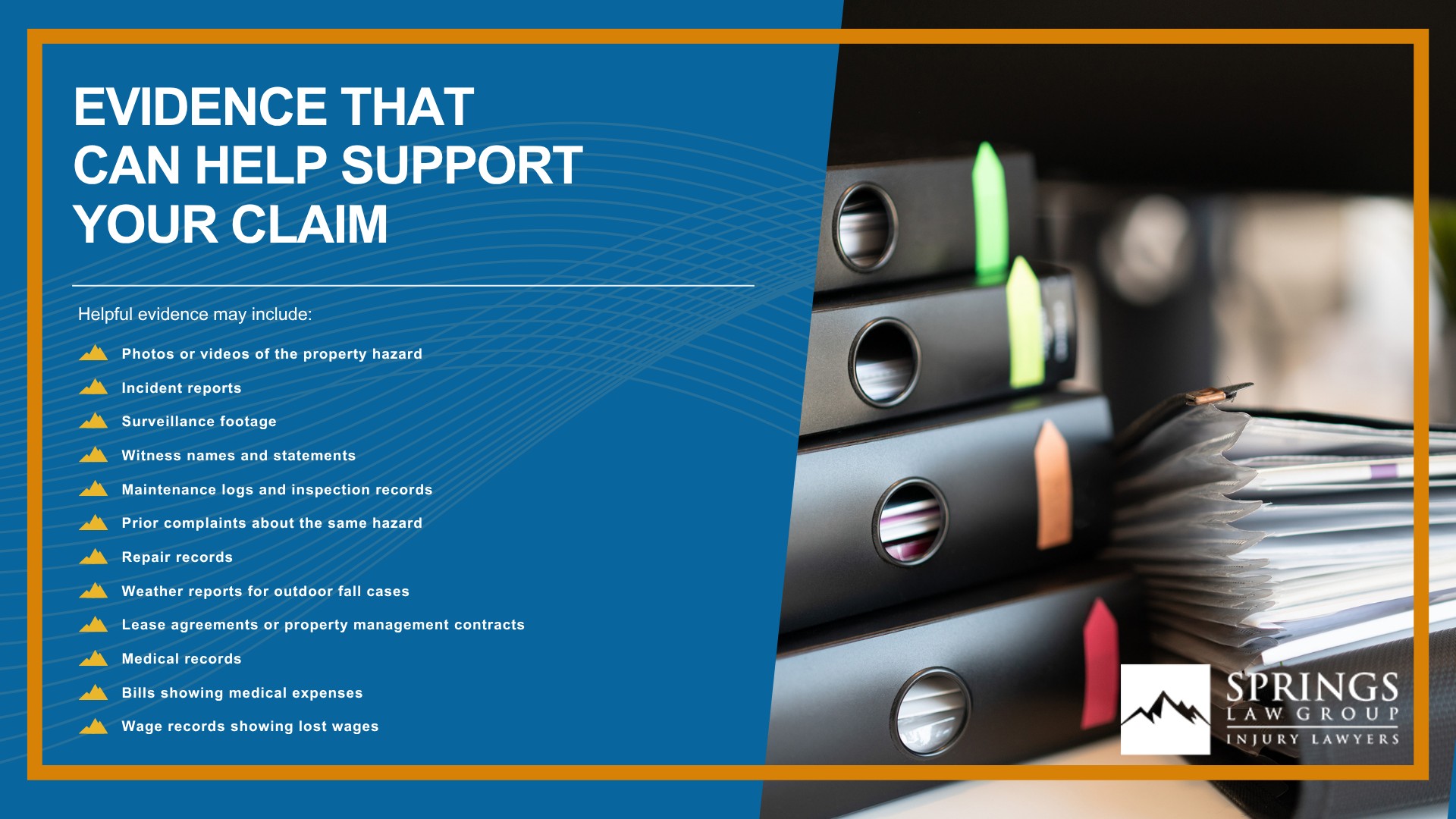
Common evidence in a premises liability claim includes:

  • Photographs or videos of the hazardous condition and surrounding area
  • Incident or accident reports created by the property owner or business
  • Maintenance, cleaning, or inspection records
  • Surveillance footage capturing the accident or the condition beforehand
  • Witness statements from people who observed the hazard or the fall
  • Medical records documenting injuries and treatment
  • Expert opinions, such as safety or building code evaluations

Compensation in Premises Liability Cases

Compensation in a premises liability case is intended to address both the financial losses and personal harm caused by an unsafe property condition.

The amount recoverable depends on the severity of the injury, the impact on daily life, and the degree of fault attributed to the property owner.

Damages may cover immediate costs as well as long-term consequences that affect a victim’s ability to work or function normally.

A thorough damages assessment helps ensure that all losses connected to the injury are accounted for.

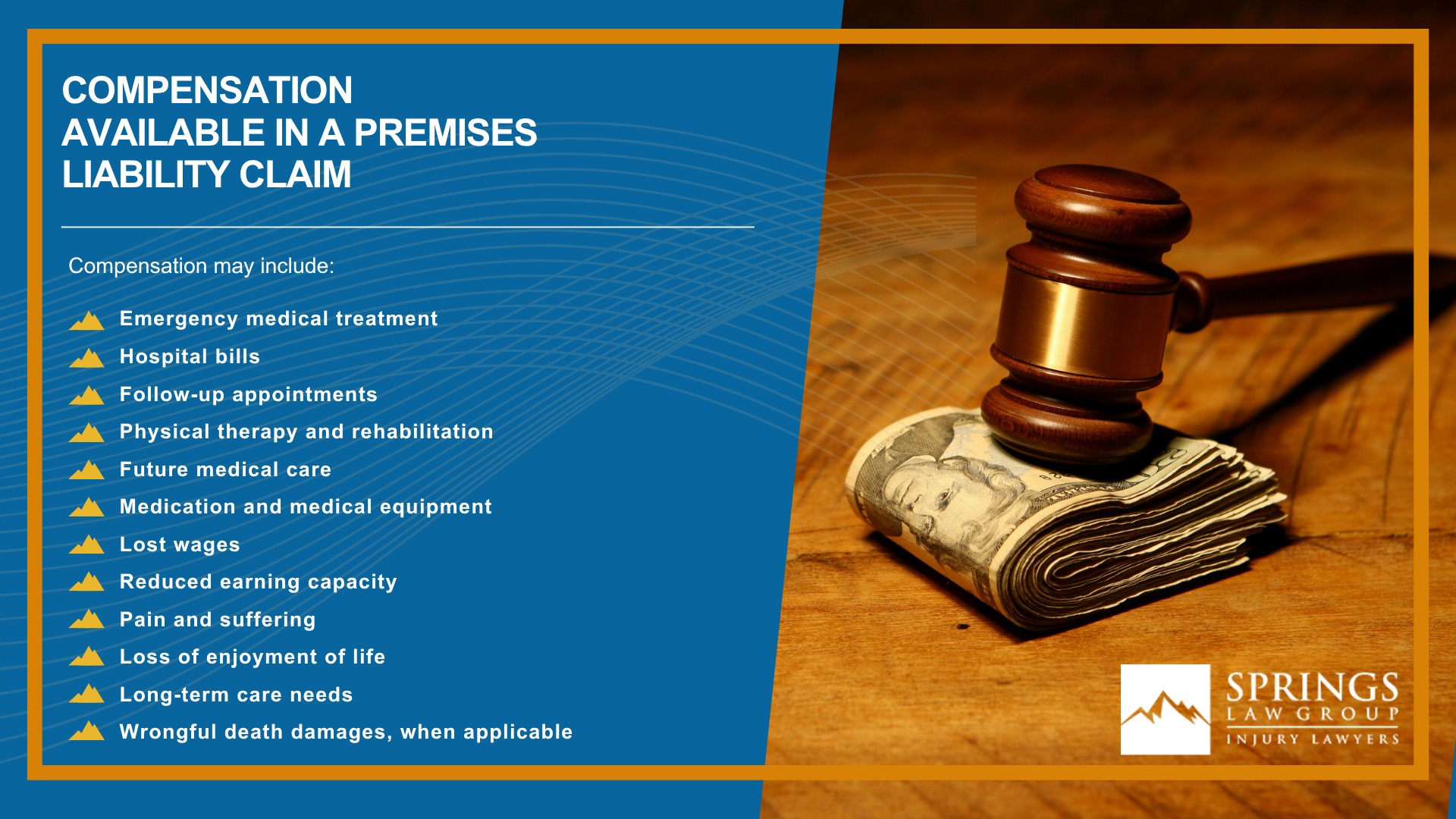
Compensable damages may include:

  • Medical expenses, including emergency care, surgery, and rehabilitation
  • Lost wages and reduced earning capacity
  • Pain and suffering resulting from physical and emotional trauma
  • Loss of enjoyment of life
  • Out-of-pocket expenses related to the injury
  • Wrongful death damages when a fatal injury occurs

Springs Law Group: Hire an Experienced Premises Liability Lawyer

Premises liability injuries can leave lasting physical, financial, and emotional consequences, especially when a property owner’s negligence could have been prevented.

Property owners and their insurers often work quickly to minimize responsibility, making it difficult for injured individuals to protect their rights without legal support.

Springs Law Group provides focused representation for people injured on unsafe property, handling the investigation, evidence development, and insurance negotiations required to pursue full compensation.

If you were injured on someone else’s property in Colorado Springs, contact Springs Law Group to discuss your legal options.

An experienced premises liability lawyer can review your case, explain your rights under Colorado law, and help you take the next step toward financial recovery.

Frequently Asked Questions

  • What is the average premises liability settlement?

    There is no true “average” premises liability settlement because these cases vary widely based on the facts, injuries, and level of negligence involved.

    Settlement values depend heavily on the severity of the injury, the cost of medical treatment, whether the injury caused long-term limitations, and how clearly the property owner’s negligence can be proven.

    Cases involving minor injuries and quick recovery often resolve for far less than those involving fractures, head injuries, or permanent impairment.

    Insurance policy limits and disputes over liability also play a significant role in how cases resolve.

    Importantly, Colorado’s comparative negligence rules can reduce a settlement if the injured person is found partially at fault.

    An experienced premises liability lawyer evaluates the specific details of a case, rather than relying on averages, to determine what compensation may be reasonable based on comparable outcomes and documented losses.

  • How is liability determined in a premises liability case?

    Liability in a premises liability case is determined by examining whether the property owner or occupier failed to take reasonable steps to keep the property safe.

    Courts look at the condition of the property, the owner’s knowledge of the hazard, and whether the injury was foreseeable.

    Evidence plays a central role in showing how long the dangerous condition existed and what actions, if any, were taken to correct it.

    Once these factors are evaluated, liability is assigned based on the owner’s duty of care under Colorado law.

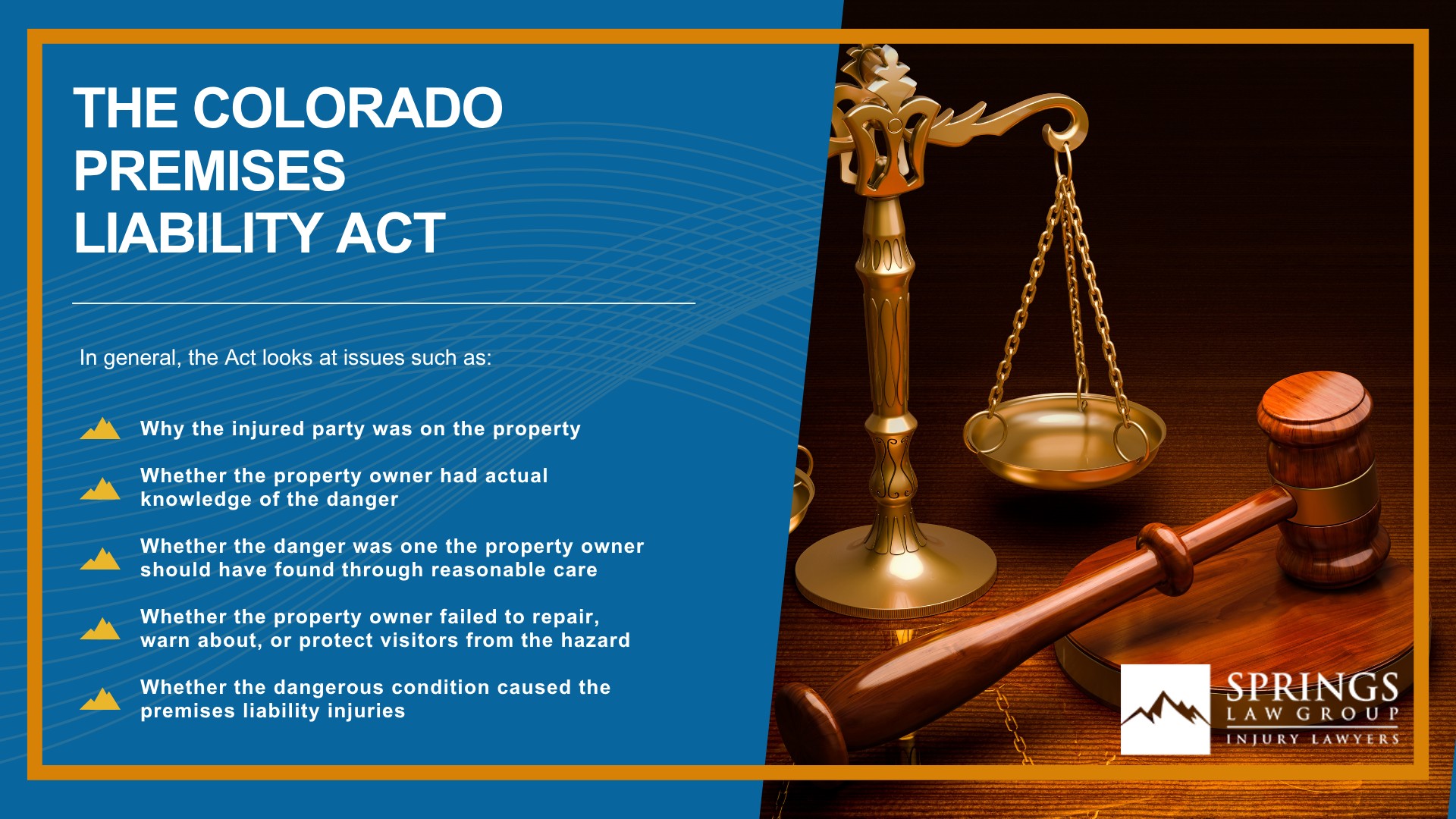
    Factors used to determine liability include:

    • Whether a dangerous condition existed on the property
    • Whether the owner knew or should have known about the hazard
    • Whether reasonable steps were taken to repair or warn of the danger
    • Whether the hazardous condition directly caused the injury

  • How long do I have to file a premises liability lawsuit in Colorado?

    In Colorado, most premises liability claims must be filed within two years from the date of the injury under the state’s personal injury statute of limitations.

    This deadline applies to slip and fall cases, negligent security claims, and other injuries caused by unsafe property conditions.

    Claims involving government-owned property may have shorter notice requirements that must be met before a lawsuit can be filed.

    Waiting too long can make it harder to gather evidence, locate witnesses, or preserve documentation related to the hazardous condition.

    Speaking with a premises liability lawyer early helps ensure your claim is filed correctly and within Colorado’s legal time limits.

  • Do I have to prove that the property owner knew about the hazard?

    In many premises liability cases, you must show that the property owner knew or should have known about the dangerous condition that caused your injury.

    This can be proven by showing the owner had actual notice, such as prior complaints or maintenance records, or constructive notice, meaning the hazard existed long enough that a reasonable owner would have discovered it.

    Colorado law does not require owners to prevent every possible accident, but it does require them to address foreseeable risks in a reasonable manner.

    Evidence such as surveillance footage, inspection logs, and witness testimony is often used to establish notice.

    A premises liability lawyer can help determine whether the facts of your case meet this legal standard.

  • What steps should I take after a premises liability accident?

    Taking the right steps after a premises liability accident can protect both your health and your legal rights.

    Even seemingly minor injuries can worsen over time, and delays can make it harder to prove what caused the accident.

    Colorado premises liability claims often depend on early documentation and clear evidence. Following these steps can help preserve your ability to pursue compensation.

    1. Seek medical care immediately, even if the injury seems minor, to create a clear medical record.
    2. Report the incident to the property owner, manager, or business and request a written incident report if possible.
    3. Document the scene by taking photos or videos of the hazardous condition and surrounding area before it is repaired or removed.
    4. Gather witness information, including names and contact details of anyone who saw the accident or the condition.
    5. Avoid detailed statements to insurance companies until you understand your rights or speak with a lawyer.

  • Can I file a claim if I was injured at a friend's or relative's home?

    Yes, you can still file a premises liability claim if you were injured at a friend’s or relative’s home.

    These claims are typically handled through the homeowner’s insurance policy rather than directly against the individual, which helps avoid personal financial strain.

    Colorado law applies the same duty of reasonable care to private homeowners as it does to businesses, depending on the circumstances of the visit.

    If the homeowner failed to address a dangerous condition they knew or should have known about, a claim may be appropriate.

    An attorney can explain how these cases are handled sensitively while still protecting your right to compensation.

Written By:

Attorney, Christopher M. Nicolaysen focuses primarily on helping those injured in car accidents due to no fault of their own.

The personal injury matters include auto accidents, bicycle accidents, pedestrian accidents, and trucking accidents.

Chris truly enjoys helping clients through a difficult time and helping them get the compensation they deserve.

Do You
Have A Case?
No out of pocket costs.
We only collect a fee AFTER you win your case and receive full compensation.
Contact our team today to discuss your case for free & Get answers in as little as 3 minutes.
Would you like our help?
right-image
600
About Springs Law Group
The lawyers at Springs Law Group have experience handling diverse personal injury cases with empathy and understanding.
We recognize the delicate nature of these claims and tailor strategies to meet your unique requirements, focusing on smart — not emotional — strategies.
Our team is committed to building long-lasting, trust-based client relationships.
We believe this approach helps ensure that choosing us means partnering with a firm that genuinely values you as a person — not just another client.
Recent Posts
Do You
Have A Case?
No out of pocket costs.
We only collect a fee AFTER you win your case and receive full compensation.
Contact our team today to discuss your case for free & Get answers in as little as 3 minutes.
Would you like our help?
right-image
600

The #1 Personal Injury Lawyers in Colorado Springs, Colorado

Local Colorado Springs Resources

Education
Emergency Services
Courthouses
Department of Motor Vehicles
Community & History

Leave Us A Review

We use reviews to help show more people like you why we do what we do!

Top-Rated Personal Injury Firm Serving Colorado Springs & Beyond

Personal injury victims represented by a lawyer recover up to 3x more.

Our Process

Play Video
1
Investigation
Gather evidence. Get police reports. Obtain insurance policies.
2
Treatment
You focus on healing. We help guide you through the process.
3
Medical Records
Get the records we need to make sure you have a strong case.
4
Demand Prep
Prepare and send our demands to the insurance company.
5
Negotiation
Negotiate with the insurance company for max compensation.
6
Settlement
Reach a settlement offer you agree with or we file a lawsuit.
7
Litigation
If we have to go to court, our trial lawyers get ready to win.

Videos

Our Team

The #1 Personal Injury Lawyers in Colorado Springs, CO