

Colorado Springs Rear End Collision Lawyer

Were You or A Loved One Injured in an Accident?
Get Free Answers In as Little as 3 Minutes
right-image
600

Our Colorado Springs Car Accident Attorneys Handle Rear-End Collision Claims

A Colorado Springs rear-end collision lawyer from Springs Law Group helps injured drivers challenge fault disputes, document injuries, and pursue compensation after a preventable crash.

Rear-end accidents are often treated as minor by insurance companies, even when they cause lasting neck, back, and spinal injuries.

Springs Law Group reviews claims from people injured in rear-end collisions to determine liability, document damages, and assess what compensation may be available under Colorado law.

Colorado Springs Rear-End Collision Lawyer

Injured in a Rear-End Collision? Contact Springs Law Group Today

Rear-end collision injuries often start as “soreness” and turn into serious injuries that affect sleep, work, and basic movement for months.

Many crashes are caused by distracted driving, following too closely, or aggressive speed changes, but negligent drivers rarely admit what they were doing in the seconds before impact.

That denial gives the at-fault driver’s insurer room to argue that the crash was unavoidable or that the injured person shares blame.

Personal injury claims in rear-end cases come down to proving what happened and proving what it cost, with medical documentation and objective evidence doing most of the work.

A strong rear-end collision case also anticipates the common defenses, such as “sudden stop,” “minimal damage,” or “pre-existing condition,” and counters them with facts.

Our personal injury lawyers focus on building a clear timeline, preserving records, and presenting the damages picture in a way that supports settlement value or trial proof.

When the evidence supports liability, injured people can seek compensation for medical care, lost income, pain, and long-term limitations tied to the crash.

The purpose of legal recourse is straightforward: hold negligent drivers financially responsible for the harm they caused and prevent the insurer from rewriting the story after the collision.

If you or a loved one sustained injuries in a rear-end accident at no fault of your own, you may be eligible to file a car accident claim and seek financial compensation.

Contact the Colorado Springs car accident attorneys at Springs Law Group for a free case evaluation.

You can also use the chat feature on this page to get in touch with our legal team.

Table of Contents

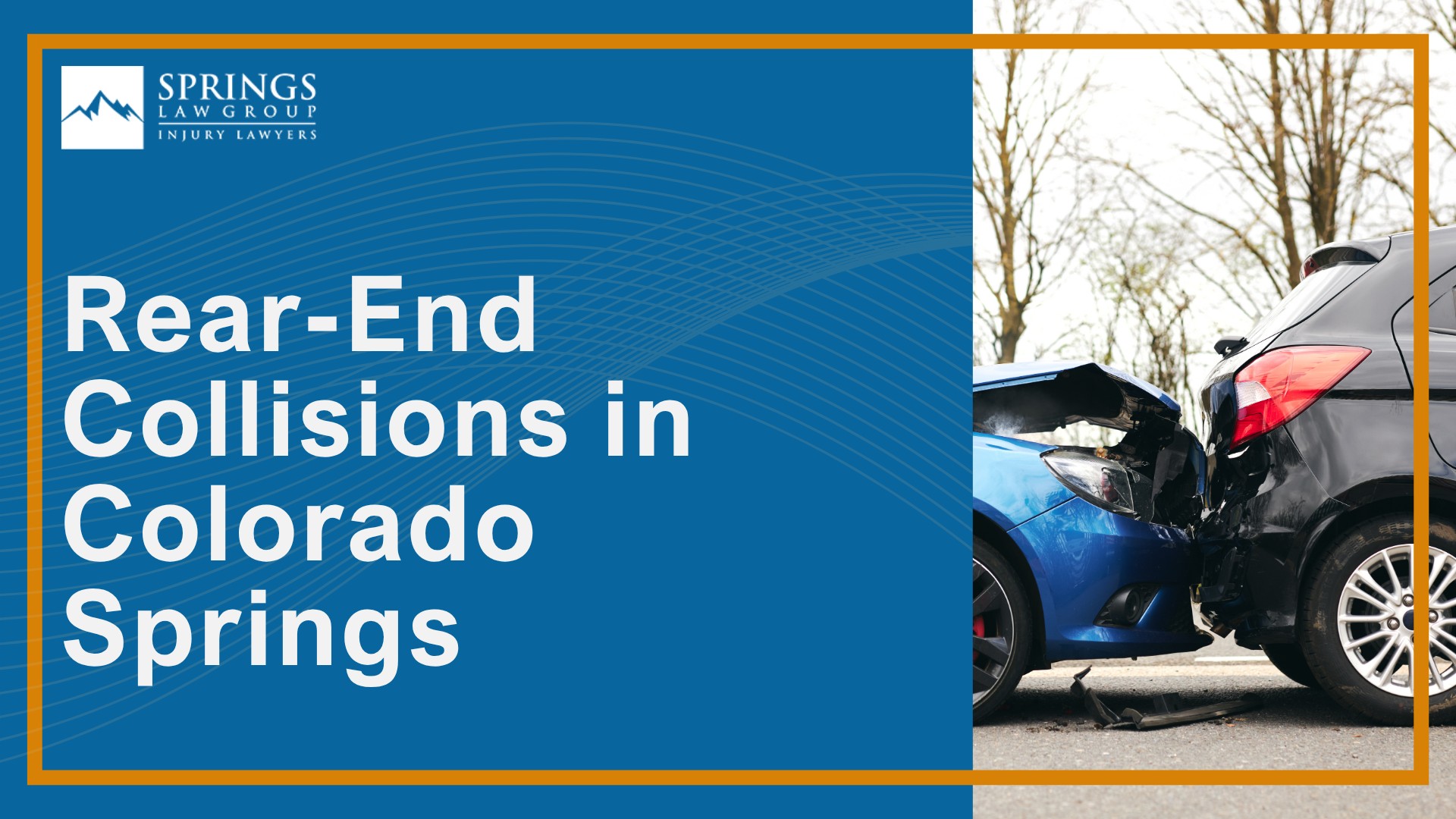
Rear-End Collisions in Colorado Springs

Rear-end crashes are one of the most common traffic collisions in Colorado Springs and across Colorado, especially in stop-and-go conditions and at busy intersections.

Colorado Springs Police Department traffic safety materials identify distraction and impairment as common factors in serious crashes, and those same factors show up repeatedly in rear-end impacts where a driver fails to slow in time.

Statewide, CDOT crash reporting tracks “front-to-rear” collisions as a leading crash type, and one summary of CDOT data reports 29,927 front-to-rear crashes in Colorado in 2021, reflecting how frequently these impacts happen on public roads.

Even when property damage looks limited, rear-end collision injuries can be severe injuries that require extensive medical care, including neck and back treatment that is not always immediately apparent at the crash scene.
When the accident occurred, the physics of the impact still transferred force into the body, and symptoms may appear hours or days later as inflammation and muscle guarding set in.

Liability may seem straightforward, but insurers often focus on proving fault disputes by arguing sudden stops, pre-existing conditions, or minimal-impact defenses.

Legal representation matters because accident victims rarely benefit from handling these disputes alone, especially when the insurer tries to reduce what it pays by questioning the injuries, the timeline, or the extent of property damage.

What to Do After a Rear-End Collision

The aftermath of a car crash is often chaotic, especially when pain, shock, or confusion sets in immediately after impact.

Many people are focused on getting home, getting help, or making sure others are safe, not on preserving evidence or thinking about traffic laws.

For those who are injured, physical limitations or delayed symptoms can make it impossible to handle everything that would later matter in a claim.

What happens in the first hours and days can shape how insurers evaluate what occurred at the accident scene and who they say is responsible.

Missing details or incomplete records give insurers room to question what caused the crash or how injuries developed.

A lawyer steps in to reconstruct what could not be handled at the time, gather records, and protect the claim from early missteps.
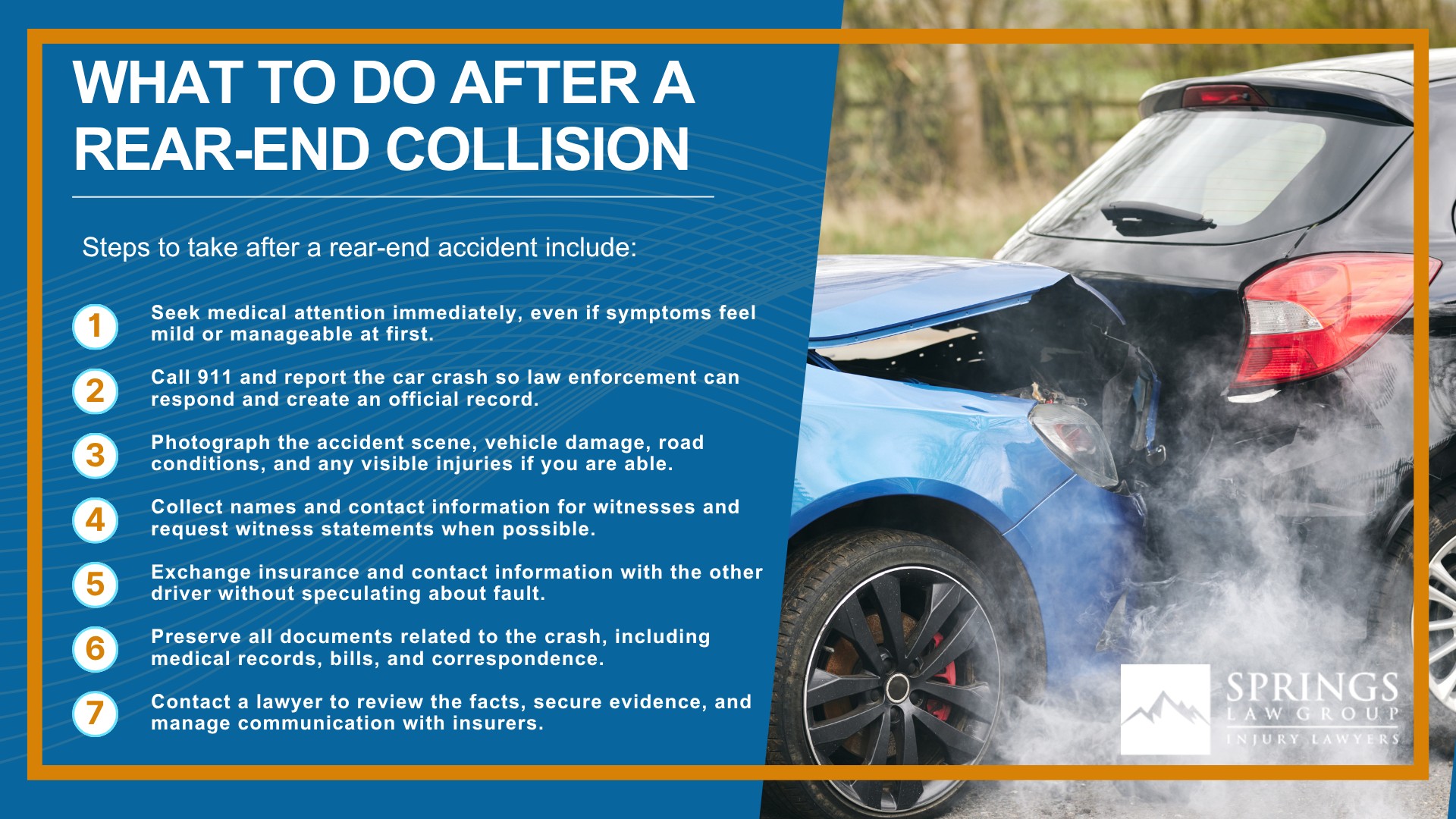
Steps to take after a rear-end accident include:

  1. Seek medical attention immediately, even if symptoms feel mild or manageable at first.
  2. Call 911 and report the car crash so law enforcement can respond and create an official record.
  3. Photograph the accident scene, vehicle damage, road conditions, and any visible injuries if you are able.
  4. Collect names and contact information for witnesses and request witness statements when possible.
  5. Exchange insurance and contact information with the other driver without speculating about fault.
  6. Preserve all documents related to the crash, including medical records, bills, and correspondence.
  7. Contact a lawyer to review the facts, secure evidence, and manage communication with insurers.

Common Causes of Rear-End Collisions

Rear-end collisions usually happen because the trailing driver fails to slow or stop in time, even though traffic conditions required closer attention.

These crashes often occur in stop-and-go traffic, at intersections, and during sudden speed changes where reaction time matters most.

Many rear-end crashes look simple on paper, but the causes often involve preventable behavior rather than unavoidable circumstances.

Insurance companies frequently try to minimize responsibility by focusing on how suddenly the front vehicle stopped instead of why the rear vehicle did not respond.

Understanding the actual cause matters because it shapes how fault is evaluated and defended.
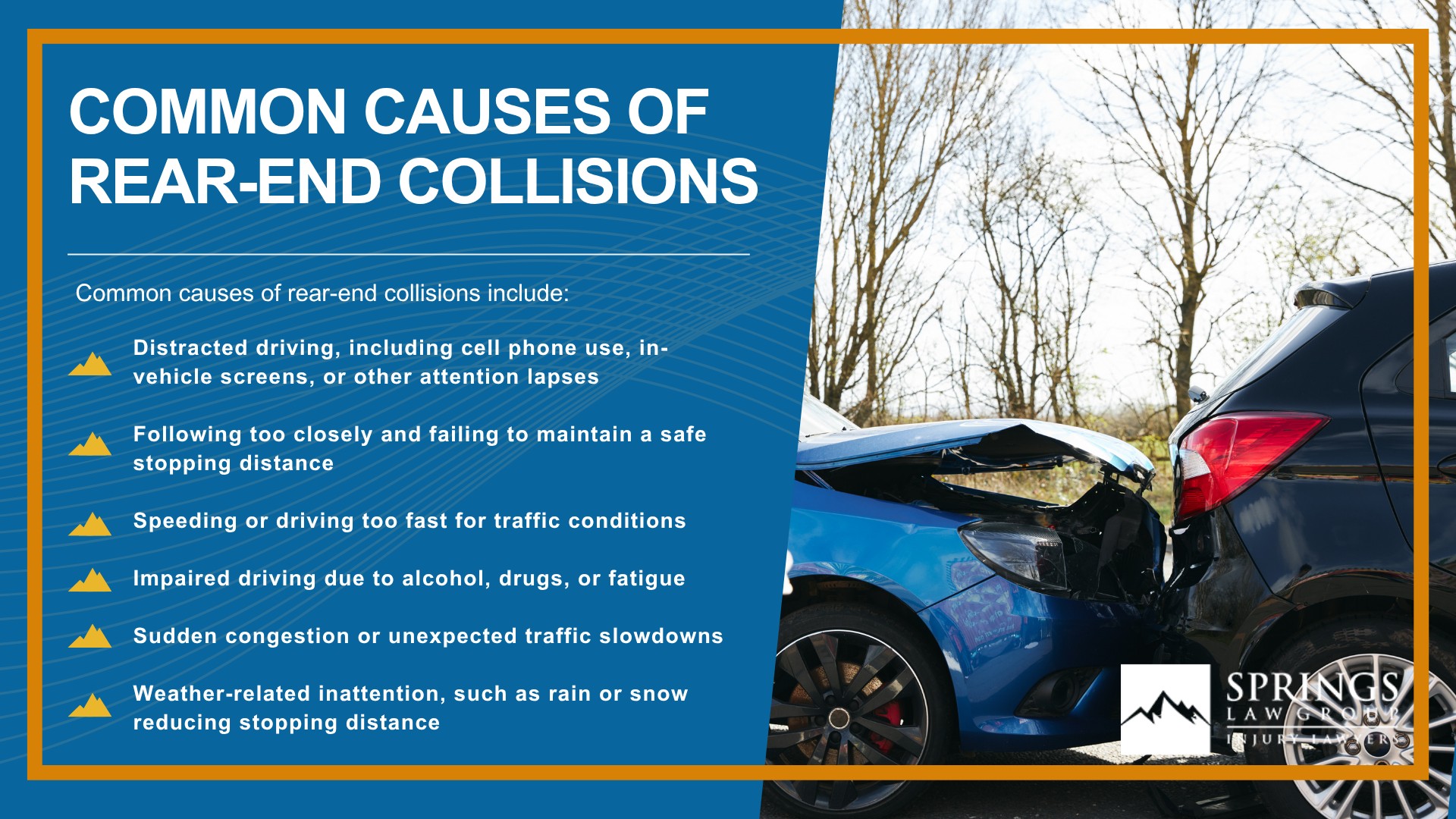
Common causes of rear-end collisions include:

  • Distracted driving, including cell phone use, in-vehicle screens, or other attention lapses
  • Following too closely and failing to maintain a safe stopping distance
  • Speeding or driving too fast for traffic conditions
  • Impaired driving due to alcohol, drugs, or fatigue
  • Sudden congestion or unexpected traffic slowdowns
  • Weather-related inattention, such as rain or snow reducing stopping distance

In most cases, the rear driver had time to avoid the impact by paying attention and maintaining proper spacing.

When insurers shift focus to the front driver’s actions, it is often an attempt to reduce what they pay rather than a fair assessment of fault.

A lawyer can identify the real cause and keep the analysis tied to what the evidence shows instead of post-crash assumptions.

Common Injuries in Rear-End Car Accidents

Rear-end impacts transfer force through the body even at lower speeds, which is why injuries are common despite limited vehicle damage.

Sudden forward-and-back motion can cause head strikes against the steering wheel or trigger air bags, while the spine absorbs force it is not designed to handle.

Many symptoms, especially neck pain and back injuries, develop hours or days later and require ongoing medical treatment and physical therapy.

When these injuries are not addressed early, they can progress into chronic pain that interferes with daily life and work.

Common injuries in rear-end car accidents include:

  • Soft tissue injuries, including whiplash, muscle strains, and ligament damage
  • Neck pain and cervical spine injuries from rapid acceleration and deceleration
  • Back injuries, including herniated discs, bulging discs, and lumbar strain
  • Traumatic brain injuries caused by head strikes, air bag deployment, or sudden movement
  • Broken bones, including fractures to ribs, arms, wrists, facial bones, and collarbones
  • Internal injuries, such as organ damage or internal bleeding that may not be immediately apparent
  • Shoulder and knee injuries caused by bracing for impact or contact with the interior of the vehicle
  • Nerve damage resulting in numbness, weakness, or radiating pain
  • Chronic pain conditions that require extended treatment, pain management, or long-term physical therapy
  • Permanent disability when injuries lead to lasting physical limitations or loss of function

Who Is at Fault in a Rear-End Collision?

In Colorado, fault in a rear-end crash often starts with the rule that drivers must not follow another vehicle more closely than is “reasonable and prudent” for speed, traffic, and road conditions, which is the basis for many rear-end liability findings under C.R.S. § 42-4-1008.

The driver in the rear is often presumed to be at fault in a rear-end collision, but this is not always the case, and Colorado’s pattern civil jury instructions discuss a rear-end collision presumption of negligence as a rebuttable concept in litigation.

Proving fault can become complex when there are multiple vehicles, competing accounts, or a chain reaction where one impact triggers several more.
A police report may help establish the basic narrative, but it is rarely the final word, and an insurance provider will still test the claim for defenses like sudden stopping, unsafe lane changes, or an intervening cause.

Rear-end collisions can also cause serious injuries, including whiplash, and symptoms are not always immediately obvious at the scene, which is why medical documentation often matters as much as crash mechanics.

Rear-end crashes are not “minor” on a national scale either, the Insurance Information Institute’s fatal-crash table shows rear-end collisions were 7.2% of all fatal crashes in 2023, which aligns with the fact that they account for over seven percent of traffic fatalities.

Because insurers commonly try to shift blame even when liability seems straightforward, a thorough investigation helps lock in the timeline and limit speculation.

A rear-end collision lawyer can guide you through every step of the legal process, from evidence preservation to fault disputes, so the claim stays anchored to proof rather than the insurer’s preferred story.

Why Rear-End Accidents Are Often Disputed

Rear-end crashes are often disputed because the claims process rewards insurers for finding uncertainty, even when fault seems obvious.

An insurance claim can turn into a debate over details that have little to do with what actually happened, such as how quickly the front vehicle slowed or whether the impact “looked” serious.

Disputes also arise because injuries like whiplash and back strains may not show up immediately, giving insurers an opening to question causation.

Adverse weather becomes a common excuse, even though drivers still have a duty to adjust speed and following distance to road conditions.

These arguments can delay resolution and reduce payouts unless the evidence is organized and the case is positioned to receive fair compensation.
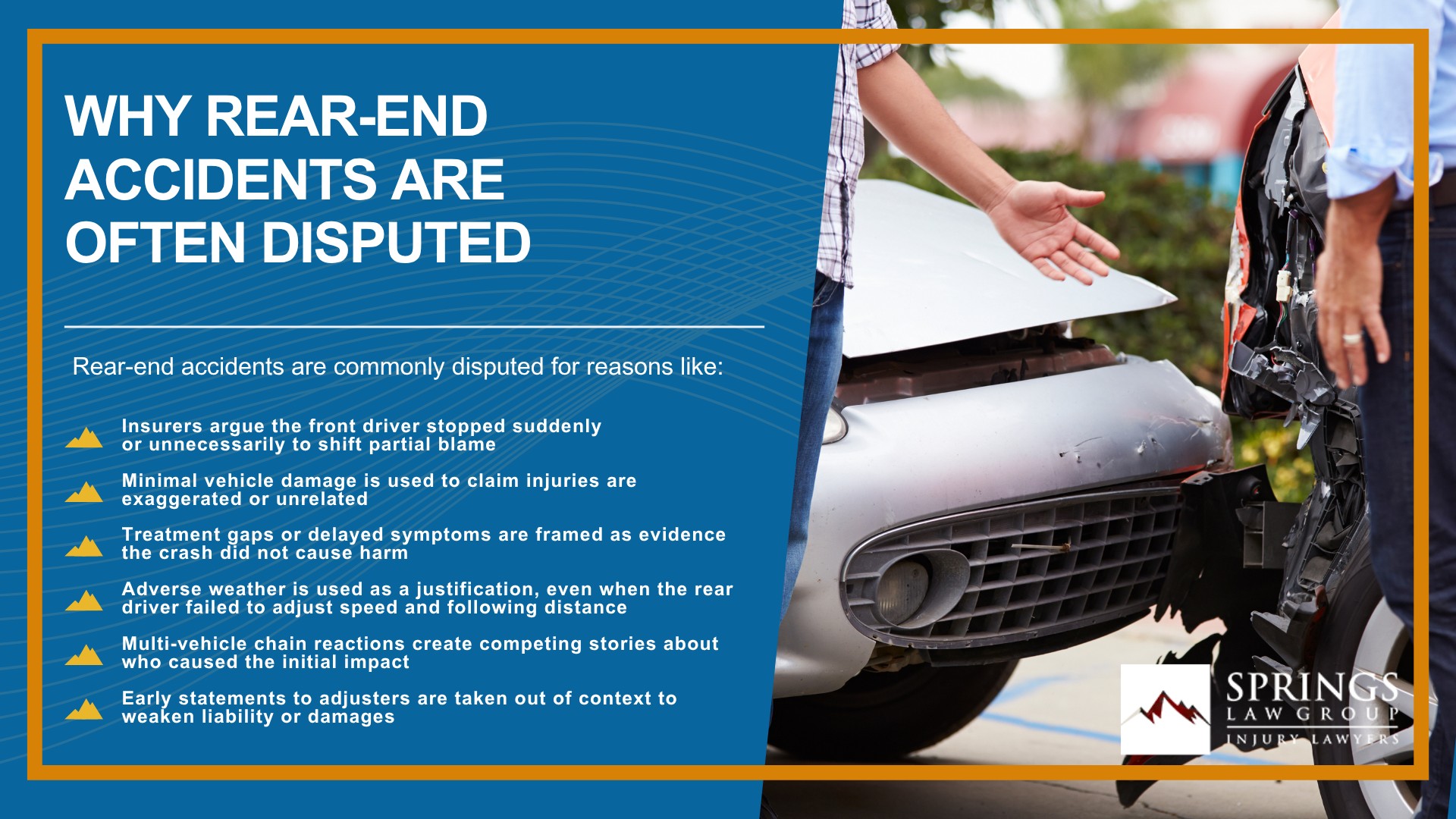
Rear-end accidents are commonly disputed for reasons like:

  • Insurers argue the front driver stopped suddenly or unnecessarily to shift partial blame
  • Minimal vehicle damage is used to claim injuries are exaggerated or unrelated
  • Treatment gaps or delayed symptoms are framed as evidence the crash did not cause harm
  • Adverse weather is used as a justification, even when the rear driver failed to adjust speed and following distance
  • Multi-vehicle chain reactions create competing stories about who caused the initial impact
  • Early statements to adjusters are taken out of context to weaken liability or damages

Colorado Comparative Negligence and Rear-End Crashes

Colorado applies a modified comparative negligence rule, which matters in rear-end cases because insurers often try to assign partial fault even when the rear driver appears responsible.

Under C.R.S. § 13-21-111, a person can still recover compensation in a negligence case as long as their negligence is not as great as the negligence of the person they are suing, and any damages awarded are reduced in proportion to the plaintiff’s percentage of fault.

In practice, that means a rear-end crash claim can lose value quickly if the insurance company convinces a jury or adjuster that the front driver shares meaningful blame.
Common arguments include sudden stopping, brake light issues, or unsafe lane changes, even though Colorado drivers still have a duty to follow at a reasonable and prudent distance.

If the injured driver is found 50% or more at fault, Colorado’s rule bars recovery entirely, which is why fault disputes are high-stakes even in “simple” rear-end collisions.

A lawyer’s job in these cases is to keep fault allocation tied to objective proof, so the claim reflects what actually caused the impact rather than blame-shifting narratives.

Do You Qualify for a Rear-End Car Accident Claim?

You may qualify for a rear-end car accident claim if you suffered an injury or financial loss because another driver hit your vehicle from behind.

A rear-end car accident injury can involve more than immediate pain, and delayed symptoms still count when medical records connect them to the collision.

Qualification usually depends on showing that the other driver failed to act reasonably under the circumstances and that this failure caused the crash and the resulting harm.

Evidence matters because insurers often dispute injuries, timelines, and fault even when liability looks obvious.

The claim also needs documented damages, including medical treatment, wage loss, and other crash-related expenses.

An experienced attorney can evaluate the facts, identify defenses the insurer is likely to raise, and build the file so the claim is positioned for a fair settlement.

When the insurer refuses to act reasonably, legal proceedings may be necessary to obtain the evidence and leverage needed to resolve the dispute.

The goal is maximum possible compensation supported by proof, not a number shaped by the insurer’s first offer.

Evidence in Rear-End Collision Claims

Evidence often determines whether a rear-end collision claim is treated as a straightforward liability case or turned into a fault dispute.

Even when the crash involves only two vehicles, insurers commonly look for gaps they can use to shift blame or minimize injuries.

Crucial evidence also helps connect the impact to the injury timeline, especially when symptoms develop after the collision.

Without strong documentation, the insurer can frame the crash as minor and argue the injuries are unrelated or exaggerated.
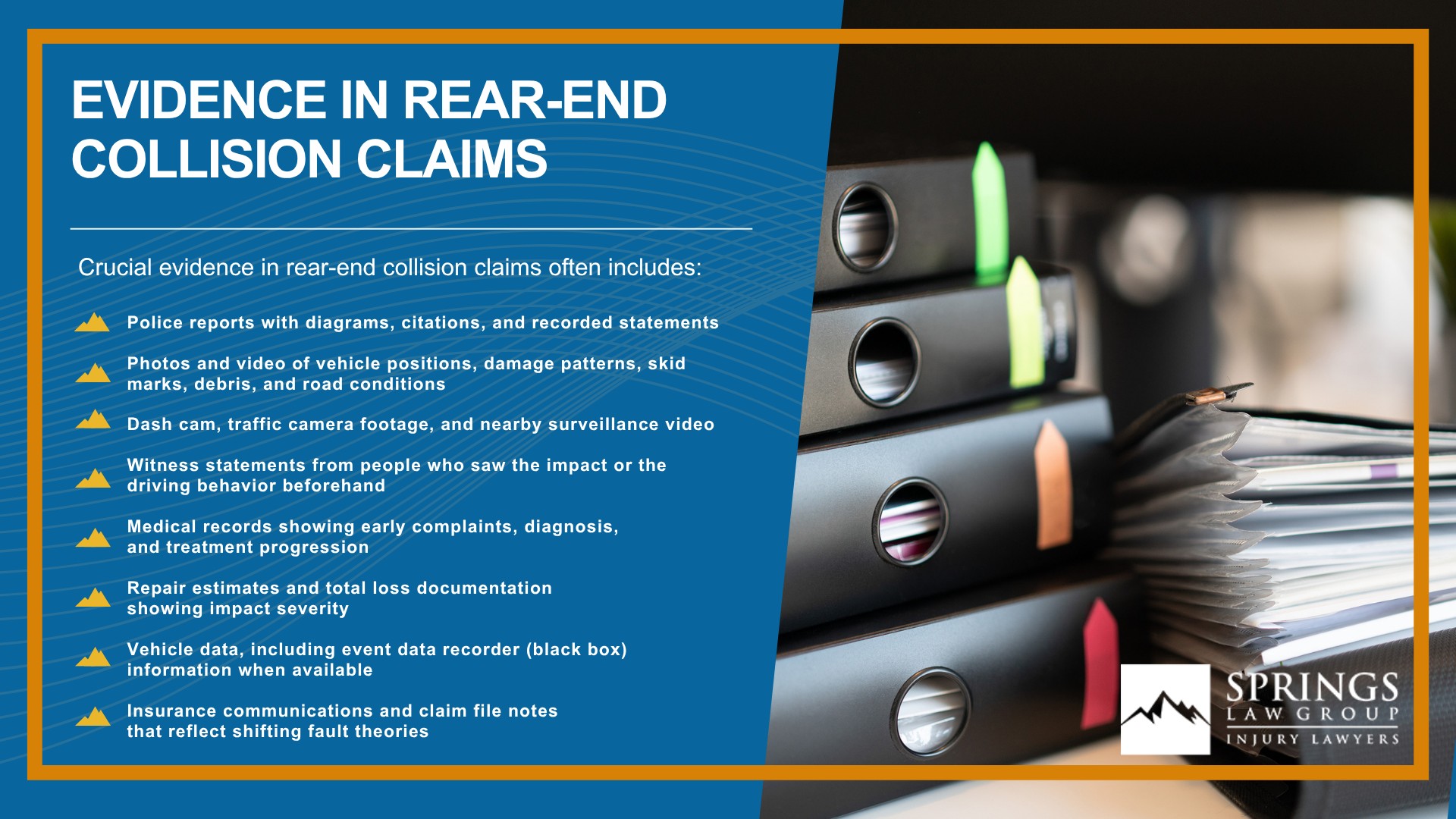
Crucial evidence in rear-end collision claims often includes:

  • Police reports with diagrams, citations, and recorded statements
  • Photos and video of vehicle positions, damage patterns, skid marks, debris, and road conditions
  • Dash cam, traffic camera footage, and nearby surveillance video
  • Witness statements from people who saw the impact or the driving behavior beforehand
  • Medical records showing early complaints, diagnosis, and treatment progression
  • Repair estimates and total loss documentation showing impact severity
  • Vehicle data, including event data recorder (black box) information when available
  • Insurance communications and claim file notes that reflect shifting fault theories

Damages in Legal Claims for Rear-End Car Accidents

Damages are the monetary amounts a person seeks to recover for losses caused by a rear-end crash, based on what can be proven and tied to the collision.

Medical expenses often anchor the claim, but the full picture may include future care needs, income disruption, and the personal impact of ongoing symptoms.

Lawyers assess and calculate damages by organizing medical bills, documenting lost wages, projecting future medical expenses when supported by treatment plans, and presenting a clear damages narrative backed by records.

That work supports a claim for maximum compensation by preventing insurers from narrowing the case to only the easiest costs to acknowledge.
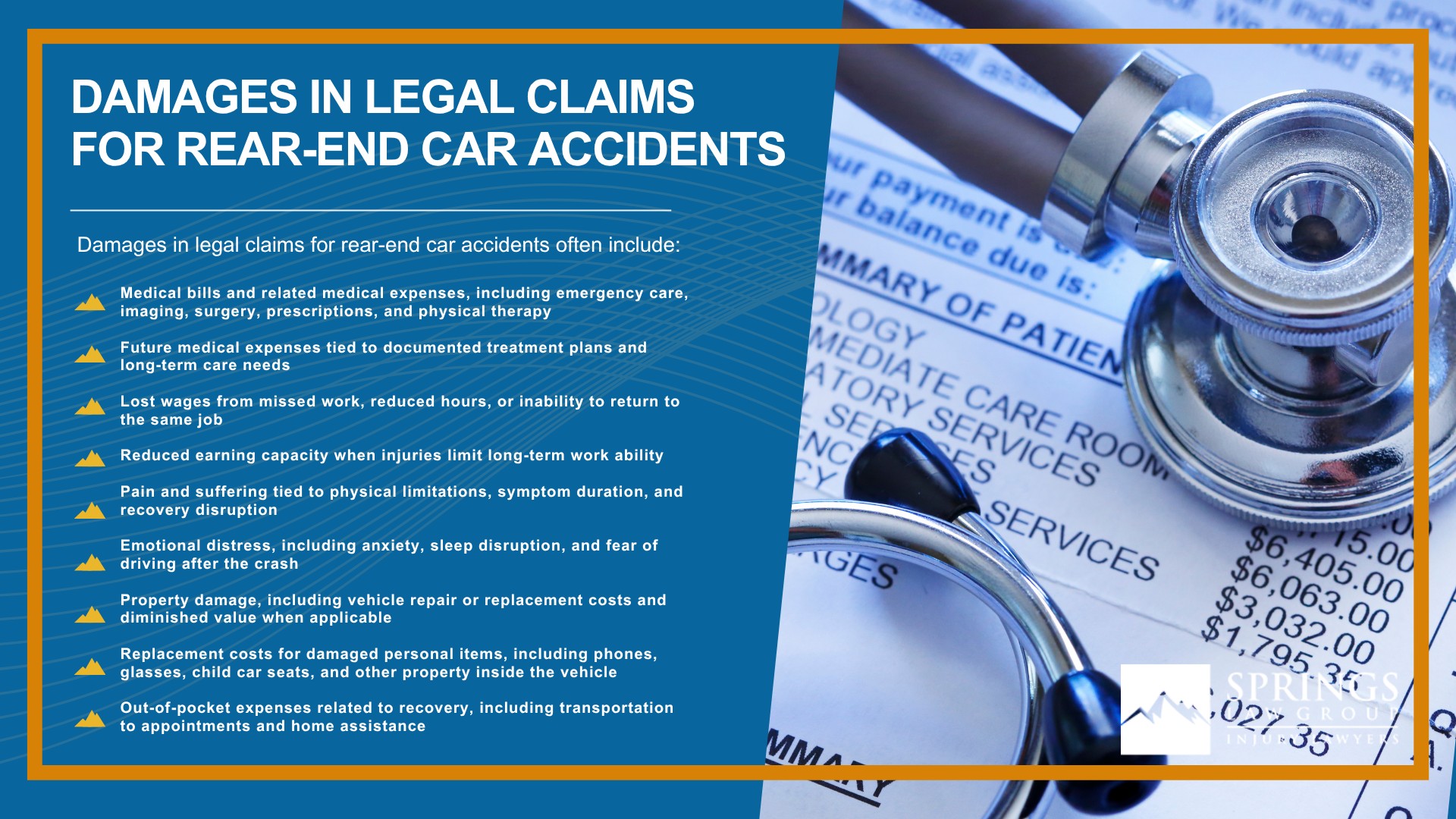
Damages in legal claims for rear-end car accidents often include:

  • Medical bills and related medical expenses, including emergency care, imaging, surgery, prescriptions, and physical therapy
  • Future medical expenses tied to documented treatment plans and long-term care needs
  • Lost wages from missed work, reduced hours, or inability to return to the same job
  • Reduced earning capacity when injuries limit long-term work ability
  • Pain and suffering tied to physical limitations, symptom duration, and recovery disruption
  • Emotional distress, including anxiety, sleep disruption, and fear of driving after the crash
  • Property damage, including vehicle repair or replacement costs and diminished value when applicable
  • Replacement costs for damaged personal items, including phones, glasses, child car seats, and other property inside the vehicle
  • Out-of-pocket expenses related to recovery, including transportation to appointments and home assistance

Springs Law Group: Colorado Springs Car Accident Lawyers

Rear-end collisions can look simple on paper, but the claims that follow are often anything but straightforward.

Springs Law Group approaches these cases with a focus on evidence, liability, and damages, not assumptions or insurer shortcuts.

That approach helps protect injured people from blame-shifting tactics and undervalued offers that do not reflect the real impact of the crash.
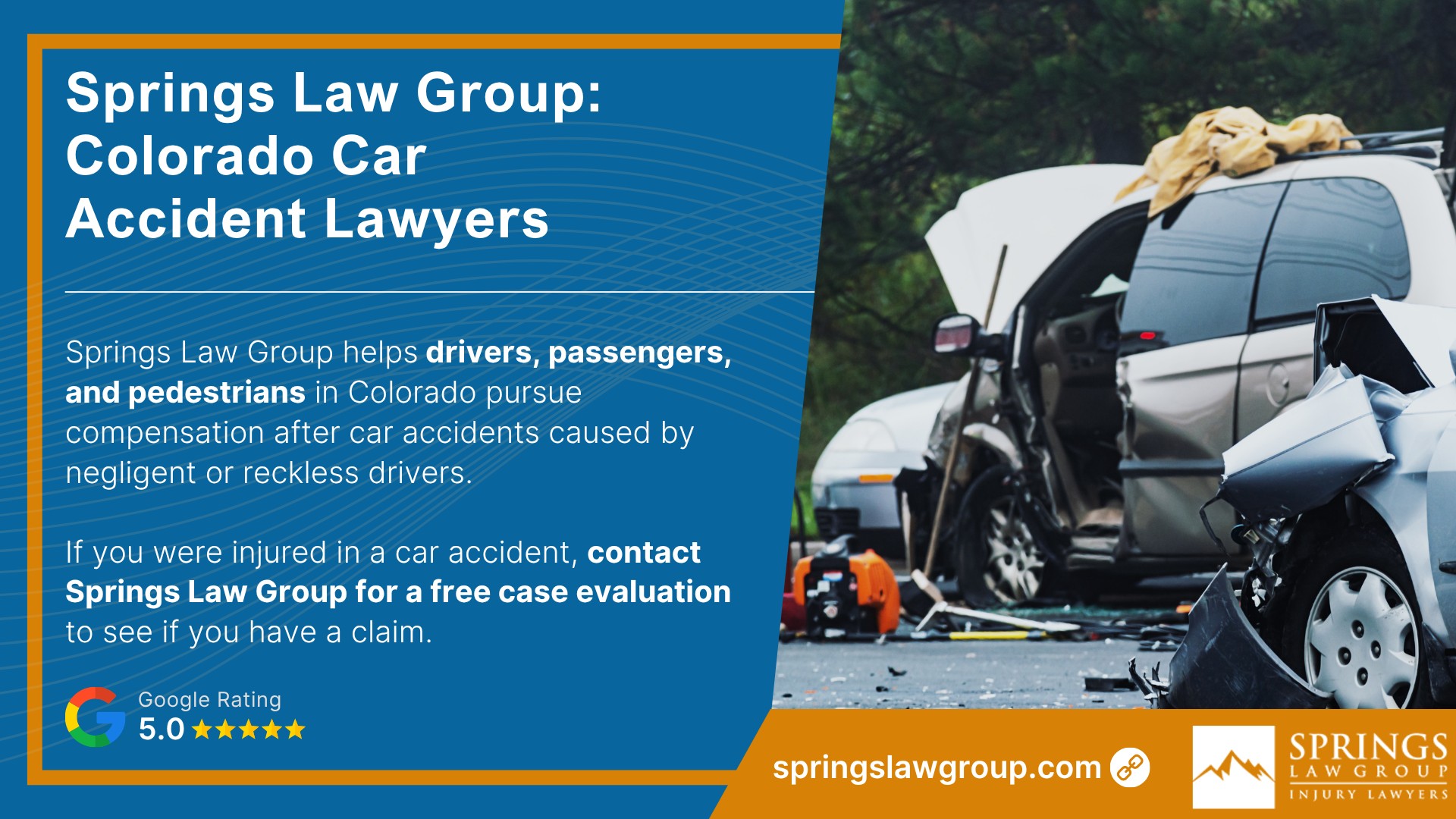
If you were injured in a rear-end collision and want to understand your options, contact Springs Law Group to speak with Colorado Springs car accident lawyers about your case and the next steps available under Colorado law.


Frequently Asked Questions

  • Is the rear driver always at fault in a rear-end collision?

    Not always. In many rear-end collisions, the rear driver is presumed responsible because drivers must follow at a reasonable and prudent distance and stay alert to traffic conditions.

    Fault can be disputed when evidence shows the front driver made an unsafe lane change, had nonfunctioning brake lights, or stopped in a way that created an unavoidable hazard.

    Multi-vehicle chain reactions can also complicate fault because the first impact may not be the last cause of injury.

    A lawyer can review the facts and evidence to determine how liability should be allocated under Colorado law.

  • What should I bring to a consultation after a rear-end collision?

    Bringing the right information helps a lawyer evaluate liability, damages, and the strength of your claim without relying on guesswork.

    Even if you do not have everything, any documentation you can provide makes it easier to confirm what happened and what losses can be proven.

    Items that are helpful to bring include:

    • The police report number or a copy of the report, if available
    • Photos or videos from the scene, including vehicle damage and road conditions
    • Insurance information for all drivers involved and any claim numbers already assigned
    • Medical records you have so far, discharge papers, and a list of providers you have seen
    • Bills, receipts, and proof of out-of-pocket expenses related to the crash
    • Proof of missed work and wage loss, such as pay stubs or employer documentation
    • Names and contact information for any witnesses or people who have relevant information

  • What if my symptoms showed up a day or two after the rear-end crash?

    That is common in rear-end collisions, especially with neck, back, and soft tissue injuries.

    Inflammation and muscle guarding can build over time, which is why pain may not feel severe at the accident scene.

    Delayed symptoms can still support a claim as long as the medical record clearly connects the onset and progression of symptoms to the crash.

    Prompt evaluation and consistent follow-up matter because insurers often use delays to argue the injury came from something else.

    A lawyer can help document the timeline and present the medical evidence in a way that addresses those arguments.

  • How do I choose the right lawyer for a rear-end collision case?

    Proving fault in a rear-end collision case can be tricky and often requires analysis of several factors, so the lawyer you choose should have specific experience with motor vehicle claims.

    Choose a lawyer whose practice primarily focuses on personal injury cases, specifically motor vehicle accidents, rather than a general practice that only handles these claims occasionally.

    Most personal injury lawyers operate on a contingency fee basis, meaning they only receive payment if they win a settlement or verdict, and that structure should be clear in writing from the start.

    Attorneys also handle all calls and paperwork to prevent victims from making statements that could damage their claim, especially early in the insurance process.

    A strong attorney-client relationship includes regular updates and clear explanations, so you understand what is happening and why.

    When selecting a lawyer for a rear-end collision, look for:

    • A practice primarily focused on personal injury and motor vehicle accidents
    • A proven track record of settlements, plus a history of favorable settlements and verdicts in similar cases
    • A contingency-fee-basis arrangement, no pay unless you win, with fees explained in plain terms
    • Evidence-handling capacity, including gathering traffic camera footage, eyewitness accounts, and vehicle black box data promptly
    • Reliable communication, including regular case updates and explanations of complex legal concepts in understandable terms
    • Deadline management, including filing within strict statutes of limitations that vary by state
    • Confirmed licensure and good standing, including checking the attorney’s standing with the State Bar Association and any disciplinary history

  • What compensation can I recover after a rear-end collision, and can I negotiate the settlement?

    You can claim compensation in all different categories within a single lawsuit after a rear-end collision, which means a claim is not limited to one type of loss.

    You can claim compensation for medical bills, car repair bills, and lost wages, along with non-economic losses tied to the injury.

    Pain and suffering damages are designed to address the emotional and mental stress caused by a rear-end collision, including disruption to daily life and recovery strain.

    In some cases, punitive damages can be awarded to punish the at-fault driver in a rear-end collision case when the conduct goes beyond ordinary negligence.

    Insurance companies often try to settle claims quickly and for less than they are worth after a rear-end collision, which is why negotiation matters.

    A lawyer can negotiate a better settlement agreement to meet your needs and negotiate for maximum compensation that reflects the true impact of the accident.

  • What factors can affect the value of a rear-end collision claim?

    The value of a rear-end collision claim depends on more than just who caused the crash, it depends on how well the losses are documented and how the insurer evaluates risk.

    Even similar accidents can lead to very different outcomes based on evidence, treatment, and coverage.

    Factors that commonly affect claim value include:

    • The severity of injuries and whether they require ongoing medical treatment
    • Consistency and timing of medical care after the collision
    • Total medical bills, lost wages, and future medical needs
    • Whether comparative negligence is alleged and how fault is allocated
    • Available insurance coverage and policy limits
    • The strength of evidence, including photos, witness accounts, and vehicle damage patterns

Written By:
Christopher Nicolaysen

Member of the Colorado Bar Association since 2014. Attorney, Christopher M. Nicolaysen focuses primarily on helping those injured in Colorado car accidents, other auto accidents, and Colorado personal injury incidents.

This article has been written and reviewed for legal accuracy and clarity by the team of writers and attorneys at Springs Law Group and is as accurate as possible. This content should not be taken as legal advice from an attorney. If you would like to learn more about our owner and experienced Colorado personal injury lawyer, Christopher Nicolaysen, you can do so here.

Springs Law Group does everything possible to make sure the information in this article is up to date and accurate. If you need specific legal advice about your case, contact us. This article should not be taken as advice from an attorney.

Do You
Have A Case?
No out of pocket costs.
We only collect a fee AFTER you win your case and receive full compensation.
Contact our team today to discuss your case for free & Get answers in as little as 3 minutes.
Would you like our help?
right-image
600
About Springs Law Group
The lawyers at Springs Law Group have experience handling diverse personal injury cases with empathy and understanding.
We recognize the delicate nature of these claims and tailor strategies to meet your unique requirements, focusing on smart — not emotional — strategies.
Our team is committed to building long-lasting, trust-based client relationships.
We believe this approach helps ensure that choosing us means partnering with a firm that genuinely values you as a person — not just another client.
Recent Posts
Do You
Have A Case?
No out of pocket costs.
We only collect a fee AFTER you win your case and receive full compensation.
Contact our team today to discuss your case for free & Get answers in as little as 3 minutes.
Would you like our help?
right-image
600

The #1 Personal Injury Lawyers in Colorado Springs, Colorado

Local Colorado Springs Resources

Education
Emergency Services
Courthouses
Department of Motor Vehicles
Community & History

Leave Us A Review

We use reviews to help show more people like you why we do what we do!

Top-Rated Personal Injury Firm Serving Colorado Springs & Beyond

Personal injury victims represented by a lawyer recover up to 3x more.

Our Process

Play Video
1
Investigation
Gather evidence. Get police reports. Obtain insurance policies.
2
Treatment
You focus on healing. We help guide you through the process.
3
Medical Records
Get the records we need to make sure you have a strong case.
4
Demand Prep
Prepare and send our demands to the insurance company.
5
Negotiation
Negotiate with the insurance company for max compensation.
6
Settlement
Reach a settlement offer you agree with or we file a lawsuit.
7
Litigation
If we have to go to court, our trial lawyers get ready to win.

Videos

Our Team

The #1 Personal Injury Lawyers in Colorado Springs, CO