
Establishing Fault in a Colorado Springs Car Accident

Were You or A Loved One Injured in an Accident?
Get Free Answers In as Little as 3 Minutes
right-image
400

How Is Fault Determined in a Colorado Springs Car Accident Claim?

Fault in a Colorado Springs car accident is established by proving that a driver or another responsible party acted negligently and caused the crash, injuries, and resulting losses.

Evidence may include the police report, photographs, video, witness statements, vehicle damage, traffic-signal data, phone records, medical records, and accident-reconstruction analysis.

A citation can support a claim, but it does not necessarily decide civil liability by itself.

Understanding Fault In Colorado Springs; Ways To Prove Fault; Legal Help In Colorado Springs; Establishing Fault In A Colorado Springs Car Accident; What Does “Fault” Mean in a Colorado Car Accident; Negligence vs. Recklessness; Who Determines Fault After a Colorado Springs Crash; Police Reports vs. Insurance Determinations; When fault is contested; When a Lawsuit Becomes Necessary; How colorado's modified comparative negligence rule; The Most Common Fault Disputes in Colorado Springs Car Accidents; Evidence That Helps Establish Fault; How insurance companies try to shift blame; Steps to Take After a Crash to Help Establish Fault; Springs Law Group_ Colorado Car Accident Lawyers

Colorado follows a modified comparative negligence rule.

An injured person may generally recover compensation if their share of fault is less than 50%, but the recovery is reduced by that percentage.

A person found 50% or more at fault generally cannot recover.

Because insurers may use disputed facts to shift fault and reduce payment, preserving evidence and presenting a consistent liability case can materially affect the outcome.

Springs Law Group’s Colorado Springs car accident lawyers investigate collisions, address comparative-fault allegations, and pursue compensation from responsible parties and available insurance coverage.

Table of Contents

How Is Fault Determined in a Colorado Springs Car Accident?

Colorado car accident fault is determined by examining how each person acted before and during the collision.

The central question is whether a driver failed to use reasonable care and whether that failure caused the accident and the claimed injuries.

Insurance adjusters evaluate fault during the claims process.

If a lawsuit is filed, a judge or jury may make the final liability determination.

Neither the other driver’s opinion nor an insurer’s initial assessment is necessarily controlling.
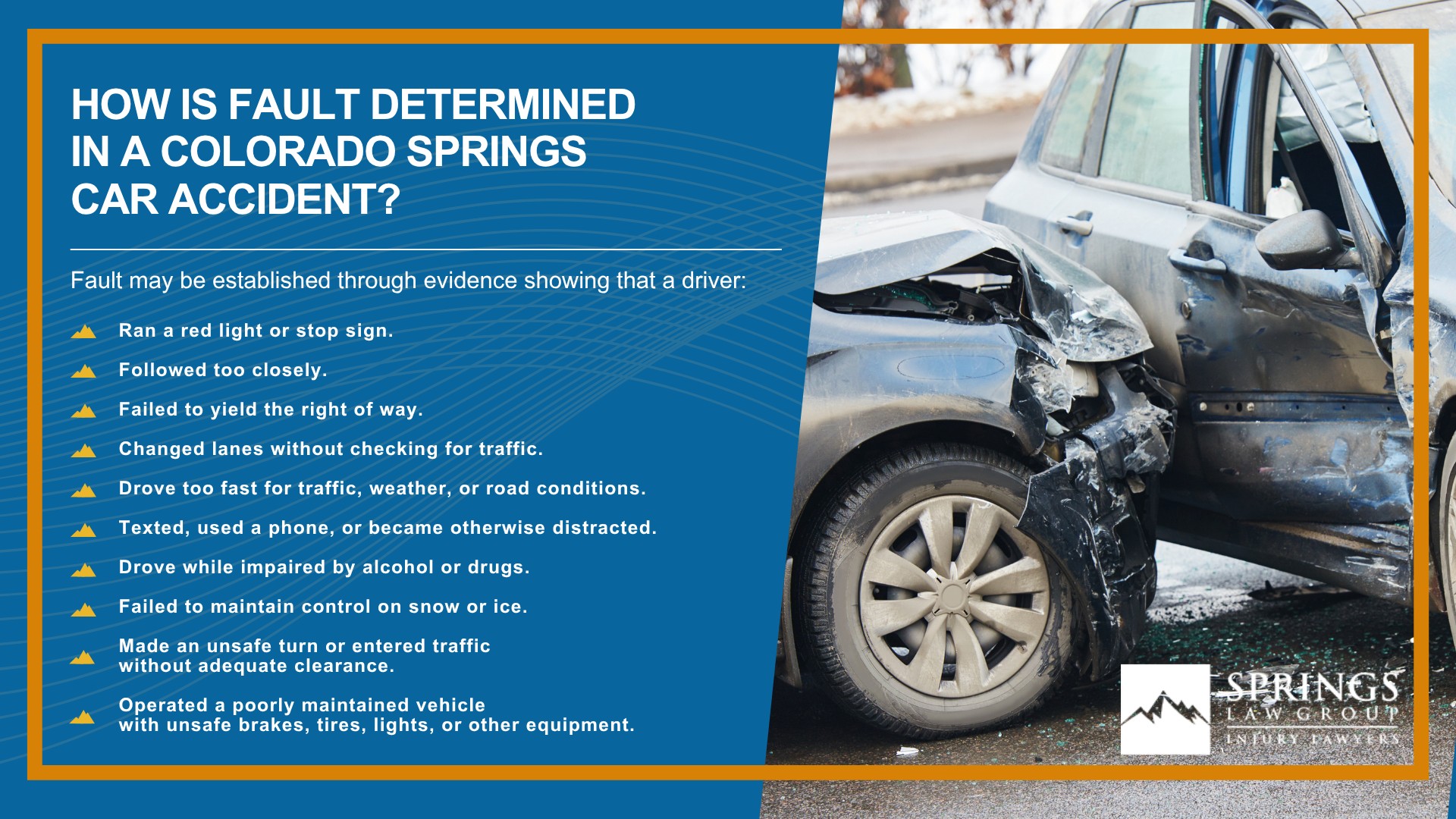
Fault may be established through evidence showing that a driver:

  • Ran a red light or stop sign.
  • Followed too closely.
  • Failed to yield the right of way.
  • Changed lanes without checking for traffic.
  • Drove too fast for traffic, weather, or road conditions.
  • Texted, used a phone, or became otherwise distracted.
  • Drove while impaired by alcohol or drugs.
  • Failed to maintain control on snow or ice.
  • Made an unsafe turn or entered traffic without adequate clearance.
  • Operated a poorly maintained vehicle with unsafe brakes, tires, lights, or other equipment.

Some crashes involve more than one contributing act.

For example, one driver may make an unsafe left turn while the approaching driver is traveling too fast.

Colorado negligence law allows fault to be divided among the people or entities whose conduct contributed to the collision.

What Must Be Proven in a Colorado Car Accident Claim?

A negligence-based car accident claim ordinarily requires proof of four elements: duty, breach, causation, and damages.
The injured person has the burden of proving these elements by a preponderance of the evidence, meaning the claim is more likely true than not true.

What Is a Driver’s Duty of Care?

Every driver has a duty to operate a vehicle with reasonable care under the circumstances.

That includes following traffic laws, watching for vehicles and pedestrians, maintaining a safe speed and distance, and adjusting to conditions such as congestion, darkness, snow, ice, or poor visibility.

What Is a Breach of Duty?

A breach occurs when a driver acts less carefully than a reasonably prudent driver would under similar circumstances.

Speeding, following too closely, driving while distracted, and failing to yield are common examples.

A violation of a traffic law may provide important evidence of breach, although the legal effect depends on the violation and the surrounding facts.

How Is Causation Proven?

The claimant must connect the negligent conduct to both the crash and the injuries.

It is not enough to show that another driver made a mistake; the mistake must have caused or contributed to the collision and resulting harm.

Medical causation may become disputed when symptoms appeared after a delay, diagnostic imaging shows degenerative changes, or the claimant had a prior injury.

Treatment records, physician opinions, prior medical records, and a clear symptom timeline can help establish the connection.

What Damages Must Be Documented?

A claimant must prove actual losses.

Depending on the case, recoverable damages may include medical expenses, future treatment, lost income, reduced earning capacity, vehicle damage, pain and suffering, physical impairment, disfigurement, and loss of enjoyment of life.

Medical bills alone do not establish every category of loss.

Treatment records, wage documents, expert opinions, photographs, receipts, and testimony about daily limitations may be necessary to present the full effect of the accident.

What Is Comparative Fault in Colorado?

Comparative fault in Colorado is the rule used to reduce or bar compensation when an injured person shares responsibility for an accident.

Colorado Revised Statutes section 13-21-111 establishes a modified comparative negligence system for negligence claims.
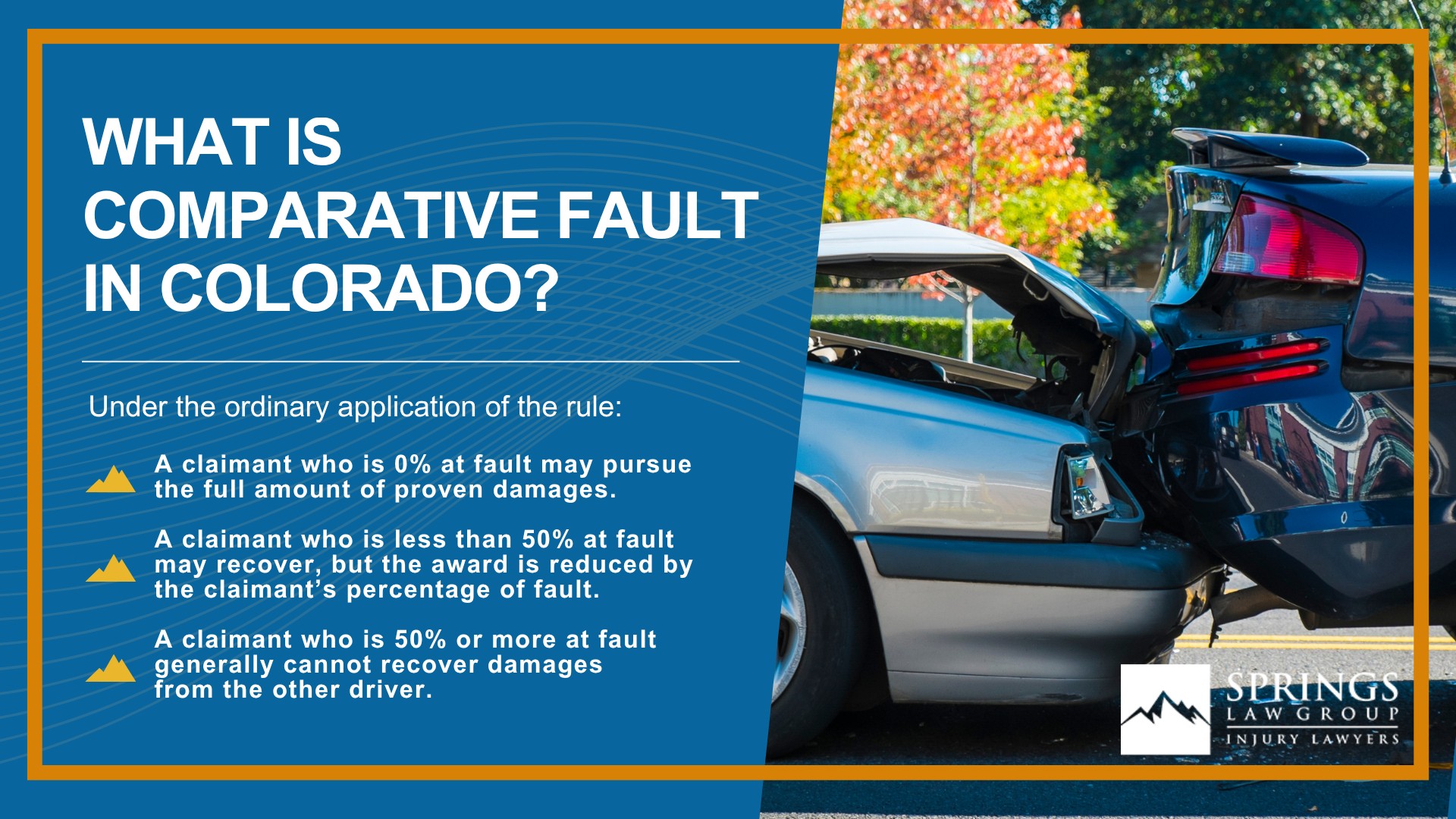
Under the ordinary application of the rule:

  • A claimant who is 0% at fault may pursue the full amount of proven damages.
  • A claimant who is less than 50% at fault may recover, but the award is reduced by the claimant’s percentage of fault.
  • A claimant who is 50% or more at fault generally cannot recover damages from the other driver.

This is sometimes described as the “50% bar rule.”

It is important to distinguish it from a pure comparative negligence system, which may permit recovery even when a claimant bears most of the fault.

How Does Colorado Comparative Negligence Reduce Compensation?

Colorado follows a modified comparative negligence system, which means your compensation is reduced in proportion to your percentage of fault for the accident.

For example, if you prove $100,000 in damages and are found 0% at fault, you may recover the full $100,000.

If you are 10% responsible, your recovery may be reduced to $90,000.

A finding of 25% fault could reduce your compensation to $75,000, while 49% fault would leave you with only $51,000.

However, if you are found 50% or more at fault, Colorado law generally bars you from recovering damages altogether.

As an illustration, if a jury determines that another driver caused a collision by making an unsafe lane change but also concludes that you were speeding and assigns you 20% of the fault, a $100,000 damages award would be reduced to $80,000.

Because even a small increase in fault can significantly reduce the value of a claim, for example, increasing fault from 20% to 30% lowers a $100,000 recovery by another $10,000, and increasing fault from 49% to 50% may eliminate recovery entirely, building a strong liability case and challenging unsupported allegations of comparative negligence is often critical to maximizing compensation.

Can More Than One Driver Be at Fault for a Colorado Car Accident?

Yes.

Colorado law permits fault to be allocated among multiple drivers and, in appropriate cases, other people or businesses.

A chain-reaction collision, commercial-vehicle crash, or accident involving a defective vehicle component may have several responsible parties.
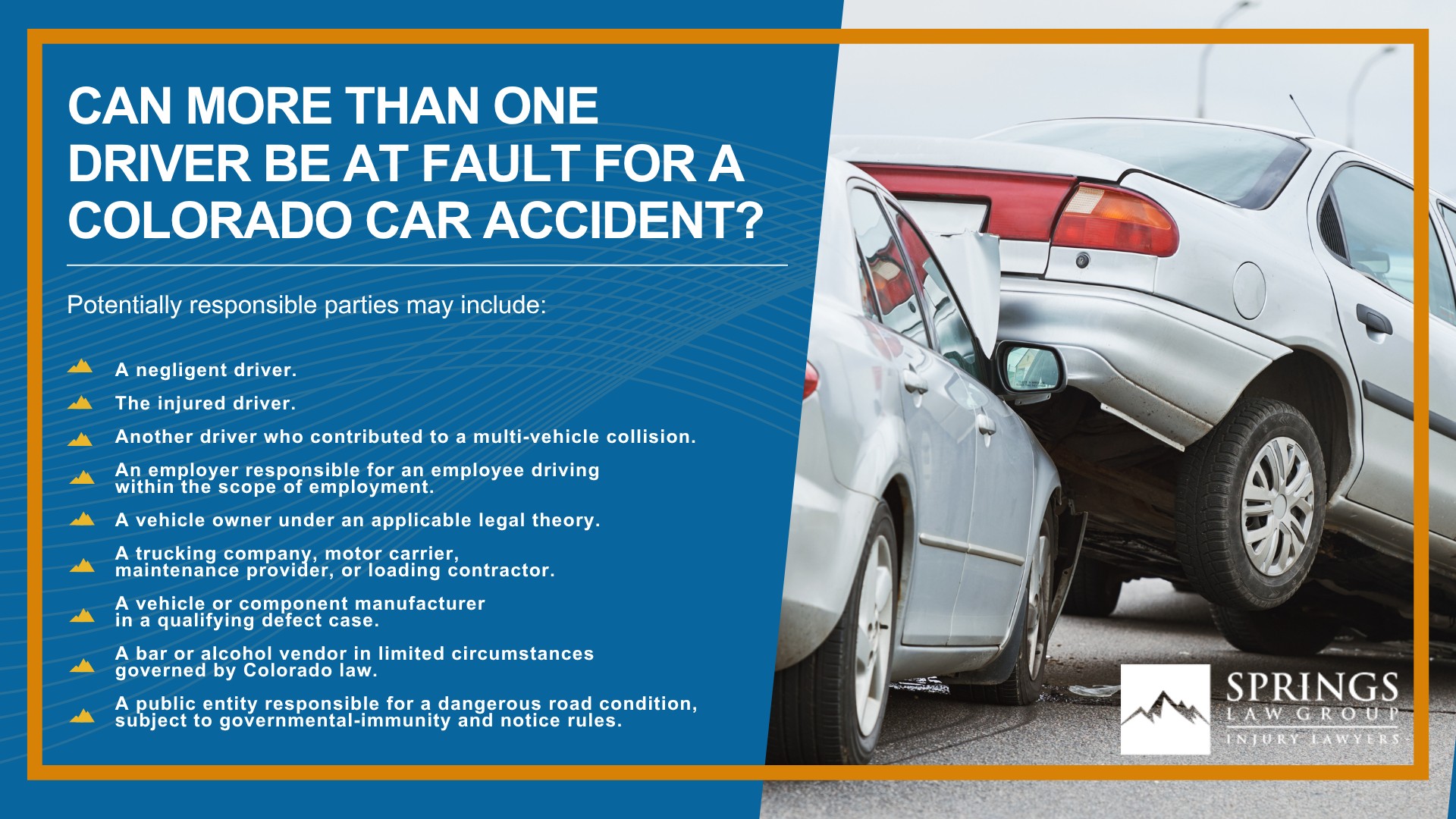
Potentially responsible parties may include:

  • A negligent driver.
  • The injured driver.
  • Another driver who contributed to a multi-vehicle collision.
  • An employer responsible for an employee driving within the scope of employment.
  • A vehicle owner under an applicable legal theory.
  • A trucking company, motor carrier, maintenance provider, or loading contractor.
  • A vehicle or component manufacturer in a qualifying defect case.
  • A bar or alcohol vendor in limited circumstances governed by Colorado law.
  • A public entity responsible for a dangerous road condition, subject to governmental-immunity and notice rules.

Colorado generally applies pro rata liability under section 13-21-111.5.

This means a defendant is ordinarily responsible for the percentage of damages corresponding to that defendant’s allocated fault, subject to statutory exceptions and other liability doctrines.

Can Fault Be Assigned to Someone Who Is Not Named in the Lawsuit?

In some cases, a defendant may designate a nonparty at fault.

If the legal requirements are met and the evidence supports the designation, the jury may assign a percentage of responsibility to that person or entity even though the nonparty is not a defendant.

A nonparty designation can reduce the portion of damages allocated to the named defendants without providing a judgment against the nonparty.

Identifying all responsible parties and applicable insurance coverage early is therefore critical.

What Evidence Establishes Fault in a Colorado Springs Car Accident?

No single document proves every crash.

Strong claims use multiple sources of evidence that support the same account of how the collision occurred.
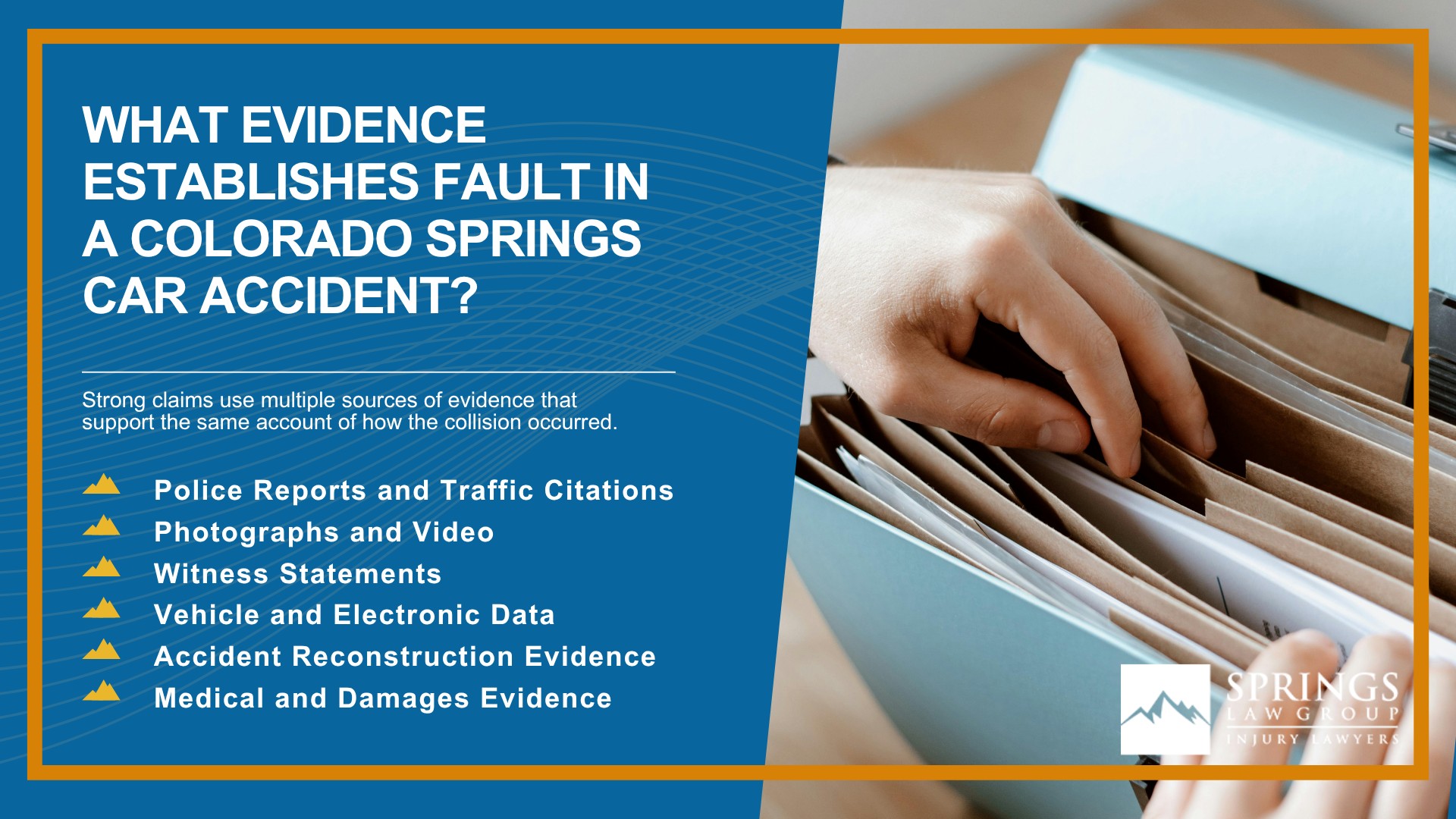
Police Reports and Traffic Citations

A police report may identify the drivers, vehicles, witnesses, road conditions, apparent contributing factors, statements, diagrams, and citations.

It can be valuable during an insurance investigation, but an officer’s preliminary assessment does not automatically bind an insurer, judge, or jury.

A citation may support an argument that a driver violated a traffic rule.

The civil case still requires analysis of admissibility, causation, comparative fault, and the complete accident evidence.

Photographs and Video

Scene photographs can preserve vehicle positions, skid marks, debris, lane markings, traffic controls, sight obstructions, weather, and road conditions.

Vehicle photographs may reveal the direction and severity of impact.

Dash-camera footage, business surveillance, residential cameras, traffic-camera recordings, and phone video may provide a more objective account.

Because footage is often overwritten, prompt preservation requests can be essential.

Witness Statements

Independent witnesses may describe traffic-signal phases, speed, lane position, sudden braking, admissions, distraction, or conduct after the crash.

Their names and contact information should be obtained promptly while memories are fresh.

Vehicle and Electronic Data

Modern vehicles may store event data concerning speed, braking, throttle position, seat-belt use, and other information shortly before a crash.

Commercial vehicles may also contain electronic logging, telematics, camera, dispatch, and maintenance data.

Phone records and app data may become relevant in a distracted-driving claim.

Access to private or proprietary records may require consent, a preservation demand, a subpoena, or formal discovery after a lawsuit is filed.

Accident Reconstruction Evidence

When liability is seriously disputed, an accident reconstructionist may analyze vehicle damage, measurements, roadway evidence, event data, photographs, video, and witness accounts.

The expert may evaluate speed, reaction time, visibility, impact angles, and whether the physical evidence is consistent with each driver’s account.

Medical and Damages Evidence

Fault and damages are distinct, but both must be established.

Medical records can document when symptoms began, the mechanism of injury, diagnoses, treatment, restrictions, and prognosis.

Wage records, tax documents, employment verification, receipts, and expert opinions may establish financial losses.

Does a Police Report Decide Who Is at Fault?

No.

A police report may strongly influence an insurance company’s initial evaluation, but it does not necessarily decide civil liability.

The officer may not have witnessed the crash, may have received incomplete statements, or may not have had access to later-obtained video or electronic data.

An insurer may reach a different conclusion after reviewing additional evidence.
If a lawsuit is filed, fault is determined under the rules of evidence and civil procedure, not solely from the report’s narrative or diagram.

A report that contains an error should be addressed promptly.

Depending on the circumstances, a party may provide supplemental information to the investigating agency or present contrary evidence directly to the insurer.

Does a Traffic Ticket Prove Fault in a Colorado Car Accident?

Not necessarily.

A ticket reflects an officer’s belief that a traffic violation occurred, but the citation itself does not automatically establish every element of a negligence claim.

The circumstances of the violation, the disposition of the ticket, evidentiary rules, and the connection between the conduct and the collision all matter.
For example, a citation for an equipment violation may have little bearing on causation if the defective equipment did not contribute to the crash.

Conversely, evidence that a driver entered an intersection against a red light may be central to proving breach and causation.

How Do Insurance Companies Determine Fault After a Car Accident?

Insurance companies determine fault by conducting their own claim investigations.

The adjuster typically compares the drivers’ accounts with the police report, photographs, video, witness statements, vehicle damage, traffic laws, and policy information.
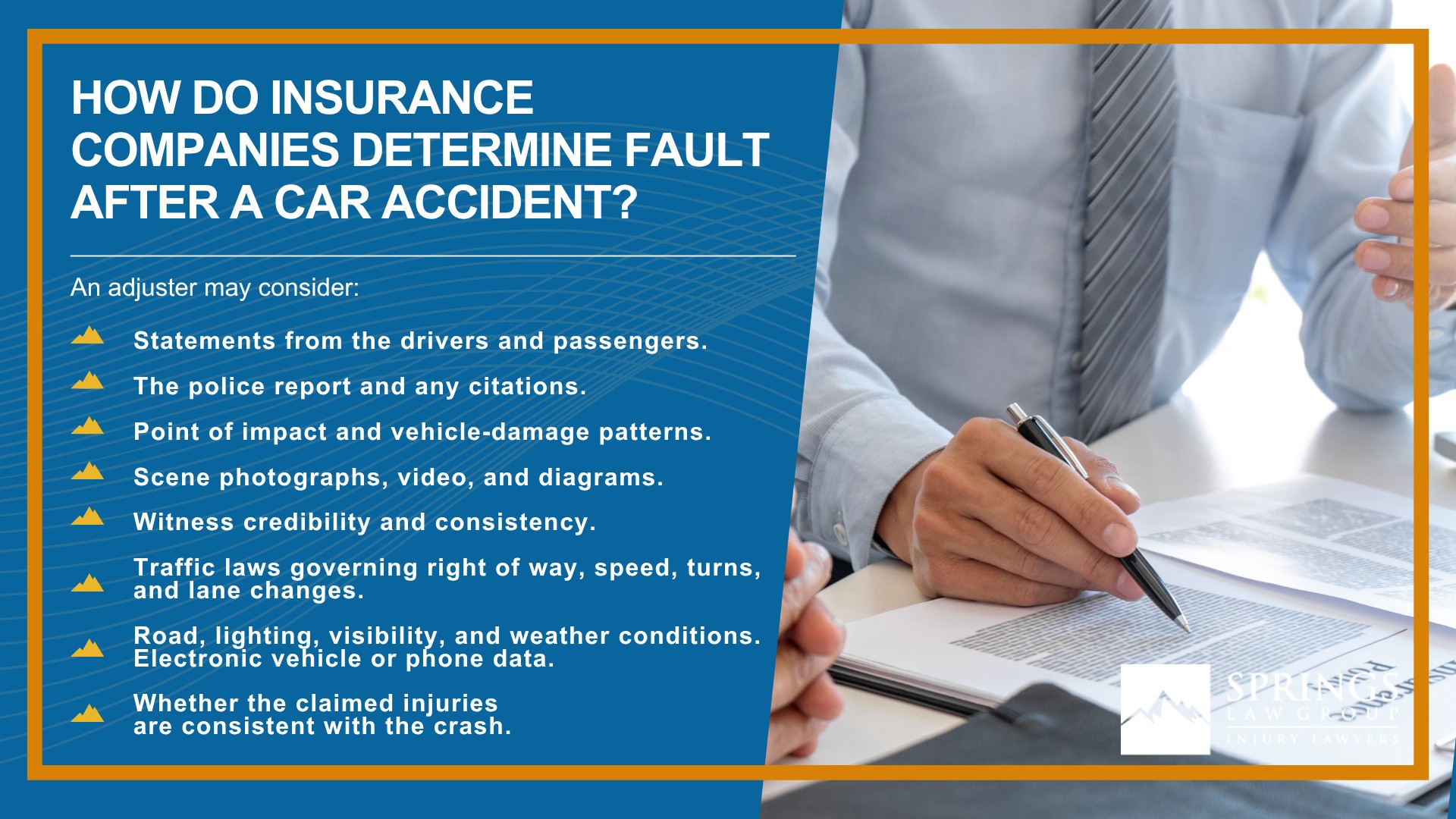
An adjuster may consider:

  • Statements from the drivers and passengers.
  • The police report and any citations.
  • Point of impact and vehicle-damage patterns.
  • Scene photographs, video, and diagrams.
  • Witness credibility and consistency.
  • Traffic laws governing right of way, speed, turns, and lane changes.
  • Road, lighting, visibility, and weather conditions.
  • Electronic vehicle or phone data.
  • Whether the claimed injuries are consistent with the crash.

An insurance company’s fault decision is a negotiating position, not a court judgment.

Different insurers may assign different percentages based on the same collision.

A claimant may challenge an adverse determination by identifying factual errors, submitting additional evidence, addressing the comparative-negligence theory, and, when necessary, filing a lawsuit.

Should I Give the Other Driver’s Insurer a Recorded Statement?

A recorded statement can become evidence about speed, distance, visibility, injuries, and possible comparative fault.

An injured person should not guess about facts they do not know or minimize symptoms before the medical condition is understood.

The other driver’s insurer does not represent the injured claimant.

Before agreeing to a recorded interview or broad authorization, the claimant should understand why the information is requested, whether it is required, and how it may affect the claim.

What Are Common Fault Disputes in Colorado Springs Car Accidents?

Fault disputes often arise when the drivers provide conflicting accounts or objective evidence is limited.

The following accident types commonly require close factual analysis.
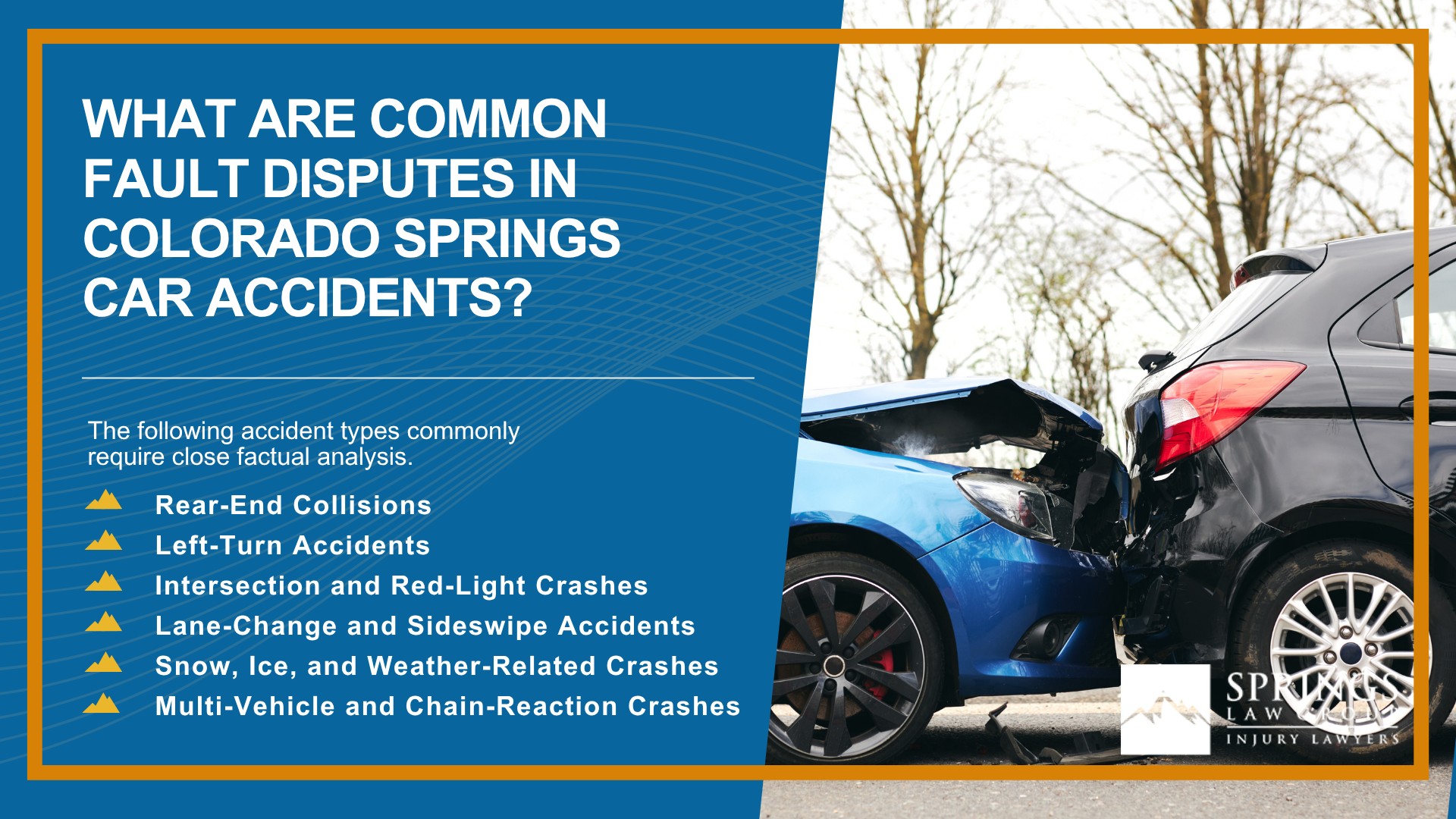
Rear-End Collisions

The rear driver is often blamed for following too closely or failing to stop, but fault is not automatic.

Evidence may show that the front vehicle made an unsafe lane change, had inoperative brake lights, reversed, or stopped unexpectedly for no traffic-related reason.

Vehicle damage, video, and witness testimony can clarify what occurred.

Left-Turn Accidents

A driver turning left generally must yield to approaching traffic when required by law.

The turning driver may argue that the oncoming vehicle was speeding, entered against a light, changed lanes improperly, or was not visible when the turn began.

Signal data, video, sight-distance evidence, and reconstruction analysis may be important.

Intersection and Red-Light Crashes

When both drivers claim a green light, the case may turn on independent witnesses, camera footage, signal sequencing, vehicle paths, and physical evidence.

Statements made immediately after the collision can also be significant.

Lane-Change and Sideswipe Accidents

These cases frequently involve disputes over lane position, blind spots, signaling, and speed.

Dash-camera video, mirror or side-panel damage, road markings, and surrounding traffic may help identify which vehicle left its lane.

Snow, Ice, and Weather-Related Crashes

Bad weather does not excuse unsafe driving. Drivers must account for reduced traction and visibility.

A motorist may be negligent for driving too fast for conditions, following too closely, using unsafe tires, or failing to maintain control even when traveling below the posted speed limit.

Multi-Vehicle and Chain-Reaction Crashes

More than one impact may occur, and each collision must be evaluated.

Investigators may examine the sequence of impacts, spacing between vehicles, braking, event data, and whether an initial collision made later impacts unavoidable.

Can a Passenger Be Blamed for a Colorado Car Accident?

A passenger is ordinarily not responsible for operating either vehicle.

A passenger may therefore have claims against one or more at-fault drivers, including the driver of the vehicle in which the passenger was riding.

These issues are fact-specific and should not be assumed merely because the passenger knew the driver.

What If the Other Driver Says I Was Partly at Fault?

An allegation of partial fault does not end the claim.

The percentage must be supported by evidence and tied to conduct that contributed to the collision or harm.

After a comparative-fault allegation, useful steps may include:

  1. Obtain and review the police report, photographs, and available video.
  2. Identify inconsistencies in the other driver’s account.
  3. Locate independent witnesses.
  4. Preserve vehicles, electronic data, and camera footage.
  5. Analyze the traffic rules governing the collision.
  6. Evaluate whether expert reconstruction is warranted.
  7. Respond with a documented liability analysis rather than an unsupported denial.

Admissions made at the scene should be evaluated in context.

A driver may apologize out of concern without admitting legal fault, while a specific statement such as “I did not see the red light” may carry greater evidentiary significance.

What Should I Do After a Colorado Springs Car Accident to Protect a Fault Claim?

Actions taken immediately after a crash can preserve evidence and reduce later disputes.

  1. Call 911 and report the collision. Request medical assistance when anyone may be injured.
  2. Move to safety if possible. Follow lawful instructions and avoid creating an additional roadway hazard.
  3. Photograph the scene. Capture vehicles, damage, license plates, debris, skid marks, signs, signals, lanes, weather, and visible injuries.
  4. Exchange information. Obtain driver, vehicle, insurance, and contact details.
  5. Identify witnesses. Record names, phone numbers, and brief descriptions of what they observed.
  6. Seek appropriate medical care. Prompt evaluation protects health and creates contemporaneous documentation.
  7. Preserve evidence. Save dash-camera footage, damaged personal property, receipts, messages, and insurer correspondence.
  8. Avoid speculation. Provide accurate facts, but do not guess about speed, distance, injuries, or fault.
  9. Notify the appropriate insurers. Comply with policy duties while protecting against unnecessary or overbroad requests.
  10. Review legal deadlines. Do not assume an open insurance claim extends the time to file suit.

How Long Do I Have to File a Colorado Car Accident Lawsuit?

Colorado generally provides a three-year limitations period for tort actions involving bodily injury or property damage arising from the use or operation of a motor vehicle.

The deadline is governed by Colorado Revised Statutes section 13-80-101 and depends on when the claim accrued.

Exceptions and shorter requirements may apply.

A claim involving a government vehicle, public employee, or dangerous public-road condition may require written notice under the Colorado Governmental Immunity Act within a much shorter period.

Wrongful death, insurance coverage, out-of-state parties, minors, and other circumstances can also require separate analysis.

Opening an insurance claim or negotiating with an adjuster generally does not, by itself, stop the statute of limitations.

Evidence may also disappear long before the filing deadline, so waiting can weaken an otherwise valid claim.

What Compensation Is Available After an At-Fault Colorado Car Accident?

An injured person may seek compensation for losses caused by the accident, subject to proof, insurance coverage, comparative fault, statutory limitations, and the facts of the case.

Economic damages may include:

  • Emergency care, hospitalization, surgery, therapy, medication, and rehabilitation.
  • Reasonably necessary future medical treatment.
  • Lost wages and employment benefits.
  • Reduced future earning capacity.
  • Vehicle repair or replacement and loss of use.
  • Other reasonable out-of-pocket expenses.

Non-economic damages may include:

  • Physical pain and suffering.
  • Emotional distress.
  • Loss of enjoyment of life.
  • Physical impairment.
  • Scarring or disfigurement.
  • Loss of consortium in an appropriate case.

Exemplary damages may be available only in qualifying cases involving conduct beyond ordinary negligence and are subject to specific pleading and proof requirements.

They should not be assumed in a routine collision claim.

How Can a Colorado Springs Car Accident Lawyer Help Establish Fault?

A car accident lawyer can investigate liability independently rather than relying only on an insurer’s initial conclusion.

Counsel can also protect evidence, identify all responsible parties and policies, and present the claim under Colorado negligence law.
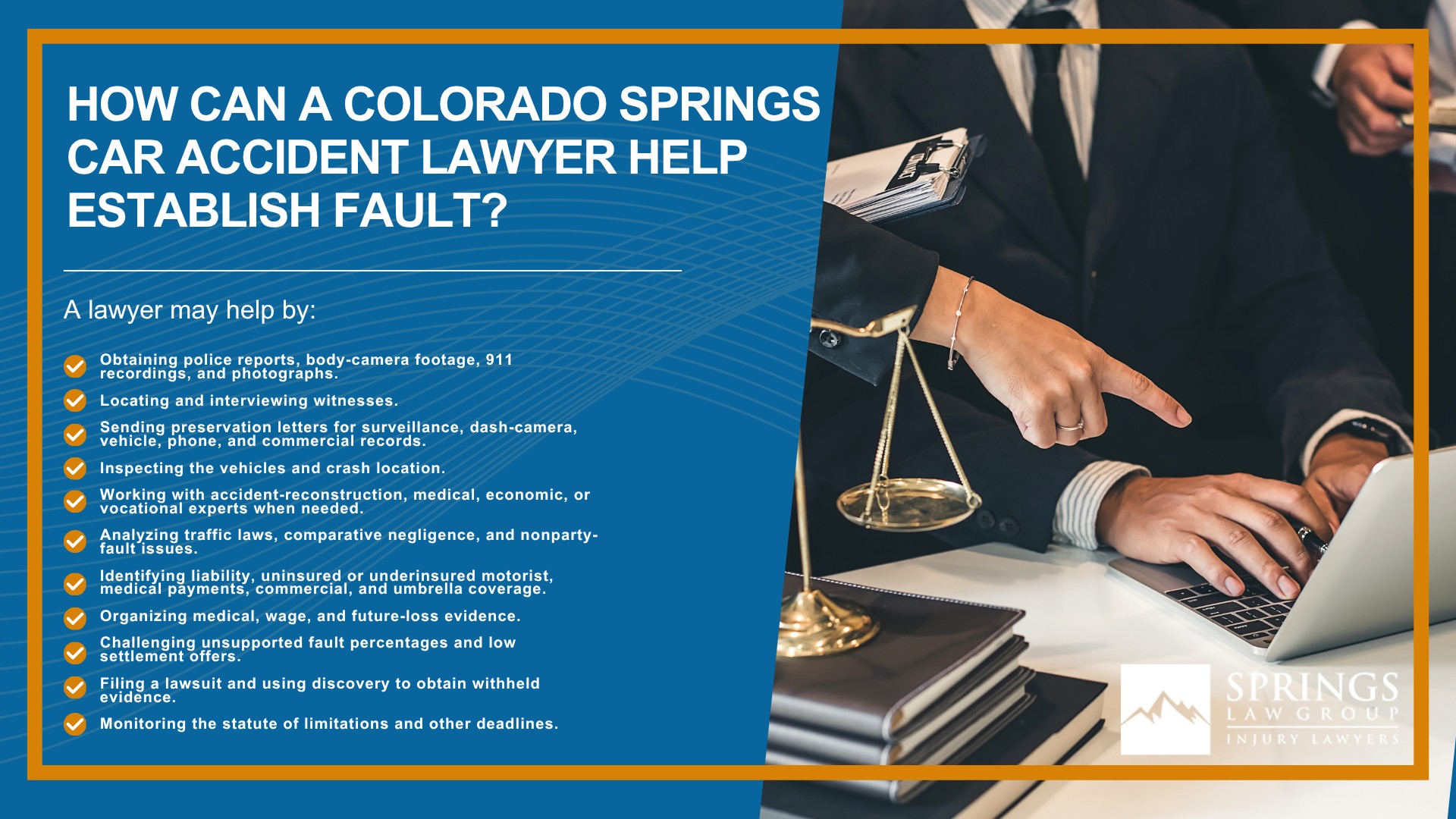
A lawyer may help by:

  • Obtaining police reports, body-camera footage, 911 recordings, and photographs.
  • Locating and interviewing witnesses.
  • Sending preservation letters for surveillance, dash-camera, vehicle, phone, and commercial records.
  • Inspecting the vehicles and crash location.
  • Working with accident-reconstruction, medical, economic, or vocational experts when needed.
  • Analyzing traffic laws, comparative negligence, and nonparty-fault issues.
  • Identifying liability, uninsured or underinsured motorist, medical payments, commercial, and umbrella coverage.
  • Organizing medical, wage, and future-loss evidence.
  • Challenging unsupported fault percentages and low settlement offers.
  • Filing a lawsuit and using discovery to obtain withheld evidence.
  • Monitoring the statute of limitations and other deadlines.

Legal representation is particularly important when the insurer denies liability, alleges the claimant is close to 50% at fault, multiple vehicles are involved, injuries are serious, a commercial or government vehicle is involved, or critical evidence is controlled by another party.

How Does a Lawyer Challenge an Insurance Company’s Fault Decision?

A lawyer can challenge a fault decision by testing the factual and legal basis for it.

That may include correcting inaccurate assumptions, comparing statements with physical evidence, presenting video or witness testimony, retaining an expert, and explaining why the alleged conduct did not cause the crash.

If negotiation does not produce a fair result, filing suit provides formal discovery tools.

Counsel may request documents and electronic data, take depositions, subpoena third-party records, obtain expert opinions, and ask a judge or jury to allocate fault.

The objective is not simply to reject the insurer’s position.

It is to replace an unsupported percentage with a documented account of how the collision occurred and how Colorado comparative negligence should apply.

When Should I Contact a Lawyer About Fault in a Colorado Springs Car Accident?

Prompt legal review may be useful when fault is disputed, evidence may be lost, the insurer requests a recorded statement, the crash involves multiple parties, or the injuries may produce long-term losses.

Early investigation can preserve video, electronic data, vehicle evidence, and witness recollections that may not remain available later.

Immediate review is also important when a government entity, rideshare vehicle, commercial truck, uninsured driver, or underinsured driver may be involved.

These matters can present additional notice, coverage, and evidence issues.

Springs Law Group: Speak With a Colorado Springs Car Accident Lawyer

Disputes over fault can affect whether a Colorado Springs car accident claim succeeds and how much compensation may be available.

Our attorneys investigate how the collision occurred, preserve physical and electronic evidence, interview witnesses, review police reports and traffic laws, and challenge unsupported allegations of comparative negligence.

We can also identify additional responsible parties and insurance coverage when a crash involves multiple vehicles, commercial drivers, government entities, or other complicating factors.

Springs Law Group handles qualifying personal injury cases on a contingency fee basis, so clients do not pay upfront attorney fees and legal fees are tied to a financial recovery.

If fault is disputed after a Colorado Springs car accident, contact Springs Law Group today for a free consultation or use the chat feature on this page to discuss your claim.


Frequently Asked Questions

  • How do you prove negligence in a Colorado Springs car accident case?

    A personal injury claim based on negligence generally requires proof that the other party owed a duty of care, breached that duty, caused the incident, and caused measurable damages.

    The injured party must connect the negligent conduct to both the collision and the plaintiff’s injury.

    Medical records, photographs, witness testimony, vehicle data, and other evidence may be used to establish causation and plaintiff’s damages.

    A Colorado personal injury lawyer can evaluate whether the available evidence supports each element of the claim.

  • How does Colorado's modified comparative negligence rule affect a car accident claim?

    Colorado is a modified comparative negligence state, which means an injured person may generally recover compensation when their share of fault remains below the statutory bar.

    Colorado’s modified comparative negligence system reduces recovery according to the plaintiff’s percentage of responsibility.

    For example, a plaintiff with $100,000 in proven damages who is found 20% responsible may recover $80,000, subject to the facts and available insurance coverage.

    If the court finds the plaintiff meets or exceeds the applicable fault threshold, comparative negligence laws may bar recovery.

  • Is comparative negligence the same as contributory negligence?

    No.

    Contributory negligence laws and comparative negligence laws can produce very different results.

    Traditional contributory negligence may bar recovery when a plaintiff bears any legally relevant share of fault, while comparative negligence generally reduces damages according to the plaintiff’s percentage of responsibility.

    Different states use different rules, and Colorado applies a modified comparative negligence system rather than a traditional contributory negligence rule.

  • What is a comparative negligence defense in a Colorado car accident case?

    A comparative negligence defense argues that the injured party contributed to causing the accident or resulting harm.

    The other party may claim that the plaintiff was speeding, distracted, failed to yield, made an unsafe maneuver, or otherwise contributed to the incident.

    The defense must be evaluated against the available evidence rather than accepted simply because one party raises it.

    Photographs, video, witness statements, electronic vehicle data, and accident reconstruction experts may become important in such cases.

  • Can fault be divided among several parties involved in a car accident?

    Yes.

    Colorado law allows responsibility to be allocated among multiple parties involved in a collision, and qualifying nonparties may also be assigned a percentage of fault.

    One party may be responsible for one part of the crash while another driver’s conduct contributed to the same result.

    Multi-vehicle crashes, commercial vehicle accidents, and cases involving defective vehicle components may require separate analysis of each person’s or entity’s conduct.

  • What evidence can help an accident victim challenge an unfair fault determination?

    An accident victim may challenge an insurer’s fault decision with police records, photographs, video, witness testimony, traffic-signal evidence, electronic vehicle data, phone records, and accident reconstruction evidence.

    Accident reconstruction experts may be used when the physical evidence, impact sequence, speed, visibility, or vehicle movements are disputed.

    A Colorado personal injury lawyer can also use the legal process to obtain evidence through subpoenas, depositions, and discovery if the case proceeds to litigation.

  • Does sharing fault mean I cannot receive full compensation?

    Sharing fault can reduce the amount recoverable under Colorado’s modified comparative negligence rule.

    A plaintiff who is assigned some responsibility will generally have the award reduced according to the plaintiff’s percentage of fault, while a plaintiff assigned no responsibility may pursue full compensation for proven losses, subject to insurance coverage and other applicable state laws.

    Whether a fair settlement reflects the evidence may depend on how fault, medical causation, and damages are documented.

  • Do most car accident fault disputes go to trial?

    No.

    Most cases do not necessarily require a trial, and a fault dispute may be resolved during the insurance claim process or through settlement negotiations.

    Litigation may become necessary when the insurer refuses a fair settlement, assigns an unsupported percentage of fault, or withholds evidence needed to evaluate responsibility.

    If the case reaches trial, the judge or jury may determine negligence, causation, plaintiff’s damages, and the percentage of responsibility assigned to the parties involved.

  • When should I seek legal help after being blamed for a Colorado Springs car accident?

    Legal help may be useful when the insurer disputes liability, raises a comparative negligence defense, assigns substantial fault to the plaintiff, or when multiple parties and insurance policies are involved.

    A Colorado personal injury lawyer can investigate the collision, preserve evidence, identify responsible parties, review applicable state laws, and challenge fault allegations that are not supported by the record.

    The goal is to build the strongest evidence-based claim possible and pursue the compensation the injured party may deserve under Colorado law.

  • Is Colorado a no-fault car accident state?

    No.

    Colorado uses an at-fault liability system.

    The person seeking compensation from another driver generally must establish that the other driver’s negligence caused the accident and damages.

    Separate first-party coverages, such as medical payments or uninsured and underinsured motorist coverage, may apply depending on the policy and circumstances.

Written By:
Christopher Nicolaysen

Member of the Colorado Bar Association since 2014. Attorney, Christopher M. Nicolaysen focuses primarily on helping those injured in Colorado car accidents, other auto accidents, and Colorado personal injury incidents.

This article has been written and reviewed for legal accuracy and clarity by the team of writers and attorneys at Springs Law Group and is as accurate as possible. This content should not be taken as legal advice from an attorney. If you would like to learn more about our owner and experienced Colorado personal injury lawyer, Christopher Nicolaysen, you can do so here.

Springs Law Group does everything possible to make sure the information in this article is up to date and accurate. If you need specific legal advice about your case, contact us. This article should not be taken as advice from an attorney.

Do You
Have A Case?
No out of pocket costs.
We only collect a fee AFTER you win your case and receive full compensation.
Contact our team today to discuss your case for free & Get answers in as little as 3 minutes.
Would you like our help?
right-image
400
About Springs Law Group
The lawyers at Springs Law Group have experience handling diverse personal injury cases with empathy and understanding.
We recognize the delicate nature of these claims and tailor strategies to meet your unique requirements, focusing on smart — not emotional — strategies.
Our team is committed to building long-lasting, trust-based client relationships.
We believe this approach helps ensure that choosing us means partnering with a firm that genuinely values you as a person — not just another client.
Recent Posts
Do You
Have A Case?
No out of pocket costs.
We only collect a fee AFTER you win your case and receive full compensation.
Contact our team today to discuss your case for free & Get answers in as little as 3 minutes.
Would you like our help?
right-image
400

The #1 Personal Injury Lawyers in Colorado

Local Resources

Education
Emergency Services
Courthouses
Department of Motor Vehicles
Community & History

Leave Us A Review

We use reviews to help show more people like you why we do what we do!

Estudio especializado en lesiones personales de primera categoría al servicio de Colorado Springs y más allá

Personal injury victims represented by a lawyer recover up to 3x more.

Our Process

Reproducir vídeo
1
Investigation
Gather evidence. Get police reports. Obtain insurance policies.
2
Treatment
You focus on healing. We help guide you through the process.
3
Medical Records
Get the records we need to make sure you have a strong case.
4
Demand Prep
Prepare and send our demands to the insurance company.
5
Negotiation
Negotiate with the insurance company for max compensation.
6
Settlement
Reach a settlement offer you agree with or we file a lawsuit.
7
Litigation
If we have to go to court, our trial lawyers get ready to win.

Videos

Our Team

The #1 Personal Injury Lawyers in Colorado Springs, CO