
A Colorado wrongful death claim is a civil action brought when another person or entity’s negligence, wrongful act, or reckless or intentional misconduct causes a person’s death.
Unlike a personal injury claim brought by the injured person, a wrongful death action focuses on the emotional and financial losses suffered by eligible surviving family members because of the decedent’s death.
Depending on the circumstances, recoverable losses may include lost financial support, funeral costs, burial or other final-disposition expenses, grief, loss of companionship, and other damages recognized under Colorado law.
A wrongful death claim may arise from a motor vehicle crash, medical malpractice, a dangerous property condition, a defective product, workplace conduct, or another fatal incident involving legally actionable conduct.
A wrongful death lawsuit is separate from any criminal proceeding arising from the same death.
The civil case addresses civil liability and compensation for eligible survivors, while a criminal prosecution concerns violations of criminal law and potential punishment.
Colorado law limits wrongful death claims to specific people whose rights depend on their relationship to the deceased and, in some cases, when the lawsuit is filed.
The surviving spouse generally has priority during the first year, while heirs and certain other eligible parties may have broader rights during the second year.
A personal representative may pursue a separate survival claim on behalf of the estate, but that role is different from filing the wrongful death action itself.
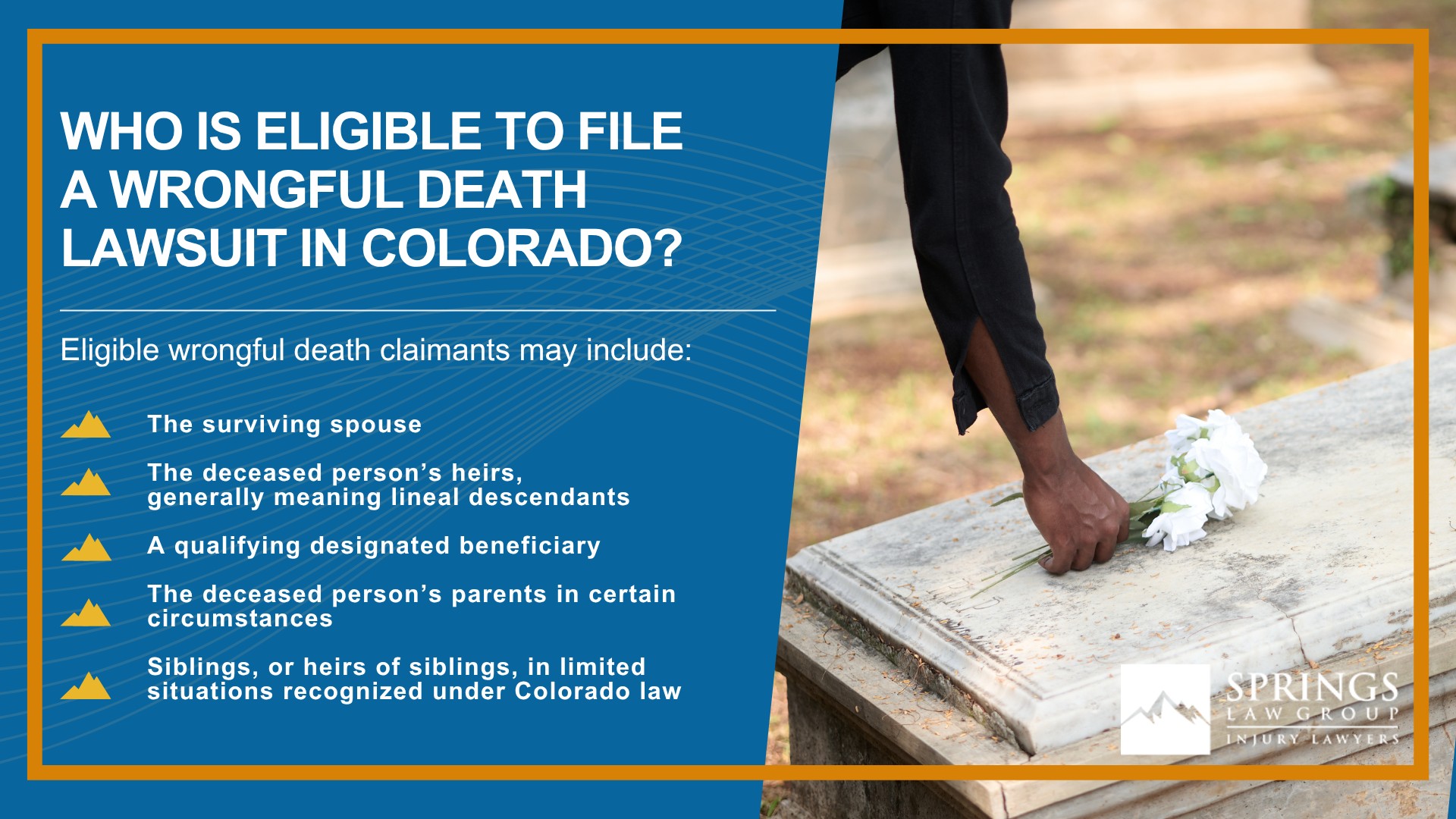
Eligible wrongful death claimants may include:
When a person dies with a surviving spouse, Colorado law generally gives the spouse priority to bring a wrongful death action during the first year after the death.
During that period, the surviving spouse may file the claim alone or make a written election allowing the spouse and the deceased person’s heirs to file together or permitting the heirs to bring the action.
The first-year rule can become especially important when the deceased person had children from a prior relationship or when several family members may have an interest in the claim.
A surviving spouse should review the available filing options before signing a written election or allowing another eligible party to proceed.
The timing of that decision can affect who participates in the lawsuit and how the claim moves forward under Colorado law.
During the first year after death, heirs may file a wrongful death action if there is no surviving spouse.
If a spouse survives, the heirs may bring the action during the first year only if the spouse makes the written election required by Colorado law, either allowing the heirs to file or allowing the spouse and heirs to proceed together.
During the second year after death, the heirs have an independent right to bring the wrongful death action.
A surviving spouse may also file during the second year, or the spouse and heirs may proceed together.
If the heirs begin the action, a surviving spouse or qualifying designated beneficiary who receives written notice may move to join the lawsuit within 90 days after service of that notice.
These rules make the date of death and the deceased person’s family structure important when determining who has authority to file.
During the first year after death, heirs may file a wrongful death action if there is no surviving spouse.
If a spouse survives, the heirs may bring the action during the first year only if the spouse makes the written election required by Colorado law.
Depending on the family structure, heirs may include:
A surviving spouse has separate rights under Colorado’s wrongful death statute and is not treated as an “heir” for purposes of this filing framework.
Parents also receive standing through a separate statutory provision in qualifying cases rather than through the statutory definition of heirs.
Siblings and heirs of siblings may have separate filing rights in the limited circumstances established by
Colorado law, but they should not be grouped with the decedent’s lineal descendants when determining heir status.
A designated beneficiary may have rights in a Colorado wrongful death case if the deceased person properly designated that beneficiary under Colorado law.
This can matter when the deceased person had a legally recognized partner or another qualifying relationship but did not have a surviving spouse.
A designated beneficiary may be able to file or participate in a wrongful death lawsuit depending on the timing of the case and whether there are heirs.
The designated beneficiary must have been given the wrongful-death standing right through a qualifying Colorado designated beneficiary agreement.
The statutory form specifically permits a person to confer the right to sue for wrongful death.
The Colorado wrongful death statute includes specific references to designated beneficiaries, which means these cases should be reviewed carefully before filing.
Evidence of a designated beneficiary may include filed paperwork, legal forms, and other documents showing the relationship was properly established.
A Colorado wrongful death attorney can help determine whether a designated beneficiary has legal rights after the loved one’s death.
Surviving children may be able to file a wrongful death claim in Colorado, but their rights depend on timing and whether there is a surviving spouse.
In the first year after death, children may usually file only if there is no surviving spouse or if the surviving spouse gives written permission.
In the second year after death, surviving children may have broader rights to bring or join a wrongful death lawsuit.
The deceased’s children may also have an interest in wrongful death compensation, even when the surviving spouse files the lawsuit.
Children may recover compensation for the loss of a parent’s support, companionship, guidance, and other losses recognized under Colorado law.
Springs Law Group helps surviving family members understand how children’s rights may be protected in wrongful death cases.
Parents may be able to file a wrongful death claim after losing a child in certain circumstances.
Colorado law has specific rules for parents when the deceased person was an unmarried minor without descendants or an unmarried adult without descendants and without a designated beneficiary.
If both parents have rights, they may be able to join in the suit.
If the parents are divorced, separated, or living apart, the appropriate Colorado court may need to address how any judgment is divided.
These claims are emotionally difficult and legally sensitive.
Springs Law Group helps parents understand their legal rights after a child’s death caused by medical malpractice, car accidents, criminal acts, reckless conduct, or another wrongful act.
Siblings can file a wrongful death claim in Colorado only in limited situations.
Colorado law may allow siblings, or the heirs of siblings, to bring a wrongful death action if the deceased person had no surviving spouse, no heirs, and no designated beneficiary, or in certain cases involving an unmarried minor or unmarried adult without descendants when there is no mother or father.
HB 24-1472 added sibling standing in limited circumstances effective January 1, 2025, including when there is no spouse, heir, or designated beneficiary, or certain unmarried decedents have no surviving parent.
A sibling should not assume they can file a wrongful death lawsuit simply because they were close to the deceased person.
When siblings believe they may have the right to sue, Springs Law Group can review the family structure, the deceased person’s estate information, and the timing of the claim.
Legal representation can help avoid filing mistakes that could delay or harm a valid wrongful death claim.
During the first year after death, Colorado law generally gives priority to the surviving spouse.
The spouse may file alone, or the spouse may make a written election allowing the spouse and heirs to file together or allowing the heirs to file.
If there is no surviving spouse, the claim may be brought by the heirs or by a designated beneficiary if one exists.
If there is no designated beneficiary, the heirs may bring the claim.
In limited family situations, siblings may be able to file during the first year.
Because the first-year rules are strict, families should speak with an experienced wrongful death attorney before deciding who should file a wrongful death lawsuit.
During the second year after death, Colorado law expands who may bring a wrongful death action.
The surviving spouse, heirs, spouse and heirs together, designated beneficiary and heirs, or qualifying siblings in limited situations may be able to file depending on the family structure.
The second-year rules can help protect surviving children and other eligible family members if the spouse did not file during the first year.
If heirs file in the second year, a surviving spouse or designated beneficiary may have a right to join the action within a specific timeframe after receiving written notice.
When heirs commence the second-year action, the qualifying spouse or designated beneficiary may move to join within 90 days after service of written notice.
These timing rules can be confusing for families who are still grieving.
Springs Law Group can explain when a party may file, whether others should be included, and how the legal process may move forward.
If there is no surviving spouse, Colorado law may allow the deceased person’s heirs to file a wrongful death claim.
If there is a designated beneficiary, that person may also have rights depending on the circumstances.
When there is no spouse, the case may require a careful review of whether there are surviving children, parents, a designated beneficiary, or other legally recognized heirs.
The answer may affect who can sue, who can recover compensation, and how the claim should be filed.
Springs Law Group can review death records, family records, estate information, and other documents to determine who may have legal standing.
This is especially important when family members disagree or when the deceased person’s family structure is complicated.
Colorado law provides limited filing rights when the deceased person leaves no surviving spouse, no heirs, and no designated beneficiary.
For wrongful death claims arising on or after January 1, 2025, the deceased person’s siblings, or the heirs of those siblings, may be permitted to bring the wrongful death action in these circumstances.
Colorado also permits sibling standing in certain cases involving an unmarried minor without descendants or an unmarried adult without descendants when neither parent survives.
Extended family members and close friends do not receive standing solely because of their relationship with the deceased.
A survival claim is separate from the wrongful death action and belongs to the deceased person’s estate.
The personal representative may pursue qualifying losses incurred before death, while wrongful death damages compensate eligible survivors for losses caused by the death.
Eligible parties in a Colorado wrongful death claim are established through family relationship, legal status, timing, and documentation.
The court, insurance company, and potentially liable parties may require proof that the person filing has the right to sue.
Evidence is important because a wrongful death lawsuit must be brought by the proper party.
If the wrong person files, the insurance company or defendant may challenge the claim.
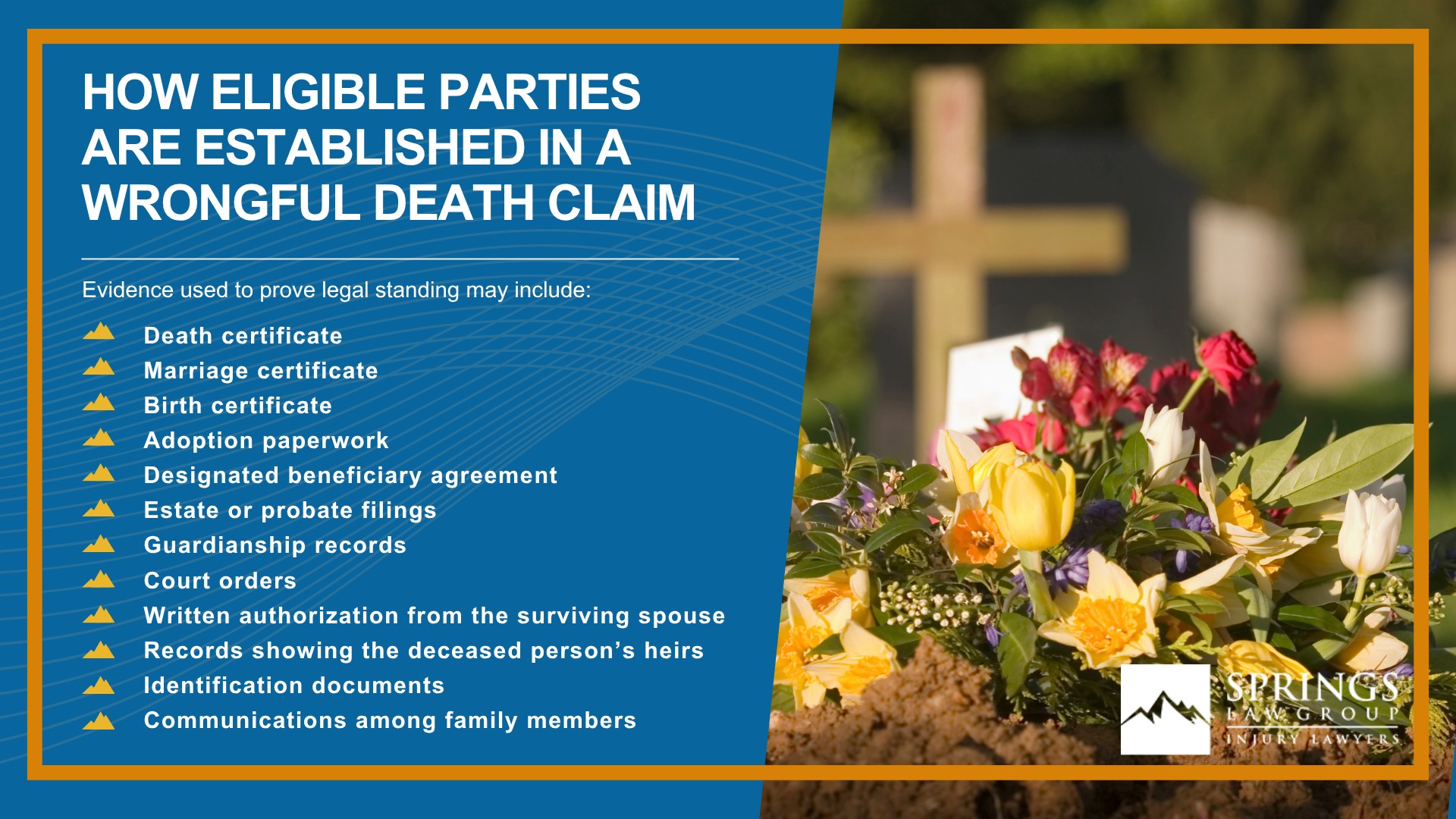
Evidence used to prove legal standing may include:
Other evidence is also needed to prove liability and damages.
Accident reports, medical records, medical bills, funeral expenses, burial expenses, lost income documentation, and witness statements can help support the wrongful death claim.
More than one eligible person may be able to participate in a Colorado wrongful death lawsuit depending on the timing and family structure.
The surviving spouse and heirs may file together, or heirs may file during the second year after death.
Colorado law generally allows only one civil lawsuit for the wrongful death of one decedent.
That means eligible parties may need to coordinate instead of filing separate wrongful death claims.
When multiple family members are involved, legal representation can help clarify roles, reduce confusion, and protect the case.
Springs Law Group can help families determine who should be included and how the claim should proceed.
Family disagreements can happen in wrongful death cases, especially when grief, financial stress, blended families, and unanswered questions are involved.
Disputes may involve who has the right to file, whether to settle, how compensation should be divided, or whether the case should proceed to trial.
These disagreements can delay the legal process if they are not handled carefully.
The appropriate Colorado court may need to resolve certain disputes, especially when multiple eligible parties claim an interest in the wrongful death suit.
Springs Law Group works to help families understand the filing rules, preserve evidence, and move the case forward when possible.
A wrongful death claim and a survival claim address different losses arising from the same death.
A wrongful death claim belongs to eligible surviving family members and focuses on the losses they experience because of the death, including grief, loss of companionship, funeral and burial expenses, and the financial support they reasonably would have received from the deceased.
Colorado law may also allow a court or jury to award punitive damages in a qualifying wrongful death case involving fraud, malice, or willful and wanton conduct, subject to statutory requirements.
A survival claim belongs to the deceased person’s estate and preserves certain claims the deceased person could have pursued before death.
When the underlying claim is based on personal injury, Colorado’s survival statute generally limits recoverable damages to losses incurred before death, including lost wages and expenses such as qualifying medical expenses.
The survival claim does not permit recovery for the deceased person’s pain and suffering, disfigurement, or prospective earnings after death.
The personal representative generally pursues the survival claim on behalf of the estate, while the wrongful death action is brought by the people authorized under Colorado’s wrongful death statutes.
A fatal accident can therefore support both types of claims when the facts and available damages satisfy the separate legal requirements.
When more than one person is entitled to recover in a Colorado wrongful death action, the compensation is not necessarily divided according to who filed the lawsuit or who participated most actively in the case.
Colorado law treats wrongful death damages as jointly owned by the eligible parties and distributes the recovery according to the applicable laws of descent and distribution.
Colorado’s current civil jury instructions confirm that this rule applies to both economic and noneconomic wrongful death damages.
A wrongful death award may compensate eligible survivors for losses such as:
The amount ultimately distributed to a surviving spouse, children, or other eligible parties depends on the family structure and the Colorado statutes governing distribution.
Different family members may experience different personal losses, but Colorado law generally treats the wrongful death recovery as a single recovery rather than separate, independent awards belonging exclusively to each claimant.
Most Colorado wrongful death claims must be filed within two years from the date the death occurred.
Because the claim accrues on the date of death, families should not wait to ask questions about who can sue or when the wrongful death lawsuit must be filed.
Some cases may involve different rules or shorter practical deadlines.
Claims involving government entities, medical malpractice cases, or certain evidence issues may require earlier action.
A specific four-year exception applies when the defendant committed vehicular homicide and, during the same criminal episode, left the scene of the fatal accident.
Missing the deadline can prevent surviving family members from recovering compensation through a wrongful death action.
Springs Law Group can review the date of death, the responsible parties, and the facts of the case to help determine the filing deadline.
Families dealing with a wrongful death are often under enormous stress.
Insurance companies may contact surviving family members quickly, and it can be difficult to make legal decisions while grieving.
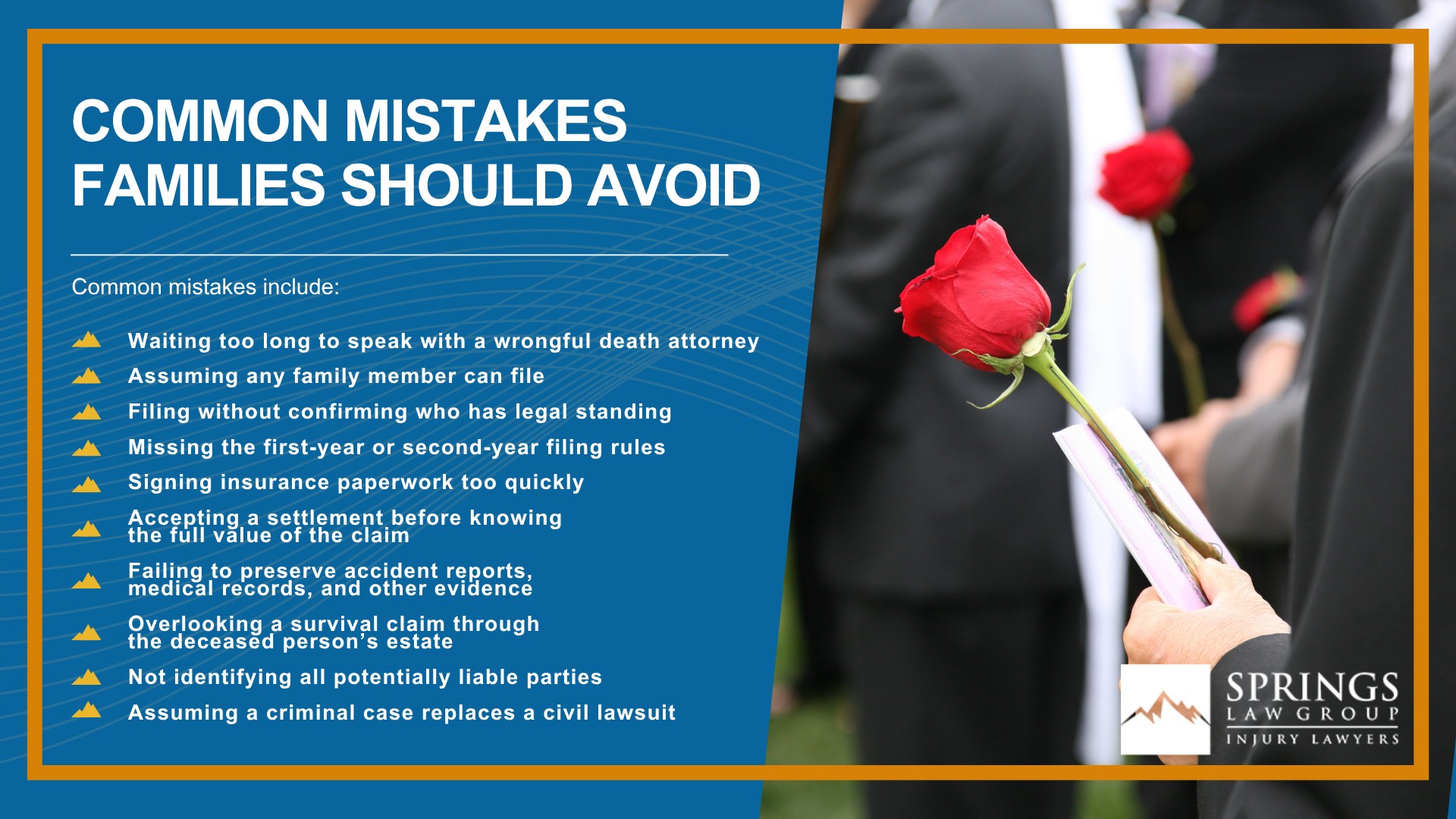
Common mistakes include:
An experienced wrongful death attorney can help families avoid mistakes and understand their legal rights before dealing with the insurance company or defendant.
Springs Law Group helps families in Colorado Springs determine who can sue under Colorado’s wrongful death law.
We review the family relationship, the timing of the claim, the deceased person’s estate, and the facts of the fatal accident or incident.
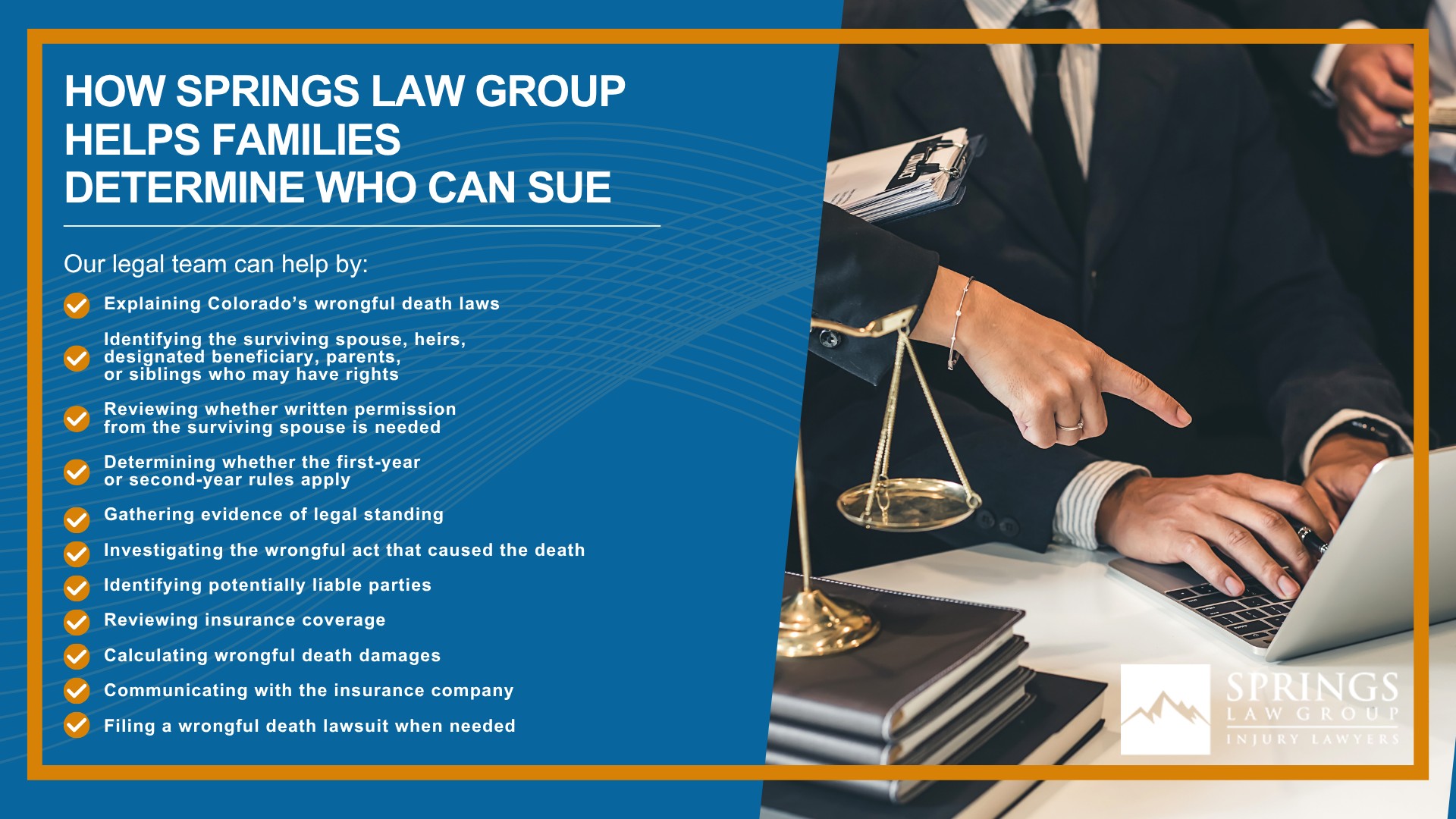
Our legal team can help by:
The firm understands that families need clear answers during a difficult time.
Springs Law Group can guide you through the legal process and help your family seek compensation after a preventable death.
Colorado wrongful death claims require careful attention to who has the legal right to file, when the action may be brought, and which losses belong to the surviving family rather than the deceased person’s estate.
Our attorneys can review the family structure, determine whether a surviving spouse, heir, designated beneficiary, parent, or qualifying sibling may have standing, and evaluate whether a separate survival claim should also be pursued.

Springs Law Group can investigate the conduct that caused the death, preserve evidence, identify responsible parties and available insurance coverage, document wrongful death damages, and file a lawsuit when necessary.
If your family lost a loved one because of another person’s negligence or wrongful conduct, contact Springs Law Group today for a free consultation or use the chat feature on this page to discuss your legal options.