
An injured passenger generally has the right to seek compensation from one or more at-fault parties.
Unlike a driver, a passenger usually does not control the vehicle and often bears no responsibility for causing the collision.
That can make liability more straightforward, although insurers may still dispute which driver was at fault, whether the crash caused the injuries, and how much the claim is worth.
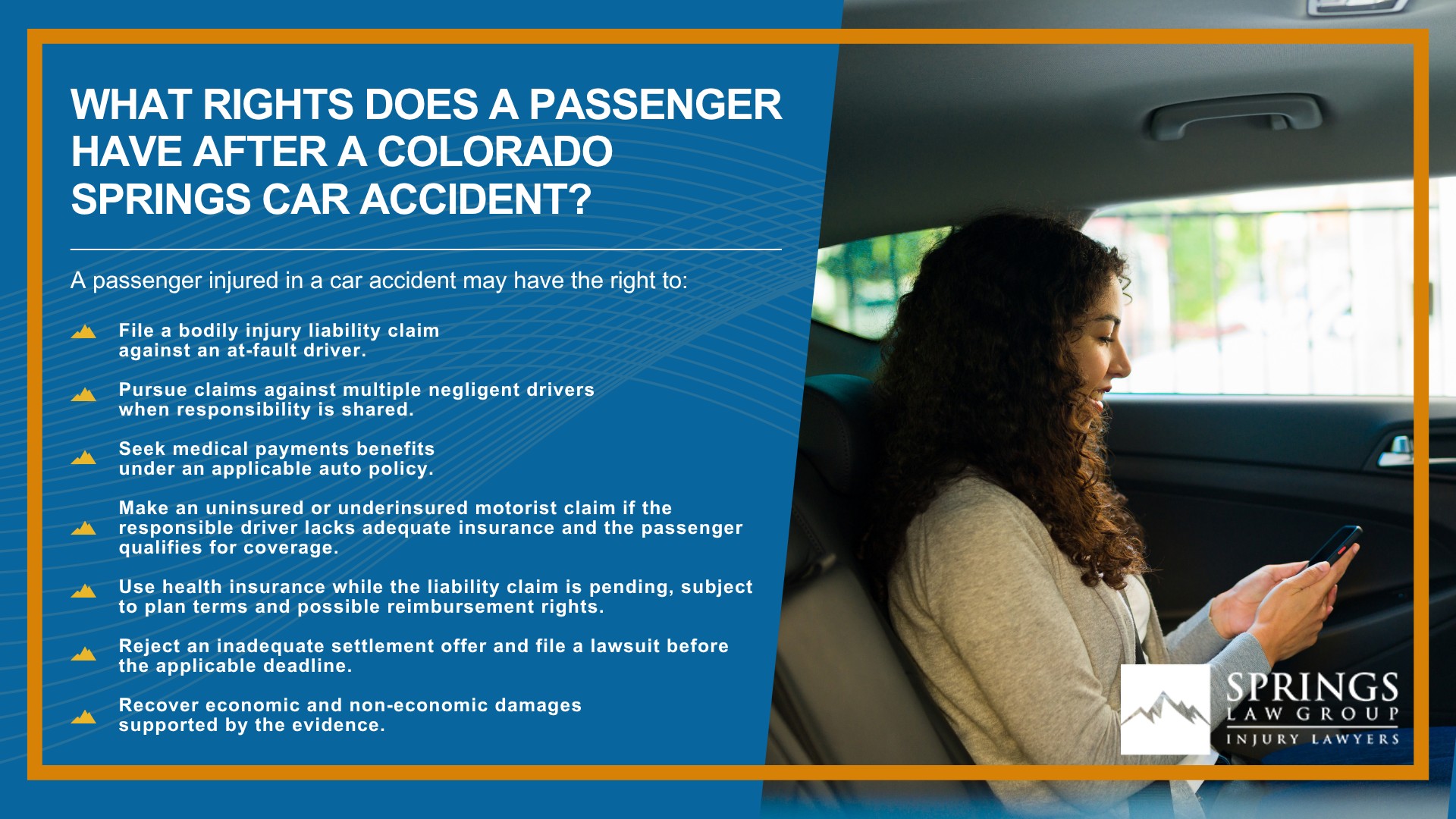
A passenger injured in a car accident may have the right to:
The available rights and coverage depend on the accident, the insurance policies, the passenger’s household relationships, and the conduct of each potential defendant.
A complete coverage review is important because the most obvious liability policy may not be the only source of compensation.
A passenger may file a claim against any party whose negligent or wrongful conduct caused the crash and injuries.
The correct defendants are determined by evidence, not by which vehicle the passenger occupied.
Yes.
If another driver caused the collision by speeding, following too closely, failing to yield, running a red light, driving while distracted, or committing another negligent act, the passenger may pursue that driver and the driver’s liability insurer.
For example, if an oncoming driver turns left across the path of the passenger’s vehicle, both the passenger and the passenger’s driver may have claims against the turning driver.
Each injured person has a separate damages claim, even though the claims arise from the same accident.
Yes.
A passenger may pursue a claim against the driver of the vehicle they were riding in when that driver caused or contributed to the crash.
The claim is typically brought against the negligent driver and handled through the applicable car insurance policy, subject to the policy terms, coverage limits, and the facts involving the parties involved.
This can apply even when the driver is a family member, friend, or someone who lives in the same household.
For example, if the host driver rear-ends another vehicle while texting, the injured passenger may have a claim based on that driver’s negligence.
The personal relationship between the passenger and driver does not eliminate the driver’s duty to operate the vehicle with reasonable care, although household definitions, exclusions, and other policy provisions may affect available coverage.
Yes.
When both drivers contributed to the collision, the passenger may pursue claims against both.
Colorado law permits fault to be allocated among multiple responsible parties.
Each defendant is ordinarily responsible for the portion of damages corresponding to that defendant’s assigned fault, subject to statutory exceptions and other liability doctrines.
Assume the passenger’s driver made an unsafe lane change while a second driver was speeding.
If both acts contributed to the crash, evidence may support claims against both drivers.
Pursuing only one policy before liability is fully investigated may leave available compensation unidentified.
Potentially.
When an employee causes a crash while acting within the course and scope of employment, the employer may bear vicarious liability for the employee’s negligence.
Separate direct-negligence claims may also arise from negligent hiring, training, supervision, entrustment, or vehicle maintenance when the facts and Colorado law support them.
Commercial cases may involve delivery companies, contractors, motor carriers, shuttle operators, construction businesses, or other employers.
Relevant evidence may include driver files, time records, dispatch communications, electronic logs, telematics, maintenance records, and company safety policies.
A passenger injured during an Uber, Lyft, taxi, or other hired ride may have claims involving the rideshare driver, another negligent motorist, and applicable commercial or rideshare insurance.
Coverage can depend on the driver’s status in the app, whether a ride had been accepted, and whether the passenger was being transported when the crash occurred.
Colorado requires at least $1 million in primary liability coverage during a prearranged TNC ride, with separate statutory UM/UIM requirements for drivers and riders during that period.
These cases require prompt preservation of app data, trip receipts, driver information, and communications.
Learn more about Colorado Springs Uber and taxi accident claims.
Some passenger car accident injuries involve responsibility beyond the drivers.
Other potentially liable parties may include:
Identifying all responsible parties matters when injuries are serious or several victims must share limited insurance proceeds.
Usually, the personal relationship does not prevent a liability claim.
If a spouse, parent, sibling, relative, dating partner, or friend negligently caused the crash, the injured passenger may seek benefits under the applicable liability policy, subject to policy language and any valid coverage defenses.
The practical purpose of liability insurance is to pay covered claims arising from negligent driving.
An injured passenger should not assume that seeking compensation means taking money directly from the driver.
The insurer generally investigates and defends a covered claim up to applicable policy limits.
Coverage exclusions, household definitions, and policy conditions can create complications.
The policy and all endorsements should be reviewed before concluding that coverage is available or excluded.
A passenger pursuing a negligence claim generally must prove duty, breach, causation, and damages.
The standard in a civil case is a preponderance of the evidence, meaning the asserted facts are more likely true than not true.
A passenger often has limited knowledge of what happened immediately before impact.
That does not defeat the claim.
Police reports, photographs, video, witness accounts, vehicle data, and reconstruction evidence can establish fault independently of the passenger’s observations.
A passenger is rarely responsible for causing a collision because the passenger does not control the vehicle.
Colorado’s modified comparative negligence law nevertheless permits a claimant’s compensation to be reduced when the claimant’s own negligent conduct contributed to the injury.
If the claimant’s fault reaches the statutory threshold, recovery may be barred.
Passenger-fault allegations are highly fact-specific.
An insurer might allege that a passenger grabbed the steering wheel, knowingly interfered with driving, or engaged in other conduct that contributed to the crash.
Merely riding with a friend, being present in the vehicle, or failing to anticipate another driver’s negligence does not ordinarily establish fault.
Riding with an impaired driver can impact a passenger car accident case.
An insurer may argue that a passenger knowingly accepted a danger by riding with an obviously impaired driver.
Whether that argument affects recovery depends on what the passenger knew, the passenger’s capacity and circumstances, the available alternatives, and whether the conduct legally contributed to the claimed harm.
Knowledge should not be assumed simply because alcohol was later detected or the passenger knew the driver.
Witness accounts, receipts, text messages, toxicology evidence, and the driver’s behavior before departure may become relevant.
No.
Failure to wear a seat belt does not cause two vehicles to collide and is not a basis for assigning responsibility for the crash itself.
Colorado law permits evidence of seat-belt nonuse to mitigate pain and suffering damages, but it cannot be used to limit recovery of economic losses or medical payments.
Seat-belt evidence does not automatically eliminate a passenger’s claim.
The defense may need medical, biomechanical, or other evidence showing that proper restraint would have prevented or reduced particular injuries.
Different rules apply to child-restraint requirements.
A passenger injured in a Colorado Springs car accident may have access to multiple insurance policies, depending on how the collision occurred and who was at fault.
The at-fault driver’s bodily injury liability insurance may cover medical expenses, lost wages, pain and suffering, permanent impairment, and other damages, provided the driver’s negligence caused the crash.
Medical payments (MedPay) coverage can help pay eligible medical bills up to the policy limits regardless of who caused the accident.
If the at-fault driver has no liability insurance, uninsured motorist (UM) coverage may compensate the passenger for covered damages, while underinsured motorist (UIM) coverage may apply when the at-fault driver’s insurance is insufficient to fully cover the passenger’s losses.
A passenger’s health insurance may also pay for medical treatment according to the terms of the health plan, regardless of fault, although reimbursement obligations may later apply.
When the accident involves a commercial vehicle, taxi, or rideshare service, additional commercial or rideshare insurance policies may provide coverage depending on the circumstances of the trip and the applicable policy terms.
A complete coverage review can identify policies that may otherwise be overlooked.
Liability insurance is the primary source of recovery in many passenger claims.
It pays covered damages for people injured by the insured driver’s negligence, up to the policy limits.
A passenger may claim against the other driver’s policy, the host driver’s policy, or both when fault is shared.
Policy limits can be a serious issue.
Colorado’s minimum bodily injury limits may be insufficient for a severe injury, and the per-accident limit must be shared when multiple people are hurt.
A prompt search for commercial, umbrella, excess, and additional household coverage may be necessary.
Yes, if the passenger qualifies for coverage under an applicable auto insurance policy.
Medical payments coverage, commonly called MedPay, can pay covered accident-related medical expenses without requiring the passenger to first establish who caused the crash.
Colorado auto policies generally include at least $5,000 in MedPay coverage unless the named insured rejects the coverage as permitted by law.
The Colorado Division of Insurance likewise explains that $5,000 in medical payments coverage is included unless it is rejected.
For an injured passenger, MedPay may help with ambulance charges, emergency treatment, physician visits, diagnostic testing, therapy, deductibles, copays, and other covered medical expenses while a liability claim remains pending.
Whether a particular passenger is covered depends on the policy terms, the vehicle involved, and the passenger’s status under the policy.
MedPay can provide an immediate source of payment for qualifying medical bills while claims against the at-fault driver and other available insurance coverage are investigated.
Potentially.
Uninsured motorist coverage may apply when the driver responsible for the passenger’s injuries has no applicable bodily injury liability insurance, while underinsured motorist coverage may apply when the responsible driver has insurance but the available liability coverage is insufficient to compensate the passenger for covered damages.
Colorado law generally requires qualifying automobile liability policies to include uninsured motorist coverage unless the named insured rejects the coverage in writing.
Under Colorado law, uninsured motorist coverage also includes protection against underinsured motorists.
An injured passenger may qualify for UM/UIM benefits under the policy covering the vehicle they occupied or under another policy that covers the passenger as an insured, depending on the policy terms and circumstances.
When several policies may apply, the coverage limits, insured status, policy provisions, and any applicable rejection of UM/UIM coverage should be reviewed before a settlement or release is signed.
Yes.
A passenger should not delay necessary care while waiting for the liability claim to resolve.
Health insurance may pay covered treatment according to the plan’s deductibles, copays, network rules, and other terms.
The health plan may assert a lien, subrogation right, or reimbursement claim against a later settlement. Medicare, Medicaid, ERISA plans, military benefits, and other payors follow different rules.
These interests should be identified and addressed before settlement funds are distributed.
A passenger may seek compensation for losses caused by the crash.
The available amount depends on the evidence, injury severity, prognosis, insurance limits, fault allocation, statutory rules, and other case-specific factors.
Economic damages are financial losses that can usually be documented through records or expert analysis.
Non-economic damages compensate for human losses that do not come with an invoice.
Colorado law places limitations on certain categories of damages, and the applicable amount can depend on the claim, injury date, proof, and statutory adjustments.
A claim should be valued using current law rather than a generic online settlement calculator.
Exemplary, or punitive, damages may be available only when the evidence satisfies Colorado’s heightened statutory requirements, such as fraud, malice, or willful and wanton conduct.
They are not presumed in an ordinary negligence case and ordinarily cannot be included in the initial complaint without satisfying the statutory procedure.
Evidence of extreme misconduct, such as particularly dangerous impaired driving, may support further analysis.
Availability, proof, insurance treatment, and statutory limits require case-specific review.
A strong passenger injury claim proves both liability and damages.
The passenger should preserve evidence even if the drivers appear to agree about fault, because accounts may change after insurers become involved.
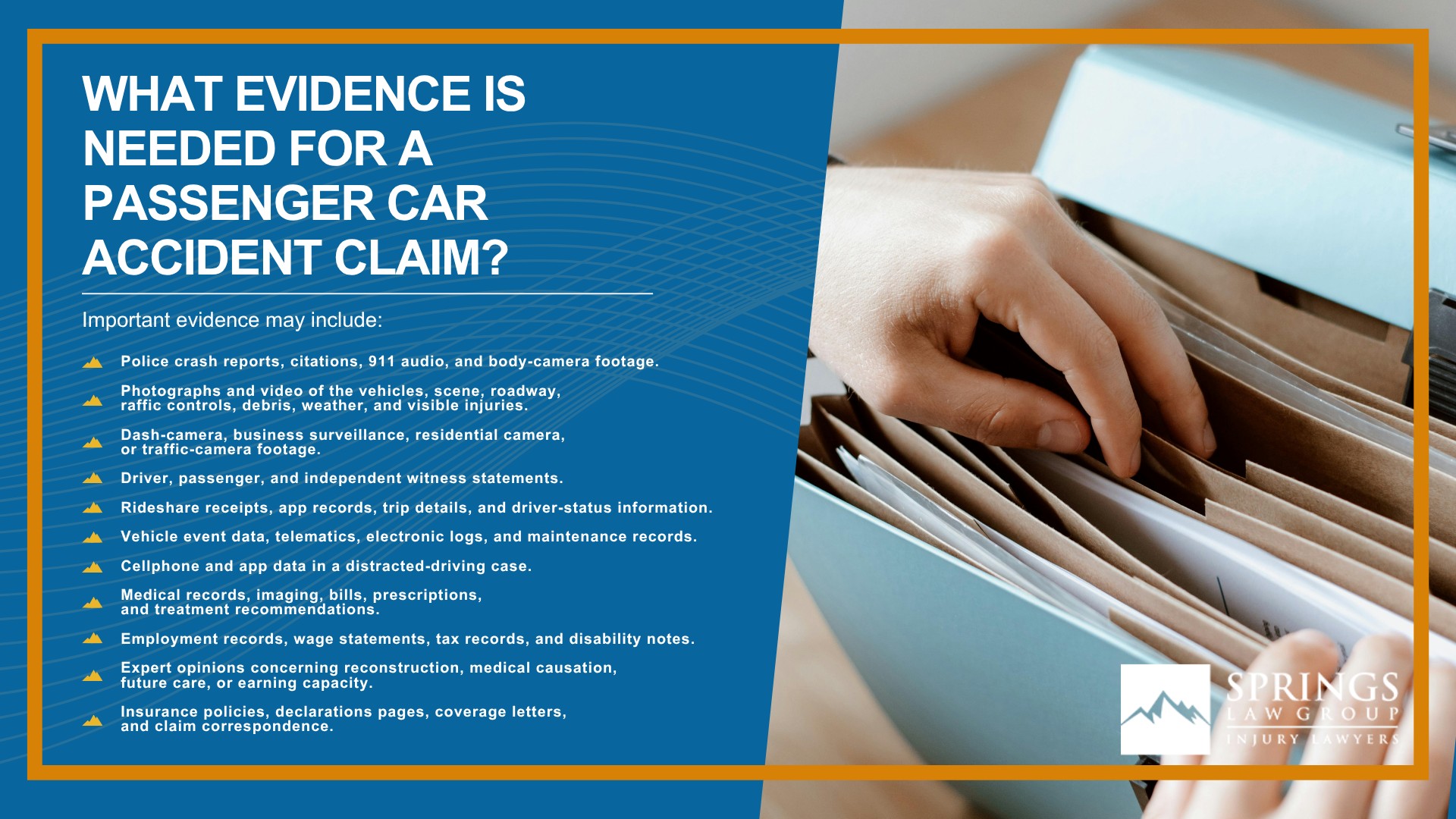
Important evidence may include:
Video and electronic information may be erased or overwritten quickly.
Preservation letters should be sent as soon as the potential source is identified.
If you were injured in a car accident as a passenger, take steps that protect both your health and the evidence supporting your claim.
Steps to take:
Passenger injury claims generally begin with an insurance investigation and demand for compensation.
A lawsuit is filed when the claim cannot be resolved fairly, formal discovery is needed, or a legal deadline is approaching.
The investigation identifies how the collision occurred and every party who contributed.
Police materials, video, photographs, witness interviews, vehicle damage, traffic laws, and electronic data may be used.
When drivers blame each other, the passenger can preserve claims against both while the evidence is evaluated.
Coverage analysis may include the host driver’s liability and MedPay coverage, another driver’s liability coverage, the passenger’s own or household UM/UIM coverage, rideshare or commercial policies, and umbrella insurance.
Written coverage confirmation is more reliable than an assumption based on an insurance card.
Medical records should connect the passenger’s condition to the collision and explain treatment, restrictions, prognosis, and future needs.
Wage records, receipts, photographs, and testimony about daily limitations help document other losses.
When the injuries and future needs can be evaluated responsibly, the passenger or counsel may submit a demand package.
The insurer may accept liability, dispute causation, request additional records, make an offer, or deny the claim.
A settlement should account for available coverage, medical liens, future treatment, lost earning capacity, and the effect of signing a release.
An early payment may not be adequate when the prognosis remains uncertain.
Litigation may be needed when insurers dispute fault, blame the passenger, contest medical causation, undervalue damages, withhold evidence, or refuse to disclose sufficient coverage information.
A complaint initiates the lawsuit, after which the parties may use discovery, depositions, subpoenas, expert testimony, motions, mediation, and trial.
Filing suit does not mean the case will necessarily be tried.
Many claims settle after discovery clarifies liability, coverage, injuries, and damages.
Each injured passenger has a separate claim, but several claims may draw from the same automobile liability policy.
Auto policies commonly include a per-person bodily injury limit and a separate per-accident limit that caps the total amount available for everyone injured in one collision.
Colorado’s minimum liability limits, for example, are $25,000 for bodily injury or death to one person and $50,000 for bodily injury or death to all people injured in one accident.
When several passengers suffer significant injuries, their combined damages may exceed the available per-accident limit.
The insurer may then attempt to resolve multiple claims through coordinated negotiations, a global settlement, or other procedures depending on the circumstances.
Additional liability policies, commercial coverage, umbrella or excess insurance, MedPay, and applicable UM/UIM coverage may become important when one policy does not provide enough coverage for all injured passengers.
A complete investigation should identify every potentially responsible party and available insurance policy before a passenger signs a release or resolves the claim.
An uninsured driver does not necessarily leave the passenger without a claim.
Potential recovery sources may include uninsured motorist coverage on the occupied vehicle, another policy under which the passenger qualifies as an insured, or assets of the at-fault party.
Hit-and-run claims require prompt reporting and careful compliance with policy conditions.
The passenger should preserve photographs, witness information, video, vehicle descriptions, and the police report.
An insurer may investigate whether an unidentified or uninsured vehicle caused the crash and whether the passenger is legally entitled to damages.
Underinsured motorist coverage may pay covered damages that exceed the responsible driver’s available liability limits, up to applicable UM/UIM limits.
The passenger may qualify under the policy covering the occupied vehicle or another personal or household policy.
Before accepting liability limits or signing a release, all potentially applicable UM/UIM carriers should be identified and policy requirements reviewed.
A release drafted too broadly can affect additional claims, reimbursement rights, or claims against other responsible parties.
Colorado generally requires tort actions for bodily injury or property damage arising from the use or operation of a motor vehicle to be filed within three years after the claim accrues under Colorado Revised Statutes section 13-80-101(1)(n).
Missing the deadline can bar recovery even when liability is clear.
Different or shorter deadlines may apply in particular circumstances.
A claim involving a government vehicle, public employee, or actionable public-road condition may require written notice under the Colorado Governmental Immunity Act within 182 days after discovery of the injury.
Claims involving minors, a passenger’s death, out-of-state parties, insurance-contract issues, or other special facts require separate deadline analysis.
Negotiating with an adjuster does not ordinarily stop the statute of limitations.
Yes.
A child injured as a passenger may have a claim against one or more at-fault drivers and access to applicable insurance benefits.
Because a minor generally cannot manage litigation or sign a binding release independently, a parent, guardian, conservator, or court-appointed representative may need to act for the child.
Settlements for minors may require special procedures to protect the funds and the child’s interests.
The process can depend on the settlement amount, the form of payment, liens, and whether court approval or a protected account is required.
A parent should not sign a release before confirming that it will validly and adequately protect the child’s claim.
A fatal passenger crash may support claims under Colorado’s wrongful death and survival laws.
Eligibility to bring a wrongful death action changes over time and depends on the decedent’s surviving family relationships and estate.
Recoverable damages and filing deadlines also differ from a personal injury claim.
Evidence preservation, probate coordination, insurance review, and statutory notice may require immediate attention.
Families can learn more from Springs Law Group’s Colorado Springs wrongful death lawyers.
A passenger may have a strong liability position and still lose claim value through avoidable mistakes.
Common mistakes include:
An attorney can coordinate claims against multiple drivers and insurers while protecting the passenger from inconsistent positions or premature settlement pressure.
This is particularly important when the drivers blame each other, several people are competing for limited coverage, or the injuries may create long-term losses.
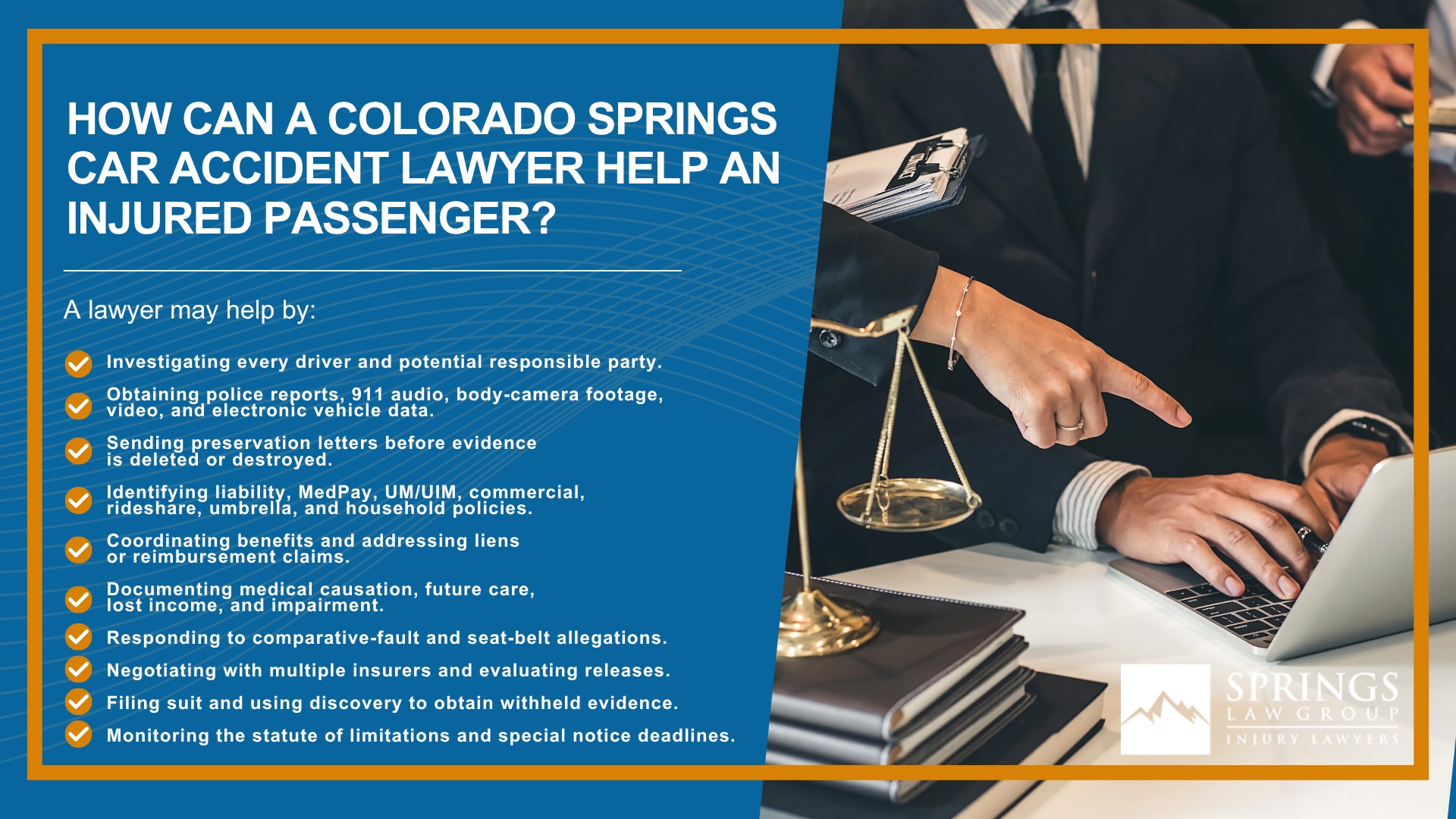
A lawyer may help by:
Prompt legal review is particularly useful when the passenger suffered a serious injury, multiple drivers may share fault, several people are competing for limited insurance, or the accident involved a rideshare, commercial truck, bus, uninsured driver, or government vehicle.
Early assistance also matters when insurers request recorded statements, dispute whether the crash caused the injuries, or offer a settlement before treatment is complete.
Video, electronic data, and witness memories may disappear long before the legal filing deadline.
Passenger injury claims can involve more than one negligent driver, several insurance policies, competing claims for limited coverage, and disputes over medical causation or damages.
Our attorneys can investigate the collision, identify every potentially responsible party, review liability, MedPay, UM/UIM, rideshare, commercial, and household coverage, and preserve evidence before it is lost.
We can also handle communications with insurers, evaluate settlement offers and releases, address liens or reimbursement claims, and file a lawsuit when litigation becomes necessary.
Our firm offers free consultations and handles qualifying personal injury cases on a contingency-fee basis.
If you were injured while riding as a passenger in a Colorado Springs car accident, contact Springs Law Group today for a free consultation or use the chat feature on this page to discuss your claim.