
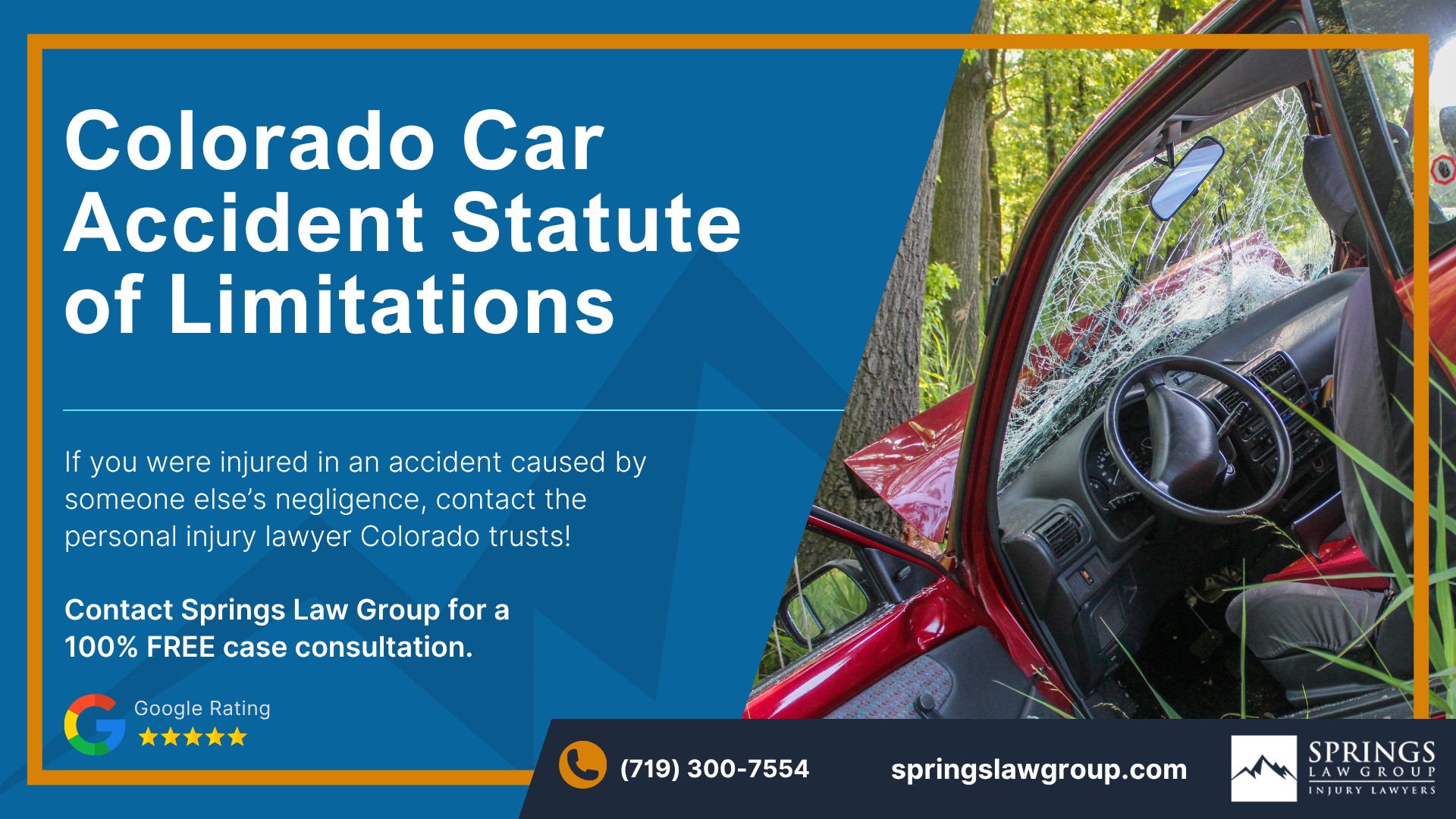
In Colorado car accident cases, the state generally requires tort actions for bodily injury or property damage arising from the use or operation of a motor vehicle to be filed within three years after the claim accrues.
This rule applies to many car accident claims based on negligence, including crashes involving passenger vehicles, motorcycles, trucks, rideshare vehicles, pedestrians, and bicyclists.
The three-year period does not apply to every claim connected with a motor vehicle accident.
Wrongful death claims generally have a two-year filing deadline, while claims involving public entities, uninsured motorists, minors, and other special circumstances can involve additional or different rules.
Filing an insurance claim does not replace the requirement to file a lawsuit within the applicable limitations period.
Settlement negotiations and communications with an insurer also do not automatically extend the statutory deadline.
Under Colorado law, many tort actions for bodily injury or property damage arising from the use or operation of a motor vehicle must be commenced within three years after the cause of action accrues.
The three-year limitations period commonly applies to claims involving:
Different statutes may apply when the accident results in death or when the claim is based on something other than bodily injury or property damage arising from the use or operation of the vehicle.
Determining the correct deadline therefore requires looking at the particular cause of action rather than assuming every claim connected with a crash has three years.
Colorado law provides that a motor vehicle claim for bodily injury or property damage generally accrues when both the existence of the injury or damage and its cause are known or should have been known through reasonable diligence.
For many crashes, this means the limitations period begins on the accident date because the injury occurred and the injured person knows that the collision caused it.
However, a different accrual date may be possible when the existence or cause of an injury could not reasonably have been discovered immediately.
The discovery rule does not necessarily postpone the deadline until the full extent or seriousness of an injury becomes known.
A person may know that an injury occurred and that the accident caused it even though the diagnosis, treatment needs, or long-term effects are still developing.
Separate rules can also affect claims involving minors, legally disabled individuals, public entities, wrongful death, and uninsured or hit-and-run drivers.
If the applicable statute of limitations expires before a lawsuit is filed, the defendant can raise the limitations period as a defense and the court may dismiss the claim as time barred.
This can prevent the injured person from recovering damages through the lawsuit even when there is evidence of negligence.
Depending on the case, that can affect recovery for losses such as:
An open insurance claim or ongoing settlement negotiations do not automatically preserve the right to sue after the statutory filing period expires.
For that reason, injured people should determine the applicable deadline before relying on the status of an insurance claim.
Colorado’s statute of limitations for motor vehicle claims differs from the deadline that applies to many other types of personal injury cases.
Many negligence claims in Colorado must generally be filed within two years, while tort actions involving bodily injury or property damage arising from the use or operation of a motor vehicle generally have a three-year limitations period.
A Colorado personal injury lawsuit involving premises liability, medical malpractice, wrongful death, or another non-motor-vehicle claim may therefore follow a different deadline.
Additional rules can also affect claims involving minors, legally disabled individuals, government entities, hit-and-run drivers, and injuries that were not discovered immediately.
Because the applicable time period depends on the specific cause of action and circumstances, an injured party should not assume that every claim connected with a car accident follows the same three-year rule.
Several Colorado laws can change how the normal filing deadline applies in a particular case.
Issues that may affect the limitations analysis include:
These rules do not automatically extend every car accident deadline.
Each has its own statutory requirements, and some involve a different type of claim rather than an extension of the ordinary three-year period.
Colorado law can provide additional time when the injured party was under 18 when the claim arose.
A minor can qualify as a person under disability for statute-of-limitations purposes, but the effect on the deadline depends on when the minor turns 18 and whether a legal representative has been appointed.
The Colorado Supreme Court has held that when a minor turns 18 before the ordinary limitations period expires, the person generally has until the later of the normal filing deadline or two years after turning 18.
Appointment of a legal representative can affect how the limitations period runs.
Families should therefore not assume that a minor automatically receives three additional years after reaching adulthood.
The specific dates and representation status should be reviewed carefully.
Colorado law also contains special limitations rules for certain people who qualify as legally disabled.
Whether a person meets that statutory definition depends on more than simply having suffered a serious injury or cognitive impairment.
A traumatic brain injury, neurological condition, or other impairment may be relevant, but it does not automatically extend the filing deadline.
The analysis can depend on the nature of the disability, whether a legal representative has been appointed, and when the disability ends.
Because these rules are highly dependent on the facts, the applicable time period should be evaluated individually rather than assuming that incapacity automatically tolls the statute.
Colorado law contains a tolling rule for certain defendants who are absent from the state or conceal themselves.
If the at-fault driver is outside Colorado and is not subject to service of process, the period of qualifying absence may affect the statute of limitations.
Similar rules can apply when a defendant conceals themselves and is not subject to service.
A driver does not receive this treatment merely because they move to another state.
If the defendant can still be properly served, the normal filing deadline may continue to run.
A hit-and-run crash can create additional issues involving identification of the driver, evidence preservation, and uninsured motorist coverage.
A nonfatal hit-and-run does not automatically create a four-year filing deadline.
Claims for uninsured motorist benefits generally follow a separate statutory limitations framework, and the applicable deadline can depend on when the claim accrued and whether the underlying claim against the uninsured driver was preserved.
The criminal charge for leaving the scene is separate from the injured party’s civil claim and does not replace the need to comply with the applicable civil filing deadline.
A different rule applies in certain fatal hit-and-run cases.
Colorado provides a four-year limitations period for a wrongful death action when the defendant committed vehicular homicide and, as part of the same criminal episode, left the scene of the crash that resulted in the death.
Colorado’s discovery rule can affect when a car accident claim accrues if the injury or its cause could not reasonably have been known immediately.
Under the general rule, a motor vehicle injury claim accrues when the existence of the injury and its cause are known or should have been known through reasonable diligence.
Delayed symptoms may therefore be relevant in some cases.
However, the filing deadline is not necessarily postponed simply because the injury later becomes more painful, receives a more specific diagnosis, or turns out to be more serious than originally believed.
If the injured party already knew or reasonably should have known that an injury occurred and that the crash caused it, the limitations period may already be running.
Car accident claims involving a government vehicle or public employee can be subject to different rules than claims against private drivers.
A collision may involve a city, county, or state vehicle, public bus, school district vehicle, police vehicle, public works truck, or another vehicle owned or operated by a government entity.
Under the Colorado Governmental Immunity Act, public entities are generally protected by governmental immunity unless a statutory waiver applies.
Colorado law includes a waiver for certain injuries resulting from the operation of a motor vehicle owned or leased by a public entity and operated by a public employee in the course of employment.
A waiver of immunity does not automatically establish liability. The injured person must still establish the elements of the underlying claim, including negligence, causation, and damages.
Claims covered by the CGIA can also involve a notice deadline that is much shorter than the standard statute of limitations.
For that reason, a crash involving a public entity or public employee should be evaluated promptly.
When the Colorado Governmental Immunity Act applies, a person claiming injury from a public entity or a public employee acting in the course of employment generally must provide written notice within 182 days after discovery of the injury.
The 182-day notice requirement is separate from the standard statute of limitations for filing the lawsuit.
Colorado law requires the notice to include specific information about the claimant, the factual basis of the claim, the public employee involved if known, the nature and extent of the injury, and the monetary damages being requested.
The notice must also be provided to the proper government recipient as required by the statute.
Failure to comply with the applicable CGIA notice requirement can bar the claim even when the ordinary statute of limitations has not yet expired.
Springs Law Group can determine whether the CGIA applies, identify the appropriate public entity, and evaluate the notice and filing deadlines that govern the claim.
Wrongful death cases arising from fatal car accidents generally have a different filing deadline than nonfatal motor vehicle injury claims.
In Colorado, a wrongful death action generally must be filed within two years from the date of death.
A limited exception provides a four-year filing period when the defendant committed vehicular homicide and, as part of the same criminal episode, left the scene of the crash that resulted in the death.
This does not mean every fatal hit-and-run automatically receives four years, since the statutory requirements must be satisfied.
Because the applicable deadline can depend on the circumstances of the fatal crash, surviving family members should determine the filing period as early as possible.
Accident reports, witness evidence, insurance information, medical records, and documentation of funeral expenses and lost financial support may also need to be preserved while the wrongful death claim is being evaluated.
Filing an insurance claim does not automatically pause or extend the Colorado statute of limitations.
An injured person may be submitting medical records, resolving property damage, responding to requests from an insurance company, or negotiating a settlement while the legal filing deadline continues to run.
Settlement negotiations also do not automatically toll the limitations period.
A claim can remain open with an insurance company even as the deadline for filing a lawsuit approaches.
If the applicable limitations period expires before a lawsuit is properly filed, the defendant may raise the statute of limitations as a defense and the claim may be dismissed as time barred.
For that reason, injured people should track the court filing deadline separately from the status of an insurance claim or settlement negotiations.
Different rules can apply to certain insurance claims, including uninsured and underinsured motorist claims.
Springs Law Group can review the applicable filing period, insurance coverage, and status of negotiations to determine whether legal action is necessary to preserve the claim.
Colorado car accident claims are subject to strict time limits, and the deadline can depend on the type of claim, the parties involved, and the circumstances of the crash.
Waiting too long can affect your ability to file a claim, bring a lawsuit, and recover damages.
Springs Law Group can review the accident date, determine which statute of limitations applies, identify any shorter government notice requirements, and evaluate whether special rules involving minors, wrongful death, hit-and-run drivers, or other circumstances may affect the filing period.
An attorney can also preserve important evidence, communicate with insurance companies, and help determine whether a lawsuit needs to be filed before the applicable deadline expires.

If you or a loved one was injured in a Colorado car accident, contact Springs Law Group for a free consultation or use the chat feature on this page.
Our Colorado Springs car accident lawyers can review your case and explain the deadlines that may apply.