
Springs Law Group represents cyclists injured in Colorado Springs bicycle accidents, including collisions involving negligent drivers, unsafe passing, intersections, bike lanes, and trail crossings.
Our law firm, founded by Colorado personal injury attorney Christopher Nicolaysen, handles bicycle injury claims involving medical expenses, lost wages, damaged equipment, and disputed fault.
Colorado law protects bicyclists’ right to use the road, but recovering compensation requires evidence that another party’s conduct caused the crash and resulting losses.
We offer free consultations and represent qualifying bicycle accident victims on a contingency fee basis, with attorney fees and case expenses addressed in a written agreement.
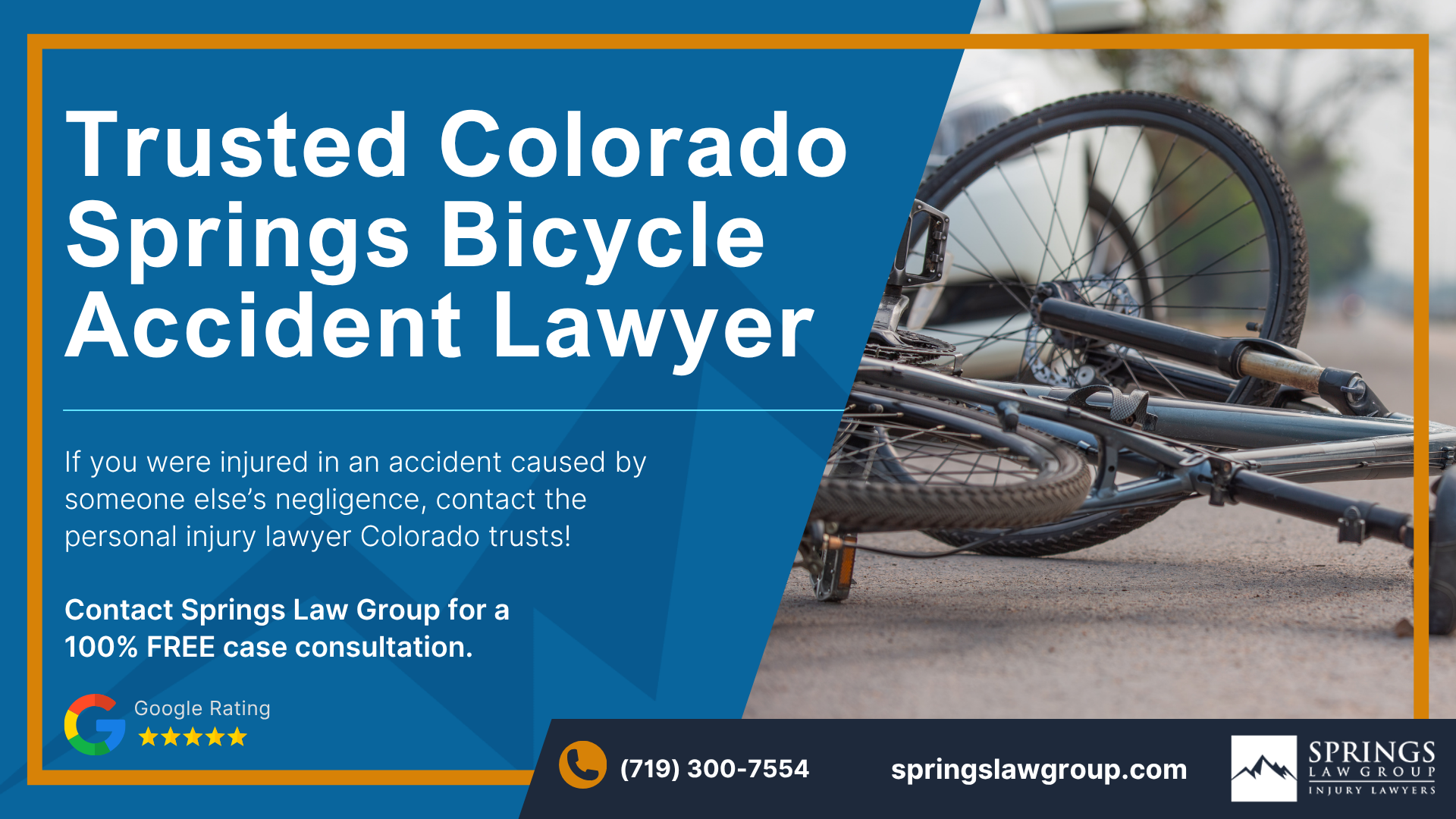
Being struck while riding a bicycle can leave you facing medical treatment, missed work, and insurance questions before you know whether your injuries will have lasting effects.
Even a collision that leaves minimal damage to a car can cause fractures, head injuries, or other serious harm to a cyclist.
After the crash, the driver and cyclist may disagree about who had the right-of-way, whether the cyclist could lawfully ride outside a marked bike lane, or what happened at a trail crossing.
Colorado’s bicycle-specific traffic rules, including the three-foot passing requirement and Safety Stop law, can be relevant when those disputes arise.
Photographs, witness statements, nearby video, bicycle and vehicle damage, and medical documentation may help establish liability and the losses caused by the collision.
If another person’s negligence caused the injury, compensation may be available for medical expenses, lost income, damaged bicycle equipment, pain and suffering, and supported future needs.
Depending on the circumstances, a claim may involve the driver’s liability insurer or coverage available through the cyclist’s own policy.
Our Colorado Springs personal injury lawyers offer a free case review to discuss potential liability, available insurance, and the time limits for bringing a claim.
If you or a loved one was injured in a bicycle accident, contact Springs Law Group or use the chat feature on this page to discuss the options available under Colorado law.
A Colorado bicycle accident claim requires attention to how cyclists use the road, where a motorist should have yielded, and what physical evidence can establish the movements of each person involved.
Springs Law Group’s founder, Christopher Nicolaysen, identifies bicycle accident representation among his personal injury practice areas.
Motorists, insurers, and jurors may disagree about bicycle safety or assume that a cyclist should have been in a bike lane, so familiarity with bicycle-specific personal injury laws can help identify which arguments the law and evidence support.
The firm’s Colorado Springs offices are located at:
Local familiarity can help when examining traffic signals, intersection layouts, bike lanes, or trail crossings, although the crash evidence and applicable law determine whether a claim is supported.
The firm also documents its Bikes for Kids community program, which provides bicycles and bicycle safety equipment to selected children in the Colorado Springs community.
Springs Law Group offers free consultations and handles qualifying personal injury cases on a contingency fee basis, reducing the upfront financial risk of hiring a lawyer while leaving attorney fees and case expenses governed by a written agreement.
When comparing bicycle accident attorneys, ask about experience with bicycle-specific injuries, who would work on your claim, how the legal team evaluates disputed liability, and what the fee agreement requires.
Relevant experience may help an attorney identify issues involving roadway design, cyclist positioning, or available evidence, but no law firm can promise a particular outcome or maximum compensation.
Bicycle collisions can happen wherever motorists and cyclists share space, particularly at intersections and other busy locations in urban areas.
In Colorado Springs, these include downtown streets, marked bike lanes, parking areas, and trail crossings.
Common causes and circumstances in bicycle accident cases include:
In its Traffic Safety Facts report covering 2024 crashes, published in 2026, the National Highway Traffic Safety Administration reported 1,103 pedalcyclist deaths in U.S. traffic crashes, with approximately 81% occurring in urban areas.
These national figures reflect bicyclists and other pedalcyclists and do not establish the cause of an individual Colorado Springs crash.
A right-turn collision may occur when a driver overtakes a bicyclist and then turns across the cyclist’s path before there is enough clearance.
Colorado also prohibits opening a vehicle door on the side available to moving traffic unless doing so is reasonably safe and does not interfere with traffic under C.R.S. § 42-4-1207.
Bicyclists generally have the rights and duties of other vehicle operators under C.R.S. § 42-4-1412, subject to bicycle-specific rules and exceptions.
A traffic violation may help establish a breach of duty when the rule applies and the conduct contributed to the collision, but a violation does not automatically prove every element of a civil injury claim.
Under C.R.S. § 42-4-1003, a motorist overtaking a bicyclist traveling in the same direction must maintain at least three feet of separation between the vehicle, including mirrors or other projections, and the bicyclist.
This passing requirement is one of Colorado’s traffic laws intended to protect bicyclists sharing roads with motor vehicles.
Colorado law does not generally require cyclists to ride in a designated bike lane whenever one is available.
Under C.R.S. § 42-4-1412, a slower cyclist ordinarily rides in the right-hand lane but may adjust position when necessary to avoid hazards, maintain a reasonable safety margin, prepare for a left turn, or pass another vehicle.
A bicyclist is not required to ride through debris, parked vehicles, or an unsafe narrow section of roadway merely to stay as far right as possible.
Motorists must yield to bicyclists using bicycle lanes under C.R.S. § 42-4-714, and Colorado Springs Municipal Code § 10.2.104 imposes a similar local duty.
A cyclist’s presence outside a marked bike lane does not automatically establish fault for a crash.
Colorado’s Safety Stop law, C.R.S. § 42-4-1412.5, permits qualifying bicycle riders to treat certain stop signs as yield signs after slowing to a reasonable speed and yielding when required.
For this purpose, the statute generally sets a reasonable speed of 10 mph or less, although properly signed local provisions may authorize up to 20 mph at particular intersections.
At a red traffic signal, a qualifying cyclist must first stop and yield before proceeding straight or turning right when legally permitted; left turns are subject to narrower conditions.
The law generally applies to riders at least 15 years old and younger riders accompanied by an adult, with additional statutory exceptions and directions from traffic-control devices.
It does not allow a cyclist to enter an occupied intersection without yielding, and not every movement through a stop-controlled intersection is lawful.
Under Colorado Springs Municipal Code § 10.19.107, bicycle riding on sidewalks is prohibited where authorized signs provide notice of the restriction.
Where sidewalk riding is allowed, cyclists must yield to pedestrians and give an audible signal before passing them.
For additional detail, see Springs Law Group’s guide to bicycle laws in Colorado Springs.
As in most personal injury cases based on negligence, a bicycle claim requires evidence that another person or business owed a legal duty, breached that duty, and caused compensable injuries or losses.
The at-fault driver may be a motorist who failed to yield or passed unsafely, but responsibility can extend beyond the person driving the vehicle when another legally relevant act contributed to the crash.
Potentially responsible parties may include:
The claim must identify the conduct and legal basis for holding each party responsible.
Bicycle claims may involve conflicting accounts of whether a motorist yielded, how much passing room was available, or whether the cyclist entered an intersection lawfully.
The most useful evidence depends on the disputed issue and may include:
Evidence can become harder to obtain as time passes after a bicycle accident because surveillance cameras may overwrite footage, witnesses may forget details, and damaged equipment may be repaired or discarded.
The firm’s evidence-gathering guide provides additional information about preserving accident records.
Insurance adjusters may argue that a cyclist rode outside a bike lane, failed to yield, was difficult to see, or traveled through an intersection unlawfully.
Those allegations should be evaluated against the applicable bicycle laws and the available evidence, rather than treated as conclusive simply because the other party or an adjuster made them.
A claim that a cyclist violated a rule does not by itself establish which person caused the collision or decide the compensation amount.
Colorado follows a modified comparative negligence rule under C.R.S. § 13-21-111.
In an ordinary two-party negligence case, an injured cyclist’s compensation may be reduced by their percentage of fault, and recovery is barred when the cyclist is found 50% or more responsible.
For example, an injured person with $100,000 in proven damages who is assigned 20% fault would generally have those damages reduced to $80,000.
Crashes involving multiple defendants or properly designated nonparties require additional fault-allocation analysis.
See the firm’s Colorado comparative negligence guide for more information.
A collision may throw a cyclist into a vehicle, onto pavement, or into a roadside object, even when the impact occurs at a relatively low vehicle speed.
Injuries can vary significantly depending on the direction of the impact and how the rider lands.
Bicycle accident injuries may include:
After a serious crash, some cyclists need emergency care, surgery, physical therapy, or long-term rehabilitation, while others receive treatment for less extensive injuries.
Medical professionals can document the injury severity, treatment needs, and any lasting limitations, including whether the cyclist has become permanently disabled.
A bike helmet may reduce the risk of some head injuries, but wearing or not wearing one does not determine who caused the collision.
Medical findings and the relationship between the crash and the injury are essential when evaluating a claim.
Your immediate priority after a bike accident is to reach safety and seek medical attention for possible injuries.
If you are able to take steps without putting yourself at risk, the following actions may help preserve information relevant to a claim:
An injured cyclist who was transported from the scene or otherwise unable to gather evidence may still have a viable claim.
Notify your own insurer within the policy’s required timeframe, provide accurate information, and review applicable cooperation requirements before responding to requests for recorded statements or settlement releases.
Before discussing the accident in detail with the other driver’s insurer, consider speaking with a bicycle accident lawyer about the facts in dispute and the applicable insurance obligations.
For a more detailed checklist, see what to do after a bicycle accident in Colorado Springs.
When a driver causes a bicycle collision, an injured cyclist may pursue insurance claims against the driver’s liability policy or another responsible party, subject to the evidence and applicable insurance terms.
An applicable uninsured or underinsured motorist policy may also provide benefits if the driver has no liability coverage or insufficient coverage, depending on the insured person’s status and the policy.
Health insurance or other applicable medical coverage may pay certain treatment costs before a liability claim resolves, although deductibles, reimbursement rights, and other obligations may apply.
For more information about medical coverage, see the firm’s health insurance and bicycle accident guide.
The compensation available depends on the party’s legal responsibility, the severity and documented effects of the injuries suffered, the available insurance, and applicable Colorado damages rules.
Under Colorado law, compensatory damages generally fall into economic and noneconomic categories, while exemplary (punitive) damages may be available separately in qualifying cases.
Economic and noneconomic losses may include:
Colorado law also permits exemplary damages in some civil injury cases involving fraud, malice, or willful and wanton conduct, although ordinary negligence alone is insufficient.
These damages are intended to punish and deter especially wrongful behavior rather than reimburse medical bills or replace lost income, and C.R.S. § 13-21-102 imposes additional requirements and limitations.
If a bicycle crash causes a death, eligible relatives may have a separate wrongful death claim under Colorado law.
See our article on accident damages and common injuries for additional information about recoverable losses.
A fair settlement should reflect the evidence, applicable law, and reasonably supported future losses, rather than assuming the first offer reflects the full value of the claim.
If insurance negotiations do not resolve a supported claim, an attorney may prepare a demand letter, explain the options to file suit, and discuss the deadlines that apply.
Not every claim requires a lawsuit, and bicycle accident attorneys cannot guarantee fair compensation or that an injured person will recover a particular amount.
Under C.R.S. § 13-80-101(1)(n), many bodily injury or property damage lawsuits arising from the use or operation of a motor vehicle generally must be filed within three years after the claim accrues.
That deadline can apply when a cyclist is injured by a car or truck, even though the injured person was riding a bicycle rather than driving a motor vehicle.
The Colorado Supreme Court addressed filing deadlines for a minor cyclist struck by a car in Kinslow v. Mohammadi (2024).
For a plaintiff who turns 18 before the ordinary motor-vehicle limitation period expires, the court held that the deadline is the later of the original deadline or two years after the plaintiff turns 18, rather than an automatic three additional years.
Many negligence claims that do not arise from the use or operation of a motor vehicle instead generally have a two-year limitations period under C.R.S. § 13-80-102.
Wrongful death claims generally have a separate two-year filing period from the date of death, subject to statutory exceptions.
A four-year deadline applies only to the narrower wrongful death circumstance described in C.R.S. § 13-80-102(2), where the defendant committed vehicular homicide and, during the same criminal episode, left the scene of the fatal crash.
A hit-and-run injury claim does not automatically receive a four-year filing period merely because the driver fled.
Claims against public entities may involve immunity restrictions and, when the Colorado Governmental Immunity Act applies, a written notice requirement within 182 days after discovery of the injury under C.R.S. § 24-10-109.
Additional rules may affect minors, legally disabled individuals, defective-product claims, and particular insurance disputes.
A serious bicycle collision may involve disputed right-of-way, complicated medical needs, and insurance questions that cannot be answered from a police report or initial claim decision alone.
If another person’s negligence caused the bicycle crash, compensation may be available for medical expenses, lost income, damaged equipment, and other supported losses.
Springs Law Group represents injured cyclists throughout Colorado Springs and offers free consultations to discuss the evidence, potential responsible parties, and legal options.
The law firm can explain the differences between a claim against an at-fault driver’s insurer and a personal injury lawsuit, without promising a particular result.
Contact Springs Law Group for a free consultation, or use the website chat to discuss your bicycle accident claim.
No general Colorado rule requires cyclists to use a bike lane whenever one exists.
The law permits riders to position themselves safely in the roadway, including avoiding hazards, preparing for a turn, or passing another vehicle.
Traffic signs, local requirements, and the circumstances of the ride may affect what was lawful in a particular case.
Colorado’s Safety Stop law permits certain cyclists to proceed through stop-controlled intersections after slowing and yielding, and through qualifying red-light situations only after stopping and yielding.
Different conditions apply to each type of intersection, and the law does not allow cyclists to disregard other traffic or a controlling bicycle-specific signal.
The cyclist’s age, movements, and the applicable signs may matter when a crash occurs at an intersection.
Possibly, if another person’s negligence caused compensable injuries.
Failure to wear a helmet does not by itself prove that the cyclist caused the collision, although injury causation and other legally relevant facts must still be evaluated.
A hit-and-run collision may still support a claim if sufficient evidence establishes what happened.
The driver’s departure does not automatically extend the general injury-lawsuit filing deadline to four years.
Photographs, witness accounts, nearby video, and an applicable uninsured motorist policy may be relevant, subject to coverage and notice requirements.
An injured cyclist should report a hit-and-run promptly and ask about the separate deadlines for injury, insurance, and any wrongful death claims.
Yes, when the evidence establishes a legal basis for holding a driver or another party responsible.
The relevant question is who had the right-of-way under the signs, signals, crossing layout, and state or local rules that applied at that location.
Trail access does not automatically give a cyclist priority over every vehicle at an intersection.
Springs Law Group offers free consultations and represents qualifying personal injury clients through contingency fee agreements.
An attorney fee generally depends on recovering compensation, rather than an upfront hourly charge.
The written agreement should explain the fee percentage, case expenses, and any other financial obligations.
It may, depending on the type of coverage, the applicable policy language, and the person’s insured status.
For example, uninsured or underinsured motorist coverage may provide benefits in a qualifying collision with a motor vehicle, but coverage is not automatic in every bicycle accident.
The driver’s liability coverage, any applicable personal insurance, and medical coverage should be evaluated separately.

Member of the Colorado Bar Association since 2014. Attorney, Christopher M. Nicolaysen focuses primarily on helping those injured in Colorado car accidents, other auto accidents, and Colorado personal injury incidents.
This article has been written and reviewed for legal accuracy and clarity by the team of writers and attorneys at Springs Law Group and is as accurate as possible. This content should not be taken as legal advice from an attorney. If you would like to learn more about our owner and experienced Colorado personal injury lawyer, Christopher Nicolaysen, you can do so here.
Springs Law Group does everything possible to make sure the information in this article is up to date and accurate. If you need specific legal advice about your case, contact us. This article should not be taken as advice from an attorney.
We use reviews to help show more people like you why we do what we do!

I was uneasy about reaching out to a law firm after being in an accident that left me injured and my vehicle totaled. I don’t care for the idea of suing for what was very clearly an accident. However, after learning more about the overall process of working with a professional team to navigate the murky waters of the insurance world, I was pleasantly surprised to find that the experience wasn’t as gross as I’d originally felt about it.

Springs Law is very friendly and professional. I always felt that they were on my side and cared about my injury and what I was going through. I highly recommend them.

Springs Law Group is an amazing group to work with! I got into a rough accident, and they never ceased to let me know they were there working hard to help me in my hour of need. It was always very easy to reach out to someone if I had any questions, and they were always happy to answer any questions I had.
I never have a problem with getting a response when I need them – which is not the case with most other firms. They really truly care about each client. As a plus, they always have positive attitudes, which matters tremendously when you are in a stressful legal situation.

Big thanks to Mr. Jake Kimbell and his team for their assistance with my case. He helped me through an incredibly challenging part of my life, and most importantly helped navigate through the convoluted legal channels of my case. I cannot thank him and his team enough for their support.

The entire team at Springs Law group has been nothing but amazing. Jake and the rest of the staff were great to work with and extremely professional. They were very attentive and answered any questions and concerns I had. I was always able to contact them and they were very responsive and communicated with me.

Springs Law Group is an amazing group to work with! I got into a rough accident, and they never ceased to let me know they were there working hard to help me in my hour of need. It was always very easy to reach out to someone if I had any questions, and they were always happy to answer any questions I had.