
Collecting evidence after a car accident in Colorado Springs can help establish how the accident happened, identify the responsible parties, and document the injuries and financial losses that followed.
Photographs, witness statements, police reports, video evidence, medical records, and electronic vehicle data may support different aspects of a personal injury claim.
Preserving evidence early is important because surveillance footage may be overwritten, damaged vehicles may be repaired, and witnesses may become difficult to locate.
Even if you were unable to collect evidence at the accident scene, additional records may be available through law enforcement agencies, medical providers, businesses, and other sources.
If you were injured in a collision, our Colorado Springs car accident lawyers can help obtain and preserve evidence to support your personal injury claim.
Contact Springs Law Group for a free consultation, or use the chat feature on this page to discuss your accident with our legal team.
Different types of evidence serve different purposes in a car accident case, including establishing liability, connecting injuries to the collision, and documenting recoverable damages.
Some crucial evidence can be collected in the immediate aftermath of an auto accident, while other information may need to be obtained days or weeks later.
Important evidence in a Colorado Springs car accident case may include:
Prioritize your safety and seek immediate medical attention for serious or potentially life-threatening injuries before attempting to gather evidence at the scene.
If you are unable to collect this information yourself, a car accident attorney may be able to obtain relevant records during an investigation.
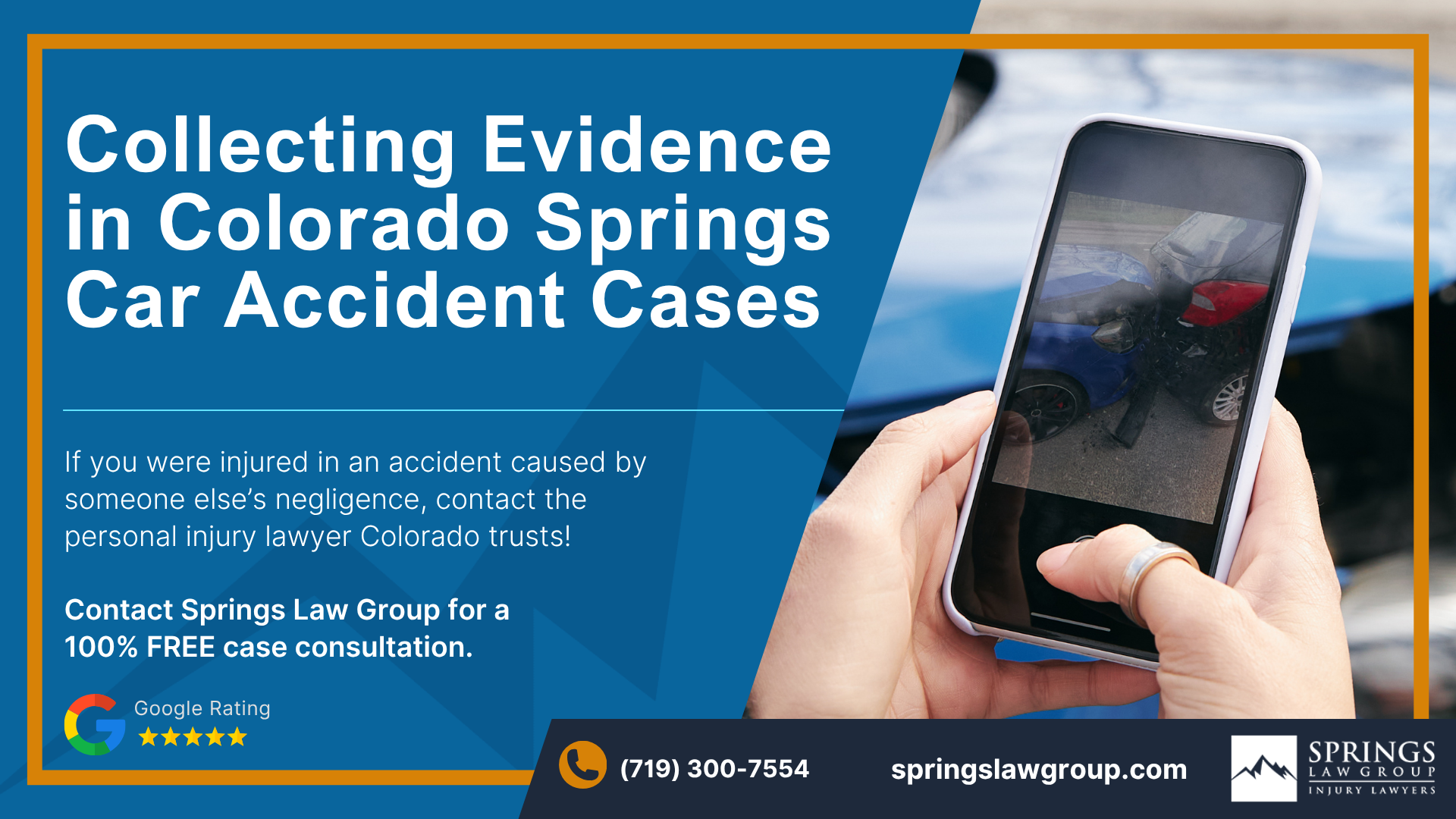
Photographs can document the physical conditions of a crash scene before vehicles are moved, debris is cleared, or roadway conditions change.
On busy Colorado Springs roads such as I-25, Powers Boulevard, Academy Boulevard, and Woodmen Road, photographs of surrounding traffic lanes and intersections may help clarify disputed vehicle movements.
Take photographs from several angles when it is safe to do so, including wide views of the surrounding area and close-up images of specific damage.
Useful photographs may include:
Include recognizable reference points, such as curbs or traffic signs, to help establish where physical evidence was located.
Preserve the original photographs and note whether vehicles were moved before the pictures were taken.
Skid marks and debris patterns may help accident reconstructionists assess braking, impact locations, and vehicle movements.
However, the absence of visible skid marks does not necessarily mean a driver failed to brake, particularly when vehicles use anti-lock braking systems.
An independent witness can provide valuable insight into the actions of the other driver, including whether that driver ran a red light or made an unsafe lane change.
Witness testimony may be especially useful when the drivers provide conflicting accounts of the collision or no video footage is available.
When speaking with witnesses, try to obtain the following information:
Use neutral questions and avoid suggesting how you believe the collision occurred.
Even sincere witnesses may remember events differently because of viewing angles, obstructions, stress, or the brief duration of an impact.
A personal injury lawyer can compare witness accounts with physical evidence and available recordings to identify inconsistencies and clarify what happened.
A police report provides an official record of the investigating officer’s observations and may identify the drivers and vehicles involved, describe the collision, document roadway conditions, and summarize witness accounts.
Detailed reports may also include accident diagrams, traffic citations, and the officer’s initial assessment of possible contributing factors.
If the Colorado Springs Police Department (CSPD) investigated your collision, you can request available records through its Police Records Release Requests system.
To request a Colorado Springs accident report:
If another law enforcement agency investigated the accident, you may need to request records directly from that agency instead.
The Colorado Division of Motor Vehicles also provides procedures for obtaining state crash records, subject to applicable fees and disclosure requirements.
A crash report submitted online by a driver is considered a counter report and is not an independent law enforcement investigation.
A police report provides useful official documentation, but it does not automatically determine liability or establish who is financially responsible for the collision.
The officer may have arrived after the vehicles were moved or may not have had access to surveillance footage, electronic vehicle data, or all relevant witnesses.
If a report contains inaccurate identifying information or other factual errors, contact the investigating agency about its correction or supplemental documentation procedures.
Additional evidence may be necessary when establishing fault in a Colorado Springs car accident, particularly when the drivers dispute the officer’s findings.
Colorado follows an at-fault system for car accidents, meaning an injured party may seek compensation from the at-fault driver or another legally responsible party and their applicable insurance coverage.
Under C.R.S. § 13-21-111, Colorado uses a modified comparative negligence rule that can reduce compensation in proportion to an injured person’s share of fault.
In a typical two-party negligence case, a person cannot recover damages if they are 50% or more at fault for the crash.
Strong evidence can help prove fault and address allegations that you contributed to the collision.
Video evidence may show how vehicles approached an intersection, whether a driver changed lanes or braked, and the sequence of impacts in a multiple-vehicle collision.
Potential sources of car accident footage include:
The City of Colorado Springs maintains a traffic camera system that may help identify cameras near a collision.
Public traffic camera images do not guarantee that a recording of an individual crash exists or that historical footage can be obtained.
Some camera systems automatically overwrite older recordings, so identify potential sources of footage as soon as reasonably possible.
If a business or residence has a camera facing the crash scene, ask whether footage from the relevant date and time exists and whether the owner can retain it.
An attorney may send a written preservation request identifying the location, approximate time, and recordings sought.
A preservation request does not necessarily compel a private business to release footage, and formal legal procedures may be necessary to obtain it.
When footage is available, retain the original recording, including the moments leading up to and following the impact when possible.
A short video clip may omit information needed to interpret the collision accurately.
Medical records help establish when symptoms were first reported, what injuries were diagnosed, and which treatments were recommended or provided.
Seek prompt medical attention after an accident and accurately describe your symptoms, medical history, and how the collision occurred.
Even apparently minor injuries should be evaluated by medical professionals, particularly when pain or other symptoms develop after the crash.
Medical evidence relevant to a car accident claim may include:
Medical records may be particularly important when injuries are not immediately visible or the insurance company disputes whether the collision caused a medical condition.
According to the Centers for Disease Control and Prevention (CDC), concussion symptoms may become apparent hours or days after an injury.
Follow-up records can document delayed symptoms, changes in your condition, ongoing treatment needs, and physical limitations affecting daily activities.
Not every injury appears on a diagnostic imaging study, and clinical findings may be necessary to evaluate conditions such as concussions and certain soft tissue injuries.
If you are seeking compensation for accident-related losses, collect records of medical expenses, lost wages, property damage, and other costs resulting from the collision.
Documentation of accident-related losses may include:
Maintain these records throughout your recovery so that the full extent of your losses can be evaluated when settling a car accident case.
Vehicle inspections, repair records, and electronic data may help clarify the speed, braking activity, and sequence of impacts involved in a collision.
Repair estimates and body shop photographs can also document damage that was not visible at the accident scene.
Physical and electronic evidence should be evaluated alongside witness statements, roadway conditions, and other available records.
An event data recorder (EDR), sometimes referred to as a vehicle’s black box, can capture limited vehicle telemetry data associated with certain crash events.
Federal regulations under 49 C.F.R. § 563.7 specify data elements for covered vehicles equipped with EDRs.
Depending on the vehicle and the event recorded, EDR data may include:
An EDR does not continuously record driving activity or function as a video camera.
Not every vehicle has the same recording capabilities, and not every collision generates retrievable data.
Accessing and interpreting EDR data may require specialized equipment, qualified professionals, and appropriate legal authorization.
Accident reconstructionists may combine these records with physical damage, roadway measurements, and photographs to evaluate disputed events.
Their findings may help an insurer assess an insurance claim or provide a basis for expert testimony in a car accident lawsuit.
Cell phone records may become relevant in distracted driving accident cases when a motorist is suspected of texting, making a call, or using a mobile device before impact.
Carrier records may identify the timing of calls or messages, but they do not necessarily establish whether a driver was actively reading or typing at the moment of the collision.
Available device activity logs, app records, and forensic findings may provide additional context.
An attorney may seek relevant electronic records through consent, discovery, subpoenas, or other lawful procedures, depending on the type of information sought.
Preserving evidence involves protecting relevant documents, physical items, and electronic files from alteration, destruction, or loss.
In Terra Management Group, LLC v. Keaten, 2025 CO 40, the Colorado Supreme Court held that parties must preserve relevant evidence when they know or should know that litigation is pending or reasonably foreseeable.
Destroying evidence in violation of that duty may result in court-imposed sanctions.
Steps you can take to preserve car accident evidence include:
Original digital files may contain timestamps and other metadata that screenshots or edited copies do not retain.
Avoid common mistakes after a car accident, including deleting relevant messages or social media posts and disposing of potentially important evidence before it can be documented.
Missing evidence does not automatically prevent you from pursuing a personal injury claim.
If you were unable to take photographs or obtain witness information because you needed emergency medical treatment, other records may help establish what happened.
For example, police diagrams, vehicle repair records, surveillance footage, and electronic vehicle data may provide information about a collision when photographs of the original vehicle positions are unavailable.
A car accident attorney can identify missing records, determine whether alternative evidence exists, and request official reports or documentation from third parties when appropriate.
The absence of a particular piece of evidence does not necessarily undermine your entire claim.
At Springs Law Group, we help injured drivers and passengers throughout Colorado Springs and the surrounding communities gather evidence to support their personal injury claims.
Our Colorado Springs personal injury lawyers can request accident reports, locate witnesses, pursue available electronic records, and work with qualified experts when additional investigation is necessary.
We gather the evidence needed to address disputed liability, document the extent of your injuries, and negotiate with insurance companies to pursue full and fair compensation for your losses.
Our law firm handles qualifying personal injury cases on a contingency fee basis, meaning you do not pay attorney fees unless we recover compensation on your behalf.
Contact Springs Law Group for a free case evaluation, or use the chat feature on this page to discuss your accident with our legal team.
Identifying the right evidence depends on which aspects of your claim are disputed.
Photographs, witness statements, police reports, and video recordings may help establish fault, while medical records and financial documentation help establish injuries and damages.
Preserving solid evidence of both liability and damages can help support a request for a fair settlement.
Possibly, although not every traffic camera records or retains historical footage.
Identify potential camera locations promptly and consider additional sources, such as nearby businesses, residential security cameras, and dashcams.
Yes, independent eyewitness testimony is not a requirement for pursuing a personal injury claim.
Vehicle damage, police reports, video recordings, electronic data, and other evidence may help establish liability when no witnesses are available.
An accurate record of your symptoms, medical appointments, missed work, and changes to your daily activities may help document how your injuries affect your life.
Discuss significant changes in symptoms with your medical provider rather than relying on a personal journal as a substitute for medical records.
A car accident lawyer may be able to identify and request records held by businesses, insurers, medical providers, or other parties.
When a car accident lawsuit is filed, discovery and subpoenas may provide additional methods of obtaining relevant evidence, subject to applicable legal and privacy requirements.

Member of the Colorado Bar Association since 2014. Attorney, Christopher M. Nicolaysen focuses primarily on helping those injured in Colorado car accidents, other auto accidents, and Colorado personal injury incidents.
This article has been written and reviewed for legal accuracy and clarity by the team of writers and attorneys at Springs Law Group and is as accurate as possible. This content should not be taken as legal advice from an attorney. If you would like to learn more about our owner and experienced Colorado personal injury lawyer, Christopher Nicolaysen, you can do so here.
Springs Law Group does everything possible to make sure the information in this article is up to date and accurate. If you need specific legal advice about your case, contact us. This article should not be taken as advice from an attorney.
We use reviews to help show more people like you why we do what we do!

I was uneasy about reaching out to a law firm after being in an accident that left me injured and my vehicle totaled. I don’t care for the idea of suing for what was very clearly an accident. However, after learning more about the overall process of working with a professional team to navigate the murky waters of the insurance world, I was pleasantly surprised to find that the experience wasn’t as gross as I’d originally felt about it.

Springs Law is very friendly and professional. I always felt that they were on my side and cared about my injury and what I was going through. I highly recommend them.

Springs Law Group is an amazing group to work with! I got into a rough accident, and they never ceased to let me know they were there working hard to help me in my hour of need. It was always very easy to reach out to someone if I had any questions, and they were always happy to answer any questions I had.
I never have a problem with getting a response when I need them – which is not the case with most other firms. They really truly care about each client. As a plus, they always have positive attitudes, which matters tremendously when you are in a stressful legal situation.

Big thanks to Mr. Jake Kimbell and his team for their assistance with my case. He helped me through an incredibly challenging part of my life, and most importantly helped navigate through the convoluted legal channels of my case. I cannot thank him and his team enough for their support.

The entire team at Springs Law group has been nothing but amazing. Jake and the rest of the staff were great to work with and extremely professional. They were very attentive and answered any questions and concerns I had. I was always able to contact them and they were very responsive and communicated with me.
Springs Law Group is an amazing group to work with! I got into a rough accident, and they never ceased to let me know they were there working hard to help me in my hour of need. It was always very easy to reach out to someone if I had any questions, and they were always happy to answer any questions I had.