
What Type of Auto Insurance Do I Need in Colorado Springs?

Were You or A Loved One Injured in an Accident?
Get Free Answers In as Little as 3 Minutes
right-image
400

Understanding Auto Insurance Requirements in Colorado Springs

Colorado drivers must carry minimum liability insurance, but the coverage required by law may not be enough to address the financial consequences of a serious accident.

Your policy may also include uninsured and underinsured motorist coverage, medical payments coverage, collision coverage, comprehensive coverage, and other protections that can affect what is available after a crash.

Springs Law Group helps injured people review applicable insurance policies, identify available coverage, and address disputes involving liability, medical expenses, vehicle damage, and other accident-related losses.

If an insurance company denies coverage, disputes the value of a claim, or raises questions about which policy applies, our attorneys can evaluate the available evidence and explain the legal options under Colorado law.

Auto Liability Coverage; Auto Collision Coverage; Comprehensive Coverage; Uninsured_Underinsured Motorist (UM_UIM) Coverage; Medical Payments (MedPay) Coverage; conclusion; What Type Of Auto Insurance Do I Need In Colorado Springs

What Auto Insurance Is Required in Colorado?

Colorado insurance law requires drivers to maintain liability coverage before operating a vehicle on public roads.

The minimum required limits are $25,000 for bodily injury or death to one person, $50,000 for bodily injury or death to two or more people in one accident, and $15,000 for property damage.

Driving without the required insurance is illegal in Colorado.

Minimum liability coverage, however, primarily protects other people when you cause a crash and may provide limited protection against the financial consequences of a serious accident.

Uninsured drivers create another significant risk.

The Insurance Research Council estimated that 19.7% of Colorado motorists were uninsured in 2023, placing the state near the upper end of uninsured-driver rates nationwide.

Colorado insurers generally provide uninsured and underinsured motorist coverage with qualifying policies unless the named insured rejects the coverage as permitted by law.

Drivers should review their Colorado car insurance coverage carefully to understand the liability limits, UM/UIM protection, medical payments coverage, collision coverage, comprehensive coverage, deductibles, and other protections included in the policy.

The amount and type of insurance appropriate for a particular driver can depend on the vehicle, personal finances, driving habits, and the amount of financial risk the driver is prepared to assume.

Springs Law Group helps people after Colorado Springs car accidents by reviewing available policies, identifying potential sources of coverage, and addressing disputes involving uninsured or underinsured drivers and insurance companies.

If you were injured in a Colorado Springs car accident or have questions about what auto insurance may apply, contact Springs Law Group today for a free consultation.

You can also use the chat feature on this page to find out whether you may have a case.

Table of Contents

Colorado Minimum Auto Insurance Requirements

Colorado law requires drivers to carry a minimum amount of auto insurance before operating a motor vehicle on public roads.

The minimum auto insurance requirements in Colorado include liability coverage for bodily injury and property damage.
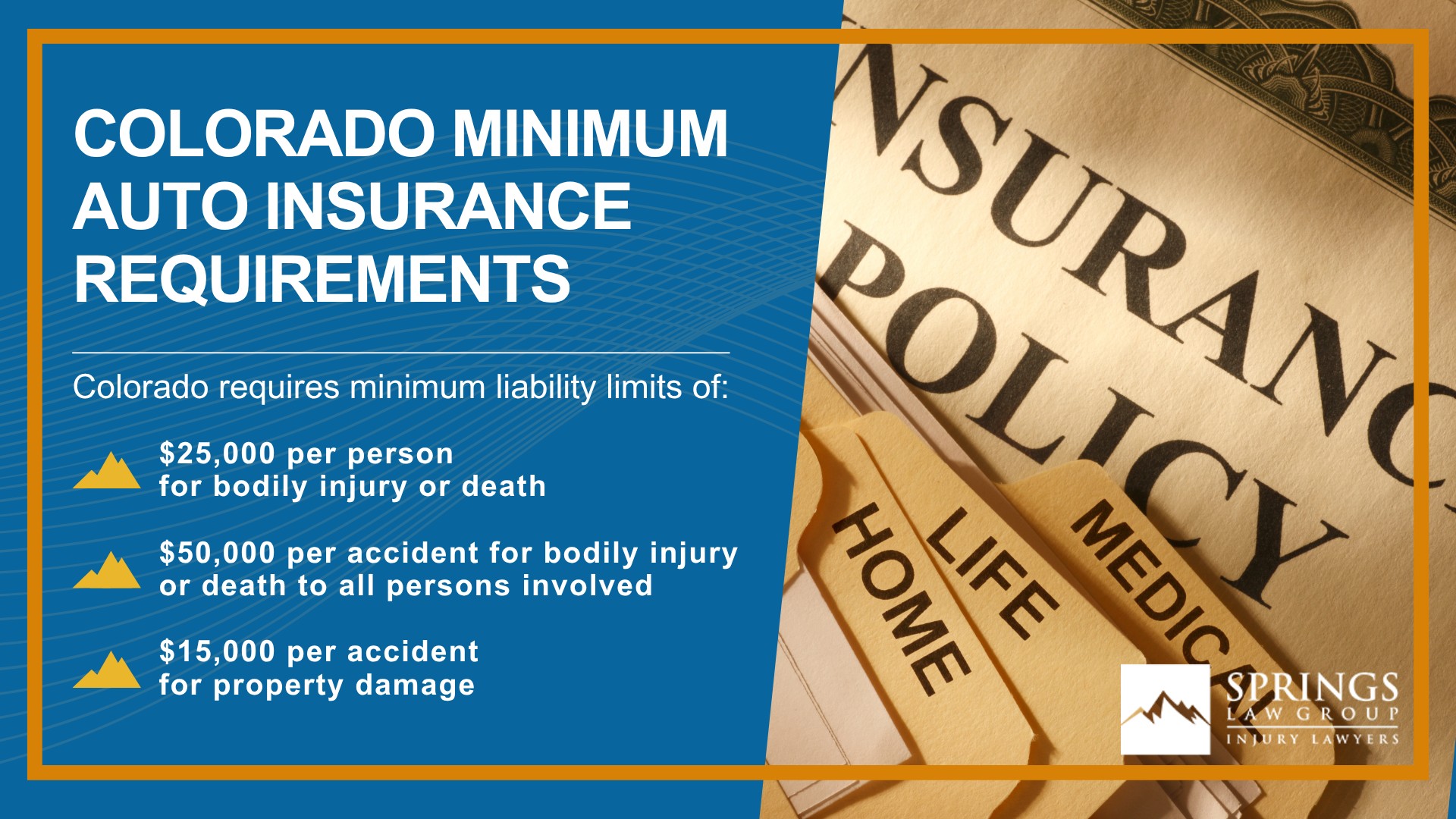
Colorado requires minimum liability limits of:

  • $25,000 per person for bodily injury or death
  • $50,000 per accident for bodily injury or death to all persons involved
  • $15,000 per accident for property damage

This coverage is sometimes called 25/50/15 coverage.

It is the minimum required by Colorado law, but it may not be enough after a serious accident involving medical expenses, lost wages, vehicle damage, or long-term injuries.

Bodily Injury Liability Coverage in Colorado

Bodily injury liability coverage helps pay for injuries you cause to another person when you are at fault for a car accident.

This may include medical expenses, medical treatment, lost wages, pain and suffering, and other damages caused by bodily harm.

Colorado car insurance requirements include at least $25,000 per person and $50,000 per accident in bodily injury liability coverage.

These limits may satisfy Colorado law, but a serious crash can cost far more than the minimum amount.

If the damages exceed your policy limits, you may be personally responsible for the difference.

That means you could have to pay out of pocket if you do not have enough insurance coverage.

Property Damage Liability Coverage in Colorado

Property damage liability coverage helps pay for damage you cause to someone else’s property in an accident.

This may include another car, a fence, garage doors, utility poles, buildings, signs, landscaping, or other physical property.

Colorado law requires at least $15,000 in property damage liability coverage.

That may sound like enough, but vehicle repairs, totaled cars, and damage to someone else’s property can exceed the minimum quickly.

Property damage liability does not usually pay for damage to your own vehicle.

To protect your own car, you may need collision coverage or comprehensive coverage depending on what happened.

Is Colorado a Fault or No-Fault State?

Colorado is a fault-based state for car accident claims.

This means the driver who caused the accident is generally responsible for the injuries and property damage caused by the crash.

If another driver is at fault, you may be able to file a claim with that driver’s insurance company.

If you caused the accident, your liability insurance may help pay for the other person’s bodily injury or property damage up to your policy limits.

Because Colorado is not a no-fault state, fault matters.

Police reports, witness statements, photos, medical records, vehicle damage, and insurance documents can all affect how the claim is handled.

Why Minimum Coverage May Not Be Enough After a Serious Accident

Minimum auto insurance may satisfy Colorado auto insurance requirements, but it may not fully protect you after a serious crash.

Medical bills, vehicle repairs, lost wages, and other expenses can exceed minimum liability limits quickly.

Minimum coverage may fall short when an accident involves:

  • Emergency medical treatment
  • Surgery or hospitalization
  • Long-term medical care
  • Serious bodily injury
  • Multiple injured people
  • A totaled vehicle
  • Damage to more than one car
  • Lost wages or reduced earning ability
  • Pain and suffering
  • A wrongful death claim

If your coverage is too low, the insurance company may only pay up to the policy limits.

After that, injured parties may look for other available insurance coverage or pursue additional legal options.

Types of Auto Insurance Colorado Springs Drivers May Consider

Colorado’s minimum liability requirements establish a baseline, but they do not address every financial risk a driver may face after an accident.

Depending on the policy, additional protection may include higher liability limits, uninsured and underinsured motorist coverage, medical payments coverage, collision coverage, comprehensive coverage, gap insurance, rental reimbursement, and roadside assistance.

The appropriate combination of coverage depends on factors such as vehicle value, financial circumstances, driving habits, deductibles, and the amount of risk a driver is prepared to assume.
Uninsured Motorist Coverage in Colorado

Uninsured motorist coverage may protect you if you are injured by a driver who has no insurance.

Colorado auto policies generally include UM/UIM coverage unless the named insured rejects it in writing.

UM/UIM coverage can also become important after a hit-and-run accident if the at-fault driver cannot be identified.

Uninsured motorist coverage may help pay for:

  • Medical expenses
  • Lost wages
  • Pain and suffering
  • Medical and other expenses caused by the crash
  • Damages that would have been owed by the uninsured driver

Even though Colorado drivers are required to carry liability insurance, not every driver follows the law.

If an uninsured driver causes a crash, your own insurance coverage may be one of the most important sources of recovery.

Underinsured Motorist Coverage in Colorado

Underinsured motorist coverage applies when the at-fault driver has insurance, but not enough insurance to cover the full value of your damages.

This can happen when a serious injury claim exceeds the at-fault driver’s liability limits.

For example, if the at-fault driver has only minimum bodily injury liability coverage, that policy may not cover major medical bills, lost wages, future treatment, or long-term harm.

Underinsured motorist coverage can help fill the gap, depending on your policy and the facts of the claim.

Underinsured motorist coverage is often one of the most important types of optional coverage for Colorado drivers.

It can protect you from being limited by another driver’s poor insurance choices.

Medical Payments Coverage After a Colorado Car Accident

Medical payments coverage, commonly called MedPay, can help pay reasonable medical expenses after a Colorado car accident regardless of who caused the crash.

Colorado auto policies generally include at least $5,000 in MedPay benefits unless the named insured rejects the coverage in writing or through the same medium used to apply for the policy.

If an insurer cannot establish a valid rejection, the policy is generally presumed to include $5,000 in MedPay coverage.

MedPay can apply to covered accident-related medical expenses such as ambulance transportation, emergency treatment, physician visits, diagnostic imaging, physical therapy, and other qualifying care, subject to the policy terms and limits.

The coverage can be particularly useful because medical bills may become due before liability is resolved or a personal injury claim is settled.
Colorado law also provides that MedPay coverage is primary to an injured person’s health insurance for covered accident-related expenses.

MedPay does not replace a personal injury claim against an at-fault driver.

Instead, it may provide an additional source of payment for medical expenses while the broader claim is pending.

Drivers should review their declarations page and policy documents to determine whether MedPay was accepted or rejected, the available limit, and the expenses covered under the policy.

Collision Coverage for Vehicle Damage

Collision coverage helps pay for damage to your own vehicle after a crash, regardless of who caused the accident.

It may apply when your car hits another vehicle, a guardrail, a wall, a pole, or another object.

Collision coverage is usually optional unless required by a lender or lease agreement.

If you have an auto loan or lease, your finance company may require collision coverage to protect the vehicle.

Collision coverage usually has a deductible.

A higher deductible may lower your premium, but it also means you may pay more out of pocket after a crash.

Comprehensive Coverage for Theft, Weather, Fire, and Other Losses

Comprehensive coverage helps pay for damage to your vehicle from events other than a collision.

This optional coverage can be important in Colorado because vehicles may be damaged by weather, theft, fire, falling objects, vandalism, animals, or other non-crash events.

Comprehensive coverage may apply to:

  • Theft
  • Hail damage
  • Fire
  • Vandalism
  • Falling objects
  • Windstorm damage
  • Flood-related damage
  • Damage from animals
  • Broken glass
  • Other covered losses under the policy

Like collision coverage, comprehensive coverage usually has a deductible.

Drivers should review their policy to understand what is covered, what is excluded, and what they would need to pay out of pocket after a claim.

Gap Insurance for Financed or Leased Vehicles

Gap insurance may help if your vehicle is totaled and you owe more on your auto loan or lease than the car is worth.

This can happen when a newer vehicle loses value faster than the loan balance decreases.

For example, if your car is totaled and the insurance company determines the vehicle is worth less than your loan balance, gap insurance may help cover the difference.

Without gap coverage, you may still owe money on a vehicle you can no longer drive.

Gap insurance may be especially helpful for drivers with newer vehicles, small down payments, long loan terms, or leased vehicles.

It is not required by Colorado law, but lenders or leasing companies may require it.

What If the At-Fault Driver Has No Insurance?

If the at-fault driver has no insurance, your options may depend on your own policy.

Uninsured motorist coverage may help pay for medical expenses, lost wages, pain and suffering, and other damages caused by the uninsured driver.

You may also need to review medical payments coverage, health insurance, collision coverage, and other available insurance coverage.

If the uninsured driver caused property damage, collision coverage may help pay for your own vehicle damage depending on your policy.

A driver who operates without required insurance may face legal consequences, including possible license suspension.

But those penalties do not automatically pay your medical bills or other losses, which is why uninsured motorist coverage can be important.

What If the At-Fault Driver Does Not Have Enough Insurance?

If the at-fault driver does not have enough liability insurance, underinsured motorist coverage may apply.

This coverage can help when the at-fault driver’s policy limits are too low to cover the full value of your claim.

This issue often arises after serious accidents involving:

  • Major bodily injury
  • Surgery
  • Hospitalization
  • Long-term medical treatment
  • Permanent disability
  • Lost wages
  • Future medical expenses
  • Multiple injured people
  • Wrongful death

If the at-fault driver only has minimum liability limits, the available coverage may be far less than the harm caused.

Springs Law Group can review all available policies and help determine whether underinsured motorist coverage may apply.

How Auto Insurance Works After a Hit-and-Run Accident

A hit-and-run accident can create immediate insurance problems because the at-fault driver may not be identified.

If the driver leaves the scene, you should report the accident to police, seek medical attention, and notify your insurance company.
Depending on your policy, coverage may come from:

  • Uninsured motorist coverage
  • Medical payments coverage
  • Collision coverage
  • Health insurance
  • Other applicable insurance coverage

Evidence can be especially important after a hit-and-run.

Camera footage, witness statements, debris, license plate information, police reports, and nearby business or traffic cameras may help identify the driver.

Common Auto Insurance Mistakes Colorado Drivers Should Avoid

Auto insurance can be confusing, and mistakes often become clear only after a crash.

Colorado drivers should review their policies before an accident happens, not after the insurance company denies coverage or limits payment.
Common mistakes include:

  • Buying only minimum coverage without understanding the risk
  • Rejecting uninsured motorist coverage without understanding the protection being waived
  • Rejecting underinsured motorist coverage without understanding the protection being waived
  • Declining medical payments coverage without understanding the protection being waived
  • Choosing a deductible that is too high
  • Failing to update coverage after buying a new vehicle
  • Assuming liability insurance covers your own car
  • Not understanding policy exclusions
  • Waiting too long to report an accident
  • Giving recorded statements without understanding the claim
  • Accepting a quick settlement before knowing the full damages

The right coverage depends on the person, vehicle, driving record, driving habits, finances, and risk level.

A cheaper premium may save money monthly but cost more after a serious accident.

How Much Auto Insurance Should You Carry in Colorado Springs?

The amount of auto insurance you should carry depends on several factors, including your assets, income, vehicle value, driving habits, and ability to pay out of pocket after a crash.

Many Colorado Springs residents choose to purchase liability limits above the state minimum to reduce their financial exposure after a serious motor vehicle accident.

Drivers may also consider whether they need more insurance through uninsured and underinsured motorist coverage, MedPay, collision coverage, or comprehensive coverage.

Car insurance rates can vary based on the limits and protections selected, along with factors such as driving history, deductible, vehicle type, and location.

Some insurers may offer discounts when policyholders bundle home and auto coverage, although pricing and eligibility vary by company.

A licensed insurance professional can help you compare available options and determine which limits and coverage types fit your financial circumstances and risk tolerance.

How Colorado Auto Insurance Laws Affect Personal Injury Claims

Colorado auto insurance laws affect how personal injury claims are paid after a car accident.

Because Colorado is a fault-based state, the at-fault driver’s liability insurance is often the first source of recovery.
A personal injury claim may involve:

  • Liability coverage
  • Bodily injury liability
  • Property damage liability
  • Medical payments coverage
  • Uninsured motorist coverage
  • Underinsured motorist coverage
  • Collision coverage
  • Health insurance liens
  • Policy limits
  • Disputes with the insurance company

The insurance company may dispute fault, question medical expenses, challenge lost wages, or argue that the injuries were not caused by the accident.

Springs Law Group can review the claim, gather evidence, and pursue compensation under Colorado law.

Evidence That Can Help Support an Auto Insurance Claim

Evidence is important after any Colorado Springs car accident.

The right evidence can help prove fault, document injuries, support property damage, and show why the insurance company should pay the claim.
Helpful evidence may include:

  • Police report
  • Photos of the vehicles
  • Photos of the accident scene
  • Property damage photos
  • Medical records
  • Medical bills
  • Proof of lost wages
  • Witness statements
  • Insurance policy documents
  • Driver information
  • Vehicle repair estimates
  • Tow records
  • Dash camera footage
  • Traffic camera footage
  • Communications with the insurance company

You should keep copies of everything related to the accident and the claim.

If the insurance company disputes coverage or undervalues the case, these records can become important evidence.

Damages in Colorado Springs Auto Insurance Claims

Damages in an auto insurance claim depend on the facts of the accident, the available insurance coverage, the severity of the injuries, and the financial losses caused by the crash.

After a serious Colorado Springs car accident, damages may involve more than vehicle repairs or the first medical bill.
Recoverable damages may include:

  • Medical bills
  • Future medical treatment
  • Ambulance and emergency room care
  • Surgery or hospitalization
  • Physical therapy
  • Lost wages
  • Reduced earning capacity
  • Property damage
  • Vehicle repair or replacement
  • Rental car costs
  • Out-of-pocket expenses
  • Pain and suffering
  • Emotional distress
  • Loss of enjoyment of life
  • Wrongful death damages after a fatal crash

The insurance company may not include all of these losses in its first settlement offer.

Springs Law Group can review the accident, medical records, insurance coverage, and financial impact of the crash to help determine what compensation may be available under Colorado law.

When to Contact a Colorado Springs Car Accident Lawyer

You should consider contacting a Colorado Springs car accident lawyer if you were injured, the insurance company disputes fault, the at-fault driver is uninsured, the at-fault driver does not have enough insurance, or the settlement offer does not cover your losses.

A lawyer may be especially helpful when the claim involves:

  • Serious bodily injury
  • High medical expenses
  • Lost wages
  • Long-term medical treatment
  • A denied claim
  • A delayed claim
  • Disputed fault
  • A hit-and-run accident
  • UM/UIM coverage
  • Multiple insurance policies
  • A commercial vehicle
  • A wrongful death claim

Legal help can also be important if the insurance company asks for a recorded statement, pushes for a quick settlement, or refuses to explain coverage.

Springs Law Group can help you understand your legal options before you make decisions that could affect your claim.

How Springs Law Group Helps After an Auto Insurance Dispute or Car Accident

Springs Law Group helps people in Colorado Springs after car accidents and auto insurance disputes.

The firm reviews what happened, identifies available insurance coverage, gathers evidence, and handles communication with the insurance company.
Our legal team can help by:

  • Reviewing auto insurance coverage
  • Explaining Colorado car insurance requirements
  • Identifying liability coverage, UM/UIM, MedPay, collision coverage, and comprehensive coverage
  • Gathering police reports and medical records
  • Calculating medical expenses, lost wages, and property damage
  • Communicating with insurers
  • Responding to denied or delayed claims
  • Negotiating for fair compensation
  • Filing a lawsuit when needed

The goal is to help injured people understand the claim process and pursue the compensation available under Colorado law.

Springs Law Group: Contact a Colorado Springs Auto Accident Lawyer Today

Auto insurance coverage can affect nearly every part of a Colorado Springs car accident claim, from payment of medical expenses and vehicle damage to the amount of compensation available when another driver is uninsured or underinsured.

Our attorneys can review the applicable policies, identify available liability, UM/UIM, MedPay, and other coverage, and address disputes involving fault, policy limits, denied claims, or settlement value.

We can also gather medical, financial, and accident evidence and communicate with the insurance companies while pursuing compensation supported by the facts of the case.
If you were injured in a Colorado Springs auto accident or are dealing with an insurance coverage dispute, contact Springs Law Group.

Call Springs Law Group today for a free consultation with a Colorado Springs auto accident lawyer.

You can also use the chat feature to find out whether you may qualify for a case.

Frequently Asked Questions

  • What automobile insurance is required in Colorado?

    Colorado law requires drivers to maintain liability insurance before operating a motor vehicle on public roads.

    The minimum liability limits are:

    • $25,000 for bodily injury or death to one person
    • $50,000 for bodily injury or death to two or more people in one accident
    • $15,000 for property damage in one accident

    These limits are commonly referred to as 25/50/15 coverage.

    Colorado auto policies also generally include uninsured and underinsured motorist coverage unless the named insured rejects the coverage as permitted by law, and policies generally include at least $5,000 in medical payments coverage unless it is rejected.

    Collision, comprehensive, gap insurance, rental reimbursement, and similar protections are not required by Colorado law, although a lender or leasing company may require certain coverage for a financed or leased vehicle.

  • Is minimum auto insurance enough after a serious car accident?

    Minimum auto insurance may satisfy Colorado law, but it may not be enough after a serious crash.

    Medical bills, lost wages, vehicle repairs, property damage, and other expenses can exceed the minimum limits quickly.

    If the insurance coverage is too low, the injured person may need to look for other available policies or legal options to recover full compensation.

  • What type of auto insurance should I consider in Colorado Springs?

    Drivers in Colorado Springs should consider more than the minimum liability limits.

    Depending on your vehicle, budget, driving habits, and financial risk, you may want uninsured motorist coverage, underinsured motorist coverage, medical payments coverage, collision coverage, comprehensive coverage, gap insurance, and higher liability limits.

    Springs Law Group can help after an accident or insurance dispute by reviewing available insurance coverage and explaining what options may apply to your claim.

  • Should I consider comprehensive coverage in Colorado Springs?

    Comprehensive coverage may be worth considering because Colorado Springs drivers face risks that liability and collision coverage do not necessarily address, including hailstorms and wildlife collisions.

    Colorado’s Division of Insurance identifies hail as a type of vehicle damage generally covered by comprehensive insurance.

    Comprehensive coverage may also apply when a vehicle strikes an animal, depending on the policy terms.

    Drivers should compare the vehicle’s value, deductible, premium, and their ability to pay for repairs or replacement before deciding how much comprehensive coverage to purchase.

  • What affects the cost of car insurance in Colorado?

    Car insurance rates in Colorado can vary considerably based on the driver, vehicle, location, coverage limits, deductible, driving history, and types of coverage purchased.

    Published 2026 averages also differ depending on the policies and coverage levels included in the calculation, so a statewide average should be treated as a reference point rather than what every Colorado Springs driver will pay.

    Selecting higher liability limits, comprehensive coverage, collision coverage, UM/UIM protection, or lower deductibles can affect the premium.

    Colorado Springs drivers should compare quotes based on the same limits and coverage types rather than relying only on the advertised monthly price.

Written By:
Christopher Nicolaysen

Member of the Colorado Bar Association since 2014. Attorney, Christopher M. Nicolaysen focuses primarily on helping those injured in Colorado car accidents, other auto accidents, and Colorado personal injury incidents.

This article has been written and reviewed for legal accuracy and clarity by the team of writers and attorneys at Springs Law Group and is as accurate as possible. This content should not be taken as legal advice from an attorney. If you would like to learn more about our owner and experienced Colorado personal injury lawyer, Christopher Nicolaysen, you can do so here.

Springs Law Group does everything possible to make sure the information in this article is up to date and accurate. If you need specific legal advice about your case, contact us. This article should not be taken as advice from an attorney.

Do You
Have A Case?
No out of pocket costs.
We only collect a fee AFTER you win your case and receive full compensation.
Contact our team today to discuss your case for free & Get answers in as little as 3 minutes.
Would you like our help?
right-image
400
About Springs Law Group
The lawyers at Springs Law Group have experience handling diverse personal injury cases with empathy and understanding.
We recognize the delicate nature of these claims and tailor strategies to meet your unique requirements, focusing on smart — not emotional — strategies.
Our team is committed to building long-lasting, trust-based client relationships.
We believe this approach helps ensure that choosing us means partnering with a firm that genuinely values you as a person — not just another client.
Recent Posts
Do You
Have A Case?
No out of pocket costs.
We only collect a fee AFTER you win your case and receive full compensation.
Contact our team today to discuss your case for free & Get answers in as little as 3 minutes.
Would you like our help?
right-image
400

The #1 Personal Injury Lawyers in Colorado

Local Resources

Education
Emergency Services
Courthouses
Department of Motor Vehicles
Community & History

Leave Us A Review

We use reviews to help show more people like you why we do what we do!

Estudio especializado en lesiones personales de primera categoría al servicio de Colorado Springs y más allá

Personal injury victims represented by a lawyer recover up to 3x more.

Our Process

Reproducir vídeo
1
Investigation
Gather evidence. Get police reports. Obtain insurance policies.
2
Treatment
You focus on healing. We help guide you through the process.
3
Medical Records
Get the records we need to make sure you have a strong case.
4
Demand Prep
Prepare and send our demands to the insurance company.
5
Negotiation
Negotiate with the insurance company for max compensation.
6
Settlement
Reach a settlement offer you agree with or we file a lawsuit.
7
Litigation
If we have to go to court, our trial lawyers get ready to win.

Videos

Our Team

The #1 Personal Injury Lawyers in Colorado Springs, CO