
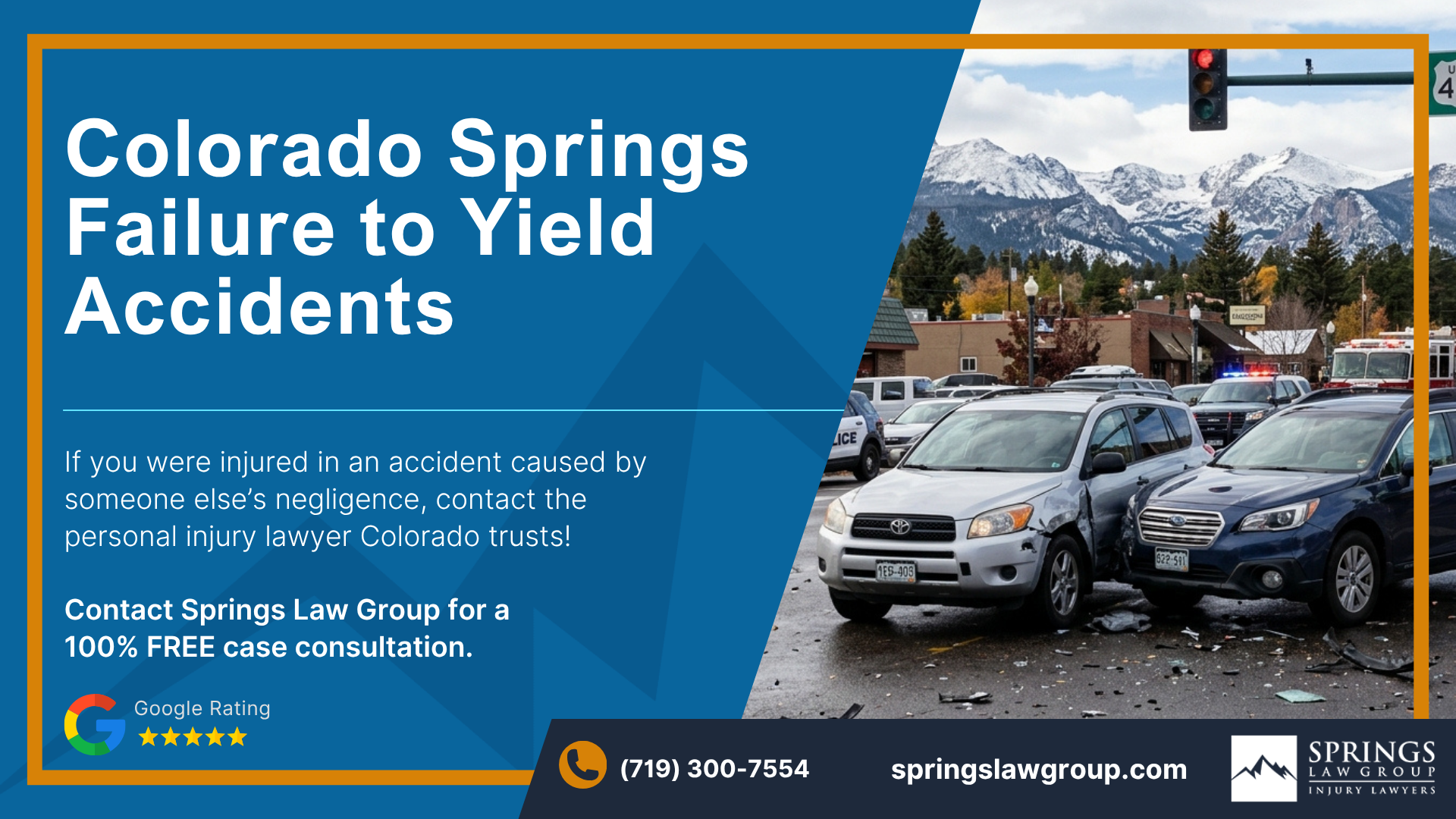
A failure-to-yield accident occurs when a driver enters traffic, turns, merges, or crosses another vehicle’s path without giving the right of way when required.
These crashes commonly happen at intersections, stop signs, crosswalks, driveways, and other areas where drivers must wait for approaching traffic, pedestrians, or bicyclists.
An accident resulting from a failure to yield may support a personal injury lawsuit when the driver’s actions cause injuries, medical expenses, lost income, or other losses.
Springs Law Group represents people injured in Colorado Springs failure-to-yield crashes and helps them understand their options for pursuing compensation.
Failure to yield violations occur when a driver does not give another vehicle, pedestrian, or bicyclist the right of way when Colorado law requires it.
Common examples include turning left across approaching traffic, entering an intersection too soon, pulling onto a roadway from a driveway, or proceeding through a stop or yield sign without waiting for traffic that has the right of way.
Colorado classifies several common failure to yield violations as Class A traffic infractions, including violations involving intersections, left turns, stop and yield signs, and vehicles entering a roadway.
A traffic violation can help establish what happened, but it does not automatically resolve every issue in a personal injury claim.
Failure to yield crashes can also result in serious injuries or death.
In national fatal-crash data, failure to yield right of way was the fourth-most frequently reported driving behavior among drivers involved in fatal crashes.
Side-impact collisions, crashes involving pedestrians or bicyclists, and left-turn accidents can be particularly dangerous because the injured person may have little time to avoid the collision.
Multiple factors can influence liability after a failure to yield accident.
Investigators and insurers may consider traffic signals, vehicle speed, visibility, witness accounts, camera footage, roadway conditions, and whether either driver violated another traffic law.
Colorado’s comparative negligence rules can also affect compensation when more than one person contributed to the crash.
Springs Law Group represents people injured in Colorado Springs traffic accidents and provides legal guidance when fault or insurance coverage is disputed.
If you or a loved one was injured in a failure to yield crash, contact Springs Law Group for a free consultation to discuss your legal options.
A failure to yield accident happens when a driver moves into traffic when another car, pedestrian, bicyclist, motorcycle, emergency vehicle, or other vehicle has the right of way.
In Colorado, drivers are required to wait in several common situations, including when turning left across oncoming traffic, entering a road from a driveway or parking lot, or approaching certain stop and yield signs.
Colorado’s right-of-way laws also address what drivers should do when two vehicles reach an uncontrolled intersection at about the same time.
These rules are designed to prevent drivers from entering another vehicle’s path when there is not enough time or space to do so safely.
A failure to yield crash may happen because a driver misjudges the speed of approaching traffic, rolls through a stop, turns too early, or pulls onto the road without checking carefully enough.
Even when one driver receives a traffic citation, fault in an injury claim can still depend on the actions of everyone involved.
Evidence such as traffic camera footage, witness statements, vehicle damage, and the location of the impact may help show who had the right of way and how the crash occurred.
Colorado right-of-way laws establish when a driver must wait for another vehicle, pedestrian, bicyclist, or emergency vehicle before proceeding.
These rules apply in many everyday situations and are intended to prevent drivers from moving into another person’s path when it is unsafe.
Under Colorado law, drivers may be required to yield when:
These rules can help determine which driver had the legal duty to wait before a crash occurred.
A typical failure-to-yield right-of-way violation also adds three points to a Colorado driver’s record.
Colorado separately prohibits knowingly obstructing a roadway where a funeral procession is taking place, although that rule is distinct from the ordinary right-of-way requirements involved in most failure-to-yield accidents.
Failure to yield accidents can happen whenever a driver enters another person’s path when the circumstances require them to wait.
Although the exact right-of-way rule depends on the roadway, traffic controls, and surrounding conditions, several scenarios occur regularly in Colorado crashes.
Common failure to yield scenarios include:
The details of the crash still matter.
Traffic signals, lane markings, vehicle speed, sightlines, and the actions of everyone involved can affect whether a driver failed to yield under the circumstances.
Fault after a failure to yield crash depends on who had the right of way, what each driver was doing before the collision, and whether either person violated a traffic law.
A citation for failing to yield can be important evidence, but it does not necessarily decide fault in a personal injury claim by itself.
Evidence that may help show how the crash happened includes:
Fault can become more complicated when both drivers are accused of contributing to the collision.
For example, one driver may have failed to yield while the other was speeding, distracted, or otherwise driving unsafely.
Colorado follows a modified comparative negligence rule under C.R.S. § 13-21-111.
An injured person can generally recover compensation when their share of fault is less than 50%, but their compensation is reduced by their percentage of responsibility.
If the injured person is found to be 50% or more at fault, they cannot recover damages from the other party under this rule.
Insurance companies may therefore try to shift some responsibility to the injured driver even when the other motorist received a failure to yield citation.
Evidence showing vehicle speed, visibility, traffic controls, driver attention, and who entered the roadway first can be especially important when the drivers give conflicting accounts.
Failure to yield crashes in Colorado Springs can happen anywhere drivers must judge whether they have enough time and space to enter or cross traffic.
Busy intersections, multilane roads, left-turn lanes, shopping-center exits, crosswalks, and highway access points can create situations where a driver must make a quick right-of-way decision.
The City of Colorado Springs has identified intersection safety as an important part of its broader traffic-safety strategy.
The city’s Safe Streets COS program uses crash data to identify higher-risk corridors and intersections and guide future safety improvements.
The city has also installed red-light safety cameras at selected intersections based on factors that include crash history, traffic volume, and the severity of previous crashes.
Intersections monitored through the city’s red-light camera program include locations along major roads such as Academy Boulevard, Platte Avenue, Dublin Boulevard, Austin Bluffs Parkway, and North Carefree Circle.
These locations should not automatically be described as the most dangerous intersections in Colorado Springs, but the city’s decision to monitor them reflects documented traffic-safety concerns.
Failure to yield accidents in these and other parts of Colorado Springs may involve left turns across traffic, drivers entering from side streets or parking lots, vehicles proceeding through stop or yield signs, or motorists failing to account for pedestrians and bicyclists.
Heavy traffic, limited sightlines, weather, construction, and larger vehicles blocking a driver’s view can make those decisions more difficult.
The location of a crash can also affect the evidence available afterward.
Traffic cameras, intersection design, lane markings, signal timing, nearby businesses, and witness accounts may help clarify which driver had the right of way and what happened immediately before the collision.
The steps you take after a failure to yield accident can affect both your health and your ability to document what happened.
Seeking prompt medical attention is important because injuries such as whiplash, which is common in side-impact collisions, may not be immediately obvious.
If you are able, take the following steps after the crash:
Many civil claims are resolved through settlement rather than going to trial, although the outcome depends on the evidence, damages, and willingness of the parties to reach an agreement.
For clients who lose a family member in a fatal failure to yield crash, a Colorado wrongful death claim may also seek certain losses associated with the death, including funeral and burial expenses.
Under C.R.S. § 13-80-101, most personal injury and property damage claims arising from a motor vehicle accident in Colorado must be filed within three years.
Missing that deadline can prevent an injured person from recovering compensation through a lawsuit. Some claims have shorter deadlines, particularly when a city, county, state agency, or other public entity may be responsible.
Under the Colorado Governmental Immunity Act, a claimant generally must provide written notice of an injury claim against a public entity within 182 days after discovering the injury.
Because the applicable deadline depends on the parties involved and the circumstances of the crash, it is important to identify potential claims well before the statute of limitations expires.
Failure to yield crashes can leave injured people dealing with medical treatment, lost income, property damage, and disputes over who was responsible.
Springs Law Group represents people injured in motor vehicle accidents throughout Colorado Springs and helps clients understand their legal rights after a serious crash.
A skilled car accident lawyer from our team can review the circumstances of the collision, explain the options that may be available, and help determine whether legal action is appropriate.
The value and viability of a claim depend on factors such as fault, the severity of the injuries, available insurance coverage, and the financial losses caused by the accident.
If you or a loved one was injured in a failure to yield accident, contact Springs Law Group for a free consultation.
You can also use the chat feature on this page to connect with our team and discuss what steps may be available next.
The driver who failed to yield is often primarily at fault, but responsibility is not automatic.
Another driver’s speed, distraction, traffic signal, visibility, or other actions can affect how fault is divided.
Colorado uses modified comparative negligence, so an injured person’s compensation may be reduced if they share responsibility for the crash.
A traffic citation can provide useful evidence, but the insurance company or court may consider additional evidence before determining fault.
In some cases, violation of a specific traffic-safety law may also support a negligence per se argument.
That does not eliminate the need to establish that the violation contributed to the accident and resulting injuries.
Unsafe left-hand turns and ignoring stop signs are common failure to yield scenarios.
Distracted driving can also cause a driver to overlook approaching traffic, traffic lights, pedestrians, or a vehicle that already has the right of way.
Other crashes occur when a driver makes a rolling stop, pulls out of a driveway too quickly, or enters a multi-lane highway without enough space.
Colorado law generally requires a driver changing lanes to first determine that the movement can be made safely.
Speeding and other aggressive driving behavior can make these accidents more likely because drivers have less time to judge distance or react when another vehicle enters their path.
A rolling stop can violate Colorado law because a driver approaching a stop sign is required to stop completely before proceeding.
After coming to a complete stop, the driver must yield to traffic that is already in the intersection or approaching closely enough to create an immediate hazard.
The rule is different at a yield sign.
A driver must slow to a reasonable speed and stop if necessary for safety, but a complete stop is not required every time.
Colorado also requires drivers facing steady red traffic lights to stop before the designated stop line, crosswalk, or intersection before proceeding when a turn is legally permitted.
Failure to yield accidents frequently involve side impacts, angled collisions, pedestrian impacts, or crashes in which one driver has little time to react.
Injuries can range from relatively minor soft-tissue damage to permanent impairment.
Possible injuries include:
The severity of the injuries can depend on vehicle speed, the direction of impact, whether a pedestrian or bicyclist was involved, and other circumstances surrounding the crash.
Compensation depends on the injuries, financial losses, insurance coverage, and degree of fault involved.
Economic damages generally address measurable financial losses, while noneconomic damages address the personal effects of the injury.
Recoverable losses may include:
A wrongful death claim may also seek losses resulting from the death of a family member, including qualifying funeral and burial expenses.
Court costs and litigation expenses are separate from the damages caused by the accident, and how those expenses are handled can depend on the agreement with the law firm.
Yes.
Under Colorado’s driver point system, a typical failure to yield right-of-way conviction adds three points to a driver’s driving record.
Certain violations involving pedestrians, emergency vehicles, bicyclists, or other circumstances can carry a different number of points.
Accumulating too many points within the applicable period can result in a driver’s license suspension.
The number of points that triggers a suspension depends partly on the driver’s age and how quickly the points accumulate.
A failure to yield citation may also affect auto insurance premiums, although any premium increase depends on the insurer, the driver’s history, and other factors.
Yes.
Colorado law requires drivers to yield when an authorized emergency vehicle approaches using the required audible or visual signals.
This can include fire trucks, ambulances, police vehicles, and other qualifying emergency vehicles.
Under C.R.S. § 42-4-705, drivers generally must move toward the right side of the roadway, clear the intersection when possible, stop, and remain stopped until the emergency vehicle passes unless directed otherwise.
Failure to yield to an emergency vehicle is treated separately from an ordinary right-of-way violation and carries additional consequences under Colorado law.
Not necessarily.
Many car accident claims are resolved through an insurance settlement without a trial, although a lawsuit may become necessary when fault, the extent of the injuries, or the value of the claim remains disputed.
An experienced attorney can explain the available options and whether filing a lawsuit makes sense based on the circumstances.
A Colorado Springs car accident attorney may also address questions about evidence, negotiations, filing deadlines, court costs, and what to expect if a case proceeds into litigation.
Speaking with a law firm does not mean the case will necessarily go to trial.
The appropriate course depends on the evidence, insurance coverage, injuries, and how the parties respond during the claim.

Member of the Colorado Bar Association since 2014. Attorney, Christopher M. Nicolaysen focuses primarily on helping those injured in Colorado car accidents, other auto accidents, and Colorado personal injury incidents.
This article has been written and reviewed for legal accuracy and clarity by the team of writers and attorneys at Springs Law Group and is as accurate as possible. This content should not be taken as legal advice from an attorney. If you would like to learn more about our owner and experienced Colorado personal injury lawyer, Christopher Nicolaysen, you can do so here.
Springs Law Group does everything possible to make sure the information in this article is up to date and accurate. If you need specific legal advice about your case, contact us. This article should not be taken as advice from an attorney.
We use reviews to help show more people like you why we do what we do!

I was uneasy about reaching out to a law firm after being in an accident that left me injured and my vehicle totaled. I don’t care for the idea of suing for what was very clearly an accident. However, after learning more about the overall process of working with a professional team to navigate the murky waters of the insurance world, I was pleasantly surprised to find that the experience wasn’t as gross as I’d originally felt about it.

Springs Law is very friendly and professional. I always felt that they were on my side and cared about my injury and what I was going through. I highly recommend them.

Springs Law Group is an amazing group to work with! I got into a rough accident, and they never ceased to let me know they were there working hard to help me in my hour of need. It was always very easy to reach out to someone if I had any questions, and they were always happy to answer any questions I had.
I never have a problem with getting a response when I need them – which is not the case with most other firms. They really truly care about each client. As a plus, they always have positive attitudes, which matters tremendously when you are in a stressful legal situation.
Big thanks to Mr. Jake Kimbell and his team for their assistance with my case. He helped me through an incredibly challenging part of my life, and most importantly helped navigate through the convoluted legal channels of my case. I cannot thank him and his team enough for their support.

The entire team at Springs Law group has been nothing but amazing. Jake and the rest of the staff were great to work with and extremely professional. They were very attentive and answered any questions and concerns I had. I was always able to contact them and they were very responsive and communicated with me.
Springs Law Group is an amazing group to work with! I got into a rough accident, and they never ceased to let me know they were there working hard to help me in my hour of need. It was always very easy to reach out to someone if I had any questions, and they were always happy to answer any questions I had.