
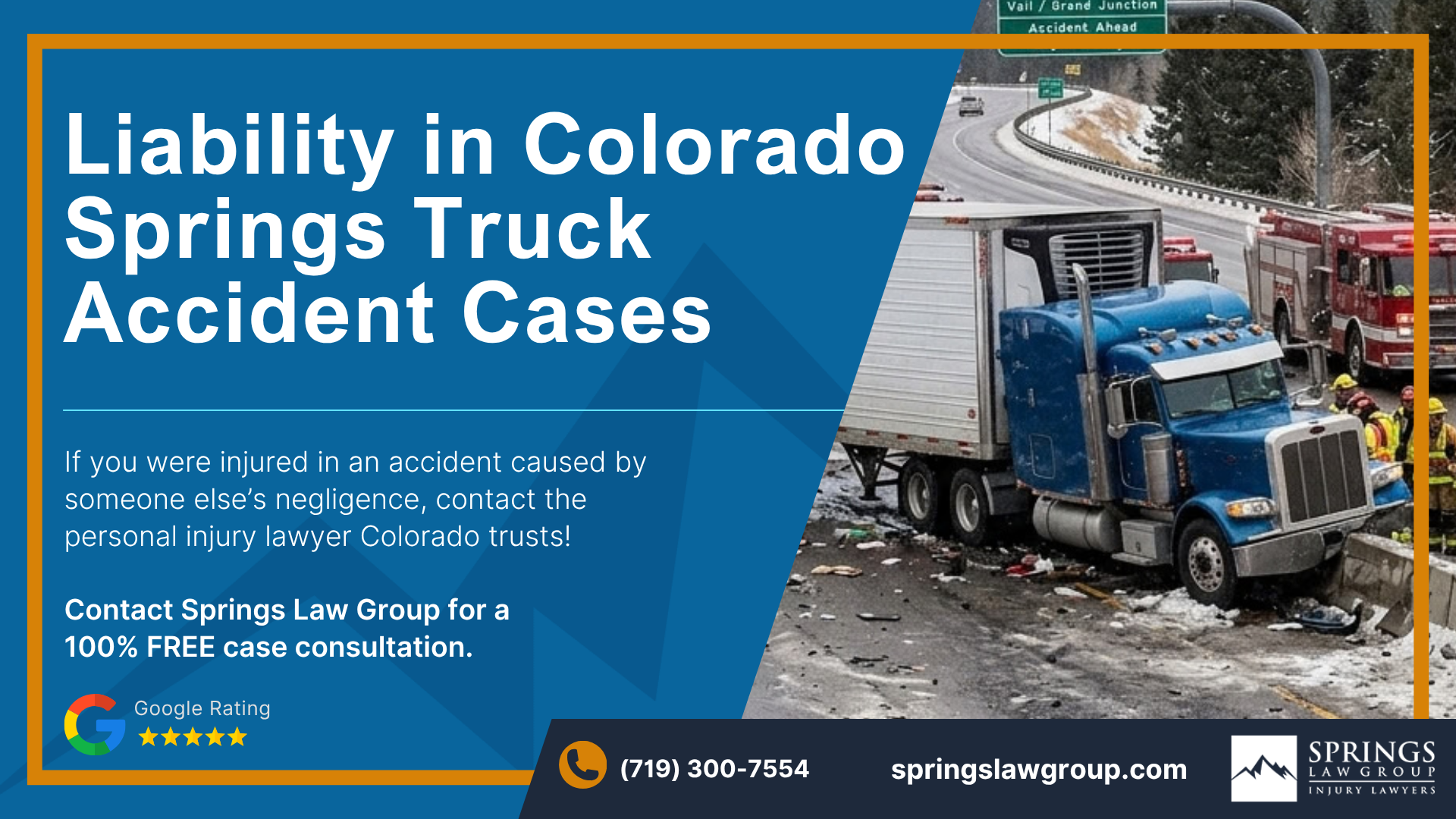
Determining liability in a truck accident in Colorado Springs can be more complicated than in many car accidents because multiple parties may influence how a commercial vehicle is operated, loaded, and maintained.
Depending on what caused the collision, the truck driver, trucking company, vehicle owner, maintenance company, cargo loader, or another party may be held responsible.
Commercial trucks are larger and heavier than passenger vehicles, so drivers must account for longer stopping distances and handling limits while following applicable safety requirements.
Truck accident victims may need to review company records, driving data, and vehicle maintenance history to determine liability beyond what is visible at the crash scene.
The existence of several businesses connected to a truck does not automatically make all of them liable.
Each potential claim depends on what a particular person or company did, whether that conduct violated a legal duty, and whether that negligence contributed to the accident.
Springs Law Group represents people injured in commercial truck collisions throughout Colorado Springs and surrounding communities.
If you have questions about which parties may bear responsibility, our Colorado Springs truck accident lawyers offer a free consultation to discuss your legal options.
Proving liability in an ordinary negligence claim generally requires showing that another party owed a duty of reasonable care, failed to meet that duty, and caused an accident resulting in legally recoverable injuries or losses.
For example, a truck driver may be negligent for following another vehicle too closely.
A carrier may face a separate claim if pressuring drivers to work unsafe schedules or neglecting maintenance contributed to the same collision.
However, a safety violation, poor business practice, or equipment defect does not establish liability by itself unless the applicable legal requirements are met and the conduct is connected to the harm.
Truck accident cases can also involve responsibility for another person’s conduct.
A trucking company may be liable for its truck driver’s negligence when the driver was acting within the scope of employment, even if the company did not personally direct the dangerous maneuver.
This is commonly called vicarious liability.
Separate claims may address the company’s own hiring, training, supervision, or maintenance decisions.
The answer depends on the truck’s operation, the relationships among the businesses involved, and the cause of the collision.
Identifying the at-fault party may require separate inquiries into driver conduct, employer responsibility, and the work performed by outside contractors.
The following parties are among those who may need to be considered.
A commercial driver may be liable when careless driving caused or contributed to a crash.
The truck’s size and weight increase the consequences of unsafe operation, while federal and state regulations impose specific requirements on covered commercial drivers.
Examples include speeding, distracted driving, unsafe lane changes, failing to yield, driving while impaired, or failing to maintain enough distance to stop safely.
Fatigue may also be relevant when a driver works beyond applicable driving limits or operates a truck without adequate rest.
Whether the driver violated a traffic or safety rule, and whether that violation caused the collision, must be established from the evidence.
A trucking company can face liability through more than one legal theory:
Colorado law permits qualifying direct negligence claims against an employer even when that employer acknowledges vicarious liability for an employee’s negligence.
C.R.S. § 13-21-111.5 addresses that distinction.
A claimant still needs evidence supporting the particular claim; the company’s relationship to the driver is not proof that every alleged safety failure occurred.
A maintenance company may share liability if negligent repairs, worn tires, or defective brakes caused a driver to lose control.
Tire blowouts or other mechanical failures do not establish negligence automatically; inspection records and the cause of the failure are important.
A truck or trailer owner may also have relevant duties, depending on its role in maintaining or providing the equipment.
Cargo loaders or other businesses involved in preparing a shipment may be responsible where improper loading, excessive weight, or inadequate securement contributed to a rollover, falling-load accident, or loss of control.
Relevant records may include inspection histories, repair orders, bills of lading, weight tickets, and loading instructions.
A shipper, freight broker, or equipment owner is not automatically liable simply because its name appears in the shipment records.
Liability depends on its specific conduct, contractual role, and applicable law.
A defective tire, braking component, steering system, or other truck part may raise a claim under product liability laws.
These claims have requirements that differ from an ordinary claim against a negligent driver or repair business.
Other motorists may also share responsibility in a multi-vehicle or chain-reaction collision.
In some cases, a government vehicle or an actionable roadway condition may be involved, although public-entity claims are subject to separate immunity rules and strict notice requirements.
The same collision may support claims against multiple parties, including defendants whose distinct actions contributed to the resulting injuries.
The key is identifying each party’s legally relevant contribution rather than treating everyone connected to the truck as equally responsible.
Truck drivers and motor carriers are subject to traffic laws and, when applicable, federal and state regulations governing commercial vehicle safety.
The Federal Motor Carrier Safety Administration (FMCSA) administers federal regulations covering many interstate motor carriers and their drivers.
Which requirements apply depends on the vehicle, operation, and regulatory classification.
Several categories of safety rules can be particularly relevant:
Electronic logs and dispatch records may help establish whether fatigue or scheduling contributed to a crash.
Regulatory violations can influence liability when they concern the conduct that caused the crash, but a violation does not automatically establish who must pay a claim.
The safety rule must apply to the driver or carrier, and the alleged failure must have a legally sufficient connection to the collision and resulting injuries.
Different causes may point to different responsible parties.
An exhausted driver who falls asleep could raise questions about the driver’s conduct, driver logs, and the carrier’s scheduling practices.
A truck that cannot stop because of poorly maintained brakes may require reviewing inspection duties, repair work, and who controlled the vehicle.
If cargo shifts during a turn, loading and securement responsibilities may be relevant.
The type of crash, whether a jackknife, rollover, rear-end impact, or underride collision, can help identify issues worth examining.
It does not establish fault without supporting evidence.
Some evidence is collected at the accident scene, while other material may be held by the trucking company or an outside contractor.
The most useful records depend on the particular dispute.
Evidence that may help explain responsibility includes:
Not every truck stores the same electronic information, and access to company records may require formal legal processes.
Depending on the equipment, event data or engine control systems may record speed and braking activity around a crash, as documented in NTSB truck investigations.
According to FMCSA guidance, electronic logging devices primarily document hours-of-service information and are not required to record vehicle speed or braking.
Preserving relevant black box data, driver logs, and company records promptly may matter because electronic information can be overwritten or lost as time passes.
Our guide to evidence after an accident explains additional records that may be useful.
A police report or an insurance adjuster’s initial conclusion may inform a claim, but neither automatically decides civil liability.
Experienced truck accident attorneys may assess the available records and the applicable legal requirements, but their review does not guarantee a particular fault finding.
Conflicting accounts may need to be evaluated against physical evidence, relevant records, and the applicable legal standards.
Yes, in some circumstances.
Colorado follows a modified comparative negligence rule commonly described as a 50% bar.
Under C.R.S. § 13-21-111, an injured person’s recovery can be reduced according to their share of negligence.
In an ordinary two-party claim, the injured person cannot recover if their negligence equals or exceeds the other party’s negligence.
For example, a claimant with $100,000 in proven damages who is found 20% responsible for a collision would generally have those damages reduced to $80,000.
If that claimant is found 50% at fault in a two-party negligence case, recovery is barred.
Truck accidents may involve several defendants or other parties whose conduct contributed to the collision.
When multiple defendants are responsible, their combined negligence is compared with the injured person’s percentage of fault.
Properly designated nonparties may also be included in the fault allocation.
These calculations can determine whether the injured person may recover compensation and how financial responsibility is divided among the defendants.
Determining who was responsible affects which negligent parties and insurance policies may be available to respond to a claim.
It also affects how fault is divided, particularly if a driver, employer, and outside contractor are involved.
Injury victims may seek compensation for qualifying medical expenses, lost wages or other lost income, diminished earning capacity, property damage, pain and suffering, and other supported losses.
Some crashes cause severe injuries, permanent impairment, or extensive ongoing care.
The recoverable damages depend on the injuries, proof of causation, applicable Colorado law, and any statutory limitations.
In fatal truck crashes, eligible surviving family members may seek compensation through a wrongful death claim for losses allowed by Colorado law.
Colorado’s wrongful death statutes determine who may sue and when, rather than granting every relative an automatic right to compensation.
For more information about damages generally, see our discussion of car accident damages and common injuries.
Identifying more than one potentially liable party does not guarantee a larger settlement or a particular financial recovery.
Each claim must be supported, and insurance limits, fault allocation, and the ability to satisfy a judgment affect what fair compensation may be available.
Under C.R.S. § 13-80-101(1)(n), many personal injury claims arising from the use or operation of a motor vehicle generally must be filed within three years after the claim accrues.
The deadline is not the same for every claim arising from a truck accident.
Under C.R.S. § 13-80-102, wrongful death actions generally have a two-year filing period, subject to statutory exceptions.
Claims against a manufacturer or seller involving defective truck components are generally subject to a two-year filing deadline under Colorado Revised Statutes § 13-80-106, although exceptions may apply.
When a claim is subject to the Colorado Governmental Immunity Act, a written notice may be required within 182 days after discovery of the injury under C.R.S. § 24-10-109.
Whether a claim against a public entity is permitted at all also depends on the applicable immunity rules.
These are general deadlines, not a calculation of the filing period for a particular accident.
Settlement discussions do not ordinarily suspend the time to bring a lawsuit, and trucking records may become unavailable well before any filing deadline expires.
The question after a commercial truck collision is not only whether a driver made a mistake.
It is whether the evidence supports a claim against the driver, the trucking company, a contractor, or another responsible party, and how Colorado law applies to each.
Springs Law Group represents people injured in truck accidents throughout Colorado Springs and the surrounding area.
Our personal injury law firm offers free consultations to discuss disputed liability, available information, and potential legal options.
When considering legal representation, ask personal injury lawyers about their experience with commercial trucking regulations, company records, and claims involving multiple responsible parties.
If you or a loved one was injured in a commercial truck accident, contact Springs Law Group for a free consultation or use the chat feature on this page to reach our team.
Potentially.
A driver may be responsible for negligent driving, while the trucking company may be liable for the truck driver’s negligence under applicable employment rules.
The company may also face a separate claim based on its own negligent hiring, supervision, scheduling, or maintenance practices if the evidence supports one.
These claims depend on the facts and cannot be established from the driver’s employment alone.
Not automatically, and the label in a contract does not settle every liability question.
The driver’s working relationship, the carrier’s responsibilities, its degree of control, and any independent negligent conduct may all be relevant.
A claimant must establish a legal basis for holding the company responsible.
Some event data recorders may help reconstruct a collision by capturing speed, braking, and other operating conditions just before or during an impact.
The information recorded and its availability vary depending on the vehicle and recording system.
Those records are usually considered alongside photographs, witness statements, inspection documents, and other evidence; black box data alone does not necessarily establish negligence.
Responsibility may depend on who inspected, maintained, repaired, loaded, or controlled the truck.
A carrier, maintenance contractor, cargo-loading company, driver, or parts manufacturer could be relevant, depending on the defect or failure and the law governing the claim.
Inspection records, repair histories, loading documents, and equipment analysis may help establish what happened.
An insurer may assign some responsibility to the injured person when evaluating the claim, but its assessment is not a binding court finding.
Photographs, witness accounts, available vehicle data, and traffic evidence may support or contradict that position.
Colorado comparative negligence law determines how proven fault affects recoverable compensation, and a disputed claim may ultimately require resolution through litigation.
A truck accident lawyer can explain the legal issues raised by competing fault allegations, although no attorney can promise that an insurer or court will accept a particular position.
Seek medical attention for possible injuries and call emergency services when needed.
If it is safe to do so, document the crash scene and obtain the other drivers’ contact and insurance information.
Preserve photographs, witness details, and insurer correspondence, and consider asking a truck accident lawyer about time-sensitive electronic records.

Member of the Colorado Bar Association since 2014. Attorney, Christopher M. Nicolaysen focuses primarily on helping those injured in Colorado car accidents, other auto accidents, and Colorado personal injury incidents.
This article has been written and reviewed for legal accuracy and clarity by the team of writers and attorneys at Springs Law Group and is as accurate as possible. This content should not be taken as legal advice from an attorney. If you would like to learn more about our owner and experienced Colorado personal injury lawyer, Christopher Nicolaysen, you can do so here.
Springs Law Group does everything possible to make sure the information in this article is up to date and accurate. If you need specific legal advice about your case, contact us. This article should not be taken as advice from an attorney.
We use reviews to help show more people like you why we do what we do!

I was uneasy about reaching out to a law firm after being in an accident that left me injured and my vehicle totaled. I don’t care for the idea of suing for what was very clearly an accident. However, after learning more about the overall process of working with a professional team to navigate the murky waters of the insurance world, I was pleasantly surprised to find that the experience wasn’t as gross as I’d originally felt about it.

Springs Law is very friendly and professional. I always felt that they were on my side and cared about my injury and what I was going through. I highly recommend them.

Springs Law Group is an amazing group to work with! I got into a rough accident, and they never ceased to let me know they were there working hard to help me in my hour of need. It was always very easy to reach out to someone if I had any questions, and they were always happy to answer any questions I had.
I never have a problem with getting a response when I need them – which is not the case with most other firms. They really truly care about each client. As a plus, they always have positive attitudes, which matters tremendously when you are in a stressful legal situation.

Big thanks to Mr. Jake Kimbell and his team for their assistance with my case. He helped me through an incredibly challenging part of my life, and most importantly helped navigate through the convoluted legal channels of my case. I cannot thank him and his team enough for their support.

The entire team at Springs Law group has been nothing but amazing. Jake and the rest of the staff were great to work with and extremely professional. They were very attentive and answered any questions and concerns I had. I was always able to contact them and they were very responsive and communicated with me.

Springs Law Group is an amazing group to work with! I got into a rough accident, and they never ceased to let me know they were there working hard to help me in my hour of need. It was always very easy to reach out to someone if I had any questions, and they were always happy to answer any questions I had.