
A wrongful death claim is a civil claim brought after a person dies because of someone else’s negligence, wrongful act, recklessness, or intentional misconduct.
In Colorado, a wrongful death action may allow eligible surviving family members to pursue compensation for losses tied to a loved one’s death.
A wrongful death claim is different from a criminal case.
A criminal case is brought by the government, while a Colorado wrongful death lawsuit is a civil lawsuit brought by eligible family members or other parties allowed under Colorado law.
Wrongful death cases may involve fatal car accidents, drunk driving, distracted driving, medical malpractice, workplace accidents, unsafe property conditions, defective products, or other events that cause a fatal injury.
Springs Law Group helps families understand whether the facts may support a Colorado wrongful death claim and what legal options may be available.
A wrongful death claim may be filed in Colorado when a person dies because of another party’s negligence, wrongful act, or failure to act with reasonable care.
In many cases, the claim is based on the idea that the deceased person could have brought a personal injury claim if they had survived.
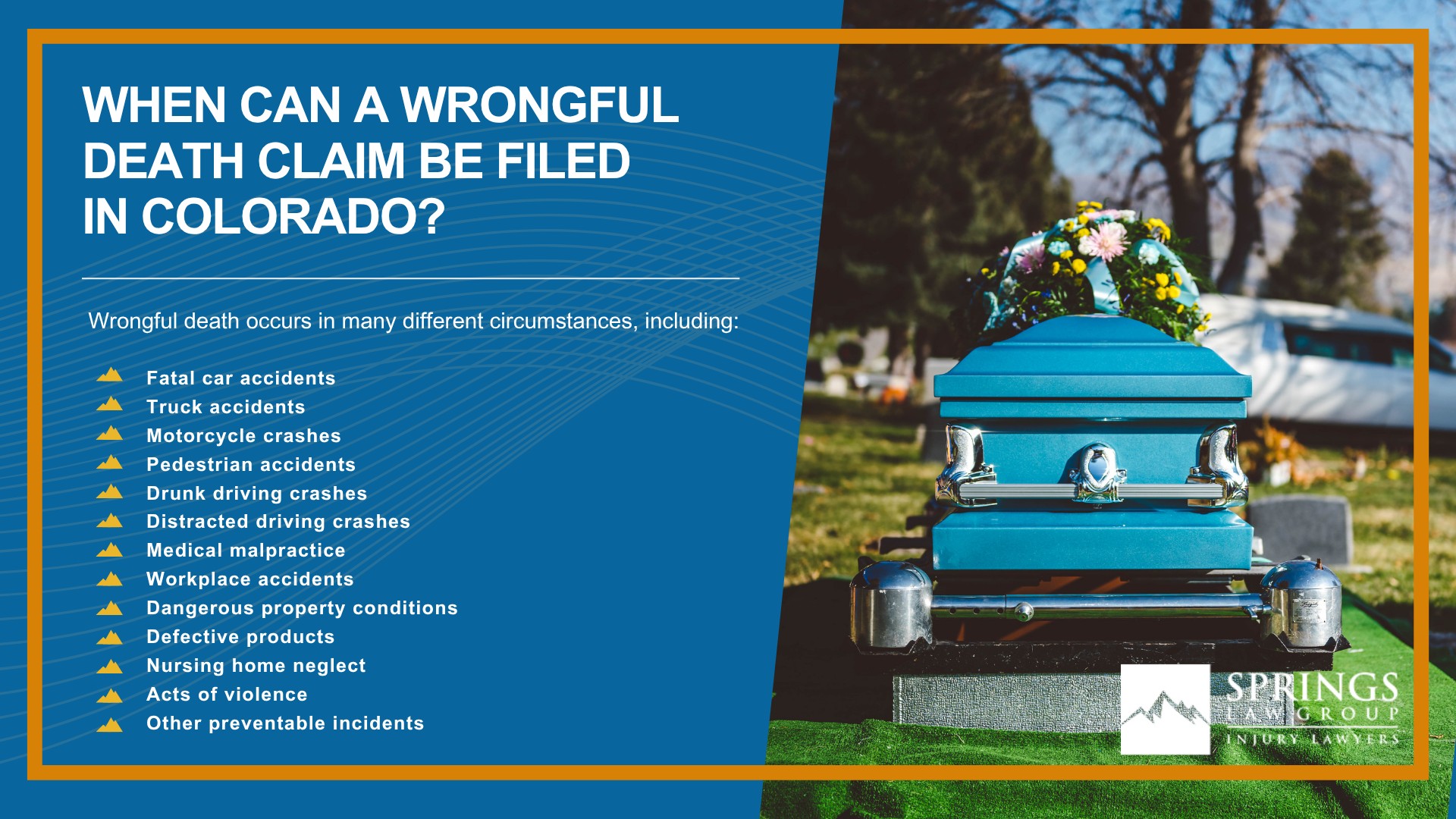
Wrongful death occurs in many different circumstances, including:
A death claim in Colorado may involve more than one responsible party.
A fatal accident may involve an at fault party, an employer, a property owner, a product manufacturer, or another entity whose conduct contributed to the decedent’s death.
Colorado law limits who may file a wrongful death claim and gives different parties filing rights during the first and second years after the death.
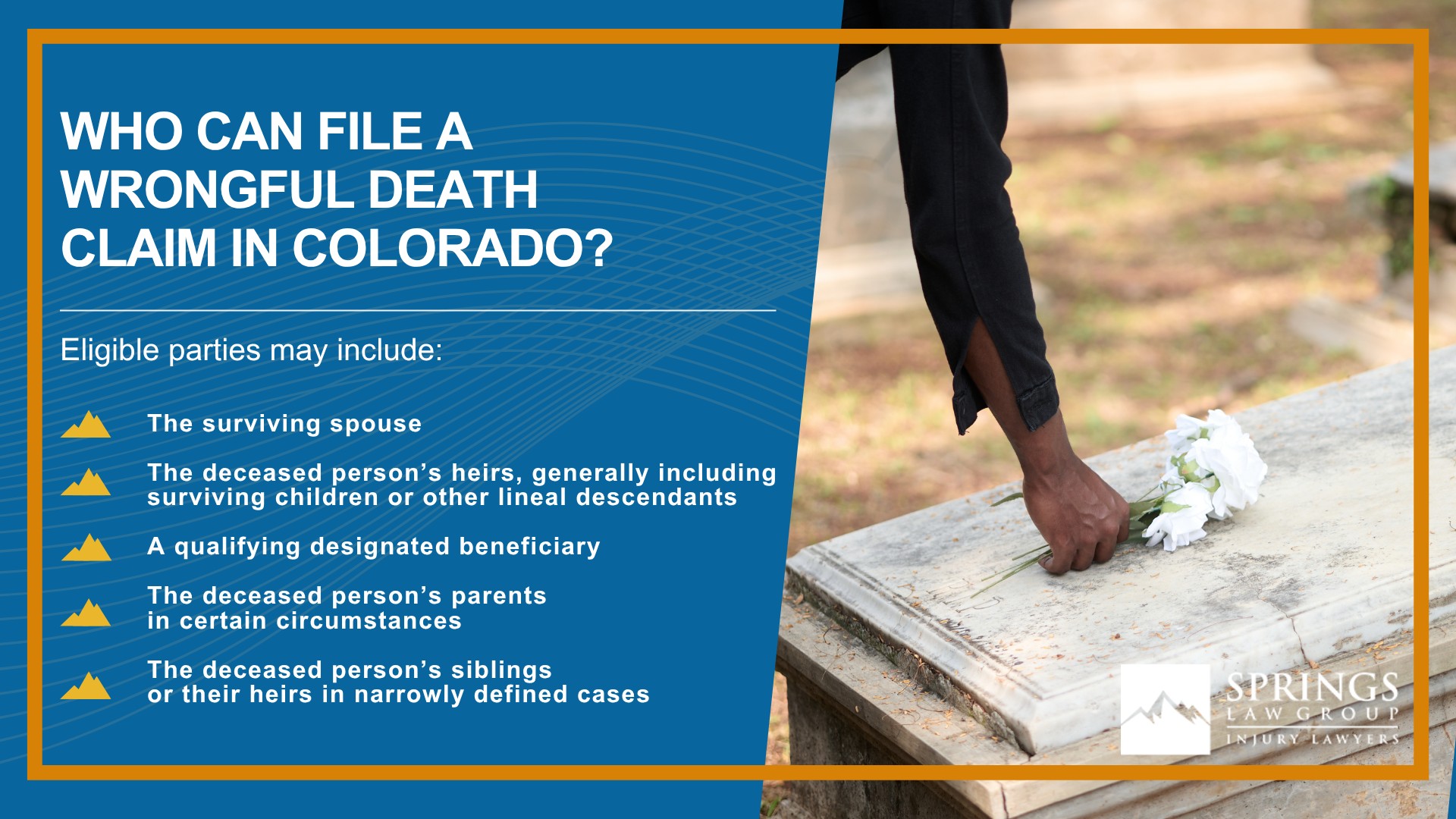
Eligible parties may include:
During the first year after the death, the surviving spouse generally has priority.
The spouse may file alone, elect in writing to file jointly with the deceased person’s heirs, or authorize the heirs to bring the claim.
If there is no surviving spouse, the heirs or a qualifying designated beneficiary may be able to file.
During the second year, the surviving spouse, the heirs, or both may bring the wrongful death action.
A qualifying designated beneficiary may also have filing or joinder rights, and a spouse or designated beneficiary may have 90 days to request joinder after receiving written notice that the heirs filed the case.
The parents of an unmarried minor or unmarried adult without descendants or a qualifying designated beneficiary may also file. When both parents survive, Colorado law generally gives them equal interests in the judgment, although a court may divide the recovery differently based on each parent’s relationship with the deceased.
For claims governed by changes effective January 1, 2025, siblings or their heirs may file only in limited circumstances, generally when the deceased left no spouse, heirs, designated beneficiary, or surviving parent who has priority under the statute.
Only one wrongful death action may be maintained for the death of one person, making coordination among eligible family members important.
A Colorado wrongful death attorney can review the family relationships, timing, written elections, and joinder requirements to determine who may file or participate in the claim.
The process of a Colorado Springs wrongful death case usually begins with reviewing how the death occurred, who may be legally responsible, and whether eligible family members have the right to bring a claim under Colorado law.
A lawyer can investigate the accident or incident, gather evidence, review medical records and insurance coverage, document the family’s financial and emotional losses, and pursue compensation through a claim or lawsuit.
Some wrongful death cases resolve through settlement negotiations, while others may require filing a lawsuit, completing discovery, attending mediation, or going to trial if the responsible party or insurance company refuses to offer a fair resolution.
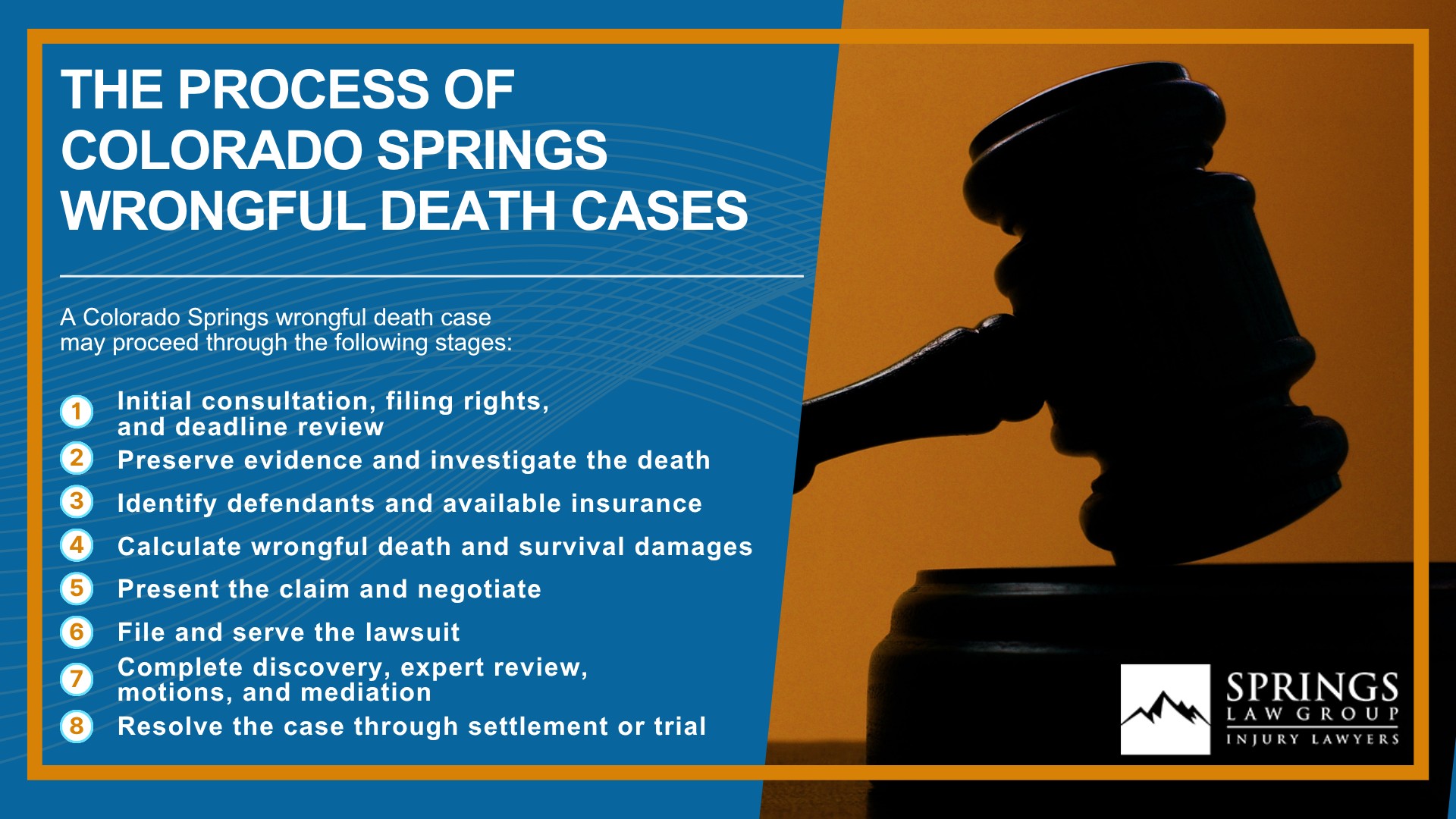
A Colorado Springs wrongful death case may proceed through the following stages:
The first step is determining whether the family member’s death may support a claim, who may file, and which deadlines apply.
During the first year, only the surviving spouse generally has priority, although the spouse may permit the heirs to file or join the action.
Parents may file during the first year in certain cases when the deceased was unmarried and left no spouse, children, or qualifying designated beneficiary.
Most wrongful death claims must be filed within two years. A four-year deadline may apply when the defendant committed vehicular homicide and left the scene during the same criminal episode.
Claims against government entities or employees may also require written notice within 182 days.
A personal representative generally files a survival claim for the estate rather than replacing family members authorized to bring the wrongful death suit.
The legal team can investigate how the death occurred, what medical treatment was provided, and whether another person or company caused the fatal injury.
Acting promptly may prevent vehicles, video footage, documents, physical evidence, and witness information from being lost.
Relevant evidence may include:
Both wrongful death and survival claims can arise from the same fatal incident.
The wrongful death claim addresses losses suffered by eligible family members, while the survival claim addresses certain losses incurred by the deceased person before death.
A wrongful death case may involve more than one responsible party. Potential defendants may include a negligent driver, employer, property owner, medical provider, product manufacturer, contractor, or government entity.
The attorney can also identify available insurance coverage, including auto, commercial, property, malpractice, umbrella, or uninsured motorist policies.
Insurers may dispute fault, blame the deceased person, or minimize the family’s losses. Identifying all responsible parties and coverage sources helps pursue the compensation the family deserves.
Wrongful death damages compensate eligible family members for losses caused by the death.
These losses may include funeral and final disposition expenses, lost financial support, loss of household services, grief, and loss of companionship or guidance.
A survival action may seek damages belonging to the estate, including medical treatment expenses, property damage, and lost wages incurred before death.
Colorado generally does not allow a survival claim to recover the deceased person’s pain and suffering or income that would have been earned after death.
For general wrongful death claims accruing on or after January 1, 2025, non-economic damages are generally capped at $2.125 million unless an exception applies.
Separate limits govern medical malpractice and government claims.
Eligible plaintiffs may also choose Colorado’s statutory solatium instead of proving the full value of grief, emotional distress, and loss of companionship.
After investigating the death and calculating damages, the attorney may send the responsible parties and insurers a demand for compensation.
The demand explains how the death occurred, why the defendant is liable, and what financial and personal losses the family suffered.
The insurance company may accept responsibility, dispute the evidence, or make a settlement offer.
The attorney can negotiate on the family’s behalf and advise whether an offer fairly accounts for the available damages.
If negotiations do not result in a fair settlement, the family may file a wrongful death lawsuit.
The complaint identifies the plaintiffs and defendants, describes the alleged wrongful conduct, and states the damages being sought.
The defendants must then be formally served with the lawsuit.
They may file an answer, deny liability, raise defenses, or ask the court to dismiss certain claims.
The court will also establish deadlines for discovery, motions, mediation, and trial preparation.
During discovery, both sides exchange documents, submit written questions, take depositions, and investigate the opposing party’s evidence.
Experts may analyze accident reconstruction, medical treatment, professional standards, lost financial support, or other disputed issues.
Discovery may include:
The parties may also attend mediation, where a neutral mediator helps them explore a possible settlement.
Mediation does not require the family to accept an offer or give up the right to proceed to trial.
Many wrongful death cases settle before trial, including some that resolve after discovery or mediation.
A settlement ends the case in exchange for an agreed payment and may provide the family with greater control over the outcome.
If the parties cannot reach an agreement, the case may proceed to trial.
A judge or jury will review the evidence and decide whether the defendant is liable and what damages should be awarded.
Springs Law Group can prepare the case for either outcome while helping the family understand each decision along the way.
Compensation in a Colorado wrongful death case depends on the relationship between the deceased person and the surviving family members, the financial and personal losses caused by the death, the available evidence, and the limits imposed by Colorado law.
A wrongful death claim compensates eligible surviving family members for losses they experienced because of the death.
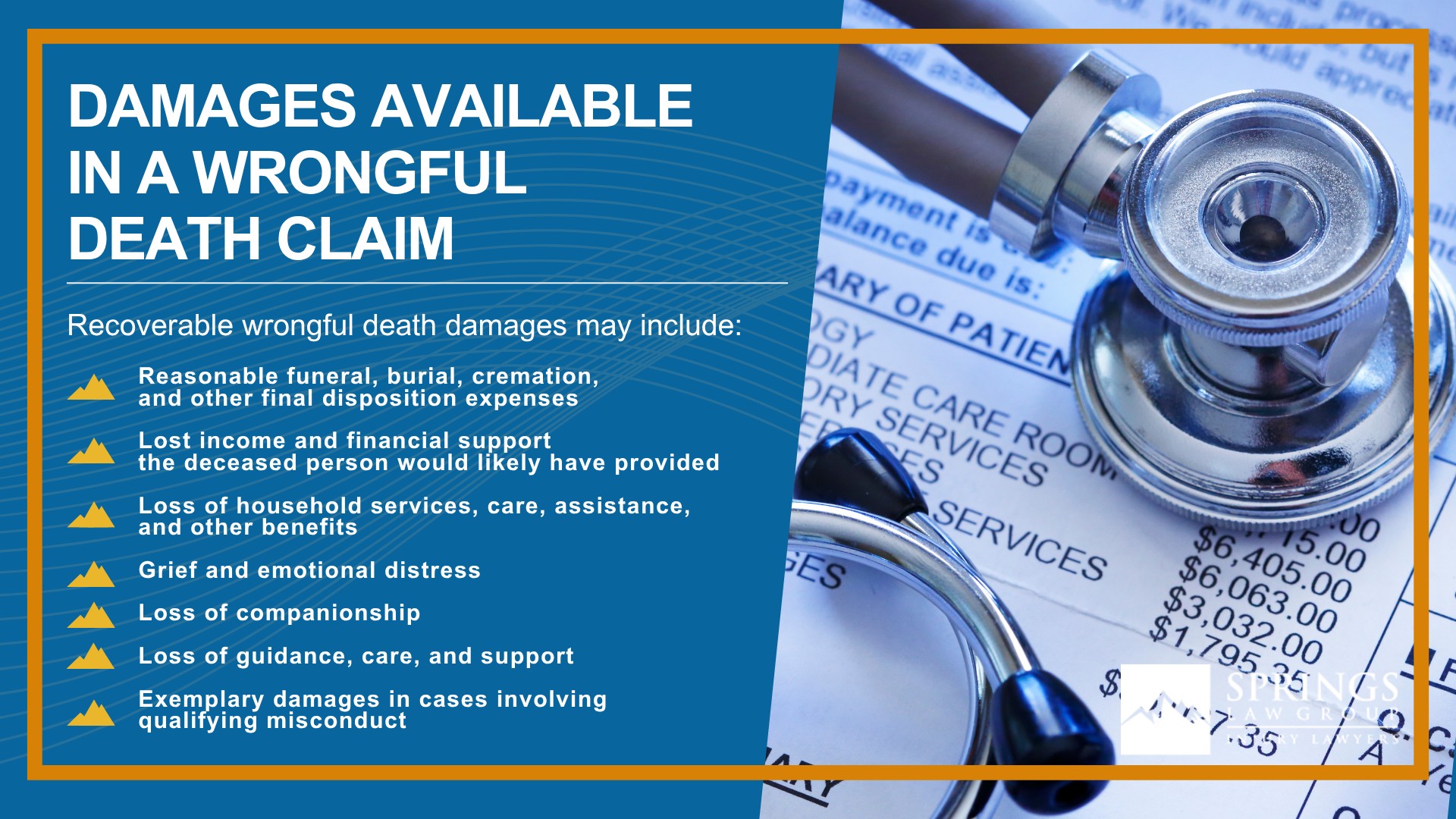
Recoverable wrongful death damages may include:
Colorado classifies grief, loss of companionship, pain and suffering, and emotional stress as non-economic wrongful death damages.
For claims accruing on or after January 1, 2025, general non-economic wrongful death damages are ordinarily subject to a $2.125 million limit, although the limit does not apply when the death resulted from a qualifying felonious killing.
Different limits may govern medical malpractice claims and actions against public entities or employees.
Economic damages, such as lost financial support and services, require evidence showing the deceased person’s earnings, employment history, expected career path, household contributions, age, health, and relationship with the surviving family members.
A survival action is separate from a wrongful death claim.
The wrongful death action belongs to eligible surviving family members, while the survival action is generally brought by the deceased person’s personal representative on behalf of the estate.
A Colorado survival action may seek losses the deceased person incurred before death, including:
In a personal injury survival action, Colorado generally does not permit the estate to recover damages for the deceased person’s pain, suffering, or disfigurement, or earnings the person would have received after death.
The survival action may proceed alongside a wrongful death claim because the two actions compensate different losses.
Eligible wrongful death plaintiffs may elect in writing to recover a statutory solatium instead of attempting to prove the full value of their non-economic damages.
The solatium is awarded after the defendant admits liability or is found liable for the wrongful death.
It is available in addition to economic damages and reasonable final disposition expenses, but it replaces damages for grief, emotional distress, and loss of companionship. Colorado periodically adjusts the statutory solatium amount for inflation.
A family may consider the solatium when liability can be established but proving the extent of non-economic harm would be difficult, intrusive, or heavily disputed.
Whether to elect the solatium or pursue ordinary non-economic damages depends on the evidence and the family’s circumstances.
Colorado may permit exemplary damages, sometimes called punitive damages, when the death involved fraud, malice, or willful and wanton conduct.
An exemplary-damages claim generally cannot be included in the initial complaint.
The plaintiff must first exchange initial disclosures and present prima facie evidence showing that the issue should be tried before the court may allow the claim to be added.
The initial exemplary-damages award generally cannot exceed the amount of actual damages, although Colorado law permits increases in narrowly defined circumstances involving continued or aggravated misconduct.
A Colorado wrongful death lawyer can determine whether the family may pursue wrongful death damages, whether the estate has a separate survival claim, which statutory limits apply, and whether the solatium or exemplary damages should be considered.
The length of a wrongful death case depends on the facts, the number of responsible parties, the amount of insurance coverage, the complexity of the evidence, and whether the insurance company offers a fair settlement.
Some cases resolve through negotiation, while others take longer because a lawsuit, discovery, mediation, or trial is necessary.
A case may take longer when it involves medical malpractice, disputed liability, multiple at fault parties, expert testimony, unclear insurance coverage, or significant damages.
A Colorado wrongful death attorney can help the family understand what steps may affect the timeline.
Springs Law Group works to move cases forward while still taking the time needed to investigate, gather evidence, calculate damages, and pursue compensation based on the full impact of the loss.
Colorado law controls who can file a wrongful death claim, when the claim must be filed, and what damages may be available.
The Colorado Wrongful Death Act and Colorado wrongful death statute set out important rules that families should understand before taking legal action.
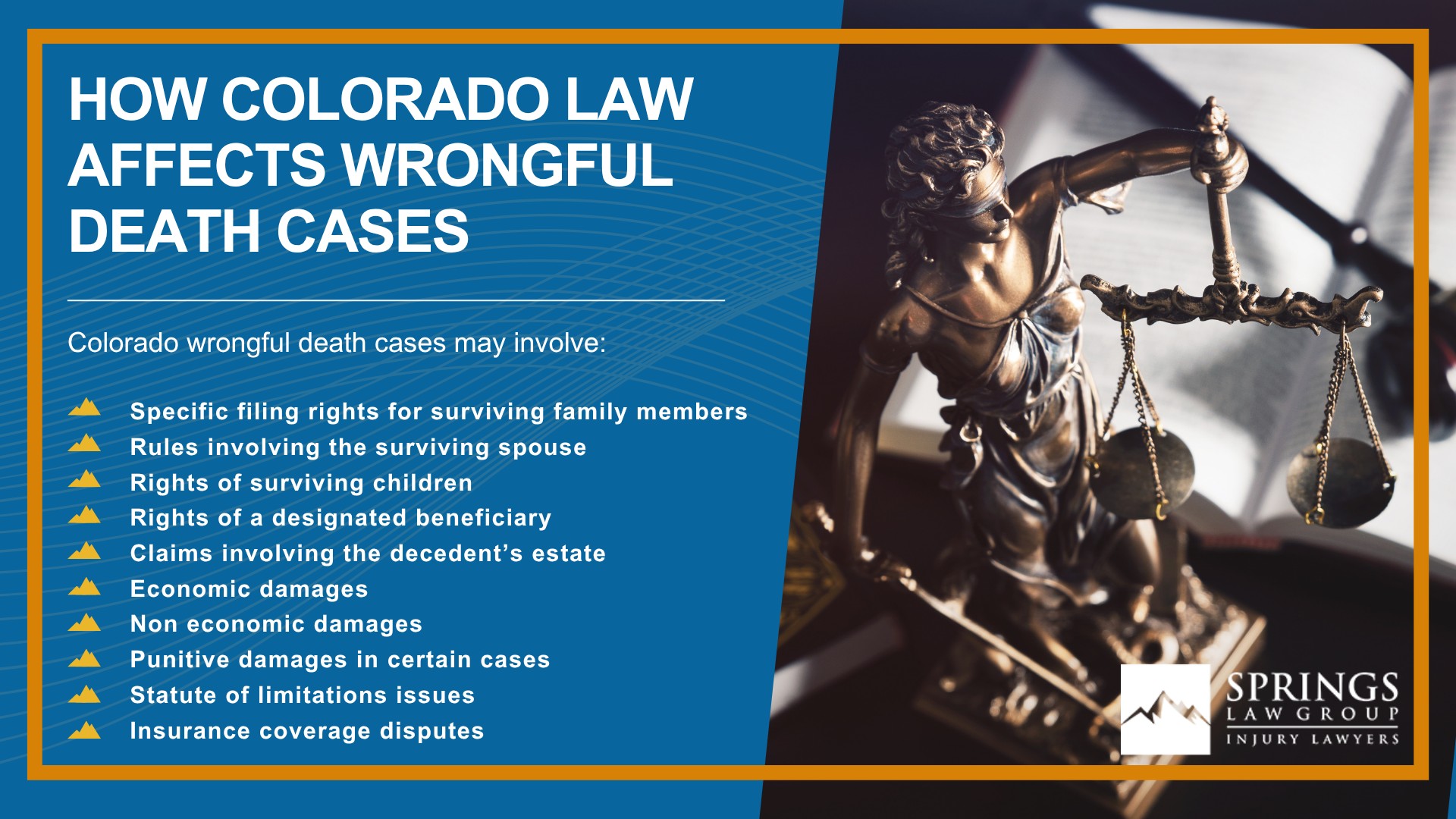
Colorado wrongful death cases may involve:
Because Colorado wrongful death laws are specific, families should not assume every relative can file a claim at any time.
Springs Law Group can explain how Colorado law applies to your family and what steps may be available.
In many Colorado wrongful death cases, the statute of limitations is generally two years from the date the death occurred.
If a claim is not filed on time, the family may lose the right to bring the case.
Some cases may involve different or shorter deadlines, especially when a government entity is involved.
Certain fatal hit-and-run or vehicular homicide circumstances may involve different timing rules.
Because deadlines can affect the entire case, families should speak with a wrongful death attorney as soon as possible after a loved one’s death.
Springs Law Group can review the facts, identify the applicable deadline, and help preserve the family’s legal options.
Wrongful death cases can be emotionally and legally difficult.
Families are grieving while also dealing with insurance companies, medical bills, funeral costs, legal deadlines, and questions about what happened.
Common challenges may include:
These challenges do not mean the family has no case.
They do mean the claim should be investigated carefully by an experienced wrongful death attorney who understands Colorado wrongful death claims.
Springs Law Group supports families by handling the legal work while they focus on grieving and rebuilding.
The firm helps families understand the process, gather evidence, deal with the insurance company, and pursue compensation when the facts support a claim.
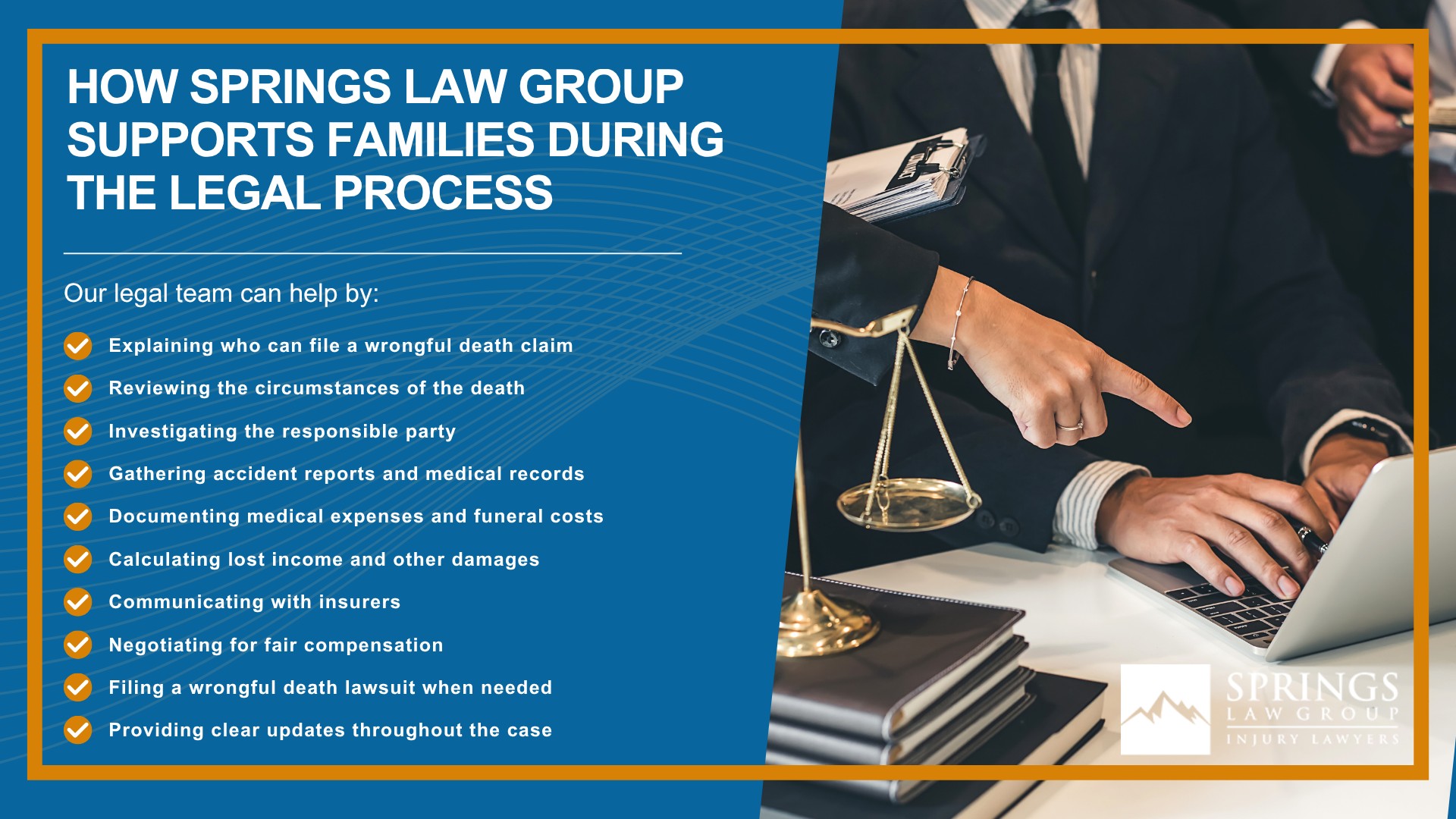
Our legal team can help by:
Springs Law Group understands that families need more than legal filings.
They need clear communication, practical guidance, and emotional support during an extremely difficult time.
Evidence is important in Colorado wrongful death cases because the family must show how the death occurred, who may be legally responsible, and what losses resulted from the death.
The right evidence can help prove liability, document financial losses, and support the family’s claim for compensation under Colorado law.
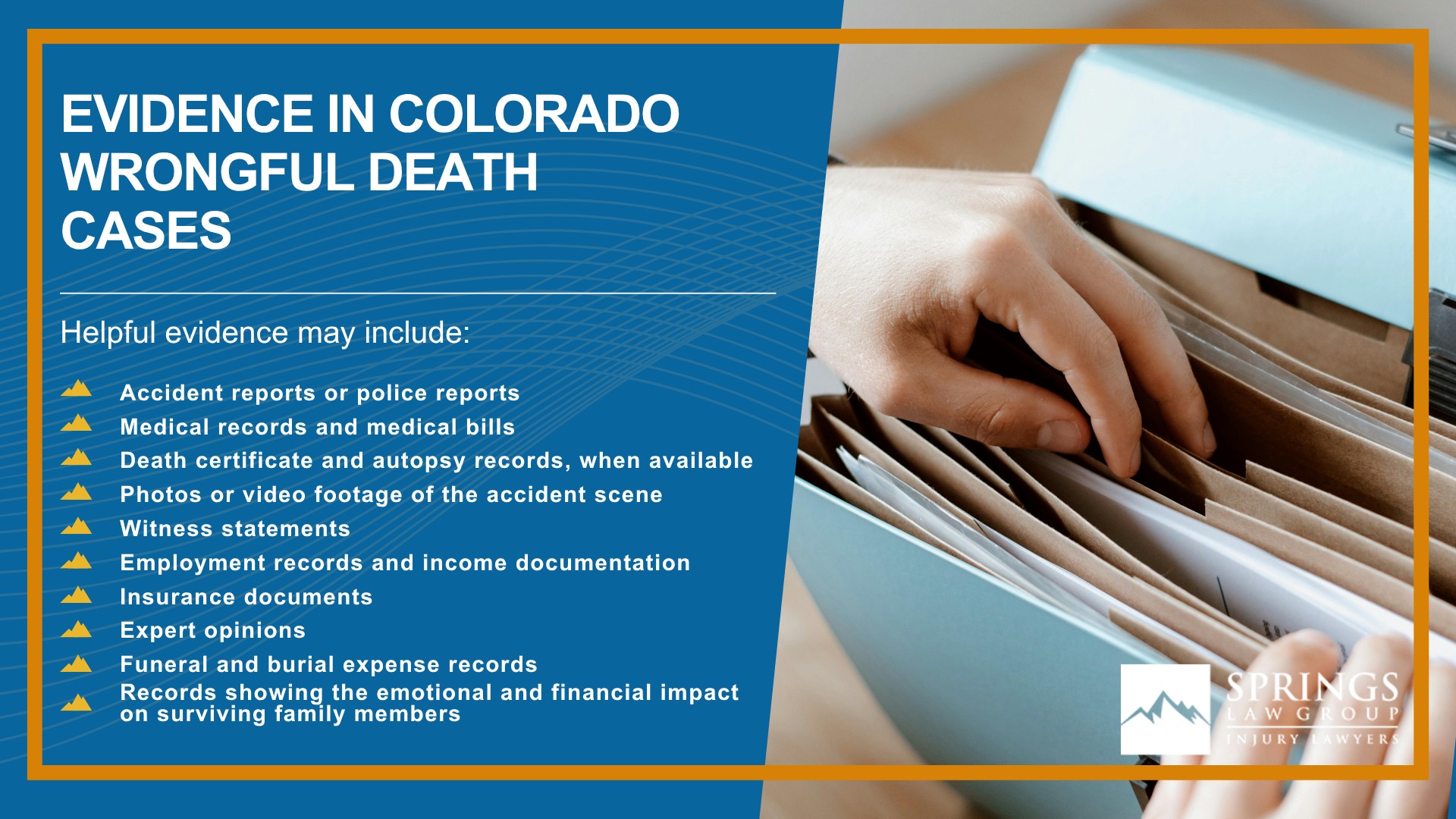
Helpful evidence may include:
Springs Law Group can help gather and preserve evidence, review the facts, and build a claim that supports the family’s right to pursue compensation after a wrongful death.
Families choose Springs Law Group because the firm provides compassionate legal representation and practical guidance during one of the hardest times in a person’s life.
A Colorado Springs wrongful death case requires careful investigation, strong evidence, and an understanding of Colorado wrongful death laws.
Springs Law Group helps families pursue accountability after fatal car accidents, workplace accidents, medical malpractice, dangerous property incidents, and other preventable losses.
The firm works to hold the responsible party accountable and seek justice for surviving family members.
Every case is different, and Springs Law Group does not promise a specific result.
The firm does work to understand what happened, identify who may be liable, document the family’s losses, and pursue compensation supported by the evidence.
If your family member died because of someone else’s negligence, Springs Law Group can help you understand your legal options.
A Colorado Springs wrongful death lawyer can review the facts, explain Colorado wrongful death laws, and help determine whether eligible surviving family members may file a wrongful death claim.
Your family may be able to recover compensation for medical bills, funeral expenses, funeral and burial costs, burial expenses, lost income, emotional distress, and other wrongful death damages allowed under Colorado law.
No legal action can replace your loved one.
But a wrongful death claim can help hold the responsible party accountable and provide financial support for the surviving family.
Contact Springs Law Group today for a free consultation with a Colorado wrongful death lawyer.
You can also use the chat feature to connect with the firm and learn whether your family may have a case.