
Collecting Evidence in Colorado Springs Car Accident Cases

Were You or A Loved One Injured in an Accident?
Get Free Answers In as Little as 3 Minutes
right-image
600

Evidence for Car Accident Cases in Colorado Springs

Evidence in Colorado Springs car accident cases often determines who is found at fault, how damages are calculated, and whether an insurance company accepts or disputes responsibility.

Because physical evidence, digital records, and witness accounts can change or disappear quickly, collecting and preserving documentation early can directly affect the strength of a claim.

Springs Law Group helps car accident victims gather, retain, and present evidence to seek compensation they deserve.

A Personal Injury Attorney Can Gather, Retain, and Present Evidence in a Car Accident Claim

After a car crash, injury victims are often dealing with pain, confusion, and pressure from an insurance adjuster to give statements before the full impact is clear.

Seeking medical attention early creates a record of symptoms and helps connect the collision to your injuries and future care.

Medical records, diagnostic imaging, and treatment notes from physical therapy can also support claims for medical expenses and long-term limitations.

In many personal injury cases, the most persuasive proof comes from details gathered at the scene, photos, witness names, and documentation of road conditions.

A car accident attorney can identify what evidence matters, send preservation requests, and prevent key records from being lost or rewritten.

Strong legal representation also helps push back when insurers minimize injuries or dispute causation to avoid paying fair compensation.

This guide explains what to collect, how to preserve it, and how evidence supports both injury claims and wrongful death claims.

If you or a loved one was injured in a Colorado Springs car accident, gathering and preserving evidence early can protect your ability to pursue fair compensation for medical expenses, lost income, and other losses.

Contact Springs Law Group for a free consultation.

Use the chat feature on this page to get in touch with a car accident lawyer who can help you gather evidence for your claim.

Table of Contents

Why Evidence Matters After a Car Accident

Evidence matters after an auto accident because it determines how fault is assigned and what damages can be proven in the legal process.

In a car accident in Colorado, the first dispute is usually liability, and insurers often rely on selective facts when evaluating insurance claims.

Photos, witness information, and crash documentation can anchor the timeline and prevent the story from shifting as insurance claims move forward.

Medical records matter too, because a personal injury claim rises or falls on whether the injuries are documented and connected to the collision.

Serious injuries can require extensive medical treatment, and complete records help prove the scope of medical bills and future care needs.
Colorado law also allows fault to be divided, so evidence can affect how much a person can pursue compensation if the insurer argues shared blame.

When evidence is missing, adjusters and defense attorneys often fill the gaps with assumptions that reduce the claim’s value.

Collecting strong proof early makes it easier to show what happened, why it happened, and what the crash has cost.

What Evidence to Collect at the Crash Scene

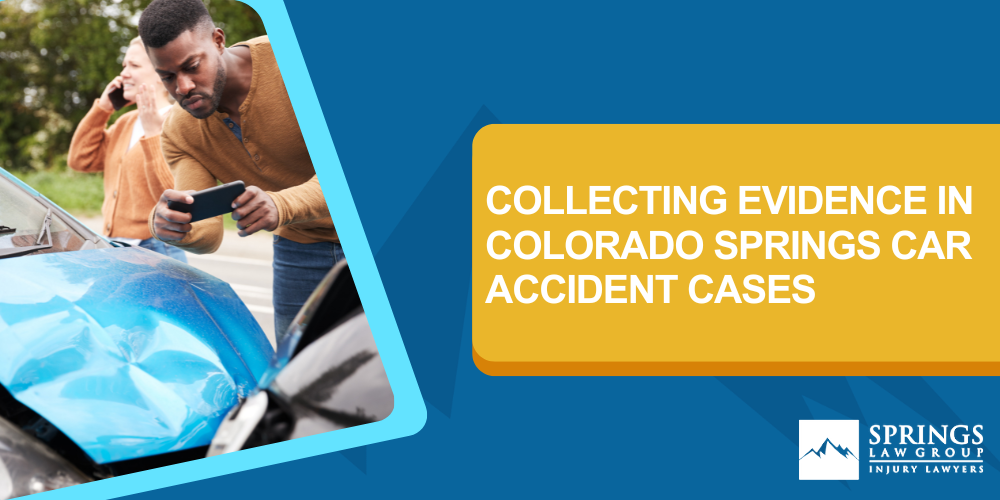
The crash scene is often the best chance to capture objective proof before vehicles move, memories fade, and the story becomes an insurance dispute.

In a serious car accident, small details can matter, including the location of debris, skid marks, lane positions, and visible property damage.

Information about the other driver, their insurance, and the vehicle involved can also disappear quickly if you do not document it immediately.

If you are physically able, treating the minutes after a motor vehicle accident as a focused evidence-gathering window can protect your ability to recover compensation later.

A concerted effort at the scene also reduces the risk that an insurer later claims there is “not enough proof” to support your version of events.

Even basic documentation can preserve details that are difficult to recreate days later.
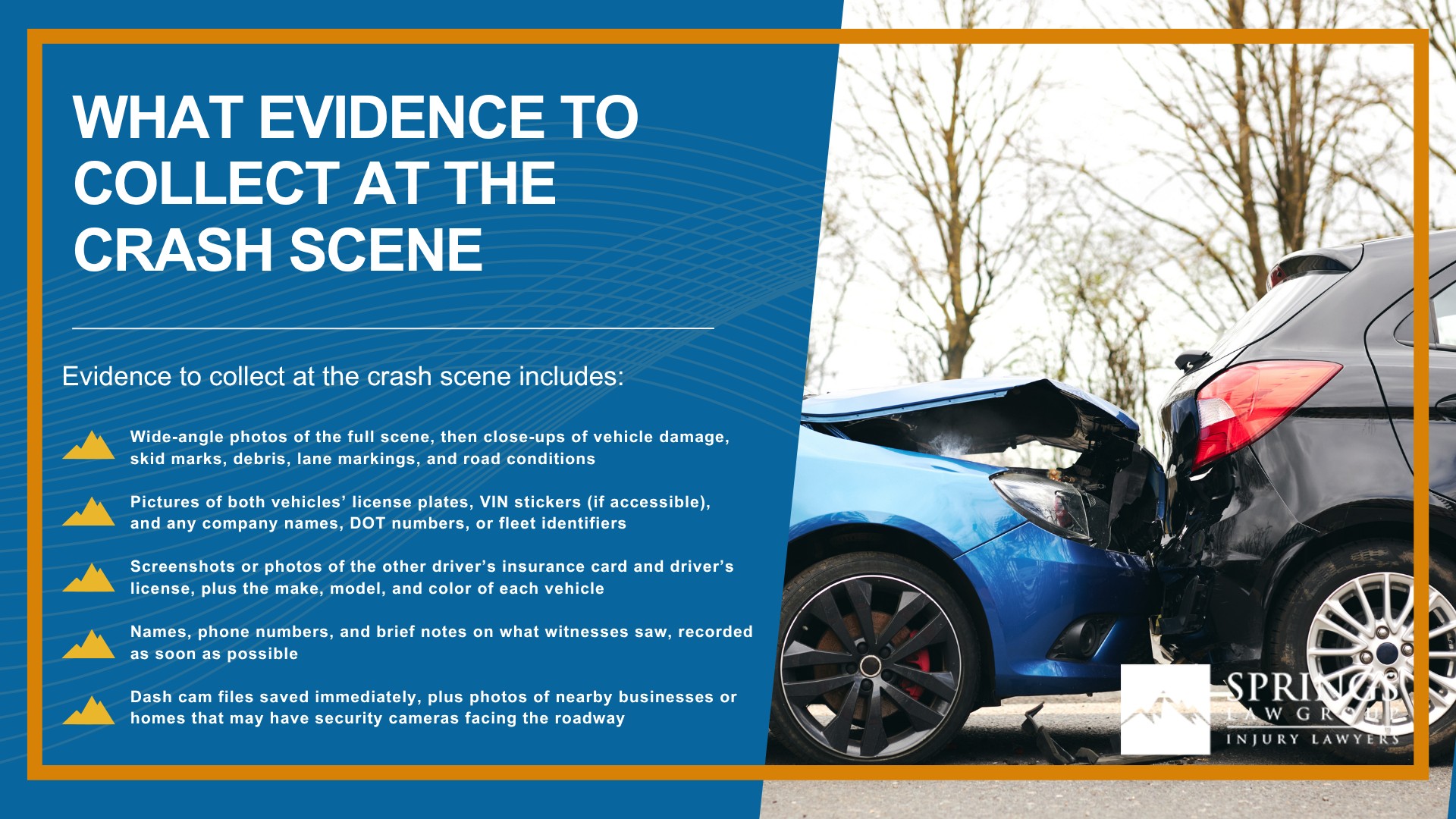
Evidence to collect at the crash scene includes:

  • Wide-angle photos of the full scene, then close-ups of vehicle damage, skid marks, debris, lane markings, and road conditions
  • Pictures of both vehicles’ license plates, VIN stickers (if accessible), and any company names, DOT numbers, or fleet identifiers
  • Screenshots or photos of the other driver’s insurance card and driver’s license, plus the make, model, and color of each vehicle
  • Names, phone numbers, and brief notes on what witnesses saw, recorded as soon as possible
  • Dash cam files saved immediately, plus photos of nearby businesses or homes that may have security cameras facing the roadway

If you have suffered injuries or are dealing with severe injuries, you may not be able to gather every piece of documentation yourself.

An experienced personal injury attorney can step in quickly to identify and preserve time-sensitive evidence, including surveillance footage and digital records with short retention periods.

A lawyer can also coordinate witness outreach, request the crash report, and organize medical documentation to support the claim.

That support can keep the case moving while you focus on treatment and recovery.

Getting the Police Report and Identifying Key Details

After a car accident, the responding officer’s report often becomes the foundation of the insurance claim.

In Colorado Springs, most crash reports are completed by the Colorado Springs Police Department and include basic identifying information, statements, and an initial assessment of what occurred.

The report typically lists the drivers involved, vehicle details, insurance information, witness names, and the officer’s diagram of the scene.
It may also note citations issued, road conditions, and any visible signs of impairment or distraction. While the report is not the final word on fault, insurance companies rely heavily on its contents when evaluating liability.

It is important to review the report carefully for errors in vehicle position, direction of travel, or injury documentation.

If key facts are missing or incorrect, those issues should be addressed quickly so the written record does not shape the claim in a misleading way.

Medical Records and Injury Documentation

Medical records are the backbone of any car accident claim because they connect the crash to documented physical injuries.

Emergency evaluations often identify fractures, soft tissue damage, and internal injuries that may not be visible at the scene.

In more serious cases, imaging and neurological assessments are used to diagnose traumatic brain injuries and other conditions that require ongoing care.

Clear documentation of each physical or emotional injury helps prevent insurers from arguing that symptoms are unrelated or exaggerated.

As treatment continues, records also show whether recovery is progressing or whether complications are developing.

Reaching maximum medical improvement becomes a key milestone because it helps define long-term limitations and projected future medical expenses.
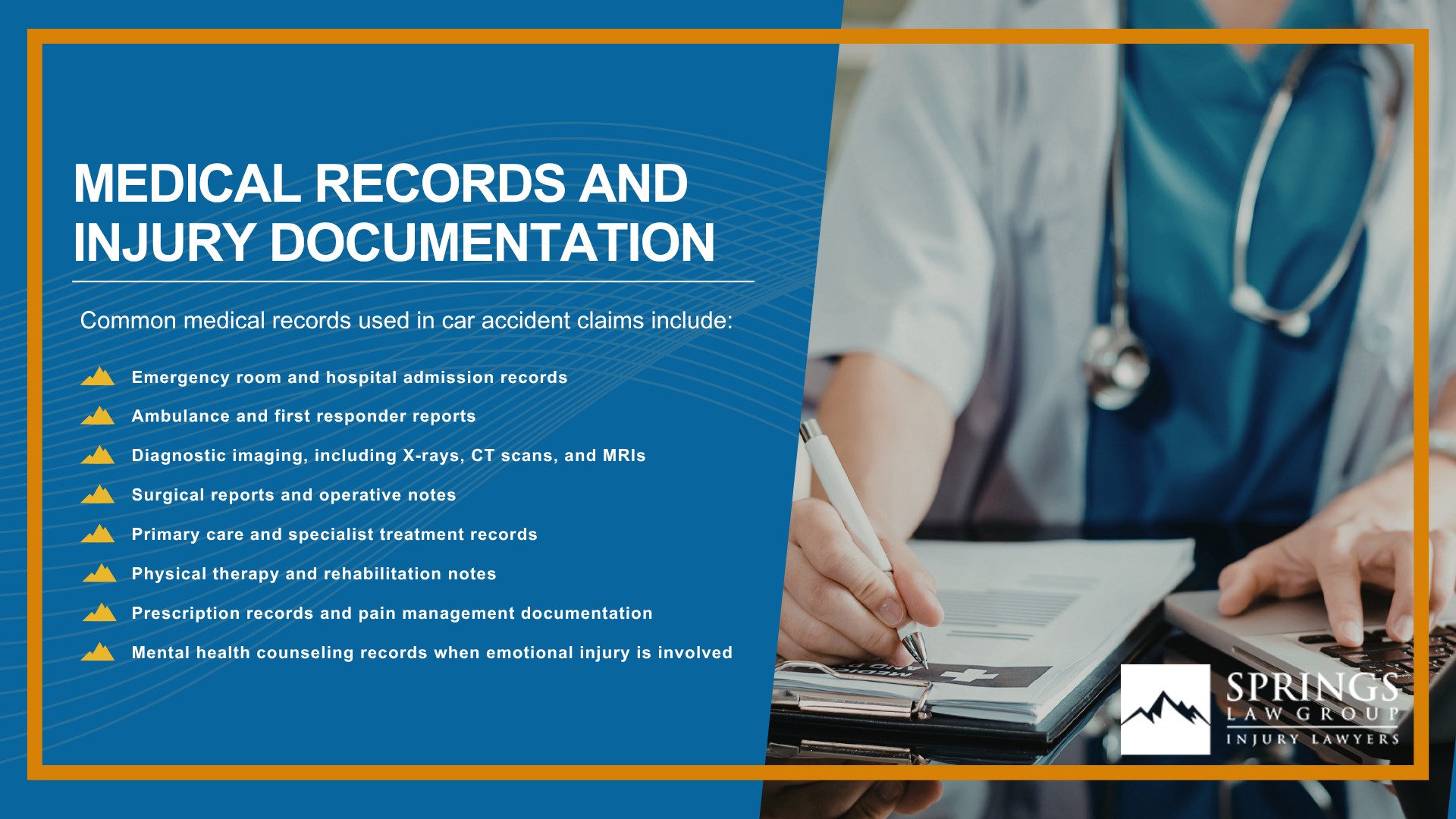
Common medical records used in car accident claims include:

  • Emergency room and hospital admission records
  • Ambulance and first responder reports
  • Diagnostic imaging, including X-rays, CT scans, and MRIs
  • Surgical reports and operative notes
  • Primary care and specialist treatment records
  • Physical therapy and rehabilitation notes
  • Prescription records and pain management documentation
  • Mental health counseling records when emotional injury is involved

Organized medical documentation creates a clear timeline from the date of injury through recovery.

It also allows experts to evaluate whether additional care will be required in the future.

When records are thorough and consistent, they provide a structured basis for calculating both past losses and anticipated future medical expenses. complete documentation, mounting medical bills can be challenged as unnecessary or unrelated to the collision.

Proving Fault Through Physical and Digital Evidence

Physical and digital evidence often determines how fault is assigned after an automobile accident.

Skid marks, vehicle crush patterns, debris fields, and final resting positions can confirm speeds, angles, and points of impact when stories conflict.

Digital records can add a second layer of proof, especially when phone use, app activity, or vehicle data explains delayed braking or lane drift.

This evidence matters under Colorado personal injury law because liability findings directly affect what damages can be recovered.

It also affects medical care disputes, since insurers often challenge whether treatment was necessary when fault is contested.

Lost wages claims tend to face more resistance when the insurer argues the injured person caused or contributed to the crash.

Car accident lawyers in Colorado Springs often build the claim by combining scene evidence with records that reconstruct the seconds before impact.

An experienced legal team can also identify missing pieces early, before photos, footage, and device data are deleted or overwritten.
Evidence commonly used to prove fault includes:

  • Scene photos showing vehicle positions, lane markings, signals, and visibility conditions
  • Close-ups of damage points, paint transfer, broken parts, and debris distribution
  • Skid marks, yaw marks, gouges, and other roadway markings that indicate braking or loss of control
  • Dash cam footage, business surveillance video, and doorbell camera recordings
  • Cell phone records and app usage data when distraction is suspected
  • Vehicle data, including event data recorder information when available
  • Witness statements that describe speed, lane movement, and right-of-way behavior
  • Weather reports and roadway condition documentation that confirm traction and sight distance factors

Insurance Evidence and Claim File Documentation

Insurance evidence often shapes how a claim is evaluated long before a case ever enters the legal system.

Adjusters and, in more serious disputes, an insurance defense attorney will review policy documents, recorded statements, and internal claim notes to assess exposure and risk.

These records can influence whether the carrier offers a fair settlement or positions the case for litigation.

Understanding what exists inside the claim file helps clarify how the insurer is viewing liability, damages, and credibility.

Before responding to requests or providing additional statements, many injury victims choose to seek legal advice to avoid unintentionally strengthening the defense’s position.
Policy Declarations, Coverage Limits, and Exclusions

A policy declarations page, often called the “dec page,” is the quickest way to see what insurance is actually available after a crash because it summarizes coverages, limits, deductibles, listed drivers, and covered vehicles for that policy period.

Liability limits can cap what the at-fault driver’s insurer will pay, which is why coverage analysis often starts with identifying every applicable policy and each limit shown on the declarations.

Exclusions matter because they define situations where the insurer may deny coverage, and Colorado law requires insurers to have a summary disclosure form on file that explains major coverages and exclusions for their auto policies.

In Colorado, uninsured and underinsured motorist coverage must be offered, and whether it was purchased or rejected can directly affect what coverage is available when the at-fault driver is uninsured or underinsured.

Policy items to pull and review early include:

  • Declarations pages for every potentially relevant policy, including household policies and any umbrella coverage
  • Bodily injury and property damage liability limits listed on the dec page
  • UM/UIM limits and endorsements, including whether coverage was rejected in writing
  • Medical payments coverage limits and deductibles, when included on the policy information
  • Named insureds, listed drivers, covered vehicles, and usage classifications that can trigger coverage disputes
  • The insurer’s disclosure summary describing major coverages and exclusions, which can help spot denial arguments early

Communication Logs, Emails, Letters, and Call Summaries

Communication records can shape an insurance claim as much as the crash evidence because they document what was said, when it was said, and what the insurer asked for.

Emails and letters often contain coverage positions, claim deadlines, and requests for authorizations that can affect the pace and direction of the claim.

Call summaries matter because adjusters routinely record their version of conversations, and those notes may later be used to argue inconsistencies in your account.

Keeping your own communication log creates a second record that can correct misunderstandings and show how the insurer handled the claim.

These records also document delays, shifting explanations, and repeated requests that may signal a strategy to wear a claimant down.

Written communications can include settlement offers, reservation of rights letters, and denial language that should be reviewed carefully.

A consistent paper trail helps confirm that documents were provided and that requests were answered in a timely way.

If a dispute escalates, organized communication logs can also support formal discovery and help a lawyer test whether the carrier’s position matches the facts.

Repair Estimates, Total Loss Valuations, and Rental Records

Repair estimates and total loss valuations often become early points of dispute in a car accident claim.

Insurers rely on their own appraisers or valuation software, which may not fully account for pre-crash condition, recent upgrades, or local market pricing.

Comparing multiple repair estimates can reveal whether structural damage, frame issues, or hidden components were overlooked.

When a vehicle is declared a total loss, the valuation should reflect comparable vehicles in the Colorado Springs market, not just a generic database figure.

Rental records also matter because they document loss of use and the time reasonably required to complete repairs or replace the vehicle.

Keeping copies of all estimates, valuation reports, and rental agreements creates a clear record if the insurer’s offer does not match the actual loss.

Evidence for Lost Income and Financial Loss

Lost income evidence matters because insurers rarely accept wage loss claims without detailed documentation tied to the crash timeline.

Car accident injuries can force missed shifts, reduced hours, or an inability to perform the same job duties, even when the person looks “fine” on the outside.

The longer recovery lasts, the more likely the claim involves partial disability, job modification, or a delayed return to work.

When catastrophic or permanent injuries are involved, the evidence may need to show long-term earning impact, not just time missed in the first few weeks.

This is especially true when physical pain limits lifting, standing, driving, or other core job functions.

Financial loss documentation also helps separate crash-related losses from ordinary fluctuations in work hours or income.

Clear records can support both past wage loss and the projected impact of long-term restrictions.
Evidence commonly used to prove lost income and financial loss includes:

  • Recent pay stubs and year-to-date earnings statements
  • W-2s, 1099s, and prior tax returns
  • Employer letters confirming missed time, pay rate, job duties, and accommodations
  • Timecards, schedules, and attendance records showing missed shifts
  • Medical work restrictions, disability notes, and return-to-work documentation
  • Self-employment records, invoices, profit-and-loss statements, and client cancellations
  • Receipts for out-of-pocket expenses tied to the injury, including travel costs for treatment and medical supplies

Colorado Laws That Affect Your Claim

Colorado car accident claims are governed by a mix of fault rules, filing deadlines, and insurance statutes that can affect both liability and recovery.

One of the most important is Colorado’s modified comparative negligence rule, which reduces damages based on a person’s share of fault and can bar recovery if that share is too high.

Under that statute, a person’s recovery is reduced in proportion to his or her negligence, and recovery is barred if the person’s negligence is equal to or greater than the negligence of the party they are suing.

Colorado also has specific statutes of limitations that can apply to vehicle-related injury claims and wrongful death claims, which makes early evidence preservation and legal review important.

Insurance law can matter too, particularly UM/UIM coverage rules that may affect available recovery when the at-fault driver has limited coverage.

The specific laws that apply depend on the facts, but these are some of the most commonly referenced rules in Colorado car accident cases.
Relevant Colorado laws that can affect your claim include:

  • C.R.S. § 13-21-111, Comparative Negligence and the Modified Comparative Negligence Rule
  • C.R.S. § 13-80-101, Three-Year Limitations Period for Many Motor Vehicle Injury and Property Damage Claims
  • C.R.S. § 13-80-102, General Two-Year Limitations Period for Many Tort Claims, Including Wrongful Death, with Specific Exceptions
  • C.R.S. § 10-4-609, Uninsured and Underinsured Motorist Coverage Requirements and Rights

What To Do After a Colorado Springs Car Accident

The steps you take after a Colorado Springs car accident can affect both your health and the strength of any future claim.

Safety comes first, but documentation should follow as soon as the situation is stable.

Even minor crashes can lead to delayed symptoms, which makes early medical evaluation important.

Insurance companies often begin investigating immediately, sometimes before the full extent of injuries is known.

Statements given too early can be incomplete or imprecise. Preserving evidence and creating a clear timeline protects your position if fault is later disputed.

Acting methodically in the first days after a crash reduces the risk of preventable claim problems.
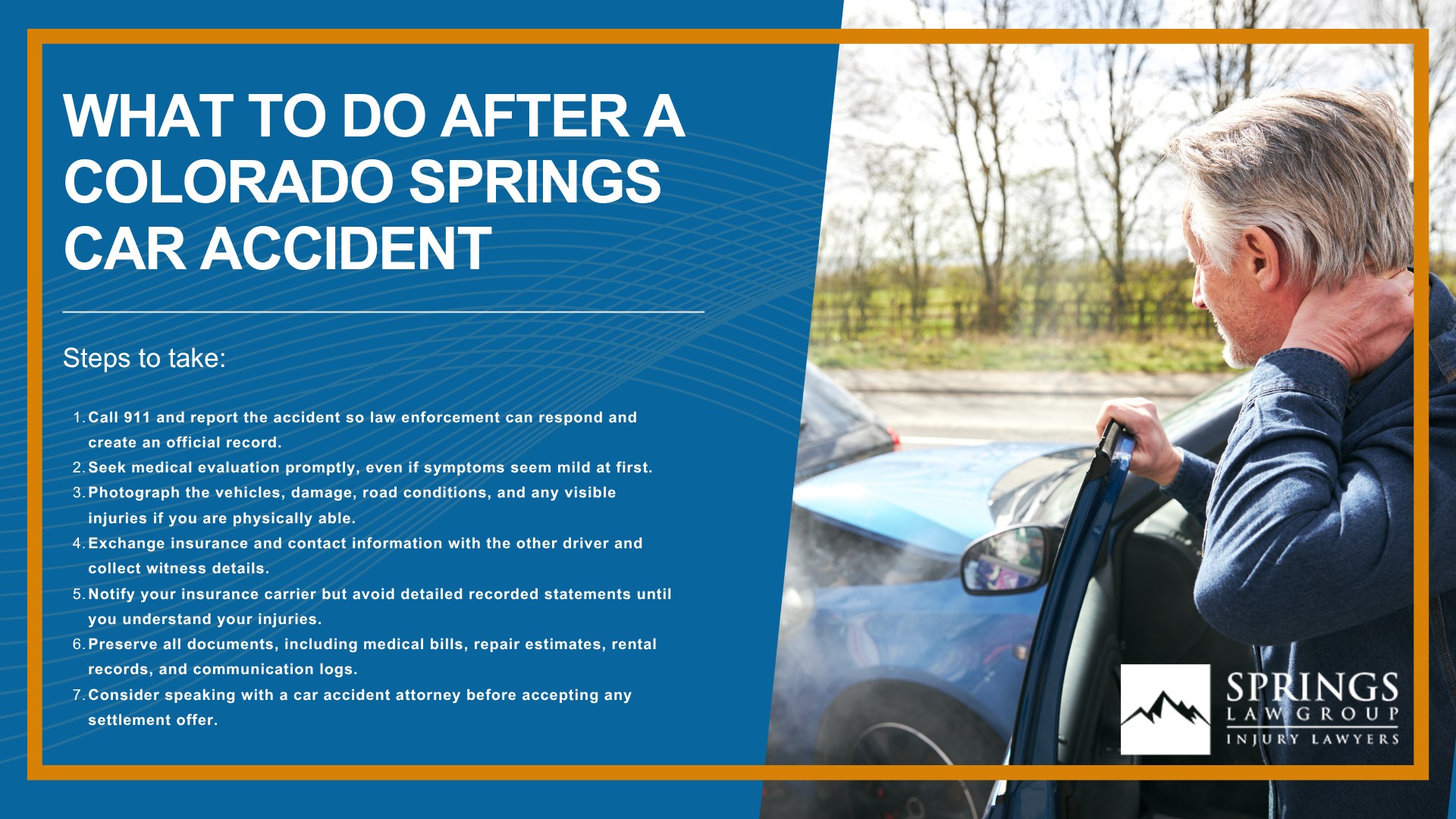
Steps to take:

  1. Call 911 and report the accident so law enforcement can respond and create an official record.
  2. Seek medical evaluation promptly, even if symptoms seem mild at first.
  3. Photograph the vehicles, damage, road conditions, and any visible injuries if you are physically able.
  4. Exchange insurance and contact information with the other driver and collect witness details.
  5. Notify your insurance carrier but avoid detailed recorded statements until you understand your injuries.
  6. Preserve all documents, including medical bills, repair estimates, rental records, and communication logs.
  7. Consider speaking with a car accident attorney before accepting any settlement offer.

If you are dealing with ongoing pain or uncertainty about fault, early legal guidance can clarify your options.

An attorney can help secure records, review insurance coverage, and identify potential liability issues.

This can be especially important if serious injuries or significant property damage are involved. Clear action in the days after the crash often determines how smoothly the claim proceeds.

Springs Law Group: Representing Car Accident Victims in Colorado Springs, CO

Car accident claims often turn on details that are overlooked in the first days after a crash.

Evidence, medical documentation, and insurance records can shape the outcome long before a case ever reaches a courtroom.

When liability is disputed or injuries require ongoing treatment, careful preparation becomes critical.

Acting early can protect your ability to recover damages under Colorado law.

Springs Law Group represents car accident victims in Colorado Springs, CO, with a focused and evidence-driven approach.

The firm can review your crash report, medical records, and insurance coverage to evaluate your claim.
If you have questions about fault, coverage limits, or the value of your case, a consultation can provide direct answers.

Contact Springs Law Group to discuss your situation and learn what steps make sense for you.

Frequently Asked Questions

  • What evidence do I need to prove fault?

    To prove fault, you need evidence that shows how the crash happened and that the other driver’s actions caused it.

    The strongest cases combine objective physical proof with independent documentation, rather than relying on competing statements.

    Insurance companies often focus on inconsistencies, so a clear timeline matters as much as any single photo.

    Evidence also helps address comparative fault arguments under Colorado law.

    The items below are the most commonly used sources to establish liability:

    • Photos or video of vehicle positions, damage points, skid marks, debris, signals, and road conditions
    • The police crash report and any citations or narrative findings
    • Witness names, contact information, and statements about what they observed
    • Dash cam footage, traffic camera video, or nearby business and residential surveillance video
    • Cell phone and digital records when distraction is suspected
    • Vehicle data, including event data recorder information when available
    • Medical records that link the timing of symptoms to the collision and support causation

  • What if there is no police report?

    You can still pursue a claim without a police report, but you will need other evidence to establish what happened and who was at fault.

    Start by collecting photos and video of the scene, vehicle damage, skid marks, debris, traffic controls, and road conditions, along with any dash cam footage.

    Witness statements become more important, so identifying and contacting witnesses early can help confirm the sequence of events.

    Medical records also matter because they document the timing of symptoms and link injuries to the crash.

    Insurance companies may dispute fault more aggressively without an official report, so clear documentation and a consistent timeline help counter that.

    A lawyer can obtain supplemental records, request available video, and build a claim file that replaces what a police report would have provided.

  • What are the most common causes of car accidents in Colorado Springs?

    Car accidents in Colorado Springs often stem from distracted driving, speeding, impaired driving, and adverse weather, with “human factors” driving the vast majority of crashes.

    In a NHTSA crash causation survey, the “critical reason” in the crash sequence was assigned to a driver in 94% of crashes, while vehicle and environment were each about 2%, which aligns with the idea that most serious traffic deaths trace back to driver choices and errors.

    Colorado’s Hands-Free Law bans holding a mobile device while driving, and first-offense penalties start at $75 plus points, which matters because handheld phone use is a common form of distraction that shows up in crash investigations.

    Impaired driving also remains a major contributor to deadly collisions nationwide, and alcohol-impaired driving deaths still account for a substantial share of U.S. traffic fatalities.

    Locally, Colorado Springs crash summaries are often described as showing careless or inattentive driving as the leading cause (about 41% of crashes) and failure to yield right-of-way as the second most common cause (about 14.3%); those two patterns match what officers and adjusters frequently focus on when fault is disputed.

    Speeding increases crash risk by cutting reaction time and increasing impact forces, and poor weather like snow, ice, and rain can turn normal driving mistakes into loss-of-control events.

    Vehicle defects and road design or maintenance issues can also contribute when they create a foreseeable hazard or mechanical failure in the moments before the crash, although those causes are less common than driver-related factors in most investigations.

  • Should I talk to the insurance company after the crash?

    Many auto policies require “prompt notice” of a crash, and some insurers set short internal deadlines, sometimes 24 to 72 hours, depending on the policy terms, so reporting quickly helps avoid coverage disputes.

    If the other driver’s insurer calls, you are not required to give a detailed statement or recorded interview without legal representation, and it is often safer to limit communications to basic identifying information until you get advice.

    Insurance adjusters are trained negotiators, and recorded statements, selective questions, and early “quick resolution” offers can be used to undermine your claim before you understand your injuries.

    Many victims accept early settlement offers that do not reflect the full scope of treatment, future needs, or time off work, especially when symptoms and diagnoses develop over weeks, not days.

    If the at-fault driver is uninsured, you may be able to pursue an uninsured motorist claim through your own policy if you carry UM coverage under Colorado law.

    Delaying legal action also increases risk because evidence can disappear and witnesses can forget details, which directly weakens leverage in negotiations and litigation.

    Common insurance tactics to watch for include:

    • Quick, low initial settlement offers before you finish treatment
    • Requests for recorded statements designed to lock in wording and create inconsistencies
    • Broad medical authorizations that let the insurer search for unrelated history
    • Delay tactics that increase financial pressure to settle
    • Arguments that gaps in treatment mean you were not seriously hurt

Written By:
Christopher Nicolaysen

Member of the Colorado Bar Association since 2014. Attorney, Christopher M. Nicolaysen focuses primarily on helping those injured in Colorado car accidents, other auto accidents, and Colorado personal injury incidents.

This article has been written and reviewed for legal accuracy and clarity by the team of writers and attorneys at Springs Law Group and is as accurate as possible. This content should not be taken as legal advice from an attorney. If you would like to learn more about our owner and experienced Colorado personal injury lawyer, Christopher Nicolaysen, you can do so here.

Springs Law Group does everything possible to make sure the information in this article is up to date and accurate. If you need specific legal advice about your case, contact us. This article should not be taken as advice from an attorney.

Do You
Have A Case?
No out of pocket costs.
We only collect a fee AFTER you win your case and receive full compensation.
Contact our team today to discuss your case for free & Get answers in as little as 3 minutes.
Would you like our help?
right-image
600
About Springs Law Group
The lawyers at Springs Law Group have experience handling diverse personal injury cases with empathy and understanding.
We recognize the delicate nature of these claims and tailor strategies to meet your unique requirements, focusing on smart — not emotional — strategies.
Our team is committed to building long-lasting, trust-based client relationships.
We believe this approach helps ensure that choosing us means partnering with a firm that genuinely values you as a person — not just another client.
Recent Posts
Do You
Have A Case?
No out of pocket costs.
We only collect a fee AFTER you win your case and receive full compensation.
Contact our team today to discuss your case for free & Get answers in as little as 3 minutes.
Would you like our help?
right-image
600

The #1 Personal Injury Lawyers in Colorado Springs, Colorado

Local Colorado Springs Resources

Education
Emergency Services
Courthouses
Department of Motor Vehicles
Community & History

Leave Us A Review

We use reviews to help show more people like you why we do what we do!

Top-Rated Personal Injury Firm Serving Colorado Springs & Beyond

Personal injury victims represented by a lawyer recover up to 3x more.

Our Process

Play Video
1
Investigation
Gather evidence. Get police reports. Obtain insurance policies.
2
Treatment
You focus on healing. We help guide you through the process.
3
Medical Records
Get the records we need to make sure you have a strong case.
4
Demand Prep
Prepare and send our demands to the insurance company.
5
Negotiation
Negotiate with the insurance company for max compensation.
6
Settlement
Reach a settlement offer you agree with or we file a lawsuit.
7
Litigation
If we have to go to court, our trial lawyers get ready to win.

Videos

Our Team

The #1 Personal Injury Lawyers in Colorado Springs, CO