
Colorado Springs DUI Accident Lawyer |
Call (719) 300-7554

Were You or A Loved One Injured in an Accident?
Get Free Answers In as Little as 3 Minutes
right-image
700

Injured in a Drunk Driving Accident in Colorado Springs? Contact Springs Law Group

A Colorado Springs drunk driving accident lawyer helps investigate what happened, preserve critical evidence, and pursue accountability when an impaired driver causes a preventable crash.

DUI wrecks often lead to severe injuries because alcohol or drug impairment slows reaction time, distorts judgment, and increases risky driving behavior.

Insurance companies may still dispute fault, downplay injuries, or push comparative negligence arguments to reduce what they pay.

This page explains how Springs Law Group approaches drunk driving accident claims and what compensation may be available under Colorado law.

Do You Qualify for a Drunk Driving Accident Claim?; Do You Qualify for a Drunk Driving Accident Claim; Evidence in a Distracted Driving Accident Case; Damages in Drunk Driving Personal Injury Claims

Our Drunk Driving Accident Lawyers Help Victims Seek Compensation and Justice

Drunk driving crashes often leave families dealing with consequences that do not fade after the tow truck leaves.

They often show up in surgeries, months of rehab, and the fear that comes with a sudden loss of safety.

For drunk driving accident victims, the harm can range from serious injuries that change work and mobility to wrongful death cases that force families to grieve while bills and paperwork keep moving.

Criminal charges may follow, but they do not pay medical bills or resolve disputes with the other driver’s insurance company.

Insurance carriers still evaluate the claim through a financial lens and often try to narrow what they pay by challenging treatment, causation, or the scope of loss.

When a crash stems from reckless behavior, the civil claim should reflect the full impact of the injury or death, including the long-term costs that follow life-altering consequences.

Springs Law Group can help pursue financial compensation by building the evidence, documenting losses, and challenging insurer tactics at every stage.

If you or a loved one were harmed in a drunk driving crash, contact Springs Law Group to discuss your options and next steps.

Call today or use the chat feature on this page to get in touch with our drunk driving accident lawyers.

Table of Contents

Steps to Take After a DUI Accident in Colorado Springs

The aftermath of a DUI crash can feel chaotic, especially when you are hurt, shaken up, or trying to account for everyone involved.

Many people cannot take every recommended step in the moment, and that is normal, serious injuries, pain, and shock change what is realistic right after impact.

What matters is getting to safety, creating a record of what happened, and avoiding decisions that insurers can use later to reduce a claim.

A DUI accident lawyer can step in quickly to protect your rights, preserve evidence, and handle the communication and paperwork you should not be dealing with while recovering.
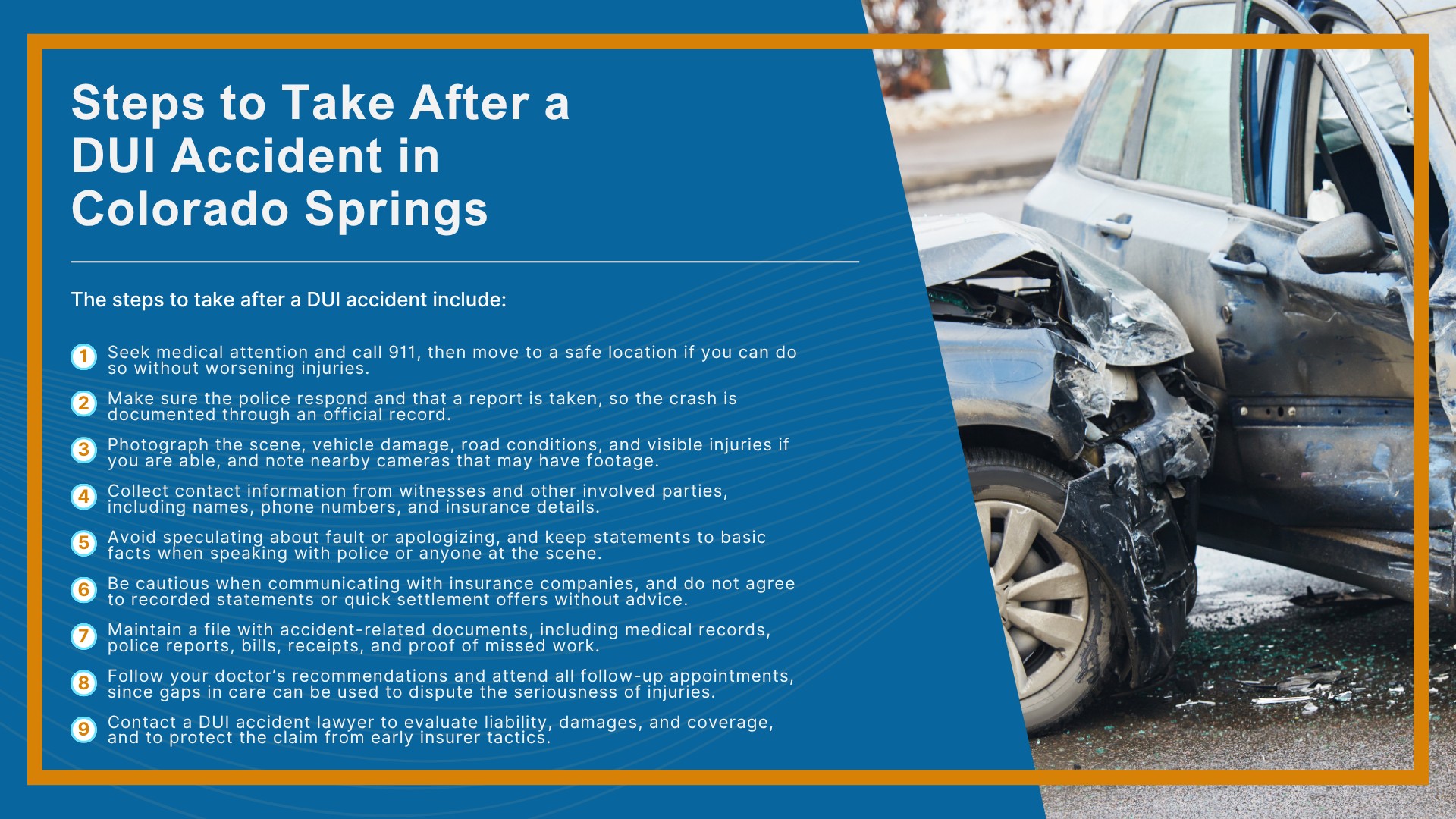
The steps to take after a DUI accident include:

  1. Seek medical attention and call 911, then move to a safe location if you can do so without worsening injuries.
  2. Make sure the police respond and that a report is taken, so the crash is documented through an official record.
  3. Photograph the scene, vehicle damage, road conditions, and visible injuries if you are able, and note nearby cameras that may have footage.
  4. Collect contact information from witnesses and other involved parties, including names, phone numbers, and insurance details.
  5. Avoid speculating about fault or apologizing, and keep statements to basic facts when speaking with police or anyone at the scene.
  6. Be cautious when communicating with insurance companies, and do not agree to recorded statements or quick settlement offers without advice.
  7. Maintain a file with accident-related documents, including medical records, police reports, bills, receipts, and proof of missed work.
  8. Follow your doctor’s recommendations and attend all follow-up appointments, since gaps in care can be used to dispute the seriousness of injuries.
  9. Contact a DUI accident lawyer to evaluate liability, damages, and coverage, and to protect the claim from early insurer tactics.

Even if you could not complete every step at the scene, a claim can still be built with the right documentation and follow-up.

Medical records created early often carry significant weight because they connect symptoms to the crash before other explanations get introduced.

Police reports and witness statements can also support the timeline, especially when impaired driving is disputed later.

An attorney can request records, identify video sources, and manage insurer communications so the claim stays grounded in facts.

They handle aggressive insurance adjusters who may try to minimize payouts or argue shared fault in DUI cases.

It’s important to consult with a personal injury attorney as soon as possible after an accident to ensure you meet all deadlines for filing your claim, as Colorado has strict statutes of limitations.

Hiring a personal injury attorney can increase your chances of receiving fair compensation, as they understand the true value of your case and know how to counter tactics used by insurance companies to minimize claims.

DUI Crashes in Colorado Springs: Statistics and Overview

Drunk driving statistics show that accidents involving alcohol use remain a persistent safety issue in Colorado Springs and across Colorado.

Statewide data from CDOT shows impaired driving is still a leading cause of fatal wrecks.

In 2024, Colorado recorded 214 impaired driving-related fatalities, and CDOT reports that impaired driving was involved in over 30% of all traffic deaths that year.
Colorado Springs has also been flagged nationally for risk, with the Colorado State Patrol citing a study that ranked Colorado Springs 25th among the 300 largest U.S. cities for the rate of drunk driving fatalities per 100,000 people, using 2018–2022 data.

Colorado DUI and DWAI Laws

Colorado’s primary impaired-driving statute is C.R.S. § 42-4-1301, which covers driving under the influence (DUI), DUI per se, and driving while ability impaired (DWAI).

The legal limit for DUI per se is a blood alcohol concentration (BAC) of 0.08% or higher, while DWAI generally involves impairment and is commonly associated with a BAC over 0.05% but under 0.08%.

Colorado also enforces an “expressed consent” rule, meaning drivers are deemed to have agreed to chemical testing under C.R.S. § 42-4-1301.1 when a police officers have probable cause.

Criminal DUI Case vs. Civil Injury Claim

A defense attorney focuses on mitigating severe criminal and administrative consequences in DUI cases.

After an accident occurs, the same impaired-driving incident can trigger both criminal and civil proceedings, and they move on separate tracks.

The criminal case happens in criminal court and focuses on the driver’s legal consequences, while the civil claim focuses on compensating the injured person for losses.

These actions can overlap in timing, but a civil case does not have to wait for the criminal case to finish, and many injury claims move forward while charges are pending.

In practice, evidence from the criminal investigation can be helpful, but civil deadlines still apply, and waiting too long can weaken proof even if the criminal case is still active.

If the intoxicated person is jailed, the civil legal process can still continue, because liability is typically addressed through insurance claims and formal service and litigation procedures still apply.
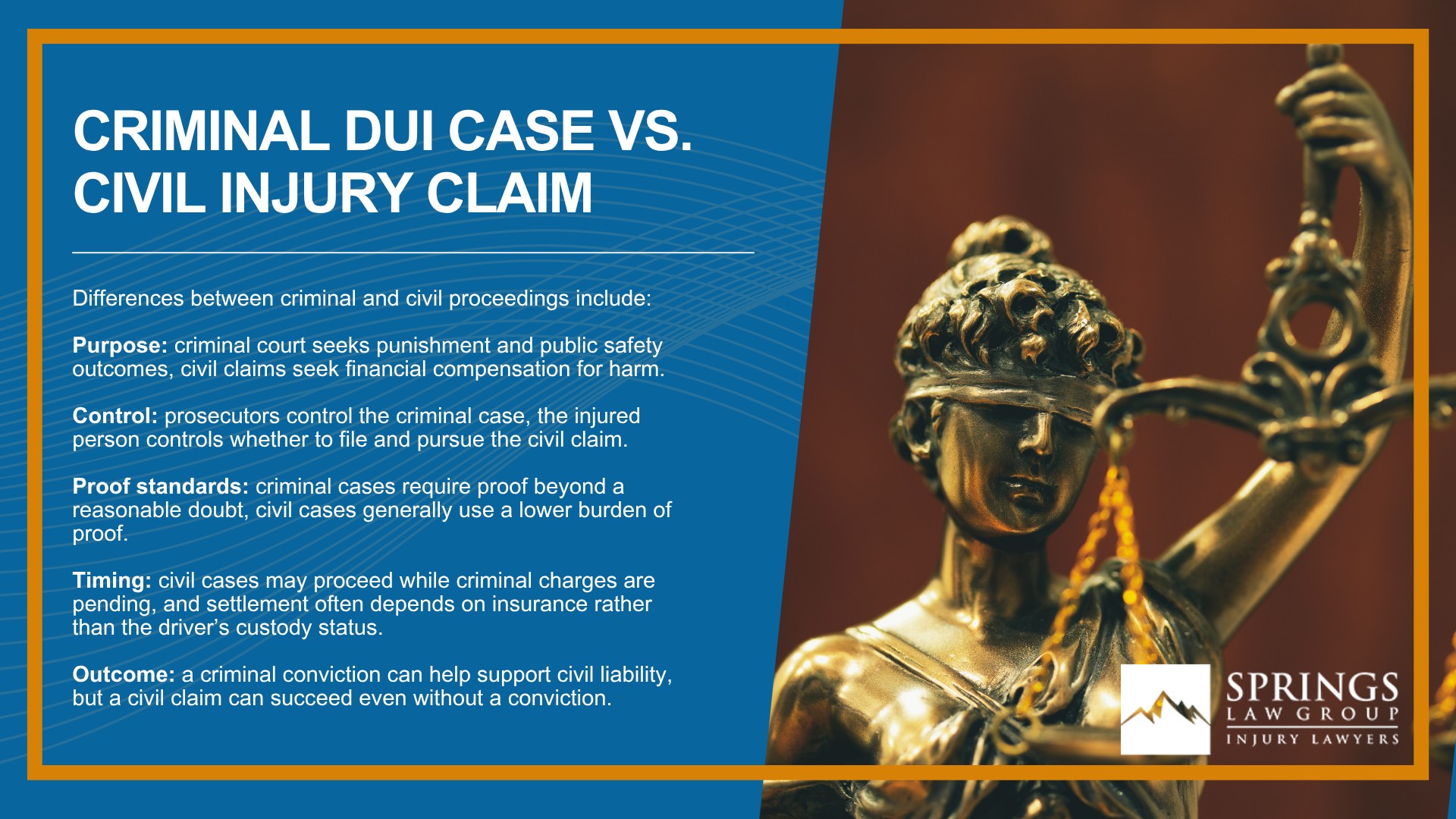
Differences between criminal and civil proceedings include:

  • Purpose: criminal court seeks punishment and public safety outcomes, civil claims seek financial compensation for harm.
  • Control: prosecutors control the criminal case, the injured person controls whether to file and pursue the civil claim.
  • Proof standards: criminal cases require proof beyond a reasonable doubt, civil cases generally use a lower burden of proof.
  • Timing: civil cases may proceed while criminal charges are pending, and settlement often depends on insurance rather than the driver’s custody status.
  • Outcome: a criminal conviction can help support civil liability, but a civil claim can succeed even without a conviction.

Most personal injury cases, including those resulting from DUI accidents, are resolved through settlement negotiations rather than going to trial.

Common Types of DUI Collisions

Alcohol-related car crashes remain a major cause of roadway death in the United States, and the patterns are consistent from year to year.

NHTSA reports that 12,429 people died in alcohol-impaired driving traffic deaths in 2023, which works out to about 34 deaths per day nationwide.

Those alcohol-impaired crash fatalities accounted for about 30% of all crash fatalities that year, which shows how often an intoxicated driver turns an otherwise survivable situation into a fatal one.

IIHS data also highlights who gets hurt most often in these incidents, including occupants of other vehicles and passengers riding with an alcohol-impaired driver, not just the impaired driver themselves.

Impairment frequently leads to reckless driving behaviors like speeding, drifting across lanes, delayed braking, and blowing through intersections, which increases impact speed and the chance of severe vehicle damage.

DUI collisions also tend to happen at night and on weekends, which can delay emergency response and increase the risk of secondary impacts.

Even when the intoxicated driver survives, the people in the other vehicle often absorb the worst forces because they have no warning and little time to react.
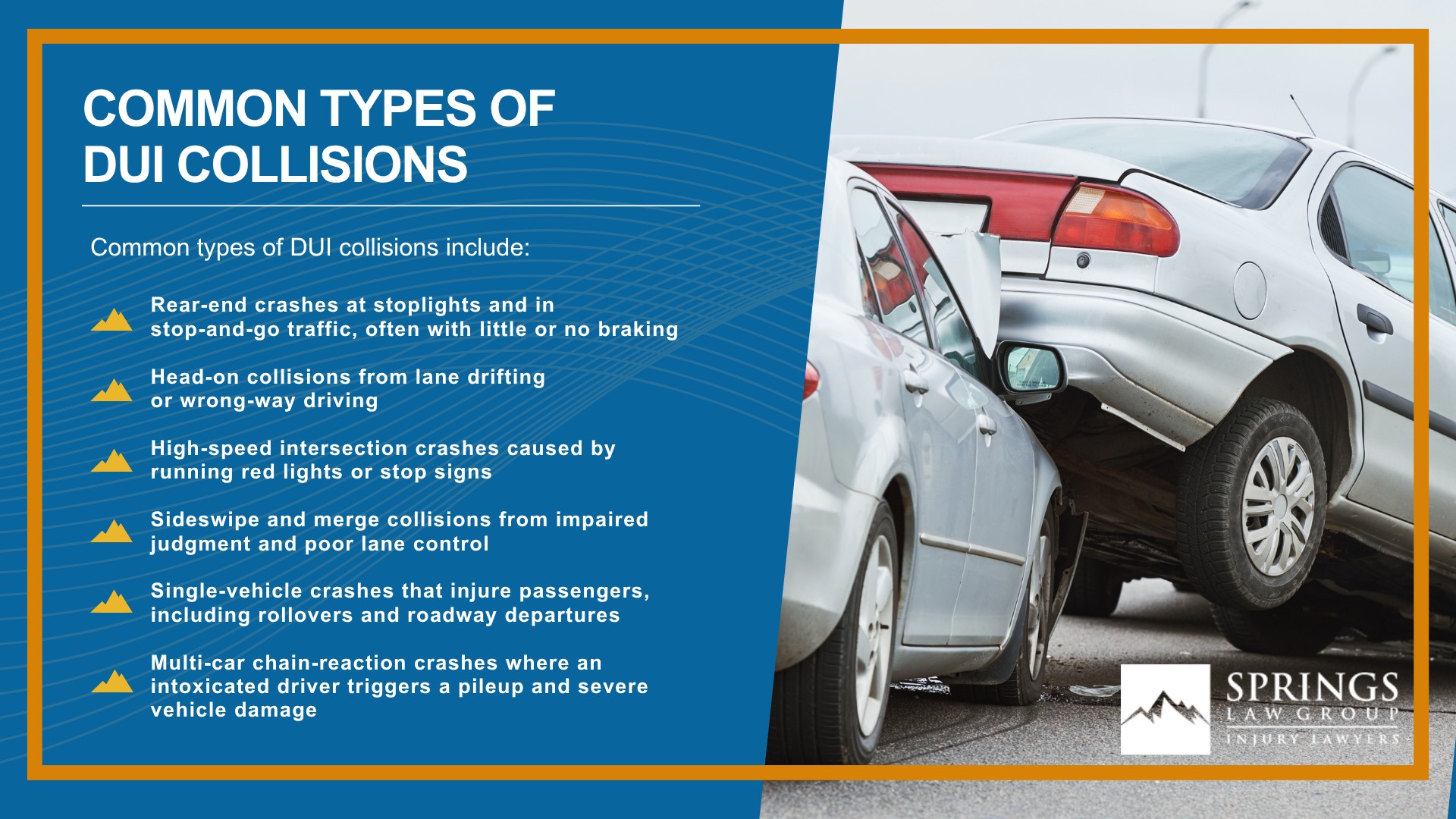
Common types of DUI collisions include:

  • Rear-end crashes at stoplights and in stop-and-go traffic, often with little or no braking
  • Head-on collisions from lane drifting or wrong-way driving
  • High-speed intersection crashes caused by running red lights or stop signs
  • Sideswipe and merge collisions from impaired judgment and poor lane control
  • Single-vehicle crashes that injure passengers, including rollovers and roadway departures
  • Multi-car chain-reaction crashes where an intoxicated driver triggers a pileup and severe vehicle damage

Common Injuries in Drunk Driving Accidents

DUI fatalities represent about 30% of all crash deaths in the U.S.

Nonfatal harm is just as widespread, NHTSA reports that 360,441 people were injured in 2023 in drunk driving crashes.

When a DUI collision causes long-term impairment, the medical and financial consequences often include chronic pain, permanent disability, and ongoing trauma symptoms that follow a person well after the physical injuries heal.
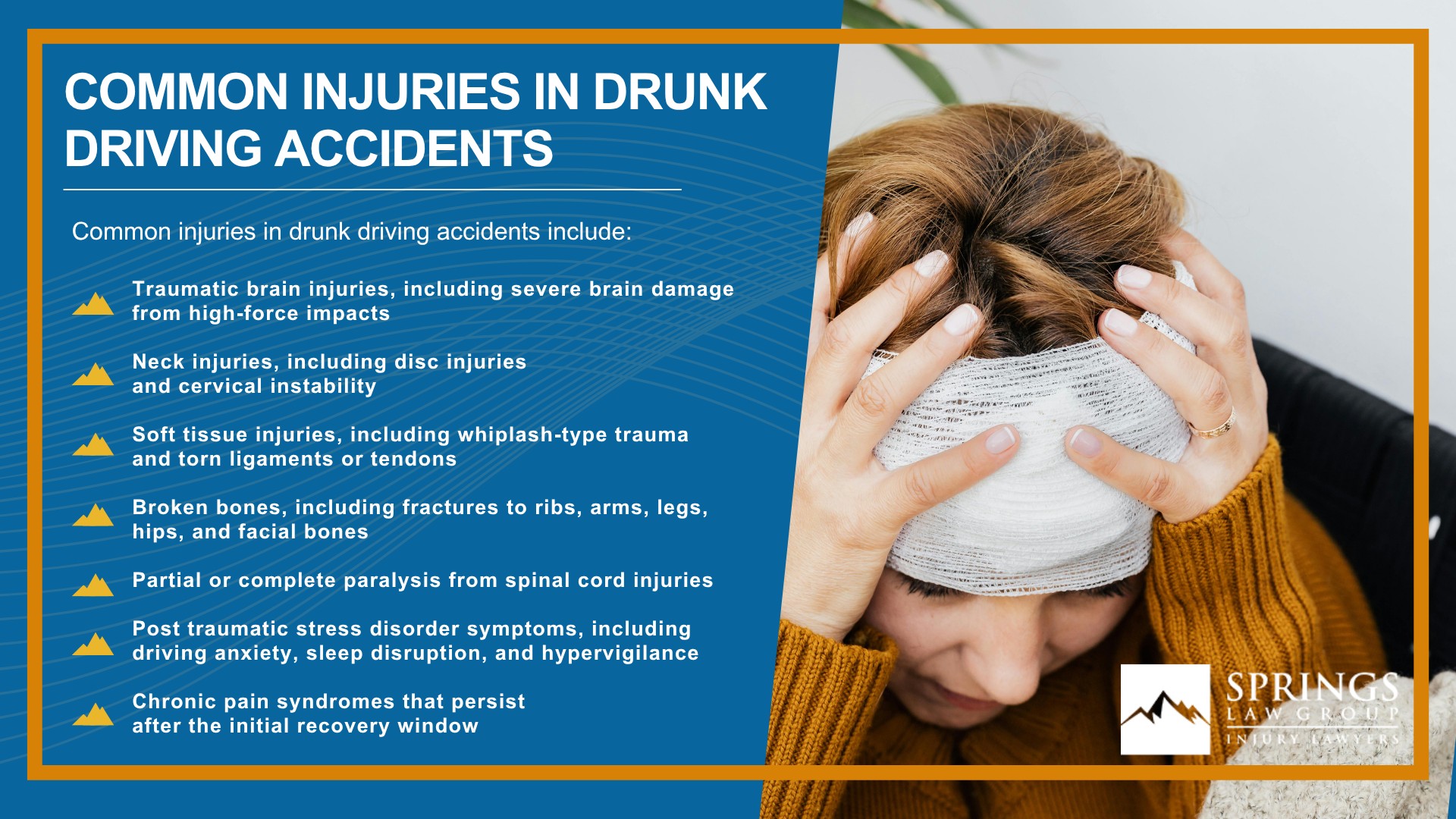
Common injuries in drunk driving accidents include:

  • Traumatic brain injuries, including severe brain damage from high-force impacts
  • Neck injuries, including disc injuries and cervical instability
  • Soft tissue injuries, including whiplash-type trauma and torn ligaments or tendons
  • Broken bones, including fractures to ribs, arms, legs, hips, and facial bones
  • Partial or complete paralysis from spinal cord injuries
  • Post traumatic stress disorder symptoms, including driving anxiety, sleep disruption, and hypervigilance
  • Chronic pain syndromes that persist after the initial recovery window

Do You Qualify for a Drunk Driving Accident Claim?

You may qualify for a drunk driving accident claim if you were injured or suffered a financial loss in a crash caused by an impaired driver.

Lawyers negotiate with prosecutors for reduced charges or alternative sentencing in DUI cases.

Drunk driving victims do not need a criminal conviction to pursue a civil case, but the claim still has to prove that the driver’s impairment contributed to the collision and the resulting harm.

Qualification usually starts with basic facts: the crash occurred, you sustained injuries or measurable losses, and there is evidence linking those losses to the wreck.

Insurance coverage matters too, because recovering compensation often depends on available liability limits, UM/UIM coverage, and whether other responsible parties may exist in limited circumstances.

Comparative fault can affect the claim’s value, so early evaluation focuses on whether the insurer may argue you contributed to the crash and how the evidence addresses that.

The goal is holding drunk drivers accountable through a claim that is built on documentation and causation, not assumptions.

Evidence in Drunk Driving Accident Cases

Evidence determines whether a drunk driving claim succeeds or stalls, especially when insurers challenge causation or the extent of harm.

It is vital to preserve evidence such as surveillance footage or witness memory soon after an accident.

Lawyers gather police reports, blood alcohol content (BAC) tests, witness statements, and photos to establish the driver’s intoxication and negligence.

DUI cases rely on objective documentation that ties impaired driving to the crash and the injuries that followed.

Records created close in time to the collision often carry the most weight because they capture conditions before stories change.

Missing or incomplete documentation gives insurers room to dispute what happened and how the injuries developed.
Evidence in drunk driving accident cases often includes:

  • Photos and video from the accident scene showing vehicle positions, damage patterns, debris, and road conditions
  • Police reports documenting impairment indicators, field sobriety observations, citations, and arrest details
  • Chemical test results, including breath or blood testing obtained through law enforcement procedures
  • Witness statements describing erratic driving, signs of intoxication, and the sequence of events
  • Medical records linking diagnosis, treatment, and symptoms to the crash
  • EMS and emergency room intake notes documenting how the injuries occurred and initial complaints
  • Video footage from dash cams, body cameras, traffic cameras, or nearby surveillance systems

Damages in Drunk Driving Personal Injury Claims

Damages are the monetary amounts a person seeks to recover for losses caused by car accidents, including injuries and financial disruption tied to the crash.

A personal injury lawyer helps victims navigate the civil justice system to recover financial losses, separate from the driver’s criminal case.

The damages picture often expands quickly because medical expenses, time away from work, and long-term limitations tend to be more severe.

A drunk driving accident attorney helps assess and calculate damages by organizing records, verifying costs, projecting future needs when supported by treatment plans, and presenting a claim that is grounded in documentation.

That preparation supports a fair settlement by giving the insurer a clear, defensible basis for what the claim is worth and why.
Damages in drunk driving cases often include:

  • Medical expenses, including emergency care, hospitalization, surgery, follow-up treatment, and rehabilitation
  • Future medical costs tied to documented care plans, specialists, and long-term recovery needs
  • Lost wages from missed work, reduced hours, or inability to return to the same job
  • Loss of earning capacity when injuries limit long-term work ability
  • Pain and suffering tied to physical symptoms, limitations, and recovery duration
  • Emotional distress, including anxiety, sleep disruption, and trauma-related symptoms
  • Out-of-pocket costs related to recovery, such as transportation to appointments and in-home assistance
  • Property damage and loss-of-use costs, including repair or replacement of the vehicle and rental expenses

Springs Law Group: Talk to a Colorado Springs DUI Accident Lawyer

A serious accident caused by an impaired driver can leave people facing medical treatment, financial strain, and unanswered questions about what comes next.

When you have suffered injuries in a DUI crash, the civil claim is the tool for holding the liable drunk driver and any other liable parties responsible for the harm caused.

Springs Law Group approaches these cases by focusing on evidence, damages, and accountability, not assumptions or shortcuts.

If you want to understand your legal options after a serious accident, contact Springs Law Group to schedule a free consultation and discuss the next steps available under Colorado law.


Frequently Asked Questions

  • How long do I have to file a drunk driving accident claim?

    In Colorado, most drunk driving injury claims arising from a motor vehicle collision must be filed within three years of the crash date.

    That deadline usually applies to a standard car accident case against the impaired driver, even when the criminal case is still moving through the criminal justice system and broader legal system.

    Some related claims can move on a shorter timeline.

    If the facts support a dram shop claim connected to premises liability principles against a bar or restaurant, Colorado’s liquor liability statute may require suit within one year of the sale or service of alcohol.

    Waiting can also create problems with insurance notice, preservation of evidence, and access to expert medical testimony or accident reconstruction specialists.

    Because drunk driving crashes often lead to serious injury cases, catastrophic injuries, and ongoing treatment, a Colorado Springs law firm handling personal injury matters can help protect deadlines and position the claim to secure maximum compensation.

  • What injuries are common in drunk driving accidents?

    Drunk driving continues to be a leading cause of preventable car accidents with injuries and fatalities, with an estimated 37 deaths per day in 2022 due to drunk driving accidents.

    Drunk driving crashes can cause a wide range of harm, from minor injuries to devastating injuries that permanently change a person’s life.

    Many injury victims require immediate medical attention, emergency medical care, surgery, rehabilitation, physical therapy, and sometimes long-term support involving medical equipment.

    Victims may also suffer physical pain, emotional trauma, and long-term complications that continue well after the collision.

    In more severe cases, treatment may continue until the patient reaches maximum medical improvement, and the claim may need to account for future medical expenses and the full scope of the loss under personal injury law.

    In 2021, 13,384 people in the United States died in alcohol-related crashes, accounting for 31% of all traffic fatalities.

    Other common injuries from drunk driving accidents include whiplash, soft tissue injuries, and internal injuries that may not be obvious at the scene.

    Common injuries from drunk driving accidents include:

    • Traumatic brain injuries, including concussions and more severe brain trauma with cognitive impairment and memory loss
    • Spinal cord injuries that can result in partial or complete paralysis and long-term treatment needs
    • Broken bones, including fractures to ribs, arms, legs, hips, and facial bones
    • Whiplash and neck or back strains from sudden impact forces
    • Soft tissue injuries, including torn ligaments, tendon damage, and muscle injuries
    • Internal injuries, including organ damage and internal bleeding
    • Psychological trauma, including PTSD symptoms and anxiety after the crash

  • Can I sue if the drunk driver was not convicted?

    Yes.

    You can still file a civil case even if the impaired driver was not convicted in criminal court.

    A criminal prosecution and a civil injury claim serve different purposes and apply different standards of proof, so the absence of a conviction does not automatically defeat the case.

    The civil claim focuses on whether the driver’s conduct more likely than not caused your injuries and losses.

    A law firm handling drunk driving claims can build that case through a thorough investigation, using police reports, witness statements, crash analysis, medical records, and when needed, accident reconstruction specialists and expert medical testimony.

    That distinction matters because the criminal justice system may fail to produce a conviction for procedural reasons even when the facts still support recovery in the civil legal system.

  • What if I was partially at fault?

    You may still be able to recover compensation under Colorado’s modified comparative negligence rule if you were less than 50 percent at fault.

    Your recovery is reduced by your percentage of responsibility, but it is not automatically barred unless you are found 50 percent or more at fault.

    These disputes matter because insurers often try to shift blame to reduce what they pay, especially when the insurance company refuses to fairly value the claim.

    In a drunk driving case, a careful factual review can be critical to push back against exaggerated at fault driver allegations and keep the analysis tied to what the evidence actually shows.

    That is especially important in personal injury matters involving major treatment, future medical expenses, and losses that continue beyond the initial emergency phase.

  • Do DUI cases qualify for punitive damages in Colorado?

    Yes, some DUI cases can qualify for punitive damages in Colorado.

    In Colorado, punitive damages are called exemplary damages, and they are not automatic in every drunk driving case.

    They generally require proof of willful and wanton conduct, meaning the defendant acted with reckless disregard for the safety of others.

    Evidence of intoxication, extreme speeding, dangerous driving behavior, or other aggravated facts may support that request, but the claim has to be developed carefully under Colorado law.

    Because these issues can become highly contested in serious injury cases, a former insurance defense attorney or similarly experienced advocate may be especially valuable in anticipating how the defense will respond and how to present the evidence in a way that supports a stronger claim for damages and helps secure maximum compensation.

  • What if the drunk driver had no insurance or not enough coverage?

    A lack of liability coverage does not necessarily end the claim.

    Your own uninsured or underinsured motorist coverage may apply, and other benefits such as personal injury protection-type coverage or MedPay may help with early treatment costs depending on the policy structure.

    Additional policies may also exist through a vehicle owner, employer, or business if the facts support another source of recovery.

    These issues often matter most in cases involving long-term care, physical therapy, specialized medical equipment, or extensive future medical expenses.

    A Colorado Springs law firm with a strong background in personal injury law can review all available coverage and build the claim so that underinsurance does not prevent recovery for the full scope of damages.

  • Can a bar or social host be liable in Colorado?

    Sometimes, but only in limited circumstances.

    Colorado law allows claims against licensed alcohol vendors when the evidence shows they knowingly served a person who was visibly intoxicated or under 21 and that person later caused the crash.

    Social host liability is much narrower and usually does not apply when alcohol is served to an intoxicated adult, though it may apply when alcohol is knowingly provided to a minor who later causes injury.

    These claims can overlap with fact patterns that resemble premises liability, but they are governed by Colorado’s specific liquor liability statute rather than ordinary slip-and-fall rules.

    Because these cases involve strict timelines and technical proof requirements, a law firm with experience in alcohol-related crash litigation can evaluate whether a business or host may also be part of the claim.

  • How long will a DUI accident claim take?

    There is no fixed timeline.

    Some claims resolve relatively quickly when liability is clear and the victim’s condition stabilizes early.

    Others take much longer because treatment is ongoing, the victim has not reached maximum medical improvement, or there are disputes over fault, coverage, or the value of future care.

    Cases involving devastating injuries, catastrophic injuries, ongoing medical care, or anticipated future medical expenses often take longer because the full extent of damages cannot be measured right away.

    Delay may also occur if the insurance company refuses to negotiate fairly, requiring formal litigation.

    A strong Colorado Springs law firm can reduce avoidable delay by organizing records early, coordinating medical proof, and presenting a complete demand supported by evidence.

  • How can a lawyer increase the value of a DUI accident claim?

    Legal representation can increase the value of a claim by proving liability, documenting every category of loss, and forcing the insurer to evaluate the case based on evidence rather than assumptions.

    In high-value personal injury matters, that often means collecting records, working with treating providers, obtaining expert medical testimony, consulting accident reconstruction specialists, and presenting the claim only after the medical picture is clear enough to measure future losses.

    This is especially important in a drunk driving crash where the victim may need continuing medical care, physical therapy, adaptive medical equipment, and compensation for long-term physical pain, emotional harm, and lost earning ability.

    A lawyer’s legal career experience can matter substantially here, particularly where the defense minimizes injuries or the insurance company refuses to recognize the true value of the case.

    The goal is not just to obtain a settlement, but to secure maximum compensation that reflects the full cost of the injury now and in the future.

    A DUI accident claim may include:

    • Economic damages: medical expenses and lost wages tied to the crash
    • Non-economic damages: pain and suffering, emotional distress, and loss of enjoyment of life
    • Potential punitive damages: in some cases, when the conduct meets the applicable legal standard and the evidence supports an additional award beyond compensatory damages

Written By:
Christopher Nicolaysen

Member of the Colorado Bar Association since 2014. Attorney, Christopher M. Nicolaysen focuses primarily on helping those injured in Colorado car accidents, other auto accidents, and Colorado personal injury incidents.

This article has been written and reviewed for legal accuracy and clarity by the team of writers and attorneys at Springs Law Group and is as accurate as possible. This content should not be taken as legal advice from an attorney. If you would like to learn more about our owner and experienced Colorado personal injury lawyer, Christopher Nicolaysen, you can do so here.

Springs Law Group does everything possible to make sure the information in this article is up to date and accurate. If you need specific legal advice about your case, contact us. This article should not be taken as advice from an attorney.

Do You
Have A Case?
No out of pocket costs.
We only collect a fee AFTER you win your case and receive full compensation.
Contact our team today to discuss your case for free & Get answers in as little as 3 minutes.
Would you like our help?
right-image
700
About Springs Law Group
The lawyers at Springs Law Group have experience handling diverse personal injury cases with empathy and understanding.
We recognize the delicate nature of these claims and tailor strategies to meet your unique requirements, focusing on smart — not emotional — strategies.
Our team is committed to building long-lasting, trust-based client relationships.
We believe this approach helps ensure that choosing us means partnering with a firm that genuinely values you as a person — not just another client.
Recent Posts
Do You
Have A Case?
No out of pocket costs.
We only collect a fee AFTER you win your case and receive full compensation.
Contact our team today to discuss your case for free & Get answers in as little as 3 minutes.
Would you like our help?
right-image
700

The #1 Personal Injury Lawyers in Colorado Springs, Colorado

Local Colorado Springs Resources

Education
Emergency Services
Courthouses
Department of Motor Vehicles
Community & History

Leave Us A Review

We use reviews to help show more people like you why we do what we do!

Top-Rated Personal Injury Firm Serving Colorado Springs & Beyond

Personal injury victims represented by a lawyer recover up to 3x more.

Our Process

Play Video
1
Investigation
Gather evidence. Get police reports. Obtain insurance policies.
2
Treatment
You focus on healing. We help guide you through the process.
3
Medical Records
Get the records we need to make sure you have a strong case.
4
Demand Prep
Prepare and send our demands to the insurance company.
5
Negotiation
Negotiate with the insurance company for max compensation.
6
Settlement
Reach a settlement offer you agree with or we file a lawsuit.
7
Litigation
If we have to go to court, our trial lawyers get ready to win.

Videos

Our Team

The #1 Personal Injury Lawyers in Colorado Springs, CO