

Accidents caused by truck driver fatigue in Colorado Springs can result in catastrophic injuries, fatal truck crashes, and multi-vehicle collisions that leave families facing sudden medical decisions and long-term financial strain.
When fatigue is a contributing factor, an investigation often focuses on whether the driver had adequate sleep, took required rest breaks, and whether trucking companies or dispatch practices pushed unsafe schedules.
Springs Law Group investigates truck accidents caused by driver fatigue, helping injured victims seek compensation for damages incurred.
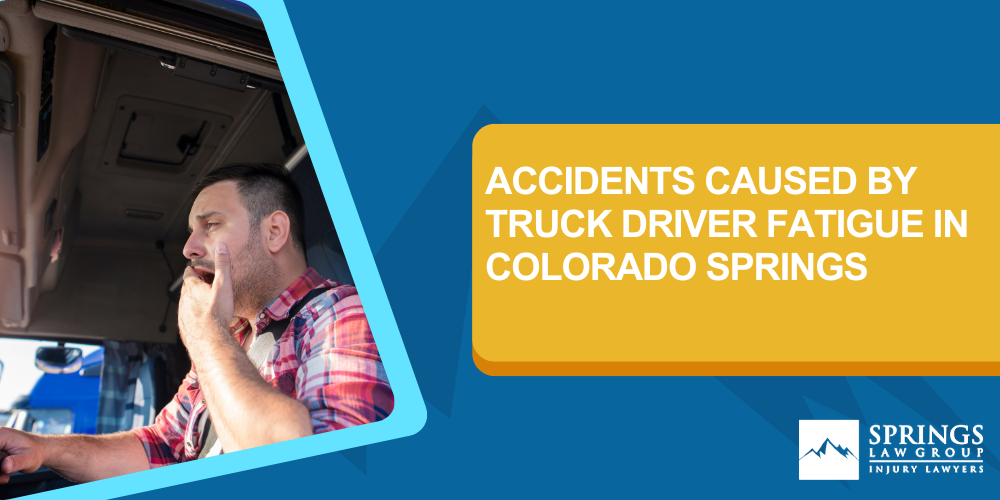
Driver fatigue is a major workplace safety risk, and it can erase the attention and reaction time a commercial driver needs to operate safely.
In commercial motor vehicle crashes, a fatigued driver may miss slowing traffic, drift across lanes, or delay braking by just enough to cause catastrophic harm.
Lack of adequate sleep, extended wakefulness, circadian rhythm disruption, monotony, health factors, and medications can all contribute to driver fatigue.
Research has found driver fatigue to be a contributing factor in approximately 13 percent of all commercial motor vehicle crashes.
One study published by the Federal Motor Carrier Safety Administration (FMCSA) reported that 65 percent of truck drivers occasionally or regularly drive while drowsy.
Nearly 50 percent of truck drivers have reported falling asleep behind the wheel, a statistic that helps explain why fatigue is linked to fatal truck crashes.
These risks do not exist in a vacuum, because trucking companies control schedules, loading demands, and policies that influence rest breaks and recovery time.
This page explains how fatigue becomes one of the most common causes of commercial truck accidents, and what evidence can show when exhaustion played a role.
If you or a loved one was injured in a Colorado Springs truck accident involving a fatigued driver, you may have grounds to pursue a claim against the driver, the trucking company, or other responsible parties whose actions contributed to the crash.
Contact Springs Law Group for a free consultation.
Use the chat feature on this page to get in touch with our attorneys.
Fatigue changes how a truck driver processes risk, and the size and stopping distance of a commercial rig makes small mistakes dangerous.
Drowsy driving slows perception and reaction time, so the driver brakes later, steers later, and misses hazards that would otherwise be manageable.
Fatigued driving also disrupts judgment, leading drivers to push through warning signs of exhaustion and keep driving time going when they should stop.
As alertness drops, lane-keeping suffers, and the truck may drift onto the shoulder, across a centerline, or into another lane without a corrective response.
Microsleeps can last only a few seconds, but at highway speed a truck can travel the length of a football field with no meaningful control, which is why fatigue is linked to fatal crashes.
In the trucking industry, long hours, overnight routes, and irregular schedules can intensify circadian disruption and raise the odds of mistakes in the early morning or late-night window.
Fatigue also compounds other hazards, because a driver dealing with alcohol or other drugs, prescription sedatives, or untreated sleep issues may reach a tipping point faster.
Many collisions follow a pattern of escalating near-miss incidents, hard braking, and erratic speed control before the final crash.
Causes of fatigued driver crashes include:
These patterns often show up in vehicle data, dash camera footage, witness accounts, and the driver’s log history when investigators reconstruct the driving time leading up to the collision.
Where records show repeated violations, long hours, or unrealistic dispatch demands, fatigue can move from a vague explanation to a documented cause.
The more severe the impact, the more likely the case involves high speeds, delayed reaction, and a failure to take corrective action in time.
That combination is a common pathway from routine highway driving to fatal crashes.
Truck driver fatigue rarely has a single cause, and drowsiness often builds over several days through disrupted sleep and limited recovery time.
A driver may start a shift already tired because off-duty activities cut into sleep, even when the work schedule looks normal on paper.
Long stretches behind the wheel, repetitive scenery, and limited opportunities to fully reset can make alertness drop in a way the driver does not recognize in real time.
Those conditions become more dangerous when changing road conditions demand quick decisions, because a large truck needs more distance and more time to respond.
As fatigue sets in, the warning signs often appear first as small errors, drifting within a lane, delayed braking, and lane departures that a rested driver would correct immediately.
The risk increases when other factors stack on top of fatigue, including irregular schedules, night driving, and the pressure to keep moving.
The sections below break down the most common sources of fatigue in trucking and explain how specific work patterns and choices translate into crash risk.
Federal HOS regulations set maximum work limits for commercial drivers because being well-rested is a basic safety requirement, not a preference.
FMCSA’s hours-of-service rules limit how many hours a driver can be on the road and require off-duty time, so investigators can determine whether a crash happened after an extended shift or an over-limit driving hour.
FMCSA research has also found that safety-critical events rise as driving hours increase, that late-shift driving carries a stronger time-on-task effect, and that breaks reduce risk in the hour after the break.
Electronic logging devices record driving time automatically to make HOS compliance easier to track, but some drivers still exceed their allowed hours and may falsify logs or commit other violations to keep moving.
In some cases, trucking companies have been accused of creating conditions that let drivers operate past legal limits, and an NTSB investigation described a carrier that created fictitious ELD driver accounts that allowed excess hours and fatigued driving.
When fatigue builds, the last few miles can be the most dangerous, because delayed braking or lane drift in a fully loaded rig can crush passenger vehicles before anyone has time to react, even if the driver thought they had enough sleep.
Common schedule pressures and compliance red flags in fatigue-related truck cases include:
In a fatigue case, the schedule often matters as much as the crash scene, because it shows whether the trip was realistic under HOS rules.
Night driving raises fatigue risk because the body’s circadian rhythm is naturally programmed for sleep, and crashes tied to drowsiness occur most often between midnight and 6 a.m.
Even drivers who started a shift feeling fine can feel fatigued in that window, especially after extended wakefulness or a long, monotonous stretch of highway.
FMCSA warns that drivers are naturally drowsy overnight, and fatigue can lead to drifting, slower reactions, and missed hazards that would be manageable in daylight.
Night work can also create a false sense of safety because traffic may be lighter, but the margin for error shrinks when visibility drops and speeds stay high.
When drowsy drivers lose focus, the crash pattern often looks like a run-off-road or lane-drift event with little or no braking.
That pattern is one reason fatigue investigations look closely at what time the trip occurred and whether the driver was pushing through the body’s strongest sleep drive.
Common crash patterns and risk factors associated with nighttime fatigued driving include:
Schedules and deadline pressure can push professional drivers toward choices that raise fatigue risk, especially when a load is still not ready and the clock keeps running.
FMCSA research on detention time describes long waits at shipping and receiving facilities as a condition that can adversely affect driver fatigue and can contribute to hours-of-service violations.
Federal regulations also prohibit coercion, meaning motor carriers, shippers, receivers, and intermediaries may not pressure a driver to operate in violation of safety rules, including hours-of-service limits.
When detention, appointment windows, and dispatch demands collide, drivers may shorten sleep, skip rest opportunities, or keep rolling to protect a delivery time.
The National Transportation Safety Board has long tied fatigue risk to scheduling policies and practices, not just individual driver choices, and has called for comprehensive fatigue risk controls across transportation.
In real-world crashes, the risk can rise late in a shift, when the driver is trying to finish the run and the last few miles feel like the easiest part, even though performance may be slipping and the safest move is to pull off and rest.
Common schedule pressures and operational patterns that increase fatigue risk include:
In a fatigue investigation, the schedule helps determine whether the driver had a realistic chance to get enough sleep and still complete the trip legally.
Investigators often focus on the timeline leading into the crash, including what happened in the first hour after leaving a shipper, when drivers may be rushing to recover lost time from detention.
FMCSA has treated detention time as a measurable operational problem because it can be tied to fatigue risk and hours-of-service compliance issues.
Medical and sleep problems can turn normal work demands into sustained driver drowsiness, especially when the condition is undiagnosed or poorly treated.
FMCSA has cited research finding that almost one-third of commercial truck drivers have mild to severe sleep apnea, a disorder tied to excessive daytime sleepiness and impaired alertness.
Sleep loss also stacks with shift work and irregular schedules, which is why the National Sleep Foundation frames drowsy driving as a preventable safety problem rooted in inadequate sleep opportunity and sleep health.
Medications can add another layer, and sources such as OSHA and CDC note that some medications can cause drowsiness that affects safe driving.
Sleeping pills and other sedating drugs may be especially concerning when combined with long shifts or when the sedating effect carries into the next day.
Alcohol matters too, because even one drink can interact with sleepiness and increase impairment, which NHTSA specifically warns about in the context of drowsy driving.
When crash investigators evaluate fatigue risk, they often look for warning signs like sleep disorder history, medication use, and behavioral clues that point to driver drowsiness long before the crash.
Fatigue rules matter because they sit at the intersection of occupational safety and traffic safety, and truck crashes often turn routine mistakes into catastrophic harm.
Federal hours-of-service basics cap how long CMV drivers can drive and work, and they require off-duty time intended to keep drivers alert.
Those limits exist for a reason, because drowsy driving is linked to fatal outcomes and is widely viewed as underreported in crash data.
Independent research summarized by the National Safety Council cites an AAA Foundation estimate that roughly 17.6% of fatal crashes from 2017 to 2021 involved a drowsy driver, which translates to thousands of deaths over that period.
In trucking cases, investigators use HOS compliance to determine whether fatigue was predictable based on schedule, duty status, and rest time.
Because money is tied to driving hour output, some drivers exceed allowed hours and some records show violations, including falsified entries or other workarounds.
The risk grows when trucking companies encourage drivers to bend or break the rules to deliver cargo faster, because the incentives shift away from staying well-rested and toward staying moving.
Common ELD and logbook issues that can signal fatigue risk or HOS pressure include:
In practice, these rules help separate a general claim of tiredness from a provable fatigue pattern tied to documented work and rest.
They also show whether the driver could realistically be well-rested given the trip demands and whether the carrier’s practices made compliance harder.
That is why HOS records, ELD downloads, and supporting documents often become the foundation for a fatigue-related truck crash investigation.
Proving fatigue after a truck accident usually requires building a record-based timeline, because drowsiness is rarely documented clearly at the crash scene.
Driver fatigue is primarily linked to sleep deprivation, long monotonous drives, and driving during circadian low points, and FMCSA specifically cautions against driving when the body is naturally drowsy overnight.
The National Transportation Safety Board has been cited as estimating that driver fatigue was identified as a principal cause in 31 percent of fatal-to-the-driver crashes, highlighting how often exhaustion shows up when the driver cannot be interviewed.
Investigators often start with the crash report and witness observations, then test whether the driver’s work and rest history matches what the crash dynamics suggest.
If a schedule appears unrealistic, the file may also raise questions about whether a carrier’s practices pushed the driver past legal limits, even though federal rules prohibit coercing a driver to operate in violation of safety regulations.
A strong fatigue case connects the human story to objective data, showing what happened before impact and why the driver did not respond in time.
Evidence sources used to prove or rule out fatigue include:
Because ELD data and fleet records can be overwritten or lost, early preservation steps often determine how much proof is available later.
The goal is not a generic claim that the driver “seemed tired,” but a documented chain showing sleep opportunity, duty status, and trip demands leading into the crash.
If the timeline shows pressure to keep driving beyond safe limits, that context can matter, especially where profit incentives may have encouraged excessive hours despite the safety rules.
Liability in a truck accident involving driver fatigue often extends beyond the person behind the wheel.
A fatigued driver may be responsible for choosing to continue driving without adequate rest, but the schedule and trip structure often reveal whether the risk was predictable.
Trucking operations also rely on dispatch, routing, and delivery commitments, and those decisions can contribute to unsafe driving time.
The facts of the crash and the records leading up to it typically determine who shares legal responsibility.
Potential liable parties include:
Compensation in a truck accident case depends on the evidence, the severity of harm, and how the injuries affect daily life and work.
In fatigue-related crashes, damages often reflect high medical costs and longer recovery timelines because impact forces are significant.
Insurance carriers commonly dispute the scope of injuries and the value of future care, so documentation matters from the start.
A claim may also account for financial losses that extend well beyond the initial hospitalization.
The categories below describe damages victims may be able to seek, depending on the facts of the case:
After a suspected fatigue truck crash, the steps you take in the first hours and days can affect your health and the strength of any future claim.
Fatigue cases often turn on records and timelines, so early action helps preserve evidence before it is lost or overwritten.
Medical evaluation should come first, even if symptoms seem delayed or minor.
Large truck collisions frequently involve complex insurance structures, which means statements and documents can be used strategically against you.
Acting carefully protects both your recovery and your legal position.
Steps to take:
Because fatigue cases often rely on electronic logging data and dispatch records, those materials can change or be lost without prompt preservation requests.
An early investigation can secure ELD data, trip schedules, and telematics information before routine retention policies erase them.
Keep track of your symptoms, treatment appointments, and how the injuries affect your work and daily activities.
Clear documentation creates a timeline that supports both medical care and any claim that may follow.
Truck accidents involving driver fatigue are rarely simple collisions.
They often involve long driving hours, electronic records, corporate scheduling decisions, and insurance carriers prepared to defend the case aggressively.
Identifying whether fatigue played a role requires a careful review of logs, trip timelines, and crash data before key evidence disappears.
Early action can make the difference between speculation and documented proof.
If you or a loved one was injured in a fatigue-related truck crash, contact a Colorado Springs truck accident attorney from Springs Law Group.
Our law firm can review the available records, assess potential violations, and explain your legal options under Colorado law.
Proving a driver was fatigued usually depends on records and timelines, not an admission at the scene.
Investigators start with the crash report and witness observations, looking for lane drift, delayed braking, missed signals, or a lack of evasive action.
They then review ELD data and logbooks to see how much driving time and on-duty time occurred before the crash and whether the entries show gaps, edits, or inconsistencies.
Dispatch, delivery, and GPS records can show whether the schedule was realistic and whether delays or detention time pushed the driver into late-night driving or extended wakefulness.
Telematics, dash cam footage, and event data downloads can document speed, braking, steering inputs, and whether the driver reacted in time.
When those sources align, they can establish that fatigue was a likely contributing factor and rule out alternative explanations.
Compliant logs do not automatically rule out fatigue. Hours-of-service records show duty status, but they do not confirm how much restorative sleep the driver actually obtained.
A driver can appear compliant on paper and still be operating after extended wakefulness or during a circadian low point.
Investigators often compare ELD data to fuel receipts, GPS pings, toll records, and delivery timestamps to confirm the timeline is accurate.
They also review dispatch communications and detention time to see whether the schedule created pressure that reduced meaningful rest.
Telematics and crash data can reveal delayed reactions or lane drift that are consistent with fatigue, even when the logs show legal driving time.
In some cases, log edits, unidentified driving segments, or patterns across prior trips raise questions about whether the compliance record reflects real-world conditions.
Electronic logging device data is typically owned and maintained by the motor carrier, not the individual driver.
Federal regulations require motor carriers to retain ELD records and supporting documents for a set period and to produce them during inspections or investigations.
Drivers can access their own records, but they do not control the company’s storage systems or retention policies.
Because the carrier manages the data platform, it can also make annotated edits that are tracked within the system.
In a truck accident case, formal requests or legal process are often required to obtain a full ELD download and related supporting records.
Colorado uses a modified comparative negligence rule under C.R.S. § 13-21-111, so you can still pursue compensation if you are partly at fault, as long as your share of fault is less than the other party’s.
If you are found 50% or more at fault, Colorado law bars recovery in that negligence claim.
If you are 49% or less at fault, your damages are reduced by your percentage of fault.
In practice, that means the dispute often becomes a fight over how the crash is reconstructed and how fault is allocated between the truck driver, the motor carrier, and any other involved parties.
A careful investigation can matter because insurers often try to shift blame onto the driver of the passenger vehicle to reduce what they pay.
In Colorado, many injury claims based on negligence have a two-year deadline, but motor vehicle crash claims often have a three-year statute of limitations under C.R.S. § 13-80-101.
Wrongful death claims are generally subject to a two-year limitation period under C.R.S. § 13-80-102, with some statutory exceptions in specific circumstances.
The clock usually starts when the claim “accrues,” which is fact-dependent and can involve discovery issues in some cases.
Because the correct deadline can turn on how the claim is classified and who is being sued, it is safer to treat the timeline as urgent rather than assuming you have time.
A lawyer can confirm the applicable statute and take steps to preserve time-sensitive trucking evidence while the case is still within the filing window.

Member of the Colorado Bar Association since 2014. Attorney, Christopher M. Nicolaysen focuses primarily on helping those injured in Colorado car accidents, other auto accidents, and Colorado personal injury incidents.
This article has been written and reviewed for legal accuracy and clarity by the team of writers and attorneys at Springs Law Group and is as accurate as possible. This content should not be taken as legal advice from an attorney. If you would like to learn more about our owner and experienced Colorado personal injury lawyer, Christopher Nicolaysen, you can do so here.
Springs Law Group does everything possible to make sure the information in this article is up to date and accurate. If you need specific legal advice about your case, contact us. This article should not be taken as advice from an attorney.
We use reviews to help show more people like you why we do what we do!

I was uneasy about reaching out to a law firm after being in an accident that left me injured and my vehicle totaled. I don’t care for the idea of suing for what was very clearly an accident. However, after learning more about the overall process of working with a professional team to navigate the murky waters of the insurance world, I was pleasantly surprised to find that the experience wasn’t as gross as I’d originally felt about it.

Springs Law is very friendly and professional. I always felt that they were on my side and cared about my injury and what I was going through. I highly recommend them.

Springs Law Group is an amazing group to work with! I got into a rough accident, and they never ceased to let me know they were there working hard to help me in my hour of need. It was always very easy to reach out to someone if I had any questions, and they were always happy to answer any questions I had.
I never have a problem with getting a response when I need them – which is not the case with most other firms. They really truly care about each client. As a plus, they always have positive attitudes, which matters tremendously when you are in a stressful legal situation.

Big thanks to Mr. Jake Kimbell and his team for their assistance with my case. He helped me through an incredibly challenging part of my life, and most importantly helped navigate through the convoluted legal channels of my case. I cannot thank him and his team enough for their support.

The entire team at Springs Law group has been nothing but amazing. Jake and the rest of the staff were great to work with and extremely professional. They were very attentive and answered any questions and concerns I had. I was always able to contact them and they were very responsive and communicated with me.

Springs Law Group is an amazing group to work with! I got into a rough accident, and they never ceased to let me know they were there working hard to help me in my hour of need. It was always very easy to reach out to someone if I had any questions, and they were always happy to answer any questions I had.