After an accident in Denver, taking immediate steps such as seeking medical attention, documenting evidence, and notifying insurance companies is crucial. A lawyer can assist with the evaluation of compensation for damages including medical expenses and lost wages due to missed work time after an accident.
Experienced Denver personal injury lawyers play a vital role in investigating accidents thoroughly to collect evidence that strongly supports your claim against at-fault drivers or their insurers.
Dedicated legal professionals negotiate with insurance companies on behalf of clients ensuring they are offered fair settlements that reflect the full extent of their losses from property damage to pain and suffering.
A Denver car accident lawyer at Springs Law Group represents people whose lives have been disrupted by injuries from negligent driving.
A crash can leave an injured person dealing with medical treatment, vehicle damage, missed work, future expenses, and an insurance company trying to limit what it pays.
Our attorneys take responsibility for the legal work that follows, including investigating fault, preserving evidence, identifying every available insurance policy, documenting the full effect of the injuries, negotiating the claim, and filing a lawsuit when that is the appropriate next step.
Our Colorado car accident attorneys provide legal representation for injured people, not the insurance companies evaluating their personal injury claims.
Springs Law Group is a Colorado-founded, Colorado-based personal injury firm that serves people with Colorado cases.
Our Denver personal injury lawyers work with injured clients throughout the state from offices across Central and South Central Colorado.
The process begins with a free consultation that is completely confidential and carries no obligation, led by an experienced member of our team.
We will listen to what happened, explain the legal and insurance issues we can identify, tell you whether our firm can accept the case, and discuss the options available from the information you provide.
Call or use the website chat to speak with Springs Law Group about a Denver car accident injury claim.
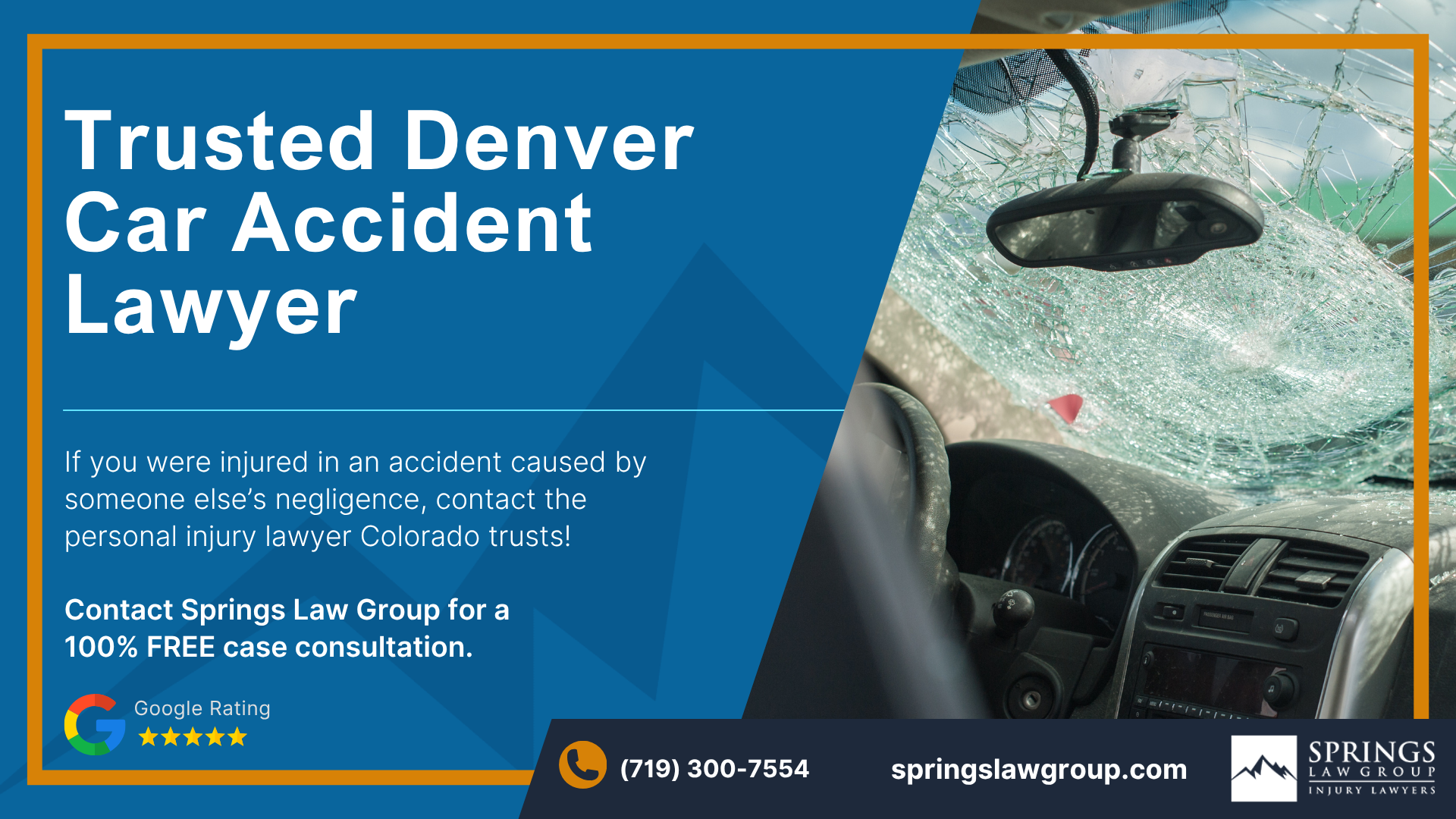
Colorado is a fault-based state for motor vehicle injury claims.
An injured person generally seeks compensation from the driver, business, vehicle owner, or other party whose negligence caused the collision, with an insurance company usually handling the defense and payment up to the applicable policy limits.
The presence of insurance does not make the claim automatic.
An auto accident can produce separate disputes over negligence, medical causation, insurance coverage, and damages even when the car crash itself lasted only seconds.
The other party’s insurance company may dispute the traffic violation, argue that both drivers share responsibility, question whether the crash caused the diagnosed condition, challenge the treatment, or value future harm differently.
An injured person’s own insurer may also become involved through medical payments coverage, uninsured or underinsured motorist benefits, or another part of the policy.
Those first-party claims are governed by policy language and legal duties that differ from the rules for a claim against someone else’s insurer.
A personal injury claim must therefore be evaluated separately from the vehicle repair claim and any traffic or criminal case.
Denver’s Vision Zero crash-data resources show why a serious collision should be evaluated from the evidence rather than assumptions about where or how crashes usually happen.
City and state dashboards can identify broader safety patterns, but they cannot establish who caused one particular accident.
That requires a focused review of the vehicles, roadway, witnesses, video, electronic data, medical evidence, and conduct of every involved party.
Our work is organized around the questions that will control the claim: what happened, who is legally responsible, which insurance applies, what injuries the crash caused, what those injuries have cost, and what future harm can be supported.
We develop those issues together because a strong liability case with incomplete medical proof can still be undervalued, just as substantial injuries do not establish that another person caused the crash.
To recover compensation, an injured person needs evidence addressing both responsibility for the collision and the harm that followed.
The first investigation often begins with the crash report, photographs, vehicle damage, witness information, medical records, and insurance documents.
Depending on the collision, we may also seek:
Video can be overwritten, vehicles can be repaired or sold, and witnesses’ memories can fade.
When evidence may be held by a business, government entity, or another driver, a prompt preservation request can be more effective than trying to reconstruct the missing information months later.
Many claims begin with another driver’s unsafe turn, following distance, lane change, speed, distraction, impairment, or failure to yield.
The complete liability analysis may extend beyond the person behind the wheel.
A vehicle owner, employer, rideshare company, delivery business, commercial carrier, maintenance provider, alcohol vendor, product manufacturer, road contractor, or public entity may have a role in a particular case.
The existence of a possible connection does not establish liability, so we examine who controlled the vehicle or work, what legal duty applied, and whether that conduct actually contributed to the crash.
When speed, visibility, braking, vehicle movement, or impact dynamics are genuinely disputed, an accident reconstruction specialist may analyze physical measurements, photographs, vehicle data, and engineering principles.
We use experts when specialized analysis can answer a material question, not simply to make a file appear more complicated.
An insurance adjuster may accept that its driver made a mistake and still dispute what injuries the crash caused.
Our legal team reviews emergency records, diagnostic testing, treatment notes, referrals, prior medical history, work restrictions, bills, and provider opinions to distinguish a new injury from an aggravated condition or unrelated problem.
We also look at the timing and progression of symptoms rather than treating one early record as the entire medical history.
The National Library of Medicine notes that whiplash pain may also be delayed, which is one reason an absence of immediate neck pain does not resolve medical causation.
Medical questions still require evaluation by qualified healthcare professionals.
Our role is to obtain the appropriate records and opinions, understand what they show, and present the medical evidence accurately.
Medical bills are only one part of a bodily injury claim.
We gather payroll records, employer verification, tax or business documents, disability notes, receipts, mileage, photographs, and other evidence of the economic effect of the crash.
When an injury may affect future work or care, the claim may require opinions from treating providers, vocational professionals, life-care planners, economists, or other qualified experts.
Noneconomic harm such as pain, physical impairment, disfigurement, sleep disruption, and loss of ordinary activities must also be described with specific evidence.
We do not rely on a standard multiplier that assumes every person with the same diagnosis has the same experience.
The insurance card exchanged at the scene may identify only one layer of coverage.
We examine the driver and vehicle owner’s policies, commercial or employer coverage, rideshare or delivery coverage, umbrella and excess policies, and coverage available to the injured person or household.
Colorado’s legislative handbook on automobile insurance describes the state’s minimum liability requirements and commonly available coverages, while the actual policy and endorsements control a particular claim.
Our Denver insurance claims lawyers evaluate liability coverage together with MedPay, uninsured or underinsured motorist benefits, and supported first-party insurance issues.
That review should occur before a release is signed because broad release language can affect additional claims or parties.
Once we accept a case, our attorneys and client management team take over covered communications with the liability carrier and coordinate appropriate communications with first-party insurers.
We provide relevant documentation, respond to claim positions, track requests, and keep a written record of important exchanges.
We also examine requests for recorded statements and medical authorizations before a client gives an insurer access that may be broader than the claim requires.
Insurance companies are entitled to investigate, and an insured has cooperation duties under the policy, but those duties do not give every carrier unlimited access to unrelated history.
We normally evaluate settlement after the evidence supports a responsible assessment of liability, medical causation, damages, coverage, liens, and future needs.
The demand should explain the claim rather than merely total the bills and announce a number.
Our attorneys respond to supported concerns, challenge reductions that do not fit the evidence, and advise the client about the strengths, risks, timing, and likely net effect of available options.
The client decides whether to accept a settlement.
Anyone handling a claim directly should understand how Denver auto accident settlement negotiations work before signing a release that permanently ends the case.
Many car accident claims resolve without trial, but an early insurance offer is not the only available path.
A lawsuit may be necessary when fault remains disputed, evidence must be obtained through subpoenas or discovery, the parties disagree about causation or damages, the insurer will not make a reasonable offer, or a filing deadline is approaching.
A car accident lawsuit also gives the parties formal tools for obtaining evidence and testing disputed positions through legal proceedings.
Springs Law Group has the resources to handle pleadings, written discovery, depositions, expert work, motions, mediation, trial preparation, and trial when the facts and client’s interests support that course.
Preparing accepted cases with litigation in mind also gives an insurer a clearer basis for evaluating risk because it can see whether the claim is supported by evidence that can be used in court.
The crash pattern helps identify likely evidence and legal issues, but a label such as rear-end or intersection collision does not decide fault by itself.
Motor vehicle accidents can involve the same traffic rule but require different evidence because the vehicles, drivers, roadway, and sequence are not the same.
We investigate how the impact occurred and what each driver had a reasonable opportunity to see and do.
A rear driver may be liable for following too closely, looking away, speeding, or failing to account for traffic and weather.
Rear-end fault is not automatic in every case.
The front vehicle may have entered the lane unsafely, lacked functioning brake lights, or been part of a chain-reaction crash involving several impacts.
Vehicle positions, damage patterns, event data, video, witness accounts, and the timing of each impact can matter.
Rear impacts commonly produce neck and back complaints, and our Denver whiplash lawyers examine the treatment and medical evidence rather than assuming that visible vehicle damage measures the occupant’s injury.
An intersection case may turn on a traffic signal, stop sign, protected turn, right of way, sight line, speed, or the location of each vehicle when the driver should have reacted.
The police report may record competing accounts without resolving them.
Signal sequencing, video, debris, skid evidence, vehicle data, and independent witnesses can help determine whether a driver ran a red light, turned across approaching traffic, or entered without yielding.
Drivers must confirm that a lane movement can be completed safely.
These cases often involve blind areas, turn signals, lane markings, speed differences, and disputes over which vehicle crossed the line.
Damage location and continuous video can be especially useful because the final resting positions may not show how the contact began.
Head-on crashes can cause severe injury because the combined forces may be substantial.
An investigation may examine impairment, fatigue, distraction, an unsafe pass, loss of control, roadway design, medical emergency, or a driver entering a one-way road or divided highway in the wrong direction.
Serious cases may require prompt vehicle inspection, toxicology evidence, electronic data, and accident reconstruction.
A single-vehicle crash is not always solely the driver’s fault.
Another vehicle may have forced an evasive maneuver, a dangerous road or construction condition may have contributed, or a tire, steering, restraint, roof, or other vehicle component may require investigation.
Rollover and ejection cases can raise distinct questions about occupant restraint, crashworthiness, vehicle stability, and whether a product defect made the injuries worse.
The National Highway Traffic Safety Administration explains that air bags are supplemental protection designed to work with seat belts, not a substitute for them.
Multi-Vehicle and Chain-Reaction Crashes
Several impacts can produce conflicting accounts about sequence, injury, and responsibility.
One driver may start the event, while another driver’s independent negligence contributes to a later impact.
We compare damage, event data, video, witness statements, and medical history to identify the order and force of impacts and evaluate whether more than one party shares fault.
When a driver was transporting a passenger, making a delivery, or performing work, an employer or platform policy may apply in addition to personal auto coverage.
Employment status, application activity, trip phase, vehicle ownership, contracts, and the scope of the driver’s work can affect liability and insurance.
A collision with a tractor-trailer, box truck, dump truck, bus, or other commercial vehicle requires a broader investigation of company records and safety responsibilities.
Our Denver truck accident lawyers handle truck accidents involving multiple businesses, federal records, onboard data, and serious injuries.
Motorcyclists may be blamed based on assumptions about speed or risk even when another driver failed to see the motorcycle, yielded improperly, opened a door, or made an unsafe turn.
Colorado motorcycle law, rider position, sight distance, protective equipment, and the movement of each vehicle should be examined from the evidence.
Our Denver motorcycle accident lawyers address motorcycle-specific liability and the serious injuries that can result when a rider has little physical protection.
People walking or cycling can suffer substantial injuries from an impact that leaves limited damage on the vehicle.
Right of way, driver attention, turning movement, passing distance, lighting, visibility, crosswalk location, and road design may all matter.
Our Denver pedestrian accident lawyers focus on people struck by motor vehicles, while our Colorado bicycle accident lawyers handle bicycle-specific traffic rules and evidence.
A citation can support an investigation, but civil liability does not depend entirely on whether an officer issued one.
Our attorneys compare the alleged traffic error with the physical and electronic evidence and determine how it caused the collision.
Distracted Driving and Inattention
A driver can be distracted by a phone, navigation system, message, passenger, food, object in the vehicle, or event outside it.
Proof may come from witness observations, video, admissions, phone records obtained through lawful process, application data, or evidence that the driver did not brake or steer until too late.
Phone activity near the time of a crash is relevant only when it can be connected to the driver and the event.
Speeding and Driving Too Fast for Conditions
A driver can be negligent even while traveling below the posted limit if traffic, weather, visibility, road surface, or another condition required a slower speed.
Speed can affect stopping distance, reaction time, crash avoidance, and impact severity.
Event data, video timing, skid evidence, debris, vehicle movement, and reconstruction analysis may help evaluate a disputed estimate.
Impaired Driving
Alcohol, cannabis, illegal drugs, and some prescription or over-the-counter medications can affect judgment, coordination, perception, and reaction time.
CDOT reports that alcohol and cannabis affect safe driving in different ways but can both slow or compromise driving functions.
A criminal DUI case and a civil injury claim have different purposes and burdens of proof.
The civil case still requires evidence connecting the driver’s impairment or other negligent conduct to the collision and the injured person’s damages.
Fatigued and Drowsy Driving
Fatigue can reduce alertness, attention, judgment, and reaction time even when a driver never falls fully asleep.
The National Highway Traffic Safety Administration identifies drowsy driving as a safety risk and recommends adequate sleep as the primary protection.
Work schedules, trip timing, rest history, messages, video, witness observations, and vehicle movement may help establish fatigue in an appropriate case.
We do not describe fatigue as legally equivalent to alcohol impairment without evidence supporting that comparison.
Following Too Closely and Aggressive Driving
Tailgating, rapid lane changes, unsafe passing, road-rage conduct, and attempts to beat a traffic signal can leave too little time to respond.
The investigation should separate observable conduct from a conclusion about the driver’s state of mind.
Video, witnesses, prior movements, speed, and statements can establish what the driver did without relying on a label alone.
Weather, Road, and Construction Conditions
Snow, ice, rain, glare, darkness, confusing lane shifts, construction, potholes, missing signs, and signal problems may contribute to a crash.
Bad weather does not excuse unsafe driving because a motorist must respond reasonably to the conditions.
A road contractor, property owner, utility, or public entity may also require investigation when its conduct created or failed to address a dangerous condition.
Claims involving the City and County of Denver or another public entity can carry special notice requirements and defenses.
Vehicle and Component Failures
Brake, tire, steering, lighting, air-bag, seat-belt, or other vehicle problems may result from poor maintenance, negligent repair, recall issues, or a product defect.
Preserving the vehicle and failed component is critical because repair or disposal can prevent a qualified expert from determining why the failure occurred.
Ownership and a defect alone do not establish responsibility, so the investigation must identify what failed, who controlled it, and how it contributed to the crash or injury.
The priorities at the scene are safety, medical care, compliance with Colorado law, and accurate documentation.
No checklist fits every emergency, but the following steps can protect health and preserve information.
Call 911 and Address Immediate Safety
Report the location, apparent injuries, traffic danger, fire, suspected impairment, hit-and-run, or other emergency.
Follow the dispatcher’s instructions and do not place yourself in moving traffic to collect evidence.
Colorado law requires drivers involved in qualifying crashes to stop, provide specified information, give reasonable assistance to injured people, and report the collision as required by C.R.S. sections 42-4-1601 through 42-4-1606.
Leaving an injury scene can create serious consequences separate from the civil claim.
Seek Appropriate Medical Care
Accept emergency help when needed and tell providers how the crash occurred, where symptoms are located, and whether there was a head impact or loss of awareness.
Some conditions become clearer after the initial adrenaline and shock subside.
Prompt care can identify injuries that need treatment and creates a contemporaneous medical record, but a treatment decision should be based on health needs rather than a desire to manufacture a legal claim.
Follow qualified medical advice and return for evaluation if symptoms worsen or new concerns develop.
Exchange Information and Document the Accident Scene
Obtain the other driver’s name, address, phone number, driver’s license, vehicle registration, license plate, and insurance information.
If the driver and vehicle owner are different people, record both identities.
When it is safe, photograph or record:
Ask witnesses for names and reliable contact information instead of assuming the police report will list everyone.
Do not argue about fault or post a running account of the crash on social media.
Obtain the Accident Report and Related Records
Ask the responding officer for the agency, case number, name, and instructions for requesting the report.
The Denver Police Department explains how to request traffic accident reports and other police records.
If no officer responds, the Colorado DMV crash-records process may permit an involved driver to submit an online counter report.
A counter report records the driver’s information but is not the same as an officer investigation.
Our detailed instructions for filing and obtaining a police report after a Denver crash explain the difference and the current reporting rules.
Notify the Appropriate Insurer Without Guessing
Most policies require reasonably prompt notice to the insured person’s own carrier.
Provide accurate basic information, but do not guess about speed, distances, medical diagnoses, or fault.
The at-fault party’s insurance company may ask for a recorded statement or broad medical authorization even though its insured’s policy does not impose cooperation duties on you.
Your own insurer may have contractual rights to reasonable cooperation, so the response depends on which carrier is asking, what coverage is involved, and what the policy requires.
Preserve the Vehicle, Records, and a Claim Timeline
Before a severely damaged vehicle is repaired, sold, or destroyed, determine whether it may contain useful physical or electronic evidence.
Keep photographs, medical instructions, bills, prescription information, work notes, receipts, insurer letters, emails, claim numbers, and a dated log of significant calls.
Do not edit the original photographs or discard damaged child seats, helmets, phones, glasses, or other items that may help explain the crash or injury.
Get Legal Advice Before Signing a Release
An insurance payment may require a release of all claims against named and broadly described people or businesses.
Once a valid release is signed, later treatment, lost income, or a newly discovered coverage issue may not reopen the claim.
Legal advice is especially useful when injuries are significant, fault is disputed, several vehicles or policies are involved, the driver was working, the crash involved a public entity, or the insurer requests extensive records.
Colorado personal injury law sets the elements of the claim, the effect of shared fault, filing deadlines, and the damages that may be recovered.
The applicable rule can change with the parties, vehicle, insurance, and cause of action, so a general deadline should not be treated as a case-specific calculation.
Most car accident claims require proof that the defendant owed a legal duty, breached that duty, caused the injury, and produced legally recoverable damages.
A traffic violation can be important evidence, but it does not eliminate the need to prove causation and harm.
The defendant may dispute any of those elements or argue that another person caused all or part of the crash.
Under C.R.S. section 13-21-111, an injured person may generally recover when that person’s negligence is less than the combined negligence of the defendants against whom recovery is sought.
The award is reduced in proportion to the injured person’s percentage of negligence.
A claimant who is found 50 percent or more at fault generally cannot recover under that statute.
This rule makes blame-shifting consequential rather than rhetorical.
Statements, photographs, vehicle data, right-of-way rules, visibility, and reaction opportunities may determine whether an asserted percentage is supported.
C.R.S. section 13-80-101(1)(n) generally provides three years for an action seeking bodily injury or property damages arising from the use or operation of a motor vehicle.
For most Colorado motor vehicle injury cases, the car accident lawsuit must therefore be filed within three years after the claim accrues, not merely reported to an insurer within that period.
That general rule has exceptions and does not control every insurance, product-liability, wrongful-death, contract, or public-entity claim connected to a collision.
The date a claim accrues and any legally recognized tolling issue also require analysis.
Negotiations with an insurer do not ordinarily extend the filing period by themselves.
When a government vehicle, employee, dangerous road condition, or another public-entity act may be involved, the Colorado Governmental Immunity Act can require written notice within 182 days after discovery of the injury.
The City and County of Denver’s claim instructions state that the notice is required under C.R.S. section 24-10-109 and is not a substitute for filing a lawsuit.
The correct recipient, contents, delivery, and timing matter.
Waiting for the ordinary three-year motor vehicle deadline can therefore be too late for a government claim.
Colorado does not award punitive or exemplary damages in every severe car accident.
Under C.R.S. section 13-21-102, the claimant must establish fraud, malice, or willful and wanton conduct, and the statute controls when and how that claim may be added.
An allegation such as intoxicated or deliberate dangerous driving must still be supported by admissible evidence.
The amount and availability of exemplary damages are also subject to statutory limits and judicial review.
An injury claim may involve the at-fault driver’s liability policy, coverage under the injured person’s policy, or several policies operating in a defined order.
The declarations page is a starting point, not the full policy.
Exclusions, endorsements, definitions, covered-person provisions, and other-insurance clauses can change the analysis.
Bodily Injury Liability Coverage
Liability coverage may pay covered damages for injury caused by an insured driver, up to the applicable limit and subject to policy terms.
The at-fault driver’s insurance policy may have to address claims from several injured parties, which can make limits and timing especially important.
Colorado generally requires resident vehicle owners to maintain liability coverage, and the Colorado DMV explains how the state verifies mandatory insurance.
Minimum insurance may be inadequate when a crash causes surgery, permanent impairment, substantial wage loss, or injuries to several people.
We investigate additional policies and responsible parties rather than assuming the first disclosed limit is the only available coverage.
Medical Payments Coverage
MedPay is first-party automobile coverage that may pay qualifying accident-related medical expenses up to the policy limit, generally without deciding who caused the crash.
Colorado insurers must offer MedPay in the manner required by state law, and a named insured can reject it as allowed by statute.
It may help with bills while the liability case remains pending, but the policy terms, covered-person status, available limit, and payment records must be reviewed.
Our explanation of who pays medical bills after a Denver car accident addresses health insurance, MedPay, provider balances, liens, and settlement reimbursement.
Uninsured and Underinsured Motorist Coverage
Uninsured motorist coverage may apply when the at-fault driver lacks insurance or in a qualifying hit-and-run.
Underinsured motorist coverage may apply when the responsible driver’s liability limits are insufficient for the proven damages.
Colorado law generally requires insurers to offer UM/UIM coverage in relation to bodily injury liability coverage unless it is properly rejected or reduced in writing, as summarized by the Colorado General Assembly’s automobile insurance materials.
It is a claim under an applicable policy, but the injured person must still establish coverage, the other driver’s fault, and damages.
Settlement with the liability carrier should be coordinated with UM/UIM requirements before a release is signed.
Commercial, Rideshare, Umbrella, and Excess Coverage
A driver working for an employer, carrying passengers through an application, delivering goods, or operating a business vehicle may be covered by a commercial or platform policy.
The driver’s status at the moment of the crash can affect which coverage period applies.
Umbrella or excess coverage may provide an additional layer after a primary limit is exhausted, but it has its own policy terms and attachment requirements.
Coverage requests and the relationships among the driver, owner, employer, and business must be examined together.
Insurance Claim Delays and Colorado Rules
There is no general Colorado rule requiring every automobile claim representative to answer each phone call, letter, or email within 15 days.
The Colorado Division of Insurance states that Colorado law does not set a fixed response period for those communications, although the Division can address an unreasonable delay by insurance representatives directly with the company.
For covered first-party property and casualty benefits, Colorado Regulation 5-1-14 establishes a 60-day decision or payment standard after receipt of a valid and complete claim unless a reasonable dispute or another stated condition applies.
That regulation is not a promise that every liability settlement must be paid within 60 days.
The duties depend on whether the claim is first-party or third-party, whether coverage is established, what information has been provided, and whether a reasonable dispute exists.
The type of impact does not establish a diagnosis, and vehicle repair cost does not measure the harm to a particular occupant.
Age, position, restraint use, direction of force, medical history, and other facts can affect the injury pattern.
Neck, Back, and Spinal Injuries
A collision can injure muscles, ligaments, discs, vertebrae, nerve roots, or the spinal cord.
Symptoms may include pain, stiffness, weakness, numbness, radiating pain, headaches, or restricted motion.
Some injuries improve with conservative care, while others require injections, surgery, rehabilitation, assistive equipment, or long-term restrictions.
The claim should reflect the supported medical course rather than assuming that every back or neck complaint is temporary or permanent.
Traumatic Brain Injuries and Concussions
A person can sustain a concussion from a blow to the head or from force that causes the head and brain to move rapidly, even without a prolonged loss of consciousness.
Emergency notes, imaging, cognitive testing, symptom history, provider observations, and accounts from people who know the injured person may help document the change.
Anyone with worsening headache, repeated vomiting, confusion, seizure, unusual behavior, weakness, or another danger sign should seek emergency medical care rather than waiting on a legal consultation.
Fractures, Joint Injuries, and Soft-Tissue Damage
Seat belts, air bags, doors, dashboards, and intrusion into the passenger compartment can transmit substantial forces.
Fractures, torn ligaments, shoulder and knee injuries, hand and foot injuries, bruising, and muscle or tendon damage may limit work and ordinary activity well after the initial emergency care.
Orthopedic records, imaging, therapy progress, work restrictions, and evidence of ongoing functional limits help explain the actual effect.
Internal Injuries, Burns, and Scarring
Chest and abdominal trauma can injure organs, blood vessels, or the rib cage and may require urgent intervention.
Fire, fluid exposure, broken glass, air-bag deployment, or contact with vehicle components can produce burns, lacerations, and visible scarring.
Photographs taken throughout healing, surgical records, specialist opinions, and testimony about physical limitations may be relevant to permanent disfigurement or impairment.
Psychological Harm
Some injured people develop anxiety, depression, sleep problems, or post-traumatic symptoms connected to the collision and its consequences.
The claim should rely on actual symptoms, treatment, diagnoses, and effect on functioning rather than generalized assumptions that every crash produces the same emotional response.
Psychological care can be a medically necessary part of recovery and should not be treated as less real than physical treatment.
Catastrophic Injury and Wrongful Death
Brain injury, spinal cord damage, amputation, organ injury, major burns, and other catastrophic conditions can create lifetime medical, accessibility, employment, and care needs.
These cases often require specialists who can explain future treatment, rehabilitation, equipment, housing changes, personal assistance, and lost earning capacity.
When a collision is fatal, eligible family members or a personal representative may have claims controlled by Colorado’s wrongful-death and survival statutes.
Our Colorado wrongful death lawyers evaluate who may file, which losses are legally recoverable, and the deadlines that differ from an ordinary injury claim.
Compensation depends on liability, comparative fault, available insurance and assets, medical causation, the quality of the evidence, and the proven past and future effect of the injury.
No calculator or average can determine the value of an individual case from a diagnosis alone.
The evidence must address the circumstances of each car accident victim instead of assigning the same number to everyone with a similar diagnosis.
Fair compensation means the financial compensation supported by the facts and Colorado law, not a guaranteed figure or automatic multiplier.
Our work is directed toward documenting the full compensation the evidence supports without promising a result that no lawyer can guarantee.
Medical Expenses and Future Care
A claim may include reasonable accident-related expenses for emergency care, physicians, imaging, surgery, therapy, medication, rehabilitation, equipment, and supported future treatment.
Future costs generally require a reliable medical basis rather than speculation.
Health insurers, government benefit programs, medical providers, or others may assert reimbursement or lien rights that affect the client’s net recovery.
The Centers for Medicare & Medicaid Services explains that Medicare may make conditional payments and seek reimbursement after a related settlement, judgment, award, or other payment.
We identify potential obligations, verify balances, challenge unrelated charges when supported, and address valid claims before disbursing settlement funds.
Lost Income and Reduced Earning Capacity
An injured person may claim wages, business income, benefits, or other compensation lost because the crash and resulting treatment prevented work.
When restrictions may last, the claim can include reduced future earning capacity supported by medical, employment, vocational, and economic evidence.
The analysis should account for the person’s actual occupation, education, work history, probable career path, and ability to perform available work.
Pain, Physical Impairment, Disfigurement, and Loss of Normal Life
Noneconomic damages address human effects that do not appear on an invoice.
Medical records, photographs, witness accounts, activity evidence, and the injured person’s own testimony can explain pain, mobility limits, scarring, sleep disruption, and the loss of ordinary activities.
Specific examples are more useful than broad statements that the accident changed everything.
Property-Related Losses
Vehicle repair, total-loss value, rental expense, loss of use, damaged personal property, towing, storage, and possible diminished value are distinct from the bodily injury claim.
Springs Law Group’s representation centers on personal injury, although vehicle evidence and property correspondence can be important to liability and causation.
The consultation and written fee agreement determine the scope of any accepted representation.
Losses in a Fatal Crash
A Colorado wrongful-death claim may involve funeral expenses and legally recognized economic and noneconomic losses suffered by eligible claimants.
A survival claim may address certain losses belonging to the decedent’s estate.
The available claims, filing parties, damages, and timing depend on the family relationship, estate status, and date of death.
Case Value Should Be Evaluated Individually
Published averages often combine minor injuries, catastrophic losses, disputed liability, limited insurance, and outlier results without enough context to help one injured person.
Our discussion of average Denver car accident settlements explains the factors that make a single average misleading.
The related question of how much someone can sue for after a Denver car accident involves proof, available insurance and assets, Colorado damage rules, litigation risk, liens, and the likely net recovery.
Our attorneys give case-specific advice after reviewing the evidence rather than promising a number during an advertisement or initial phone call.
Springs Law Group was started in Colorado, is based in Colorado, and represents people in Colorado personal injury matters.
Our firm history and core values reflect a model built around clear answers, coordinated teamwork, accountability, and attentive client care.
We want accident victims to have an attorney and legal resource they can rely on while also receiving personal attention from the people responsible for their case.
Christopher Nicolaysen Built the Firm Around Colorado Injury Clients
Christopher Nicolaysen, our founder and CEO, has practiced law in Colorado for more than a decade.
His experience includes personal injury matters involving cars, commercial vehicles, motorcycles, bicycles, and pedestrians.
Chris earned his law degree at the University of Denver Sturm College of Law and clerked for the Honorable David L. Shakes before developing his practice at Colorado firms.
He founded Springs Law Group to create the kind of injury practice he believed Colorado clients needed: lawyers who explain the case, a team that prepares it deliberately, and a relationship that does not feel like a file moving through a national call center.
Chris’s earlier work in education continues to influence that approach because a lawyer should be able to make a difficult issue understandable and give a client practical guidance.
David Hinkle Brings More Than 20 Years of Insurance Claim Experience
Before becoming an attorney, David Hinkle spent more than 20 years handling personal and commercial injury claims for insurance carriers.
He learned how adjusters investigate crashes, evaluate liability, read medical records, examine prior conditions, set reserves, identify coverage, seek settlement authority, and assess demands.
David now applies that experience for injured clients as a pre-litigation attorney with Springs Law Group.
His background helps our team recognize what may be driving a carrier’s position and identify the evidence needed to answer a causation, treatment, wage-loss, or valuation dispute.
That insurance perspective works together with the legal expertise of the attorneys responsible for developing the claim and evaluating a fair settlement.
Clients Receive a Defined Process and Regular Communication
After a client hires Springs Law Group, the client meets the attorney and client management team responsible for the case.
We review the facts, explain immediate priorities, answer questions, and provide a packet that maps the usual phases of the claim and practical steps the client can take.
Regular scheduled calls provide consistent updates, and we can increase their frequency when the case or client’s needs call for it.
Clients can also reach us through multiple communication channels instead of waiting for a single end-of-case conversation.
That structure lets attorneys focus on legal strategy while client management professionals help keep records, treatment information, deadlines, and communication organized.
We Prepare Cases for the Possibility of Court
Insurance companies assess whether a law firm can support its position with admissible evidence and continue when informal negotiation ends.
Our attorneys prepare accepted cases with that possibility in mind and have the resources to pursue discovery, depositions, expert analysis, motions, mediation, and trial.
An insurer may evaluate a settlement differently when the evidence shows that the lawyers are prepared and willing to litigate rather than accept an unsupported reduction.
That approach does not guarantee a result or mean every case should be litigated.
It means a client is not forced to treat a low offer as the only option simply because the case would require more work.
If another driver’s conduct caused your injuries, a Colorado car accident lawyer at Springs Law Group can evaluate the crash evidence, liability rules, insurance coverage, medical documentation, work loss, future needs, and available legal options.
Legal assistance begins with a free consultation that is completely confidential and carries no obligation to hire our firm.
If we accept the case, we explain the contingency fee, case costs, scope of representation, and client responsibilities in a written agreement before the work begins.
Call (719) 300-7554 or use the website chat to talk with an experienced member of our Colorado personal injury team.
No.
A minor property-only crash with clear fault and no injury may be resolved without personal injury counsel.
Legal advice becomes more valuable when a person is injured, fault is disputed, symptoms continue, several parties or policies may be involved, the driver was working, the insurer requests a broad statement or authorization, or a filing deadline may apply.
Contacting an attorney early can help preserve video, electronic data, vehicle evidence, and witness information before it disappears.
It is especially important to get advice before signing a release, giving a disputed recorded statement, allowing a damaged vehicle to be destroyed when it may contain evidence, or approaching a government notice or lawsuit deadline.
Getting an evaluation does not require a person to file a lawsuit.
Do not assume that a possible mistake ends the claim.
Colorado’s modified comparative negligence law generally permits recovery when the injured person’s fault is less than the combined fault of the defendants, but the damages are reduced by that percentage.
Because a finding of 50 percent or more generally bars recovery, the allocation should be evaluated from the evidence rather than accepted from an adjuster’s first assessment.
Yes, depending on the evidence.
A traffic citation is not required to prove civil negligence, and a citation does not conclusively establish every element of an injury claim.
Video, photographs, witnesses, vehicle data, traffic rules, and sworn testimony may support a different or more complete account than the officer had at the scene.
Delayed symptoms do not automatically defeat a claim, particularly with whiplash, concussion, and some soft-tissue injuries.
Seek appropriate medical advice, explain when each symptom began, and give providers an accurate history.
The medical evidence must still connect the condition to the crash rather than relying on timing alone.
A prior condition does not excuse a negligent driver from responsibility for a new injury or a proven aggravation of the existing condition.
Earlier records, the pre-crash baseline, new symptoms, diagnostic findings, treatment changes, and provider opinions may show what the collision changed.
The defense may obtain relevant history, so accuracy is more effective than trying to hide prior treatment.
It depends on which insurer is asking and what the policy requires.
The other driver’s liability carrier generally cannot enforce your own policy’s cooperation clause, while your insurer may have contractual rights to request reasonable information or a statement.
Ask who will record it, what claim and coverage it concerns, how it will be used, and whether the request is required before agreeing.
Read the scope first because some forms permit access to years of unrelated records, prescriptions, billing, or other information.
An insurer may be entitled to relevant medical documentation, but records can often be gathered and provided in a targeted way.
Legal advice can help distinguish a reasonable request from an unnecessarily broad authorization.
Review every potentially applicable policy for uninsured motorist coverage, including policies covering the vehicle, injured person, household members, or an employer.
A qualifying hit-and-run can also raise uninsured motorist issues.
The policy, notice, proof of contact or reporting, other coverage, and Colorado law determine whether benefits are available.
The claim should be investigated for vehicle-owner, employer, commercial, rideshare, umbrella, excess, and underinsured motorist coverage before a release is signed.
Other responsible parties or assets may exist, but their legal and practical importance depends on the evidence.
A policy-limit offer is not necessarily the end of the insurance analysis.
A person injured while acting in the course and scope of employment may have a workers’ compensation issue as well as a third-party claim against a negligent driver or business.
The benefits, fault rules, liens, reimbursement rights, and recoverable damages differ, so the matters must be coordinated.
A consultation with Springs Law Group will determine whether the third-party personal injury case falls within our practice and what other counsel may be needed.
The timeline depends on the medical course, liability dispute, number of parties and policies, evidence, coverage issues, insurer response, and whether litigation becomes necessary.
Settling before the future medical outlook can be evaluated may leave important harm undocumented, while unnecessary delay can put evidence and deadlines at risk.
We explain the events controlling the timeline and update clients as the case develops.
Case value depends on fault, comparative negligence, insurance and assets, the nature and duration of the injury, medical expenses, future care, income loss, impairment, disfigurement, noneconomic harm, liens, and litigation risk.
An early promise based only on medical bills or a diagnosis is not a reliable valuation.
A lawyer needs enough evidence to estimate both the potential gross result and what the client may receive after fees, costs, and valid reimbursement obligations.
Colorado does not impose a blanket 15-day response deadline for every auto claim phone call, email, or letter.
The Division of Insurance can address unreasonable delays, and different rules apply to claim decisions, covered first-party benefits, regulatory complaints, policy duties, and litigation deadlines.
Keep a dated communication log and request important claim positions in writing.
Springs Law Group handles accepted car accident cases on a contingency fee basis, so the attorney fee generally comes from a recovery rather than an hourly invoice.
There is no single percentage that should be assumed for every case, and the fee may depend on the agreement and stage of the matter.
The signed written agreement controls the percentage, treatment of case costs, scope of work, and other obligations, so those terms should be explained before the client hires the firm.
Look for a personal injury lawyer whose work centers on injury claims, who can explain Colorado fault and insurance issues, and who has the resources to investigate and litigate the type of case involved.
An experienced lawyer or auto accident attorney should be able to explain what evidence matters, who will handle the file, and what happens if negotiation does not produce an acceptable result.
Ask how often the firm communicates, whether the personal injury attorney has trial and deposition experience, how fees and costs work, and what evidence the experienced attorney would prioritize.
Local knowledge of Colorado law matters because comparative negligence, insurance coverage, filing deadlines, court procedure, and damages rules can affect the case.
Reviews can offer insight into responsiveness, but they should be considered together with the lawyer’s actual background, disciplinary record, practice focus, and the fit between the client and team.
Research multiple sources, including professional legal directories, state bar association materials, firm biographies, verifiable results, and independent client reviews, without treating any one listing as conclusive.
Claims about a successful track record or proven track record should be compared with the lawyer’s actual experience, verifiable information, and explanation of the specific case.
The Colorado Judicial Branch directs the public to the Colorado Supreme Court’s Office of Attorney Regulation Counsel attorney search, where a person can verify licensing and public disciplinary information within the Colorado legal profession rather than relying only on an advertisement or directory badge.
The injured person generally must prove that the defendant owed a legal duty, breached that duty through negligent conduct, caused the collision and claimed injuries, and produced compensable damages.
Evidence may include traffic-law requirements, photographs, video, witness testimony, crash reports, vehicle data, expert analysis, medical records, provider opinions, wage documents, and proof of daily limitations.
The defense may dispute those elements and raise comparative negligence, failure to mitigate damages, unrelated medical causes, policy limits, or other fact-specific defenses.
Springs Law Group evaluates the strengths and risks of each element before advising a client about negotiation, settlement, or litigation.

Member of the Colorado Bar Association since 2014. Attorney, Christopher M. Nicolaysen focuses primarily on helping those injured in Colorado car accidents, other auto accidents, and Colorado personal injury incidents.
This article has been written and reviewed for legal accuracy and clarity by the team of writers and attorneys at Springs Law Group and is as accurate as possible. This content should not be taken as legal advice from an attorney. If you would like to learn more about our owner and experienced Colorado personal injury lawyer, Christopher Nicolaysen, you can do so here.
Springs Law Group does everything possible to make sure the information in this article is up to date and accurate. If you need specific legal advice about your case, contact us. This article should not be taken as advice from an attorney.
We use reviews to help show more people like you why we do what we do!

I was uneasy about reaching out to a law firm after being in an accident that left me injured and my vehicle totaled. I don’t care for the idea of suing for what was very clearly an accident. However, after learning more about the overall process of working with a professional team to navigate the murky waters of the insurance world, I was pleasantly surprised to find that the experience wasn’t as gross as I’d originally felt about it.

Springs Law is very friendly and professional. I always felt that they were on my side and cared about my injury and what I was going through. I highly recommend them.

Springs Law Group is an amazing group to work with! I got into a rough accident, and they never ceased to let me know they were there working hard to help me in my hour of need. It was always very easy to reach out to someone if I had any questions, and they were always happy to answer any questions I had.
I never have a problem with getting a response when I need them – which is not the case with most other firms. They really truly care about each client. As a plus, they always have positive attitudes, which matters tremendously when you are in a stressful legal situation.
Big thanks to Mr. Jake Kimbell and his team for their assistance with my case. He helped me through an incredibly challenging part of my life, and most importantly helped navigate through the convoluted legal channels of my case. I cannot thank him and his team enough for their support.

The entire team at Springs Law group has been nothing but amazing. Jake and the rest of the staff were great to work with and extremely professional. They were very attentive and answered any questions and concerns I had. I was always able to contact them and they were very responsive and communicated with me.
Springs Law Group is an amazing group to work with! I got into a rough accident, and they never ceased to let me know they were there working hard to help me in my hour of need. It was always very easy to reach out to someone if I had any questions, and they were always happy to answer any questions I had.