
How Much Does a Colorado Springs Car Accident Attorney Cost?

After a crash, one of the first questions many car accident victims ask is how much it costs to get legal help and whether hiring a car accident lawyer is even realistic while medical bills and time off work are piling up.
The truth is that most personal injury cases are not handled rather than a flat fee or hourly rate, but through contingency fee arrangements designed to remove financial barriers to representation.
Under this structure, clients typically pay no upfront costs for legal services, and the attorney is paid only if the case results in a settlement or court award.
This page explains how legal fees work in a Colorado Springs car accident claim, what a typical fee agreement includes, and what “cost” actually means in practice.
Understanding these details helps you make informed decisions before signing anything and helps you avoid surprises later in the process.
If you were injured and want to know what it really costs to pursue a claim, this guide explains the fee structure clearly and why the right representation can help you recover maximum compensation.
Understanding Attorney Fees for Car Accident Cases
When people ask what a lawyer costs after a crash, they are usually asking two different questions: what car accident lawyers charge, and what the case itself may cost to pursue.
Attorney fees are what personal injury attorneys charge for their time, legal strategy, negotiations, and litigation work.
Separate from attorney fees are the costs and expenses required to move a claim forward, which can include court fees and administrative fees, medical record retrieval, expert evaluations, and other case-building expenses.
In many firms, these expenses are advanced during the case and reimbursed from a settlement or verdict, but the details depend on the agreement you sign.
Fee structures vary, and understanding them early helps clients avoid confusion later.
Some lawyers charge hourly fees, which means clients are billed for time spent on calls, letters, negotiations, and court filings, an approach that can become expensive quickly, especially in contested cases.
Other lawyers work on arrangements that involve no upfront payment, which is more common in injury cases because it allows clients to pursue a claim without paying out of pocket while they are still recovering.
Even seemingly straightforward claims can become complicated if the insurer disputes fault, challenges medical treatment, or minimizes damages, and those disputes can increase the time and resources required to resolve the claim.
It is also important to understand that some cases never become formal car accident lawsuits, while others require litigation to obtain fair compensation.
Litigation typically increases additional costs because it involves formal filings, depositions, expert testimony, and trial preparation.
For that reason, any attorney fee discussion should also include how case expenses are handled, whether costs are deducted before or after fees, and how the firm communicates costs throughout the life of a claim.
Contingency Fee Basis: How Most Car Accident Lawyers Work
Most car accident cases are handled on a contingency fee basis because it allows injured people to get legal counsel without paying out of pocket while they are still dealing with medical treatment, missed work, and the practical disruption that follows a serious car crash.
In this arrangement, the attorney’s fee is a percentage of the money recovered through a settlement or court result, rather than billing hourly.
This is why most personal injury lawyers do not require retainers or traditional billing statements in crash cases.
The lawyer is paid only if the case produces compensation.
For many clients, hiring a lawyer who works on contingency is the only realistic way to pursue a claim against the other driver’s insurance company, especially when the insurer disputes fault or undervalues injuries.
Contingency fees also reflect how the legal process works in injury cases.
Building a claim takes time and resources: gathering records, documenting damages, negotiating with insurers, and sometimes filing a lawsuit when a fair settlement is not offered.
With a contingency structure, clients typically have no upfront legal costs for attorney time and work performed during the case.
Instead, the attorney’s compensation is tied to the outcome, which aligns the lawyer’s incentives with the client’s goal of recovering full damages.
It’s also important to separate car accident lawyer fees from the case costs that may arise while pursuing compensation.
Even when legal fees are contingent, some cases require litigation expenses such as court filing fees, deposition costs, medical record charges, and expert analysis.
In serious injury or disputed liability cases, attorneys may also retain specialists (such as accident reconstruction professionals or medical experts) who may charge expert witness fees.
These case-related costs are often advanced during the claim and then reimbursed from the recovery, but the exact approach depends on the fee agreement and should be explained before you sign anything.
Finally, contingency representation does not mean every cost related to the accident is part of the legal fee.
Costs like vehicle repairs, rental cars, towing, and other additional expenses caused by the crash may be included as part of your damages claim, but they are not the same as legal case costs.
A good attorney will explain the difference clearly, outline what other expenses may come up during the claim, and keep you informed as the case progresses so there are no surprises later.
Springs Law Group’s Contingency Fee Structure
Springs Law Group handles motor vehicle accident cases on a contingency fee basis so clients can pursue a claim without financial strain during recovery.
Our law firm offers a free consultation to review what happened, explain your options, and outline what representation would look like.
Working with an experienced car accident attorney from Springs Law Group means you pay no upfront legal fees to start your case.
Attorney fees are only collected if compensation is recovered through a settlement or result in court.
The specifics of the fee percentage and how case costs are handled are explained clearly in writing before representation begins.
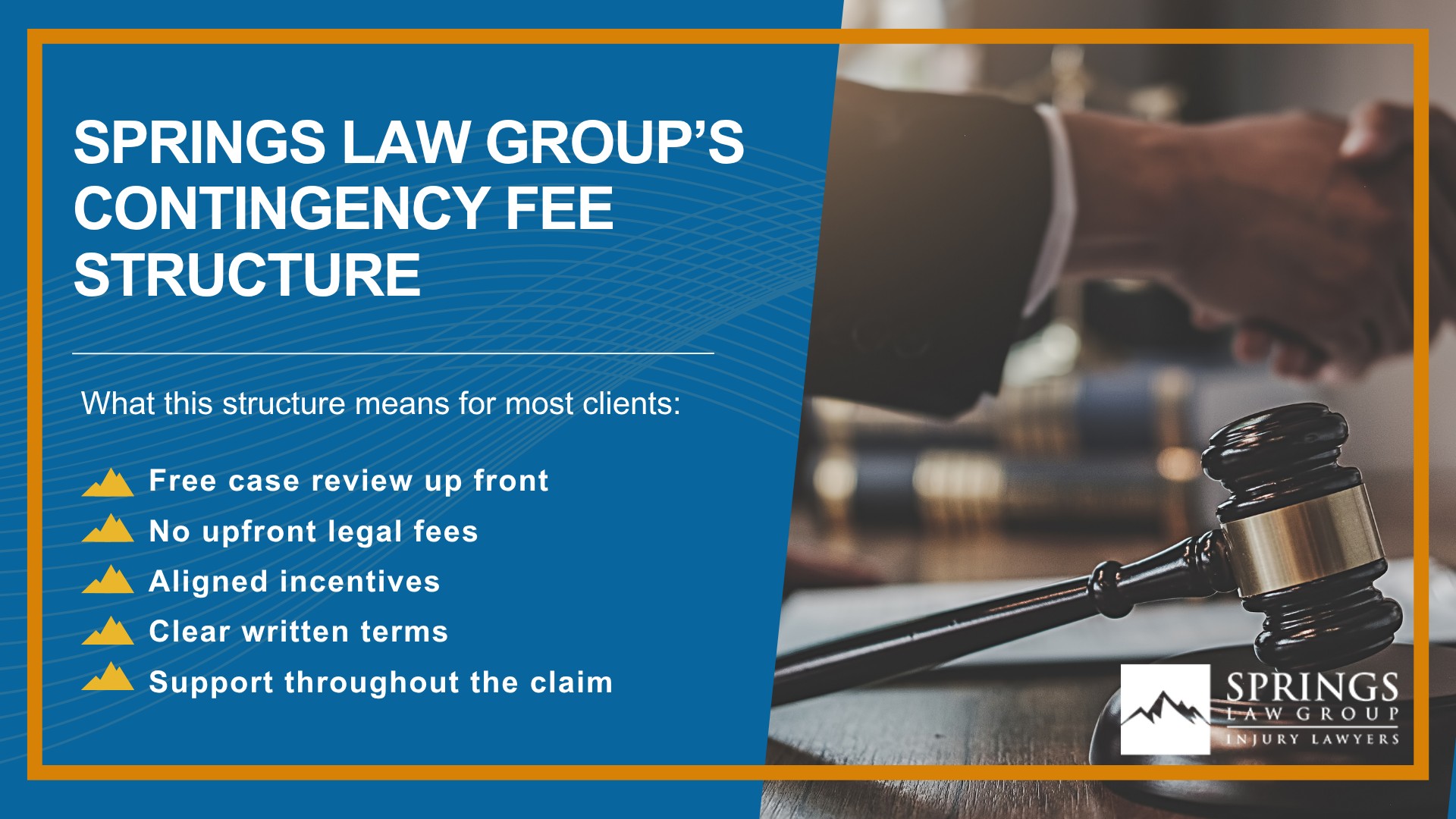
What this structure means for most clients:
- Free case review up front: A free consultation allows you to understand your options before committing to anything.
- No upfront legal fees: You can pursue a claim after a motor vehicle accident without paying out of pocket to begin the case.
- Aligned incentives: Your attorney is paid only if the case results in compensation.
- Clear written terms: The fee agreement explains the percentage, how costs work, and when any deductions occur.
- Support throughout the claim: An experienced attorney handles communications, evidence development, and negotiations while you focus on recovery.
What Happens If You Don’t Recover Compensation
In a contingency fee case, attorney fees are generally only owed if the case results in compensation.
If there is no settlement and no court recovery, clients typically do not pay attorney fees for the time and work performed on the case.
That said, the fee agreement may address what happens with case-related expenses that were advanced during the claim, such as medical record charges, filing fees, or expert costs.
Some firms absorb certain expenses if the case is unsuccessful, while others may require reimbursement of specific out-of-pocket costs depending on the contract.

This is why it is important to read the fee agreement carefully before signing and ask how litigation costs are handled in both win and loss scenarios.
A clear agreement should explain whether costs are deducted from a recovery, billed separately, or potentially owed if the claim does not succeed.
Springs Law Group should be able to walk you through these terms in plain language so you understand the financial risk before moving forward.
Knowing how fees and costs work in an unsuccessful outcome helps clients make informed decisions without surprises later.
Cost Shouldn’t Be a Barrier to Legal Help
After a serious crash, many people hesitate to call a lawyer because they assume they cannot afford it, especially while dealing with medical expenses and lost wages.
But most car accident cases are structured so clients can pursue a claim without paying out of pocket at the start, rather than working on a fixed fee model that requires immediate payment.
An experienced lawyer from Springs Law Group can step in early to handle insurer communications, preserve evidence, and help clients avoid mistakes that can weaken a claim.

Legal support also helps victims coordinate documentation from local medical providers and build a complete record of treatment and damages.
When a claim cannot be resolved fairly, having legal representation already in place puts you in a stronger position to pursue a personal injury lawsuit without starting from scratch.
The Value of Legal Representation
Insurance companies evaluate claims differently when an injured person has legal representation, especially in cases involving disputed fault or serious injuries.
A lawyer can build the claim with supporting evidence, present damages clearly, and push back when an insurer minimizes treatment or shifts blame.
Legal representation also reduces the risk of avoidable mistakes, like giving damaging recorded statements or accepting a settlement before the full injury picture is known.
In many cases, the value comes from structuring the claim in a way that forces the insurer to take liability and damages seriously.
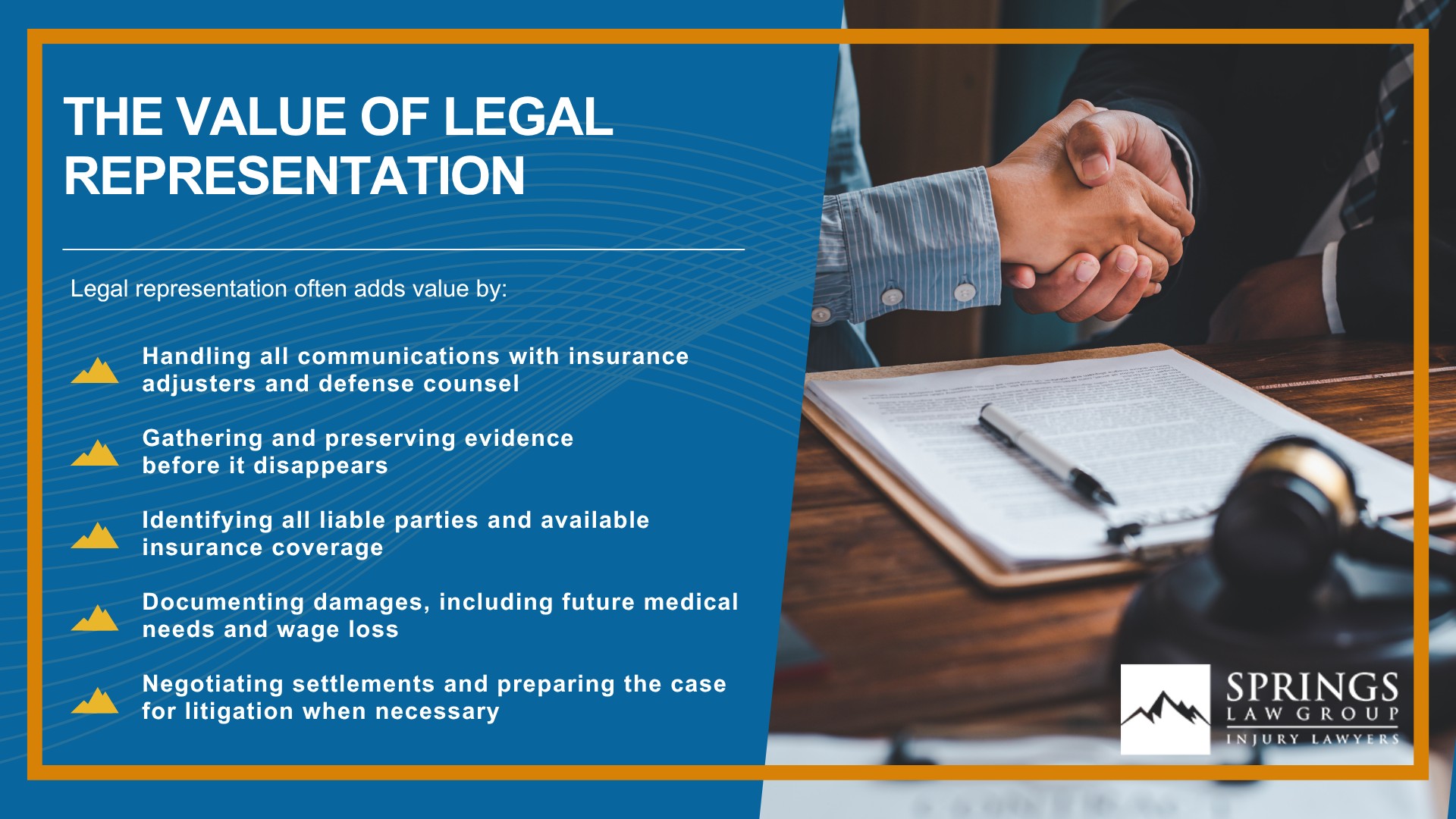
Legal representation often adds value by:
- Handling all communications with insurance adjusters and defense counsel
- Gathering and preserving evidence before it disappears
- Identifying all liable parties and available insurance coverage
- Documenting damages, including future medical needs and wage loss
- Negotiating settlements and preparing the case for litigation when necessary
Early Lawyer Involvement Helps Protect Your Claim
The earlier you involve a lawyer, the easier it is to preserve the facts that matter most in a car accident claim.
Evidence can disappear quickly.
Vehicles get repaired, footage is deleted, and witnesses become harder to track down within days.
An attorney can take immediate steps to secure evidence that supports fault and damages before the insurer controls the narrative.
Early legal involvement also helps review police reports for errors or omissions and identify what additional proof is needed to strengthen the claim.
Many firms offer free initial consultations, which gives accident victims a way to understand their options without risk or pressure.
Getting that guidance early can prevent missteps that reduce a claim’s value, such as inconsistent statements, gaps in treatment documentation, or signing releases too soon.
Springs Law Group: Colorado Springs Car Accident Lawyers
Springs Law Group handles all personal injury claims on a contingency fee basis.
Our goal is to provide top-tier legal representation without any logistical or financial barriers for people who have suffered car accident injuries and need help.

If you were injured in a crash in Colorado Springs, contact Springs Law Group for a free consultation to discuss your options.
We can explain how fees and case costs work, evaluate the strength of your claim, and take over communications with the insurance company.
If we accept your case, you will not pay upfront legal fees, and we only get paid if compensation is recovered.
FAQ
How much does a car accident lawyer cost to hire?
In most personal injury cases, the cost to hire a car accident lawyer is not an upfront payment because many firms work on a contingency fee basis.
That means you can usually hire a lawyer without paying a retainer or hourly billing while the case is pending.
Instead, the attorney’s fee is a percentage of the settlement or court award if compensation is recovered. Separate from attorney fees, there may be case costs (such as record retrieval, filing fees, or expert expenses) that are handled according to the fee agreement.
Many firms advance these costs and deduct them from the recovery later, but some may require certain expenses to be paid as they arise.
The true “cost to hire” depends on the contract terms, so it’s important to review the contingency fee agreement and how costs are treated before signing.
What percentage do car accident lawyers charge for a contingency fee agreement?
Car accident lawyers typically charge a contingency fee that ranges from about 30% to 40% of the total recovery, though the exact percentage depends on the firm and the stage of the case.
Many agreements use a lower percentage if the case settles early and a higher percentage if a lawsuit or trial is required due to the increased time and expense involved.
The specific percentage should always be clearly stated in the written contingency fee agreement before representation begins.
This fee is taken from the settlement or court award, not paid upfront by the client.
Reviewing the agreement carefully helps ensure you understand how the percentage is calculated and when it applies.
What additional costs may come about in a car accident case?
Additional costs in a car accident case are usually the out-of-pocket costs and expenses required to investigate, build, and litigate the claim, separate from attorney fees.
These additional costs may include court filing fees, payments for expert witnesses, and charges for obtaining records such as police reports.
Many lawyers will cover these costs upfront and deduct them later from your settlement or award, but the exact handling depends on the terms of your fee agreement.
Costs associated with litigation can add up significantly, potentially reaching $10,000 or more if the case goes to trial, and trial costs can reach $50,000 or more, though these are usually covered upfront by your lawyer and deducted from your payout.
Additional expenses may also include costs for accident reconstruction specialists and trial exhibits, which can be necessary in disputed liability or serious injury cases.
Because these costs are handled differently from firm to firm, it is important to review the details of your personal injury lawyer fee agreement to understand who is responsible for miscellaneous fees.
In some cases, lawyers may require you to pay specific fees directly as they arise during the case, even if the attorney fee itself is contingent on a recovery.
Why should I hire a car accident lawyer instead of handling the case on my own?
Hiring a car accident lawyer can protect you from common pitfalls that reduce the value of a claim, especially when insurers push for quick, low settlements.
Most Colorado Springs firms offer free initial consultations to evaluate your case, so you can understand your options before committing to anything.
Car accident lawyers understand the legal process and can negotiate with insurance companies in a way most injured people cannot, particularly when liability or damages are disputed.
Lawyers also help assess the full extent of damages, including non-economic damages like pain and suffering, and they prepare claims to resolve through negotiations rather than trial in most cases.
Just as important, attorneys help ensure all filing deadlines are met, which can be the difference between recovering compensation and losing the right to pursue it.
A lawyer can help by:
- Negotiating with insurers and preventing low settlement offers from controlling the outcome
- Calculating damages beyond bills, including pain and suffering and future losses
- Recovering compensation for medical expenses, lost wages, and property damage
- Handling most claims through strategic negotiation while preparing for litigation if needed
- Tracking and meeting all deadlines for claims and lawsuits to protect your right to recovery